Zaměření
Type of News
Focus
Article | Scientific article
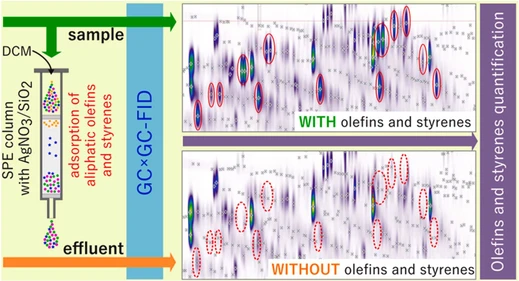
Quantitative determination of olefins in pyrolysis oils from waste plastics and tires using selective adsorption by Ag–SiO2 followed by GC×GC-FID
In the research article published in Talanta journal the researchers developed a GC × GC-FID method for routine and cost-effective olefins quantitation that does not require an MS detector.
Article | Webinars
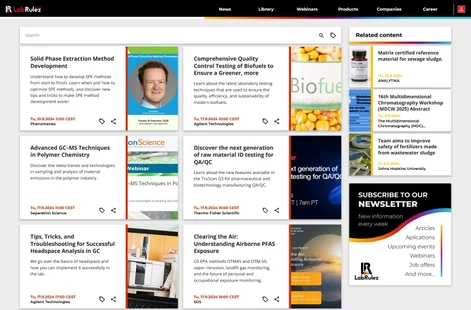
Webinars LabRulezGCMS Week 37-38/2024
8 webinars: SPE method dev., Biofuels, Polymers & TD-GC/MS, Raman & Pharma QC, Headspace troubleshooting, PFAS & Air, Spirits & GC/MS, SVOC & GC/MS.

Article | Scientific article
Team aims to improve safety of fertilizers made from wastewater sludge
Johns Hopkins researchers create new list of possibly toxic contaminants commonly found in biosolids nationwide.

Article | Product
Clean Water for Quality Results: Rely on Our Water Systems
Let’s explore the importance of high-quality water in laboratories, the types of Watrex water systems, and their applications in the laboratory environment.
Article | Scientists
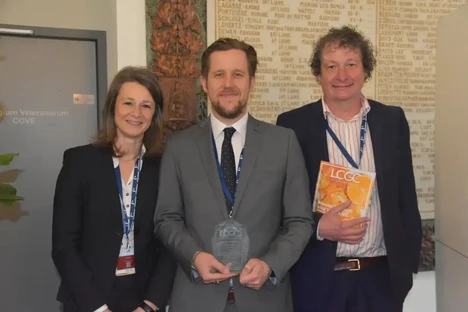
Bob Pirok wins HTC Innovation Award
Bob Pirok of the Van ‘t Hoff Institute for Molecular Sciences at the University of Amsterdam has won the 2024 HTC Innovation Award.
Article | Poster
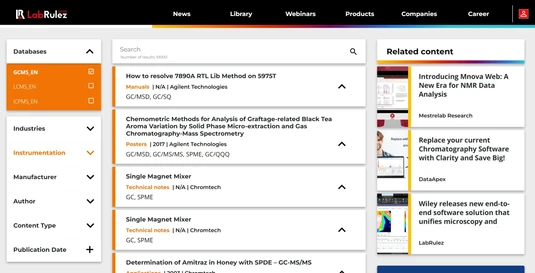
News from LabRulezGCMS Library - Week 35, 2024
New posters from ASMS 2024 by LECO, Agilent Technologies, Shimadzu, and Thermo Fisher Scientific in LabRulez Library.
Article | Scientific article
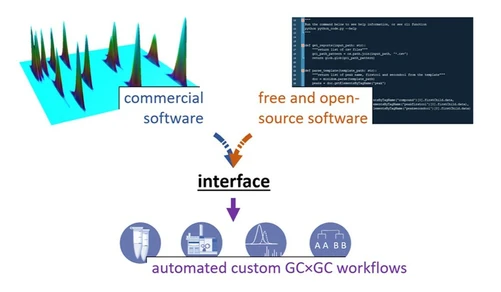
Automating and Extending Comprehensive Two-Dimensional Gas Chromatography Data Processing by Interfacing Open-Source and Commercial Software
In the article in ACS Analytical Chemistry the researchers developed a new approach to comprehensive GC×GC data processing by integrating free and proprietary tools within a single platform.
Article | Webinars
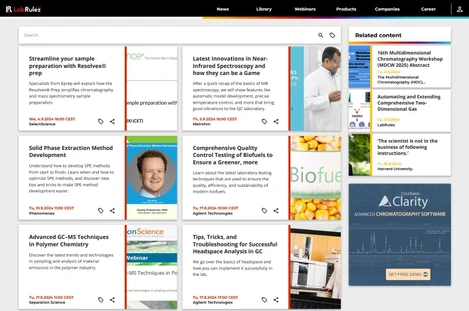
Webinars LabRulezGCMS Week 36/2024
2 webinars: SamplePrep chromatography & mass spectrometry, NIRS in QC laboratory.

Article | Interview
‘The scientist is not in the business of following instructions.’
George Whitesides became a giant of chemistry by keeping it simple. In a conversation with the Gazette, Whitesides looked back on his life and career. The interview has been edited for clarity and length.

Article | Scientific article
Only through machine learning and AI can we come to grips with all chemicals around us
Invited perspective in JACS Au describes the challenge of mapping the ‘exposome chemical space.’