
Zaměření
Type of News
Focus
Article | Academy
Understanding the Essential Components of Gas Chromatography
How does gas chromatography work? Explore the principles of GC separation, the main analytical steps, and the roles of the injection port, carrier gas, column, and detector.
Article | Academy
GC Columns - Troubleshooting & Maintenance
A practical guide to GC column troubleshooting. Learn how to identify and resolve peak tailing, loss of resolution, ghost peaks, baseline drift, sensitivity issues, and retention time shifts.
Article | Academy
Water Injections in GC: Is it Safe?
Injecting water into a GC system can cause backflash, poor vaporization, detector issues, and stationary phase degradation. Learn how to minimize these risks with the right column and injection setup.
Article | Academy
Comprehensive Two-Dimensional Gas Chromatography
Comprehensive two-dimensional gas chromatography (GC×GC) greatly expands separation power for complex mixtures. Explore its principles, applications, limitations, and future trends.
Article | Academy
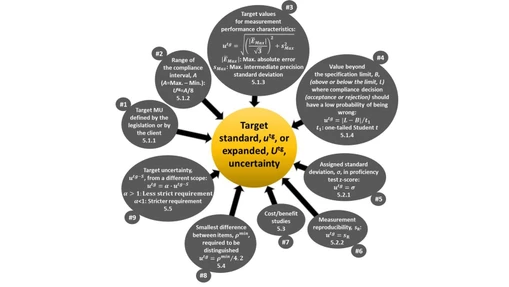
Setting Target Measurement Uncertainty
How small should measurement uncertainty be? Eurachem explains how target measurement uncertainty helps laboratories ensure results are fit for purpose and support reliable decisions.
Article | Academy
GC-MS: Principles of How it Works?
Learn how GC-MS combines gas chromatography and mass spectrometry for sensitive compound separation, identification, quantification, and structural analysis across a wide range of applications.

Article | Academy
Treatment of an observed bias
How should laboratories handle a significant measurement bias? This Eurachem leaflet explains when correction is justified and how an uncorrected bias may affect measurement uncertainty.

Article | Interview
How Mass Spectrometry Actually Works: The Quadrupole Explained
Dr. Lee Polite explains the fundamentals of GC/MS through memorable analogies, making one of analytical chemistry's most powerful techniques easy to understand.

Article | Academy
Exploring Alternatives to Rotary Evaporation in Modern Laboratories
Explore alternatives to rotary evaporators, including S-EVAP, parallel evaporation, freeze drying, centrifugal evaporation, distillation, spray drying and microwave heating.
Article | Academy
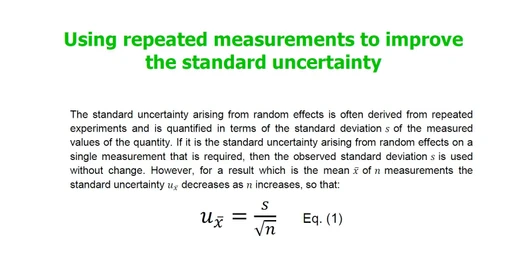
Using repeated measurements to improve the standard uncertainty
Learn when repeated measurements reduce standard uncertainty, when Equation (1) applies, and how to correctly evaluate uncertainty for grouped, correlated, and time-dependent analytical data.