

Zaměření
Type of News
Focus

From Complexity to Clarity: Smarter PFAS Identification Workflows in Compound Discoverer Software
Non-targeted PFAS analysis using Orbitrap HRAM and Compound Discoverer 3.5 enables confident identification of thousands of PFAS through advanced libraries, scoring tools and visualization workflows.

Webinars LabRulezICPMS Week 14/2026
9 webinars: AI ICP-OES, EPR spectroscopy, FTIR microscopy, ICP-MS, LOI, MALDI imaging, microplastics, O-PTIR, polymer analysis, rheology, spectroscopy, TGA

Webinars LabRulezLCMS Week 14/2026
4 webinars: HPLC method development, MALDI imaging, multimodal imaging, PFAS, Protein A resin, pre-packed columns, QCL IR, LC-MS/MS, MALDI-TOF
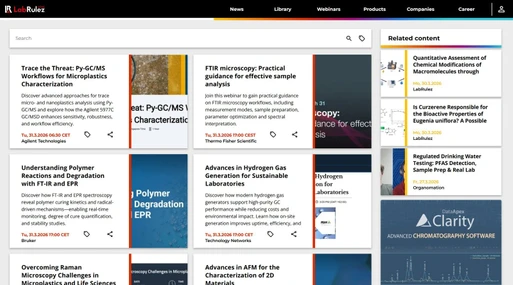
Webinars LabRulezGCMS Week 14/2026
5 webinars: FTIR microscopy, GC/MS, hydrogen generation, microplastics, O-PTIR, polymer degradation, Raman microscopy, spectroscopy, sustainability
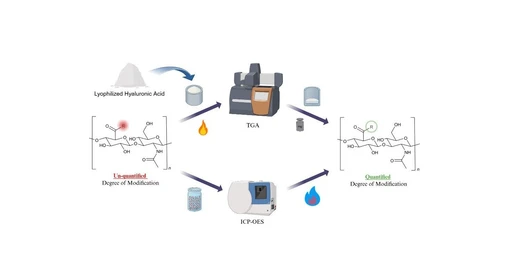
Quantitative Assessment of Chemical Modifications of Macromolecules through Counterion Measurement
A counterion-based strategy using TGA and ICP-OES quantifies modification levels in hyaluronic acid derivatives with accuracy comparable to NMR and UV–Vis.

Investigating the Effect of Isoelectric Points on the Gas-Phase Stability of Native-like Proteins Analyzed in Positive- versus Negative-Ion Mode by IMS-MS
This study shows native protein stability in IMS-MS varies with ionization polarity, being higher when ionization matches solution-phase charge.
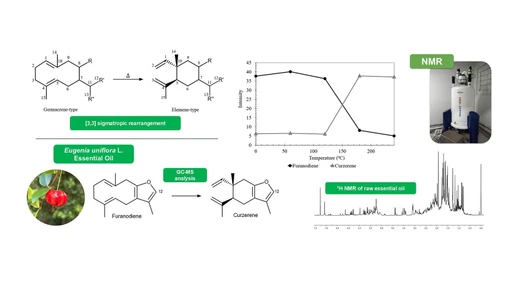
Is Curzerene Responsible for the Bioactive Properties of Eugenia uniflora? A Possible Misinterpretation of Bioactive Markers
This study shows GC-induced rearrangement of sesquiterpenes may lead to misattribution of bioactivity to curzerene in Eugenia uniflora essential oil.