Zaměření
Type of News
Focus
Article | Webinars
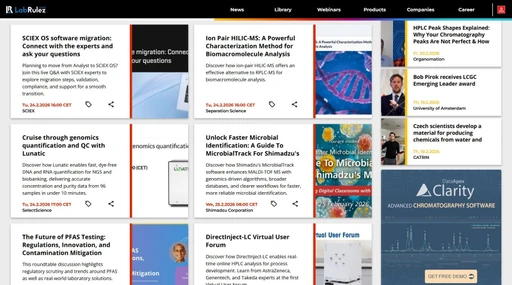
Webinars LabRulezLCMS Week 09/2026
15 webinars: AAV, biosimilarity, capillary electrophoresis, DIA MS, HILIC-MS, LC-MS, Lunatic QC, MALDI-TOF, peptide characterization, PFAS testing, SEC-MALS, SCIEX OS migration, USP impurity testing

Interview | Science and research
HPLC Peak Shapes Explained: Why Your Chromatography Peaks Are Not Perfect & How to Fix Them
Dr. M. Farooq Wahab explains why chromatographic peak shape matters, what causes tailing and fronting, how to troubleshoot LC systems, and why denoising and computation matter.

Article | Scientists
Bob Pirok receives LCGC Emerging Leader award
Dr. Bob Pirok receives the 2026 Emerging Leader in Chromatography Award for advances in LC×LC, automated method development and chemometrics at the Van ’t Hoff Institute.

Article | Science and research
Czech scientists develop a material for producing chemicals from water and sunlight, inspired by human enzymes
Czech scientists from CATRIN and CEET developed an enzyme-inspired photocatalyst that produces hydrogen peroxide from sunlight, water and oxygen—without toxic solvents or precious metals.
Article | Science and research
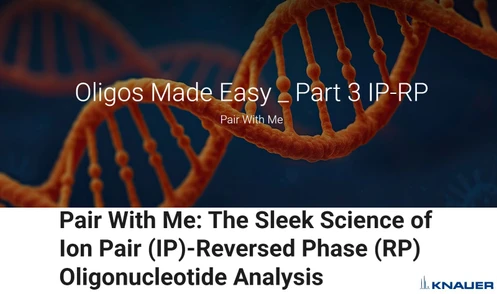
Oligos Made Easy - Part 3: IP-RP
Discover how ion-pair reversed-phase (IP-RP) chromatography enables high-resolution oligonucleotide analysis. Learn about ion-pair selection, method setup, LC-MS compatibility, and robust separation strategies.
Article | Application
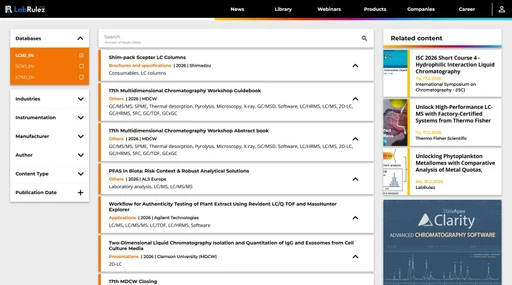
News from LabRulezLCMS Library - Week 08, 2026
This week we bring you application notes by Agilent Technologies, KNAUER, Shimadzu and Waters Corporation and presentation by MDCW / Clemson University!

Article | Academy
Why Is It Necessary to Dry the SPE Sorbent Before Elution?
Proper drying of the SPE sorbent is a critical step to achieve high sensitivity, good reproducibility, and maximum analyte recovery, especially for complex sample matrices.

Article | Events
ISC 2026 Short Course 4 - Hydrophilic Interaction Liquid Chromatography
Master HILIC at ISC 2026: understand retention mechanisms, improve gradient repeatability, optimize LC–MS sensitivity, and choose phases for robust separations of polar analytes and biopolymers.

Article | Product
Unlock High-Performance LC-MS with Factory-Certified Systems from Thermo Fisher Scientific
Get legendary Thermo Scientific LC-MS performance at a fraction of the cost. Factory-certified pre-owned systems deliver reliability, full warranty, expert support, and a smarter, sustainable investment.
Scientific article | Science and research
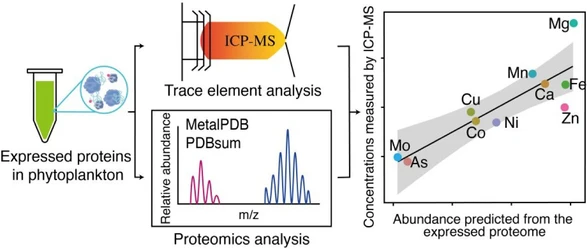
Unlocking Phytoplankton Metallomes with Comparative Analysis of Metal Quotas, Quantitative Proteomics, and Inferred Metalloproteomes
This study integrates metal quotas, quantitative proteomics, and inferred metalloproteomes to reveal trace metal requirements and adaptation strategies in phytoplankton.