We, 11.11.2026 | Original article from: LabRulezLCMS Library
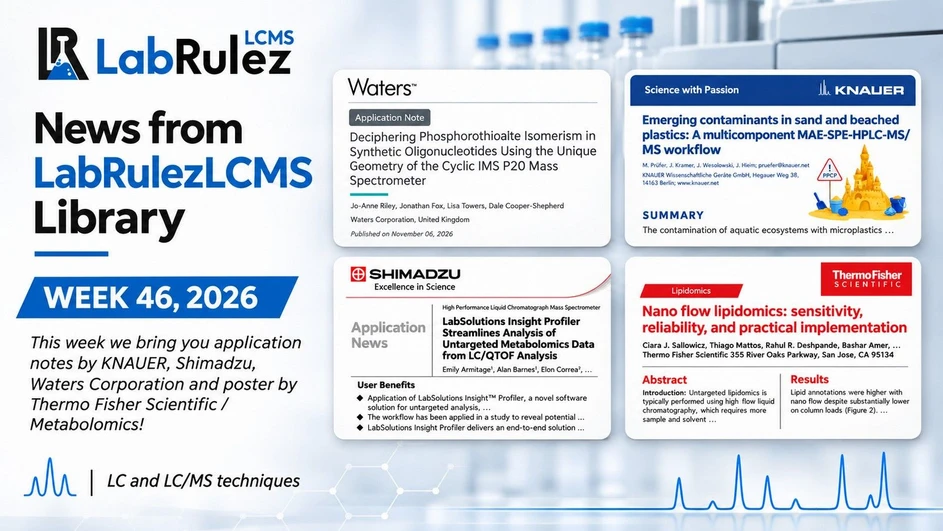
This week we bring you application notes by KNAUER, Shimadzu, Waters Corporation and poster by Thermo Fisher Scientific / Metabolomics.News from LabRulezLCMS Library - Week 46, 2026
LabRulez / AI: News from LabRulezLCMS Library - Week 46, 2026
Our Library never stops expanding. What are the most recent contributions to LabRulezLCMS Library in the week of 9th November 2026? Check out new documents from the field of liquid phase, especially HPLC and LC/MS techniques!
👉 SEARCH THE LARGEST REPOSITORY OF DOCUMENTS ABOUT LCMS AND RELATED TECHNIQUES
👉 Need info about different analytical techniques? Peek into LabRulezGCMS or LabRulezICPMS libraries.
1. KNAUER: Emerging contaminants in sand and beached plastics: A multicomponent MAE-SPE-HPLC-MS/ MS workflow
- Application note
- Full PDF for download
For a human living in a developed country, is it still possible to leave no trace in the environment? As a society, we are just recently recognizing some of the traces we leave as harmful ones. We categorize those as emerging contaminants (EC) as regulation and routine monitoring are still pending for many of them. EC include pharmaceuticals and personal care products (PPCP), which are continuously released into the environment through wastewater plants, as well as endocrine disruptors, like bisphenols, and other industrial chemicals. The EC we emit not only harm the environment, but also ourselves, e.g. by increasing the cost of drinking water treatment, or by accelerating the spread of antibiotic resistance caused by the exposure of aquatic ecosystems to antibiotics [1]. Those risks also increase the demand for environmental monitoring. One type of EC which is easily overlooked in the analysis of environmental samples by HPLC are microplastics (MP).
Experimental
- Pump: AZURA® P 8.1 L pump HPG, stainless steel, 5 ml/min
- Autosampler: AZURA® AS 6.1 L analytical Autosampler up to 1240 bar, with cool/heat function
- Thermostat: AZURA® CT 2.1 Column Thermostat for up to 8 HPLC columns with temperature range between 5-85 °C
- Detector: SCIEX Triple Quad 5500+ with Turbo V Ion Source
- Column: Eurospher®Pro, 3 μm, C18, 100 Å, 2.1 x 100 mm
Conclusion
A multicomponent workflow for the detection of EC in sand was established. It has to be considered a compromise for the large set of analytes with very different properties, which cannot be set to ideal conditions for every single compound. For the extraction of spiked blank sand by MAE, high extraction efficiencies were reached, and the method was adapted for the extraction of smaller amounts of microplastics. The validation of the whole workflow using spiked matrix samples revealed the need for further optimization of the extraction procedure for the reliable quantification of all analytes in every matrix. Major improvements could be achieved e.g. by matrix matched calibration or the use of multiple isotope-labelled internal standards. Nevertheless, 19 sand samples were extracted, and the EC content was determined. Because of the low absolute recoveries measured for samples containing matrix (Fig. 8 and Fig. 9), the results should be considered more qualitative than quantitative at this stage, but they are still insightful.
Every single sand sample contained COF, in a concentration ranging from 21–175 ng/g. Many samples also contained high concentrations of PAR, reaching up to 189 ng/g. Multiple analytes detected with high sensitivity were also found in every sample, but with much lower concentrations. These results highlight the high anthropogenic influence on aquatic ecosystems. Even a sand sample collected at a Norwegian glacier lake, which was considered relatively remote and less influenced, contained traces of multiple PPCP.
Because of the low amount of microplastics found in sand, the workflow was not applied to environmental MP. Further upscaling of the overflow separation or a more specific sampling of larger pieces of MP could enhance the available amount of MP samples, enabling a complete validation of the workflow for matrix loaded MP. In conclusion, we can already see that it’s difficult to find a place that’s truly untouched by humans, and our traces become more visible the deeper we look on a molecular level. It’s our responsibility not to let the damage grow further by improving wastewater treatment and monitoring, avoiding persistent chemicals and prevent littering, especially in nature reserves (Fig. 14). Clearly, more research in this field and continuous monitoring is needed, which this AppNote supports with a new suggested workflow.
2. Shimadzu: LabSolutions Insight Profiler Streamlines Analysis of Untargeted Metabolomics Data from LC/QTOF Analysis
- Application note
- Full PDF for download
User benefits
- Application of LabSolutions Insight Profiler, a novel software solution for untargeted analysis, bringing together feature detection and alignment, statistical analysis, filtering and compound identification into a single processing method.
- The workflow has been applied in a study to reveal potential candidate biomarkers of pancreatic cancer.
- LabSolutions Insight Profiler delivers an end-to-end solution for untargeted metabolomics research automating complex data processing from sample analysis through to identification of statistically significant features.
Advances in untargeted metabolomics increasingly rely on integrated workflows which utilise complex spectral deconvolution, data alignment, and multivariate interpretation. Several applications provide complementary capabilities for data processing and statistical analysis; however, transitioning data across discrete platforms increases workflow fragmentation, especially for large scale metabolomicsstudies. In this application, a single software package, LabSolutions Insight Profiler, has been developed to automate feature detection and alignment, statistical analysis and filtering with compound identification, delivering an integrated workflow solution for untargeted analysis applications such as metabolomics. The data processing application has been applied to a biomarker discovery study with pancreatic cancer serum samples from patients with pancreatic ductal adenocarcinoma (PDAC) and healthy controls analysed by LC/QTOF on the LCMS9030. The workflow is applicable to any untargeted metabolomics study using the LCMS-9030 or LCMS-9050 QTOF. The research project was approved by the Pancreatic Cancer Research Fund Tissue Bank (PCRFTB) Tissue Access Committee.
Data Processing using LabSolutions Insight Profiler
Data files from the untargeted metabolomics analysis of PDAC and control serum profiles were first loaded into LabSolutions Insight Profiler. As the initial step, the samples were assigned to one of three groups: ‘Healthy’, ‘PDAC’, or ‘QC’. Following group assignment, the processing method was applied as a batch to the loaded dataset for automated feature detection, alignment, filtering, and statistical analysis.
The processing method for feature detection used a minimum peak height of 1000 and a low MS response threshold, corresponding to a sum ion signal of at least 10,000 counts across a chromatographic peak. Features were aligned using a mass tolerance of 10 mDa and a retention time tolerance of 0.1 min.
Filtering was performed according to standard criteria for untargeted metabolomics. Features exhibiting high variance in the QC samples (>20% RSD) were excluded, and only features detected in at least 75% of the samples in the PDAC and/or control groups were included for statistical analysis. Missing values were replaced with one-fifth of the minimum value detected for the respective feature in the other samples. The significance threshold for fold change was set at 2, with a pvalue threshold of 0.05. For two-group comparisons, p-values were automatically calculated by the software using a t-test. Compound identification was performed using the automated library-searching functionality of LabSolutions Insight Profiler. The search supports up to five MS/MS libraries and considered several curated and public-domain compound databases, including Shimadzu compound databases (in-house libraries), LipidBlast, HMDB, NIST, MassBank, and MoNA.
Once a processing method has been set-up and saved, it can be applied as a single click by a new user or an advanced expert. The result is a single click operation that can automate complex data processing helping to identify compounds that differ between sample groups(Fig. 2).
Conclusion
LabSolutions Insight Profiler is a single software application developed to automate feature detection and alignment, statistical analysis and filtering with spectral annotation. To highlight a workflow for untargeted metabolomics, the software application has been applied to a biomarker discovery study of pancreatic cancer. The analysis of LC/QTOF data with DIA-MS/MS acquired from serum extracts from PDAC patients and healthy controls enabled the detection of statistically significant features distinguishing the two phenotypes that could be identified to metabolomics standards initiative4 level 1 or 2 within the same processing method. Using a single processing method cascade to automate metabolomics data analysis helps to simplify complex data processing workflows without compromising data quality
3. Thermo Fisher Scientific / Metabolomics: Nano flow lipidomics: sensitivity, reliability, and practical implementation
- Poster
- Full PDF for download
Lipids play key roles in membrane structure, cellular signaling, and energy storage, and altered lipid metabolism is linked to diseases including neurodegeneration, diabetes, and cancer. LC-MS with high resolution accurate mass (HRAM) mass spectrometry is widely used for untargeted lipidomics due to its broad coverage and sensitivity, but conventional analytical flow methods require more sample and solvent and may limit sensitivity. Nano flow separations can improve ionization efficiency, reduce on column load and solvent consumption, and increase lipid annotations, but require optimization for robust routine use.
Materials and methods
Methods
Nano flow LC was performed using a Thermo Scientific Vanquish Neo UHPLC System with a Thermo Scientific EASY-Spray PepMap Neo UHPLC Column. High flow LC was performed using a Thermo Scientific Vanquish Horizon UHPLC System with a Thermo Scientific Accucore C30 HPLC Column. Both methods used the same mobile phases and were coupled to an Orbitrap Excedion Mass Spectrometer with MS¹ polarity switching and AcquireX Deep Scan data-dependent MS/MS.
Data Analysis
Bovine liver extract data were processed in Thermo Scientific LipidSearch Software using consistent workflows for both flow regimes. Lipid peak areas were class-normalized to SPLASH internal standards and filtered by expected main ions and LipidSearch Software grades A, B, or C. SPLASH dilution data were evaluated in Thermo Scientific TraceFinder Software to determine limit of quantitation (LOQ).
Conclusions
- Nano flow enabled greater sensitivity and deeper lipidome coverage at lower on column loads compared with high flow.
- Increased lipid annotations, reduced unintentional MS¹ fragmentation, and lower LOQs demonstrated improved performance for untargeted lipidomics.
- Lower sample requirements may expand lipidomics workflows to limited biological samples, including small tissue inputs or low-abundance sample types.
- Solvent consumption was reduced by 99.7% for a 30-minute gradient, from 7.8 mL with high flow to 0.021 mL with nano flow, supporting lower solvent costs and reduced waste.
- Robust implementation requires careful optimization of sample loading, wash strategy, and re-equilibration to avoid column overloading, carryover, and retention time drift.
4. Waters Corporation: Deciphering Phosphorothioate Isomerism in Synthetic Oligonucleotides Using the Unique Geometry of the Cyclic IMS P20 Mass Spectrometer
- Application note
- Full PDF for download
Benefits
- Track and control phosphorothioate isomerism in oligonucleotide products with high resolution Cyclic IMS
- Reveal and quantify unresolved isomer ratios through the unique geometry of the Cyclic IMS P20 Mass Spectrometer
- Support evolving regulatory expectations with advanced, high-resolution measurement technologies
Oligonucleotide therapeutics have emerged as a novel class of medicines capable of treating a variety of diseases including spinal muscular atrophy, Duchenne muscular dystrophy, hereditary transthyretin amyloidosis, and rare metabolic disorders. Development of chemical modifications to the natural nucleic acid structure was key to overcoming the initial hurdles of efficacy and in vivo stability. One of the most common modifications used is the PS linker, which swaps a non-bridging oxygen for a sulfur atom (Figure 1) to improve the properties of the drug. This introduces a chiral center at the phosphorus atom, with each nPS linker having either Rp or Sp configuration, leading to the formation of 2n diastereomers. R and S are right- (rectus) and left- (sinister) handed configurations, respectively, and the p denotes the phosphorus atom. For example, for siRNA type molecules with one, two or three PS linkers, this would mean two, four or eight diastereomers, respectively, and so on. For a fully phosphorothioated 20-mer such as an antisense oligonucleotide, there would be 219 = 524,288 isomers.
The stereochemistry of the PS linkers can affect biological activity, with stereopure versions showing improved biological activity compared to their stereorandom equivalents.1,2 Aligning with the biological importance, oligonucleotide stereochemistry is under increased scrutiny from regulatory authorities meaning a control strategy is increasingly likely to be required for late phase clinical studies and biosimilars.3,4
Current approaches include chromatographic separation with ion-pair reversed phase,5 HILIC6 or anion exchange,7 and NMR has also been shown to enable characterization.8 Limitations to these approaches include dependence on base sequence, and number and position of PS linkers.
Recent publications have demonstrated that the high-resolution Cyclic ion mobility and the geometry of the Cyclic IMS P20 Mass Spectrometer enables separation and quantification of phosphorothioate diastereomers in therapeutic oligonucleotides from siRNA to sgRNA.5,9,10-12 In this application brief, the attributes of the Cyclic IMS P20 Mass Spectrometer are highlighted for the determination of stereochemistry ratios at individual PS linkers through the high-resolution ion mobility separation of dimeric internal fragment ions. This novel approach is demonstrated using a 16 nt ASO standard and can easily be extended to therapeutic oligonucleotides.
Conclusion
Understanding and monitoring PS stereochemistry can provide valuable insight throughout oligonucleotide drug development and commercialization. Characterizing diastereomer composition could help correlate stereochemistry with biological activity, supporting the design of therapeutics with optimized efficacy, improved potency and potentially reduced dosing levels. During process development and scale-up, monitoring stereochemistry can also support process optimization, batch-to-batch consistency and confidence in safe, reliable clinical performance.
These benefits are enabled by the unique geometry of the Cyclic IMS Mass Spectrometer, which allows fragment generation and selection prior to high-resolution, multipass ion mobility separation. The novel approach described here uses this capability to characterize individual PS linker sites through analysis of dimer fragment ions and can be applied across a range of oligonucleotide therapeutics, including antisense oligonucleotides, siRNA and sgRNA.
By combining pre-IMS fragmentation with high-resolution multipass ion mobility separation, the unique Cyclic geometry provides a powerful approach to PS stereochemistry characterization, supporting greater understanding and control of oligonucleotide drug substances and drug products as regulatory expectations evolve.