We, 14.10.2026 | Original article from: LabRulezLCMS Library
This week we bring you application notes by KNAUER and Shimadzu, brochure by Thermo Fisher Scientific and poster by Waters Corporation / ACS!News from LabRulezLCMS Library - Week 42, 2026

LabRulez / AI: News from LabRulezLCMS Library - Week 42, 2026
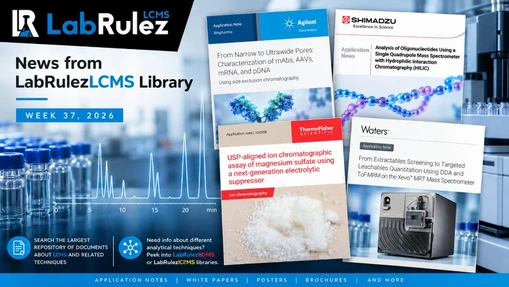
Our Library never stops expanding. What are the most recent contributions to LabRulezLCMS Library in the week of 12th October 2026? Check out new documents from the field of liquid phase, especially HPLC and LC/MS techniques!
👉 SEARCH THE LARGEST REPOSITORY OF DOCUMENTS ABOUT LCMS AND RELATED TECHNIQUES
👉 Need info about different analytical techniques? Peek into LabRulezGCMS or LabRulezICPMS libraries.
This week we bring you application notes by KNAUER and Shimadzu, brochure by Thermo Fisher Scientific and poster by Waters Corporation / ACS!
1. KNAUER: Getting in the right phase: HILIC for oligonucleotide analysis
- Application note
- Full PDF for download
Therapeutic oligonucleotides can modulate the function of specific proteins associated with disease states or pathogenicity by manipulating gene expression at translational level. For this reason, they are emerging as successful drugs for addressing unmet medical needs, such as the treatment of genetically well-defined rare diseases. Although the concept at the base of their therapeutic potential was known for a long time, improvements in ONs stability and pharmacokinetic properties have drastically increased the chances of ONs to go from bench to bedside.
By the second quarter of 2022, 17 therapeutic ONs have been approved by Food and Drug Administration (FDA) or European Medicines Agency (EMA), with 13 of them (all chemically modified) in the single period 2016-2022 [3]. IP-RPLC is the gold standard for ON characterization, but HILIC has clearly emerged as an alternative option [2]. But what are the benefits of HILIC over IP-RPLC?
For example, orthogonal selectivity: HILIC retention reflects hydrophilicity, charge, nucleobase composition, and stationary phase interactions rather than the hydrophobicity of an oligonucleotide ion-pair complex. It can therefore separate impurities that co-elute in IP-RPLC. Another fact is the use of simpler, broadly compatible mobile phases: ammonium acetate–acetonitrile–water systems are compatible with standard LC–MS workflows, making switching between oligonucleotide and other analytical methods easier. Here we will show the suitability of a zwitterionic HILIC stationary phase for oligonucleotide analysis. Furthermore, different column dimensions will be tested to investigate weather effects like the On-Off mechanism reported for IP-RPLC also apply to HILIC separation of ON.
MATERIAL AND METHODS
- Pump: AZURA® P 6.1L Pump LPG, Stainless Steel, 10 ml/min
- Autosampler: LH 8.1 Liquid Handler, 557 mm version with Robotic Cooler, including injection valve and fast wash station
- Sample Loop: Sample loop 20 µl, flexible stainless steel tubing with 1/16" ends, ID 0.25 mm
- LH Syringe: Hamilton X-Type 25µL PTFE Tip, fixed Nadel 22s gauge
- Detector: AZURA® DAD 2.1L Diode Array Detector, 190-700 nm
- Flow Cell: UV Flow Cell Cartridge, LightGuide, Analytical, 10 mm, 2 µl, SSt, 1/16'', 50 bar, up to 5 ml/min
- Thermostat: AZURA® CT 2.1 Column Thermostat for up to 8 HPLC columns with temperature range between 5-85 °C
- Column I: Eurospher II 100-3 HILIC column 50 x 4 mm
- Column II: Eurospher II 100-3 HILIC column 30 x 4 mm
- Column III: Eurospher II 100-3 HILIC guard column 5 x 4 mm
- Software: ClarityChrom 10.1 station single instrument license one time base Workstation, autosampler control included
CONCLUSION
The HILIC method using a zwitterionic sulfobetaine stationary phase proved to be suitable and robust for the analysis of the investigated oligonucleotides. It provided sufficient retention and suitable peak shapes for oligonucleotides of different lengths and modifications while simultaneously achieving a significant reduction in analysis time.
All samples were sufficiently retained on the column with dimensions of 50 × 4 mm ID. Through method optimization, the total run time was reduced from 35 to 20 minutes without compromising resolution. At the same time, peak shape and signal intensity were improved. After transferring the method to a column with dimensions of 30 × 4 mm ID and increasing the flow rate to 1.0 ml/min, good retention was maintained, while the total run time was reduced to eight minutes. This corresponds to a reduction of approximately 77 % compared with the original method (G1).
The optimized method on the 30 × 4 mm column also demonstrated high repeatability. Ten consecutive injections of the 20mer sample resulted in relative standard deviations of 0.16 % for retention time and 0.89 % for peak area. Further scaling to a 5 × 4 mm guard column additionally shortened the analysis time but resulted in a significant loss of resolution. The 64mer oligonucleotide was not retained under the investigated conditions.
Compared with the IP-RP methods investigated in VBS0089 [4], the HILIC method requires longer analysis times. Using the IP-RP systems based on HAc/TEA and HFIP/TEA, respectively, oligonucleotides could be separated on short columns in less than two minutes. A functioning on/off retention mechanism was confirmed for IP-RP, although analyte-dependent limitations also occurred on the 10 mm guard column. In contrast, HILIC provides orthogonal selectivity and does not require ion-pairing reagents. The ammonium acetate– acetonitrile–water mobile phases used are also highly compatible with LC-MS applications.
Overall, zwitterionic HILIC therefore represents a fast, reproducible, and MS-compatible alternative or complement to IP-RPLC. While IP-RPLC is particularly suitable for very fast high-throughput analyses, HILIC provides additional selectivity and is especially advantageous for routine analyses, the characterization of impurities, and orthogonal analyses of oligonucleotides.
2. Shimadzu: Non-Targeted Identification of Extractables and Leachables from Medical Device Polymers Using ESI and SICRIT-LC/QTOF with LabSolutions Insight Profiler
- Application note
- Full PDF for download
User benefits
- Application of a single processing method with a novel software application LabSolutions Insight Profiler, to identify extractable and leachable (E&L) compounds in medical polymer materials extracted in water or isopropanol.
- The screening workflow enabled detection of E&L compounds in foam extracts that were not detected in representative blanks.
- Application of SICRIT ion source extended the chemical search space for the LC-DIA-MS/MS method, enabling detection of additional E&L compounds that were not detected using ESI.
Extractables and leachables (E&L) from medical device polymers may present toxicological risks during clinical use. Regulatory frameworks such as ISO 10993 require chemical characterisation to ensure patient safety. ISO 10993-18, part of the ISO 10993 series for the biological evaluation of medical devices, provides a framework for the chemical characterisation of materials to identify substances that could leach from a device during clinical use. Within this regulatory framework, the objective is to assess biological risk and potential patient exposure by identifying E&L components in medical devices. This application presents a workflow for the non-targeted analysis of medical foam extractsto identify potential E&L compounds.
To highlight the non-targeted screening workflow for E&L, LC/QTOF was applied to the analysis of different polymer materials used in medical devices for sleep apnoea. LC/QTOF data were acquired using TOF MS and data independent acquisition (DIA)-MS/MS with Electrospray Ionization (ESI) and Soft Ionization by Chemical Reaction in Transfer (SICRIT ) in positive and negative ion modes. SICRIT was applied to increase chemical space in detecting potential E&L compounds by LC/QTOF through gas-phase ionization, where a stable dielectric barrier discharge ionization (DBDI) plasma promotes multiple concurrent ionization pathways, including proton transfer, radical cation formation, and chargetransfer/photoionization (Fig. 1).
Both ESI and SICRIT data were processed using LabSolutions Insight Profiler. The application software is designed to help automate feature detection, alignment and compound identification with suspect screening. In this work, compound screening lists included the ELSIE chemical list hosted within EPA’s CompTox Chemicals Dashboard, FDA-CLAP, and NIST 2023. Following this workflow, E&L compounds were identified in the medical foam extracts including hindered amine light stabilisers (HALS), hindered phenolic antioxidants, flame retardants, slip and anti-blocking agents, common plasticisers and surface modifiers, as well as residual surfactant or processing aids.
Data Acquisition
High resolution UHPLC-MS/MS data were acquired in both positive and negative ion mode using TOF MS and DIA-MS/MS and two different ion sources for the LCMS-9050 QTOF: ESI and SICRIT.
Application of SICRIT in E&L Analysis
Using SICRIT DBDI in addition to ESI, the analytical coverage can be expanded across lower-polarity and intermediate m/z ranges (Fig. 5). In this E&L application, the LC/QTOF analysis with SICRIT highlighted the enhanced detection of hydrophobic, non-polar E&L compounds such as the antioxidant Irganox 1135, the cyclic siloxane tetradecamethylcycloheptasiloxane, the phenolic stabiliser 2,6-di-tert-butyl-4-methoxyphenol, and the plasticiser dibutyl adipate, which typically exhibit poor response or pose analytical challenges under standard atmospheric pressure ionization conditions (Fig. 6).
Conclusion
The inherent challenges in reporting E&L reflect both the complexity of the chemical space and the complexity of data analysis. In this work, the HRMS DIA-MS/MS method optimised the LC separation and applied two complementary ionization techniques for LC/QTOF (ESI and SICRIT) to the analysis of medical foam extracts.
LabSolutions Insight Profiler software was used to automatically process all data with a single method, including feature detection and alignment, MS/MS library identification using the NIST 2023 and MassBank repositories and compound screening using open-source databases including the ELSIE chemical list and the FDA-CLAP list.
The results of the analysis revealed that the medical mattress, polyesterurethane and polyetherurethane extracts showed diverse E&L profiles dominated by typical polymer additives, while the silicone foam extracts were characterised primarily by cyclic and linearsiloxanes alongside other additives.
3. Thermo Fisher Scientific: Rise to the molecular challenges of today and tomorrow Orbitrap Tribrid Apex Small Molecule mass spectrometer
- Product specification
- Full PDF for download
Benefits
- 40% faster polarity switching for better quantitation and reduced analysis time
- Increased sensitivity with up to 10x lower limits of detection for some compounds
- MSn and alternate fragmentation for confident annotation of unknown molecules
- Intelligent data acquisition methods with the Thermo Scientific™ AcquireX™ workflow and real-time library search (RTLS) for comprehensive data
- High versatility with three mass analyzers, high resolution, MSn , and alternative fragmentation for the most challenging samples
Hardware features
Active Ion Management (AIM+) technology
AIM+ maximizes ion transmission, from injection to detection, using a novel hardware design for precise management of electrical fields and removal of noise to achieve unprecedented levels of quantitative performance.
Ion source
Thermo Scientific™ OptaMax™ Plus ion source
- Enhanced stability—the new heater and sprayer design significantly enhances heat transfer, offering superior electrospray stability across a broad temperature range
- User-friendly design—experience enhanced ease of use with adjustable and reproducible movement, simplifying our workflow
- Versatile flow rate compatibility—supports a wide range of flow rates from 1–2,000 µL/min, providing flexibility for various applications
- Optional Atmospheric Pressure Chemical Ionization (APCI) probe—the optional APCI probe is compatible with flow rates from 100–2,000 µL/min and can be upgraded with Atmospheric Pressure Photoionization (APPI) capabilities for expanded functionality
Exclusive technologies
Dynamic scan management
Enables intelligent, real-time scheduling, parallelization, and prioritization of acquisition events, and selection, sorting, and routing of precursors to different fragmentation modes and analyzers based on user-selected parameters, including precursor m/z, intensity, and/or charge.
Multiple dissociation options
Precursor dissociation can be performed in the ion-routing multipoles (HCD), the linear ion trap (CID and optional UVPD or IRMPD), with product ion detection in the linear ion trap, or Orbitrap mass analyzer at any stage of MSn analysis.
Automatic gain control
Helps ensure that the ion-routing multipole is always filled with the optimum number of ions for any acquisition type.
4. Waters Corporation / ACS: PURIFICATION OF RADIOLIGAND PRECURSOR PSMA-617 FROM A FORCED DEGRADATION STUDY USING A WATERS MAXPEAK PREMIER OBD PREPARATIVE COLUMN
- Poster
- Full PDF for download
The targeted delivery of medicine using radioligand therapy kills cancer cells with precision.1 Previous work discussed the forced degradation of the radioligand therapy precursor PSMA-617 and the development of a suitable UPLC-MS method to separate the resulting components in the mixture using MaxPeak High Performance (HPS) Technology.2 HPS Technology3 mitigates the undesirable effects of compound to metal surface interactions with inert surfaces. Pharmaceuticals and their degradation products must be meticulously characterized before they can be approved as therapeutics.
Typical forced degradation conditions, which include acidic, basic, oxidative, and thermal treatment, are useful for characterizing the stability and degradation pathways for drug candidates. As noted in previous work, PSMA-617, the precursor to PLUVICTO® from Novartis, was subjected to forced degradation conditions at a larger scale to produce enough sample to demonstrate the technical approach that might be used in a purification laboratory to isolate the PSMA-617 from its closely eluting contaminants.
The sample mixture for these experiments was first analyzed using similar conditions which resulted from the systematic screening protocol used to speed up method development in the prior study, then additional adjustments were made to the analysis method for pre-prep optimization. The optimized analytical method was then scaled for the preparative isolation. A MaxPeak Premier OBD Preparative Column installed on a UV-directed AutoPurification System configured with a Timberline Column Heater4 was employed to perform the purification.
The high purity of the recovered PSMA-617 precursor was the ideal outcome since the compound could be useful as a reference standard in subsequent studies. The short halflife of radionuclides used for targeted cancer therapy necessitate purification efficiency, which was achieved through direct scalability from small scale analysis to preparative isolation with a Waters Optimum Bed Density (OBD) Column rendered inert with HPS Technology.
METHODS
Instrumentation
- Analytical: ACQUITY UPLC H-Class System; Quaternary Solvent Manager, Sample Manager FTN-H, Column Manager, TUV Detector, ACQUITY QDa Detector
- Prep: Waters AutoPurification System; 2545 Binary Gradient Module, 2767 Sample Manager, System Fluidics Organizer, 2998 Photodiode Array Detector, Timberline Column Heater; 500 μL stainless steel sample loop
CONCLUSIONS
- The high-performance surface technology used in MaxPeak Premier Columns produced higher peak areas, lower USP tailing factors and narrower peak widths for the radioligand precursor PSMA-617 and its degradants during analytical method development, with XSelect CSH Phenyl-Hexyl stationary phase giving the best chromatographic resolution.
- Predictable scaling from UHPLC to prep was achieved by employing columns with inert hardware and using a focused gradient for the isolation of PSMA-617 from the impurities in the forced degradation sample mixture, which simplified the purification process and generated pure target.
- Two impurities were collected and enriched and analysis indicated that a final polishing step would most likely produce pure compounds for characterization, a critical step in the drug development process.
- Inert column hardware, OBD Technology, and small particle preparative columns are well-suited for the demands of the purification laboratory, generating favorable outcomes that improve target isolation while saving method and fraction drying time and promoting sustainability by reducing solvent usage.