We, 21.10.2026 | Original article from: LabRulezLCMS Library
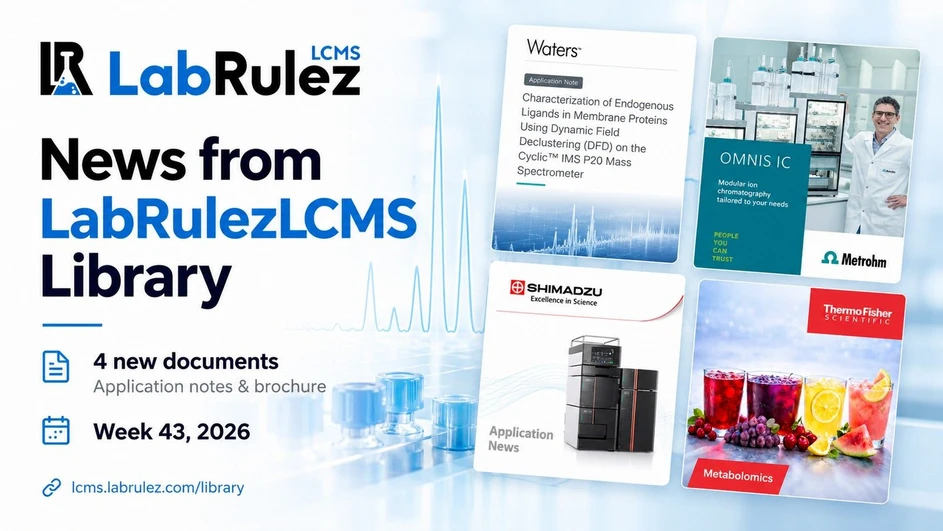
This week we bring you brochure by Metrohm and application notes by Shimadzu, Thermo Fisher Scientific and Waters Corporation!News from LabRulezLCMS Library - Week 43, 2026
LabRulez / AI: News from LabRulezLCMS Library - Week 43, 2026
Our Library never stops expanding. What are the most recent contributions to LabRulezLCMS Library in the week of 19th October 2026? Check out new documents from the field of liquid phase, especially HPLC and LC/MS techniques!
👉 SEARCH THE LARGEST REPOSITORY OF DOCUMENTS ABOUT LCMS AND RELATED TECHNIQUES
👉 Need info about different analytical techniques? Peek into LabRulezGCMS or LabRulezICPMS libraries.
This week we bring you brochure by Metrohm and application notes by Shimadzu, Thermo Fisher Scientific and Waters Corporation!
1. Metrohm: Getting in the right phase: HILIC for oligonucleotide analysis
- Application note
- Full PDF for download
The Metrohm OMNIS IC platform is a modular ion chromatography system designed to combine flexibility, automation, reliability, and a compact footprint. It can be configured as the entry-level single-channel OMNIS IC S, the more advanced OMNIS IC M, or the dual-channel OMNIS IC L for maximum throughput. Because all configurations are built on the same modular platform, laboratories can start with a basic setup and expand later with additional pumps, detectors, suppression systems, sample-preparation modules, flow monitoring, and other functional units as analytical requirements evolve.
A major strength of OMNIS IC is automation. The integrated autosampler can handle up to 160 samples in 5 mL vials and supports multiple vial and plate formats, while the cooled version maintains samples between 4 and 22 °C. Features such as vial recognition, barcode support, integrated rinsing, dilution stations, leak detection, and side pods for standards and rinse solutions are designed to improve sample safety, reproducibility, and unattended operation. Metrohm Inline Sample Preparation (MISP) further automates steps such as ultrafiltration, dilution, preconcentration, dialysis, and matrix elimination, reducing manual handling and helping standardize sample preparation.
The system also emphasizes intelligent monitoring and reagent management. OMNIS Multi Flow Monitoring checks critical liquid flows, while the Reagent Organizer Liquid Control monitors fill levels and can support automated eluent production on demand. Additional functions such as AutoPurge, AutoRinse, equilibration checks, intelligent column recognition, automatic recalibration, and leak monitoring are intended to increase reliability and reduce operator intervention. Detection options include conductivity, UV/VIS, and amperometry, and third-party devices such as mass spectrometers can be integrated for hyphenated workflows.
All components are controlled through OMNIS Software, which provides centralized system control, real-time monitoring, graphical flow-path visualization, automated workflows, live chromatograms, sample status tracking, and consolidated reporting. The software can scale to client/server environments with up to 1,000 clients and supports compliance with requirements such as FDA 21 CFR Part 11 and EudraLex Annex 11. OMNIS also extends beyond ion chromatography by integrating titration, near-infrared spectroscopy, sample robotics, and third-party devices into a single platform, allowing laboratories to manage results from multiple analytical techniques in one environment.
2. Shimadzu: Maximizing Operational Productivity through Ultra-Fast Analysis with Nexera X4
- Application note
- Full PDF for download
User benefits
- The low internal volume design of Nexera X4 significantly improves solvent delivery responsiveness and shortens reequilibration time in gradient elution, enabling high-throughput analysis.
- The independently actuated plungers and the pressure feedback mechanism incorporated into the solvent delivery pump ensure excellent reproducibility of both retention times and peak areas.
In multi-sample analyses in pharmaceutical development, improving throughput per analysis directly translates to enhanced productivity. Nexera X4 is a next-generation ultra-high-performance liquid chromatograph (UHPLC) that inherits the technologies cultivated in Shimadzu’s Nexera series and delivers best-in-class analytical performance. Its low-internalvolume design significantly improves solvent delivery responsiveness, enabling ultra-fast analysis. In addition, the solvent delivery pump equipped with independently actuated plungers and a pressure feedback mechanism greatly reduces pulsation and provides highly stable and reproducible solvent delivery even under ultra-high-pressure conditions. All highpressure sample flow paths employ end-surface-sealed connections that minimize carryover and peak broadening originating from voids (dead volume) in the fittings. Tool-free fittings (Fig. 2) are used throughout these flow paths to enhance usability. In this article, data are presented demonstrating how the superiorsolvent delivery responsiveness of Nexera X4 reduces cycle times compared with existing UHPLC systems and enables high-throughput analysis.
Conclusion
Examples of high-throughput analysis achieved by reducing analytical cycle times are presented. Nexera X4 delivers significantly improved solvent delivery responsiveness through low internal volume design, as well as high solvent delivery stability via independently actuated plungers and a pressure feedback mechanism. This enables excellent reproducibility even in ultra-fast gradient analyses with a 3-minute cycle time. By utilizing Nexera X4 for multi-sample analyses, cycle times per analysis can be shortened, contributing to maximized productivity in analytical operations.
3. Thermo Fisher Scientific: Simultaneous quantitation and discovery (SQUAD) analysis of the fruit juice metabolome
- Application note
- Full PDF for download
Fruit juice is a rich source of bioactive compounds, including sugars, organic acids, amino acids, vitamins, and phenolic compounds. Interest in fruit juice metabolomics has grown rapidly because comprehensive characterization of juice composition provides valuable insights into nutritional and health benefits, as well as the impact of food processing and manufacturing practices. Among these constituents, flavonoids—polyphenolic compounds abundant in fruit juices—are well recognized for their antioxidant activity and immune-supporting benefits.1 Most flavonoids occur as β-glycosides conjugated to one or more sugar moieties, with notable exceptions such as catechins. We present a simultaneous SQUAD workflow2 for the analysis of commercially available fruit juice samples, enabling comprehensive chemical profiling, discovery, and structural elucidation of novel natural products, identification of discriminating compounds across different juice types, and accurate quantitation of targeted polyphenols.
Five commercially available fruit juice samples were analyzed using reversed-phase liquid chromatography on a Thermo Scientific™ Vanquish™ Flex UHPLC System coupled to an Orbitrap Ascend MultiOmics Tribrid MS. A metabolomics SQUAD workflow (Figure 1) was employed, integrating targeted and untargeted acquisition strategies within a single analytical run. Comprehensive full-scan and HCD/CID MS²/MS³ data were acquired in both positive and negative ionization modes, and the Thermo Scientific™ AcquireX™ Deep Scan Intelligent Data Acquisition Workflow was used to enhance fragmentation coverage of relevant compounds. In addition to conventional HCD-MS², the Orbitrap Ascend MultiOmics Tribrid MS uniquely enables multi-stage (MSⁿ) fragmentation using its dual-pressure linear ion trap, delivering enhanced structural elucidation for compound identification.3,4 Targeted quantitation was performed using Thermo Scientific™ TraceFinder™ software version 5.2, while untargeted compound profiling, structural elucidation, and differential analysis were carried out using Compound Discoverer software version 3.5, enabling comprehensive characterization of natural products in complex juice matrices.
Instrumentation
Liquid chromatography
Ultra-high-performance liquid chromatography (UHPLC) was performed using a Vanquish Flex UHPLC system.
Mass spectrometry
Mass spectrometry data were acquired using the Orbitrap Ascend MultiOmics Tribrid MS equipped with a Thermo Scientific™ OptaMax™ NG heated electrospray ionization (H-ESI) source. The Orbitrap Ascend MultiOmics Tribrid MS incorporates softer ion funnel optics that minimize in-source fragmentation of labile compounds while maintaining high ion transmission efficiency. Reduced MS¹ fragmentation significantly lowers false-positive identifications during natural product characterization. Dual ion routing multipoles (IRMs) enable true parallelized operation, allowing ions to be accumulated, stored, and fragmented using higher-energy collisional dissociation (HCD) in the front IRM while simultaneous analyses occur in the linear ion trap or back IRM.
Software
Data acquisition was performed using Thermo Scientific™ Xcalibur™ software version 4.7 with the AcquireX Deep Scan workflow for intelligent fragmentation. Targeted quantitative analysis was performed using TraceFinder software version 5.2, while untargeted compound profiling, structural elucidation, and differential analysis were conducted using Compound Discoverer software version 3.5. This integrated workflow enabled simultaneous quantitative analysis and untargeted discovery of the fruit juice metabolome.
Results and discussion
MSⁿ data acquisition approach
The Orbitrap Ascend MultiOmics Tribrid MS full-scan ddMS³ HCD/CID method employs an intelligent, decision-tree–based acquisition strategy that dynamically adapts fragmentation in real time based on precursor mass and acquired spectral quality (Figure 4). This adaptive approach maximizes the collection of relevant multi-stage MSⁿ data and enhances confidence in compound identification. Within a cycle time of 0.9 s, datadependent HCD MS² scans were acquired for precursor ions in the m/z range of 150–420. For precursor ions between m/z 420–1,200, an intelligent product-ion-dependent MSⁿ strategy was applied, in which a high-resolution accurate-mass (HRAM) full MS scan was followed by CID MS² acquisition. When one or more predefined sugar neutral losses were detected, up to two additional CID MS³ scans were triggered, enabling detailed structural elucidation of flavonoid glycosides. Figure 5 illustrates representative data acquired using this decision-tree–based method.
Untargeted analysis using Compound Discoverer software
Compound Discoverer software version 3.5, using a modified Natural Product Unknown ID with Stats workflow template, provides an integrated platform for the identification of known natural products through database searching, discovery of novel flavonoid species, and comparative analysis across different sample groups (Figure 6). The workflow simultaneously interrogates multiple spectral libraries and compound databases, performs elemental composition prediction, and applies advanced annotation strategies to support confident compound identification. The Search Neutral Losses node flags compounds exhibiting characteristic sugar neutral losses, while the Compound Class Scoring node highlights compounds sharing diagnostic fragment ions with flavonoids, enabling efficient filtering and prioritization of both known and unknown flavonoids of interest within complex juice matrices. Structural elucidation is further supported by Fragment Ion Search (FISh) scoring, which matches experimental MSⁿ spectra against predicted fragment structures. The Molecular Networks node enables visualization of structurally related flavonoids based on fragmentation similarity and chemical transformations, while the Differential Analysis node identifies characteristic metabolites unique to each fruit juice type and, together with integrated statistical plots, supports comprehensive comparative analysis.
Conclusion
This study demonstrates a comprehensive SQUAD workflow for the analysis of commercially available fruit juice samples within a single LC-MS run using the Orbitrap Ascend MultiOmics MS together with Compound Discoverer software and TraceFinder software.
High-quality MS and MSⁿ data acquired with high resolution and mass accuracy on the Orbitrap Ascend MultiOmics Tribrid MS enable high-confidence compound identification and annotation. Multi-stage fragmentation further supports structure-based flavonoid profiling and provides sufficient fragment information for structural elucidation.
Compound Discoverer software version 3.5 delivers an integrated and powerful solution for comprehensive characterization of the chemical composition of diverse fruit juice types, facilitating the discovery of novel natural products while providing robust and intuitive statistical analysis.
TraceFinder software enables streamlined and confident targeted quantitation. The described workflow can be readily applied to the analysis of other compound classes in natural product research and food and beverage applications.
4. Waters Corporation: Characterization of Endogenous Ligands in Membrane Proteins Using Dynamic Field Declustering (DFD) on the Cyclic™ IMS P20 Mass Spectrometer
- Application note
- Full PDF for download
Benefits
- Enable high confidence assignment of protein signals with DFD
- Confirm endogenous binders from challenging membrane protein samples
- Increase confidence in endogenous binder identification through advanced multi-stage analysis
Native mass spectrometry is established as a key tool to characterize protein-ligand interactions.1 The facile nature of measurement through mass-shift detection makes the workflow attractive for drug screening assays and affinity characterization.1,2 Furthermore, catch-and-release type assays enable the detection and characterization of unknown binders directly from biological matrices or endogenous environments.3,4
Membrane proteins represent approximately 30% of the proteome and around 60% of all drug targets and as such are key molecules in drug development as well as biomedical research.5 They remain challenging to study by native mass spectrometry, as they require solubilizing detergents or membrane mimetics to preserve their native structure, which can substantially interfere with mass measurement. To enable effective and accurate mass measurement, it is necessary to remove such solubilizing agents from the protein in the gas phase postionization to reveal the ‘naked’ protein. This is usually accomplished using collisional activation after the source region or within a gas cell usually employed for collision-induced dissociation (CID). Modern mass spectrometry (MS) systems, however, often lack the voltage range for complete detergent removal. Furthermore, careful control of this activation step is essential to effectively remove the solubilizing environment while preserving the non-covalent interactions of interest.
Dynamic Field Declustering (DFD), available on the Cyclic IMS P20 Mass Spectrometer, removes unwanted bound species from proteins enabling highly accurate mass measurement and confident protein characterization. Through sustained activation in an oscillating radio-frequency (RF) field, the interactions between proteins and unwanted residual solvent and other adducts are disrupted, removing them from the protein. In the case of membrane proteins, DFD has been shown to effectively liberate them from their detergent micelle to reveal well resolved protein signals yielding accurate masses. DFD has also been shown to allow retention of binders, e.g. drugs and endogenous lipids.6
The positioning of the DFD device within the Cyclic IMS P20 Mass Spectrometer is central to its functionality. Located in the StepWave™ Ion Guide, DFD enables complete removal of micelles prior to quadrupole mass selection. This allows tandem-MS interrogation of the protein and/or its bound forms by true MS/MS.
This capability was previously demonstrated using prototype instrumentation to characterize a membrane protein-drug complex resulting from a multiplexed small molecule screening campaign.6 In the study, a pseudoMS4 workflow was employed in which the protein-drug complex was first released from the micelle using DFD, then isolated using the quadrupole. The bound ligand (the drug) was then collisionally released from the complex, subsequently separated from the protein ions by Cyclic ion mobility and, finally, dissociated by CID post-IMS for fragment-level characterization and structural confirmation. By combining efficient micelle removal, selective ion isolation, Cyclic ion mobility separation, and downstream fragmentation, this prototype instrument configuration, now implemented in the Cyclic IMS P20 Mass Spectrometer, enabled confident identification and structural confirmation of the drug candidate binder from the screening campaign.6
In this application note, the pseudo-MS4 workflow is applied on the Cyclic IMS P20 Mass Spectrometer to enable confident characterization of lipid-bound membrane protein complexes. A model system is employed; Bacteriorhodopsin (bR), a membrane-bound, light-driven proton pump from the archaeon Halobacterium salinarum which is often used as a model for G-protein coupled receptors (GPCRs). DFD effectively removes the detergent micelle to reveal well resolved protein signals. Spectral deconvolution shows that signals consistent with bound lipids are observed directly in the mass spectrum. These lipid-bound ions are then interrogated using the pseudo-MS4 workflow, enabling accurate assignment of the lipid species not just from its molecular mass but from its constituent fragments.
Experimental
- MS system: Waters Cyclic IMS P20 Mass Spectrometer
CONCLUSIONS
The Cyclic IMS P20 Mass Spectrometer provided a powerful workflow for the characterization of membrane protein–lipid interactions by native mass spectrometry. DFD enabled efficient removal of the detergent micelle from bacteriorhodopsin, revealing protein and endogenous lipid-bound species for accurate mass measurement.
The combination of DFD with quadrupole mass selection and Cyclic ion mobility separation enabled a pseudoMS4 experiment that provided additional structural information for bound lipids, increasing confidence in endogenous binder identification. Together, these capabilities extend the analytical power of native MS and provide new opportunities to study protein–ligand interactions.