

The promise of lipidomics
Lipidomics is a new field of study crucial for understanding cellular physiology and pathology. The application of lipidomic profiling to disease phenotype analysis is a rapidly growing aspect of translational medical research. Identification of unique lipid biomarkers has the potential to distinguish healthy individuals from individuals at risk for disease, detect diseases earlier, and facilitate development of personalized treatments.
Liquid chromatography combined with mass spectrometry (LC/MS) is a widely adopted technique for lipidomics analyses. Relative and absolute quantitation, and identification, of lipids from biological samples requires sophisticated software with an extensive, comprehensive database. Thermo Scientific™ LipidSearch™ software provides accurate identification of lipids and automatically integrates complex data into a concise report. With its easy-to-use web-based interface, it dramatically reduces data analysis time.
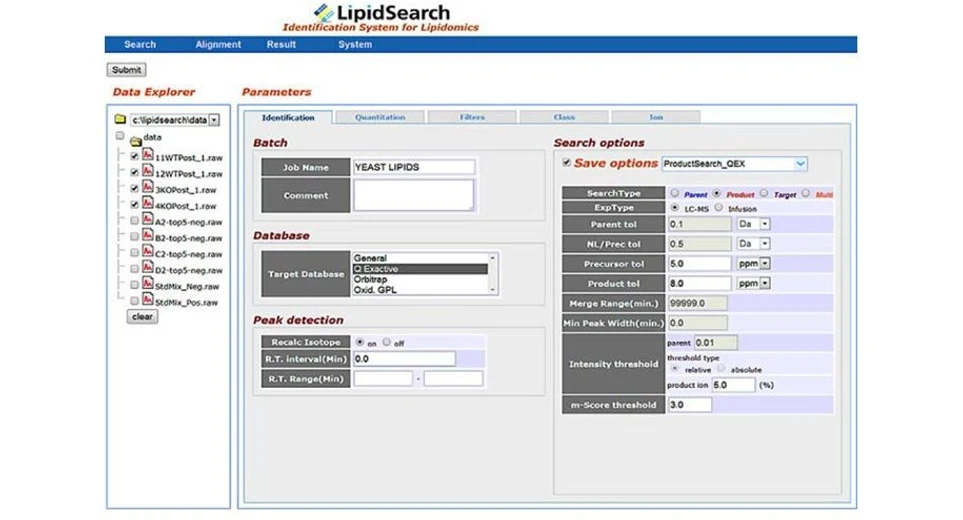 Thermo Scientific™ LipidSearch™ Software: Easy-to-use web browser interface for automated and reliable identification.
Automated identification and relative quantitation with LipidSearch software
LipidSearch software, developed jointly by Professor Ryo Taguchi and MKI, (Tokyo, Japan), is a powerful new tool for automatic identification and relative quantification of cellular lipid molecular species from large amounts of mass spectrometric data obtained in nano-infusion or LC-MS experiments. Using the industry-leading, high-resolution, accurate-mass Thermo Scientific Orbitrap™ technology with exclusive LipidSearch software, the most accurate and confident lipid profiles and identifications can be achieved more quickly than ever before.
- Compatible with data acquired from Thermo Scientific™ triple quadrupole, ion trap, and Orbitrap mass spectrometers
- Largest lipid database containing >1.5 million lipid ions and their predicted fragment ions
- Identification algorithms for product ion, precursor ion and neutral loss scans
- Alignment of lipid data obtained from multiple LC-MS and MSn experiments
- Relative quantitation of identified lipid precursors in either LC-MS or infusion experiments
The database contains defined structures and includes more than 1.5 million lipid ions and their predicted fragment ions. Fragmentation patterns are calculated and improved by using expert knowledge based on experimental results. Lipid adduct ions and MSn fingerprints are also included. Data are stored in XML files and are easily customized.
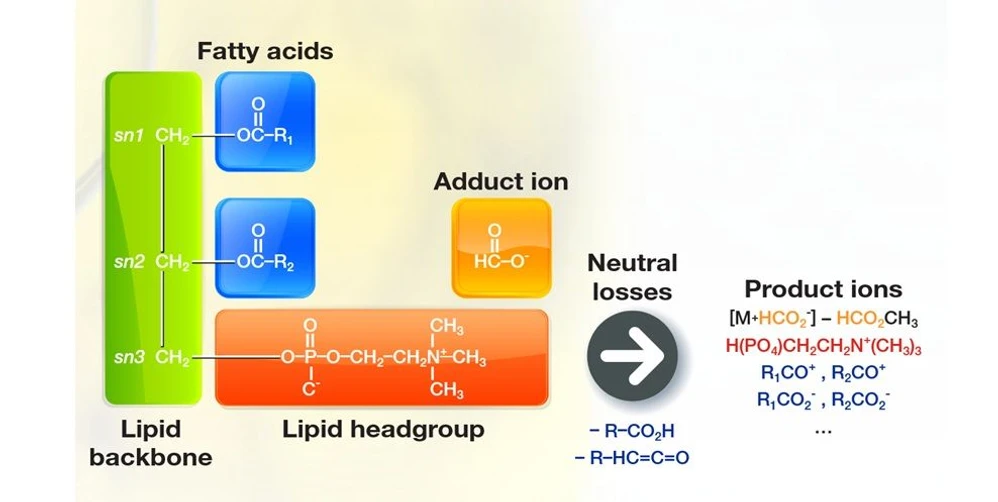 Thermo Scientific™ LipidSearch™ Software: Lipid fragment ions related to lipid headgroup, fatty acids, and backbone.
LipidSearch software provides an easy-to-use, automated workflow
From peak detection to relative quantitaiton and identification, LipidSearch software provides an easy-to-use, automated workflow.
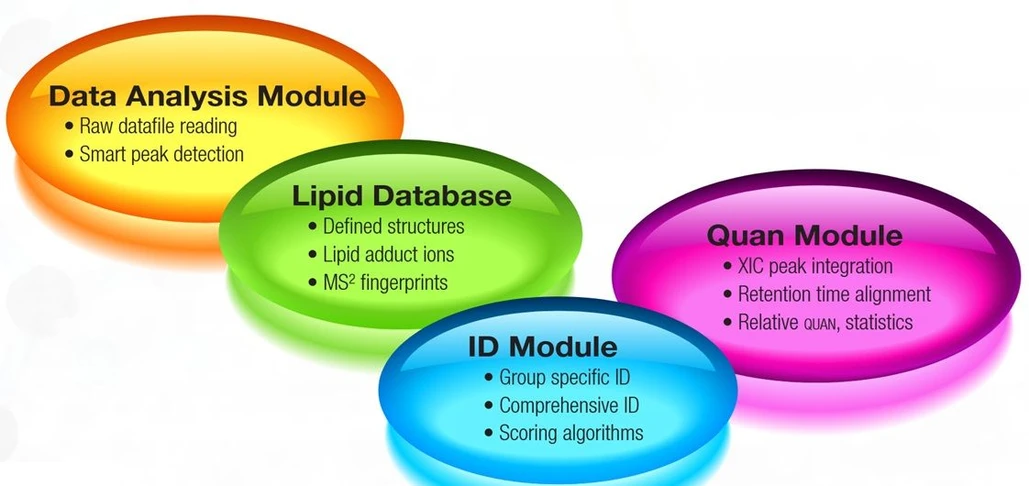 Thermo Scientific™ LipidSearch™ Software: LipidSearch software provides an easy-to-use, automated workflow.
Step 1 Data Analysis Module — Peak Detection
- Raw data file reading
- Smart peak detection
The peak detection engine implemented in LipidSearch software can handle different MS experiments and platforms. The combination of unique peak detection algorithms, tailored for each experiment and instrument type, and mass spectral processing functions enables accurate peak detection.
LipidSearch software provides two different identification algorithms as well as scoring algorithms:
- A group-specific algorithm identifies lipids based on the polar head groups or fatty acids using a combination of precursor ion scanning and neutral loss scans from lipids mixtures.
- The comprehensive ID algorithm is used for product ion scans and can discriminate each lipid by matching the predicted fragmentation pattern stored in the database.
- LipidSearch software also provides a set of scoring algorithms to filter out lower probability results
Step 2 Identification Module — Lipid Identification
- Group-specific ID (targeted)
- Comprehensive ID (untargeted)
- Scoring algorithms
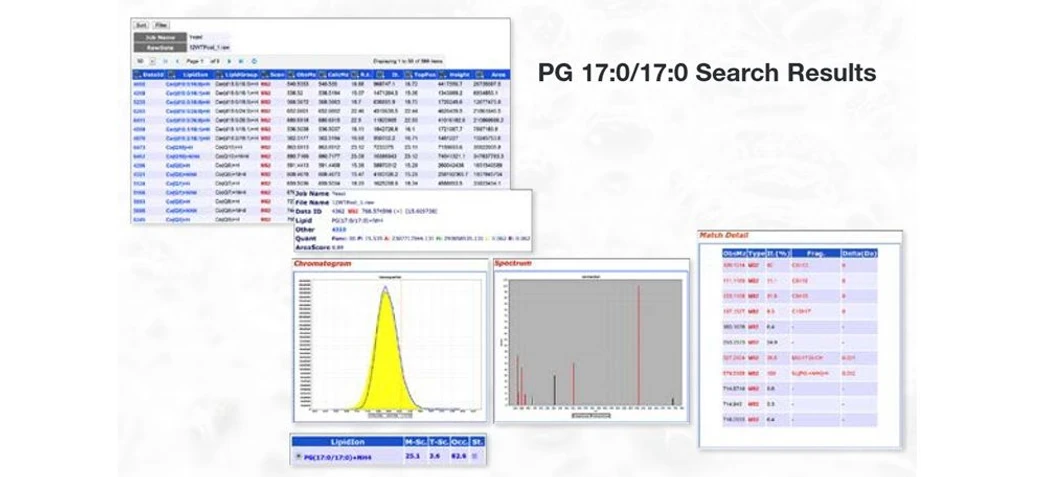 Thermo Scientific™ LipidSearch™ Software: PG 17:0/17:0 Search Results.
Step 3 Quantitation Module — Alignment and Quantitation
- XIC peak integration
- Retention time alignment
- Relative quantitation
- Statistical analysis
Prior to quantitation, lipid results from each sample are aligned within a retention time window. Identified lipids are quantified by detecting their precursor ions from full-scan MS and integrating extracted ion chromatograms.
Accurate peak areas are computed by denoising and smoothing the peak profiles prior to separating any partially overlapped peaks. Comparative analysis is then carried out between the multiple sample and control groups using t-test statistics. The mean peak area result for each group is displayed in a “box and whisker” plot.
![Thermo Scientific™ LipidSearch™ Software: Alignment results for CoQ7, [M+NH4]+.](https://labrulez.com/m/Thermo_Scientific_Lipid_Search_Software_6_196073034c_l.webp) Thermo Scientific™ LipidSearch™ Software: Alignment results for CoQ7, [M+NH4]+.
Thermo Scientific™ LipidSearch™ Software: Alignment results for CoQ7, [M+NH4]+.Using the industry-leading, high-resolution, accurate-mass Thermo Scientific™ Orbitrap™ technology with exclusive LipidSearch software, achieve the most accurate and confident lipid profiles and identifications more quickly than ever before. For targeted quantitation, LipidSearch software also supports the Thermo Scientific TSQ triple quadrupole MS systems. For both lipidomics workflows, LipidSearch software automatically integrates complex data into a combined report to dramatically reduce data analysis.
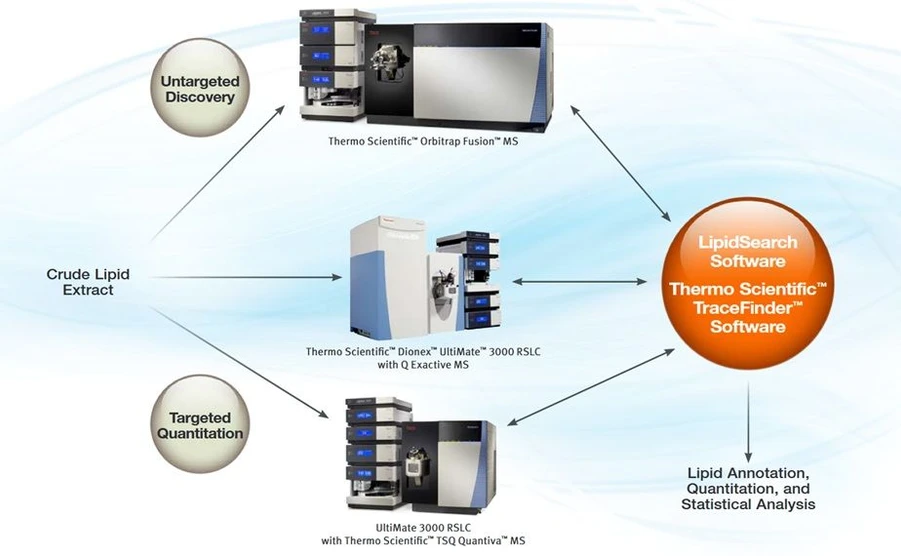 Thermo Scientific™ LipidSearch™ Software.
Minimum/Recommended PC Requirements
- OS: Microsoft® Windows® 7 Professional (x64) or Windows 8 (x64); English language
CPU: Quad - or multi-core CPU, 2 GHz or higher
Memory: 8 GB RAM or higher
HDD: 50 GB free space for LipidSearch software; 500 GB hard drive
SSD (optional): 50 GB free space for LipidSearch software; 256 GB solid-state drive