Inactive

Amino Acid Analysis: Decoded
Does Amino Acid analysis impact different stages of drug discovery or the manufacturing process? Is it important for protein and peptide identification and quantitation?

Enhancing the scientific experience using laboratory software
Novel ways to interact with LIMS. Delivering knowledge from data. Automation solutions. Intuitive workflows.

HPLC Troubleshooting
Learn how to prevent and minimize problems before they occur. Understand how to approach problem solving and troubleshooting. Review peak shape and column performance problems.

Improving End-to-End Metabolite Identification by LC-MS/MS
Here, an alternative fragmentation technique is applied to produce additional fragment ions and an informative MS/MS spectra for metabolite identification.

TIPS AND TRICKS FOR LC COLUMN SELECTION FOR ROBUST METHODS
Learn how to leverage different column attributes to drive retention and manipulate selectivity. Examples about how the latest column technologies can improve your results.
-Explore-a-mass-spectrometry-approach-for-target-deconvolution-and-compound-profiling_s.webp)
CETSA Explore – a mass spectrometry approach for target deconvolution and compound profiling
We will introduce the CETSA Explore method, present different applications and will show how CETSA Explore was part of a target deconvolution effort following a phenotypic screen.

Level up your nanoparticle quant and sizing on Stunner
Tired of slow, complex nanoparticle analysis? Stunner delivers fast, high-throughput, non-destructive quant and sizing using just 2 µL—no dyes, standards, or breakdown steps needed.

How to design an LCMSMS Experiment
This presentation will examine the scan parameters available for designing an MSMS, explain their intended function, and suggest approaches to use based on the goal of the LCMSMS experiment.
Spatial proteomics in three-dimensional intact specimens
You will learn about a new experimental approach that combines whole tissue clearing, dia-PASEF®, and TIMS MS to analyze the spatial proteome of complex tissue structures.

Optimizing PFAS Analysis for Draft Method 1633 Using a Stacked SPE Format
This webinar will present data and discuss EPA Draft Method 1633 compliant options to simplify sample clean up and increase sample throughput for PFAS analysis.
Related content
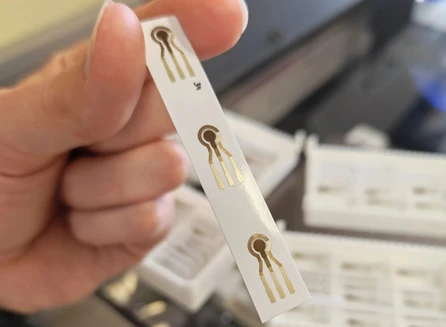
Atom by atom. Scientists reveal a new direction in medical diagnostics

In Silico Modeling, 2D-LC & Green Chromatography: Imad Ahmad on the Future of Method Development