Detecting nanoplastics – in fractions of a second
GCMSICPMSArticle | Scientific article

Detecting nanoplastics – in fractions of a second

Tiny plastic particles are an environmental problem. They can even penetrate living cells. A method has now been developed at TU Wien to detect such particles quickly and with high sensitivity.
Detecting nanoplastics – in fractions of a second
The U.S. Pharmacopeia (USP) and Mestrelab Research, S.L. (Mestrelab), are pleased to announce they have entered into a collaboration to deliver USP-ID, through Mestrelab’s Mnova platform.
ICPMSArticle | Software

The U.S. Pharmacopeia (USP) and Mestrelab Research, S.L. (Mestrelab), are pleased to announce they have entered into a collaboration to deliver USP-ID, through Mestrelab’s Mnova platform.

This one-click, automated software solution identifies, quantifies and labels a broad range of chemical components in both simple solutions and complex mixtures for analysis by qNMR.
The U.S. Pharmacopeia (USP) and Mestrelab Research, S.L. (Mestrelab), are pleased to announce they have entered into a collaboration to deliver USP-ID, through Mestrelab’s Mnova platform.
16th Multidimensional Chromatography Workshop (MDCW) will take place in Liege, Belgium, Feb. 3-5, 2025
GCMSLCMSArticle | Events

16th Multidimensional Chromatography Workshop (MDCW) will take place in Liege, Belgium, Feb. 3-5, 2025

The Multidimensional Chromatography (MDC) Workshop draws experts in this exciting field to share and discuss their research. In 2025, the 16th workshop will be hosted in person in Liege, Belgium.
16th Multidimensional Chromatography Workshop (MDCW) will take place in Liege, Belgium, Feb. 3-5, 2025
Who is Martin Pumera, one of the most cited scientists in the world?
GCMSICPMSLCMSArticle | Scientists

Who is Martin Pumera, one of the most cited scientists in the world?

Published a remarkable 900 scientific papers. What is the journey of the most cited chemist Martin Pumera working in the Czech Republic?
Who is Martin Pumera, one of the most cited scientists in the world?
Free NIST Data Processing Software Lab for Universities - Part 7: Creating a EI MS User Library in Free Laboratory Resource for Universities
GCMSArticle | Academy

Free NIST Data Processing Software Lab for Universities - Part 7: Creating a EI MS User Library in Free Laboratory Resource for Universities

In the seventh part, we will show how to create EI MS user library.
Free NIST Data Processing Software Lab for Universities - Part 7: Creating a EI MS User Library in Free Laboratory Resource for Universities
Webinars LabRulezICPMS Week 19/2024
ICPMSArticle | Webinars

Webinars LabRulezICPMS Week 19/2024

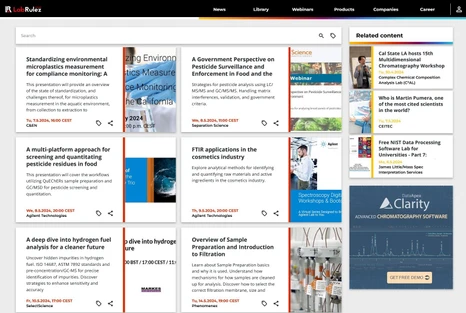
This week 7 webinars: Pyrolysis Oils, Microplastics measurement, Microscopy & Big Data, Soils & ICP-OES, Ultrapure water, NMR metabolomics & lipidomics, FTIR & cosmetics.
Webinars LabRulezICPMS Week 19/2024
Webinars LabRulezGCMS Week 19/2024
GCMSArticle | Webinars

Webinars LabRulezGCMS Week 19/2024

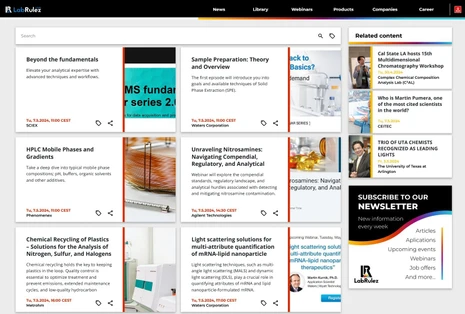
This week 5 webinars: Microplastics measurement, Pesticides & GC/MS/MS, QuEChERs & GC/MSD for pesticides, FTIR & cosmetics, Hydrogen fuel & TD-GC/MSD.
Webinars LabRulezGCMS Week 19/2024
Webinars LabRulezLCMS Week 19/2024
LCMSArticle | Webinars

Webinars LabRulezLCMS Week 19/2024

13 Webinars: Fundamentals, SPE, Mobile Phases, Nitrosamines, Pyrolysis Oils, MALS & DLS, LC/MS basics, Pesticides, Ultrapure water, Columns & Small Molecule, Lipidomics, PFAS, Beverages.
Webinars LabRulezLCMS Week 19/2024
TRIO OF UTA CHEMISTS RECOGNIZED AS LEADING LIGHTS
GCMSICPMSLCMSArticle | Scientists

TRIO OF UTA CHEMISTS RECOGNIZED AS LEADING LIGHTS

Three chemists from The University of Texas at Arlington are among the most influential analytical scientists in the world, as selected by a top publication.
TRIO OF UTA CHEMISTS RECOGNIZED AS LEADING LIGHTS
“Fat can be extracted even from thousand-year-old pottery,” says V. Brychová
GCMSICPMSLCMSArticle | Scientists

“Fat can be extracted even from thousand-year-old pottery,” says V. Brychová

Veronika Brychová finds herself peering into the culinary habits of ancient peoples through shards of prehistoric pottery, using fat residues to uncover what our ancestors cooked – and when.
“Fat can be extracted even from thousand-year-old pottery,” says V. Brychová