
Inactive

Becoming a DLS and Dynamics Expert: Part 3
Learn how to choose the best DLS data analysis method for your samples. Compare cumulants vs. regularization and know when to use which.
Reporting and data export strategies
Learn pro-level techniques for creating impactful reports and optimizing data export in SCIEX OS software.
Mastering mass spectrometry with Chromeleon CDS: Expert tips and tricks
Explore new MS features in Chromeleon 7.4! Learn tips to optimize workflows, configure settings, and boost MS performance. Live Q&A with Thermo Fisher experts.
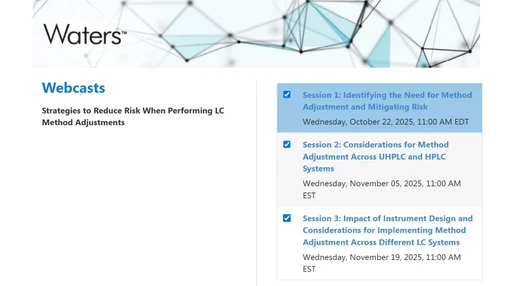
Session 2: Considerations for Method Adjustment Across UHPLC and HPLC Systems
This session will explore a real-world example of method adjustment, with a focus on scaling from UHPLC to HPLC, with appropriate instrumentation.
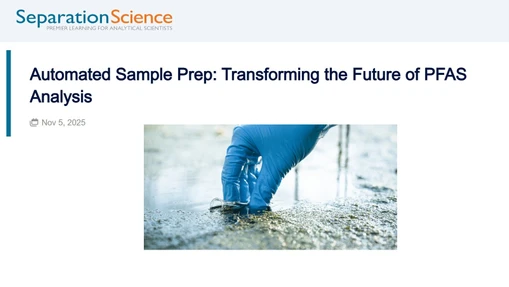
Automated Sample Prep: Transforming the Future of PFAS Analysis
This webinar introduces the Biotage® PrepXpert-8, the newest addition to the Biotage® automated solid phase extraction (SPE) portfolio, designed to deliver unmatched versatility for PFAS analysis.
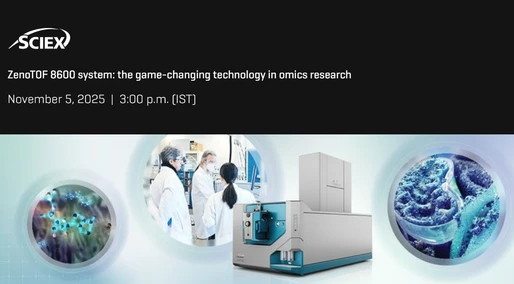
ZenoTOF 8600 system: the game-changing technology in omics research
This webinar introduces the ZenoTOF 8600 system and shows how its ultra-high sensitivity, EAD fragmentation, and fast ZT Scan DIA 2.0 enhance omics research workflows.

How automation and integrated sample QC enhance a targeted long-read-sequencing workflow
Discover how automation and integrated QC streamline targeted long-read sequencing. Learn how Agilent and PacBio technologies overcome short-read limitations in genetic variant detection.
Safeguard dataset quality in LC-MS analysis with system suitability testing and intelligent run control (SST/IRC)
Unlock the full potential of your LC-MS system with Thermo Scientific™ Chromeleon™ software features.

Hidden Threats: High-Throughput Strategies to Detect Aggregates in Biotherapeutics
Learn high-throughput strategies to detect oligomers and aggregates in biologics. Explore DLS and BMI workflows for robust stability, safety, and regulatory-ready analysis.

Flow Chemistry Meets AI and NMR for Next-Gen API Production
Discover how the PIPAc project integrates AI, NMR, flow chemistry, and 3D-printed reactors to transform API manufacturing with real-time control, scalability, and sustainability.
Related content

Oligonucleotide and mRNA Analysis Resource Roundup
Conversion to mzML Format for NIST26 Chromatogram Processing
