Inactive
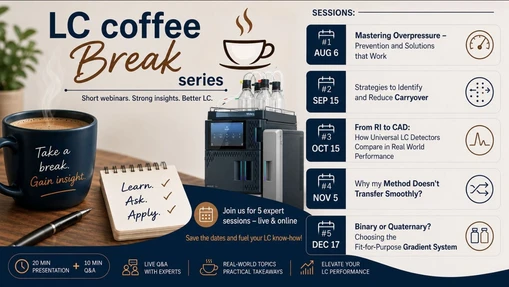
LC Coffee Breaks: Binary or Quaternary? Choosing the Fit-for-Purpose Gradient System
Compare binary and quaternary LC gradient systems. Learn their strengths, limitations, and key selection criteria to optimize separations and choose the right configuration for your analytical needs.
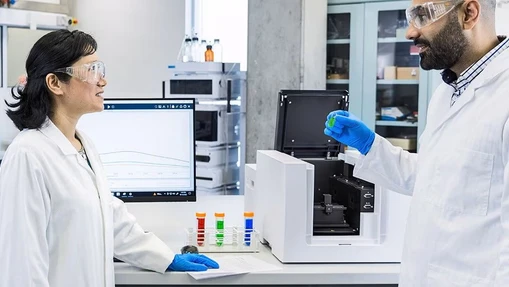
Step-by-step Measurement of IR Spectra
This session will demonstrate how to quickly set up libraries and methods to quickly analyze solids, liquids and powders using FTIR.
Troubleshooting Peak Tailing in Gas Chromatography
Learn what causes peak tailing in GC, how to troubleshoot distorted peaks, and how inert flow paths and deactivation technologies improve performance for demanding samples.
Better Separations Begin with the Right GPC/SEC Column
Choosing the right GPC/SEC column is essential for efficient separation and reliable polymer molecular weight analysis. Learn how to select suitable packing materials and column dimensions.
The PLOT Thickens: Using PLOT Columns for the Analysis of Gases and Very Volatile Compounds
Learn how PLOT columns enable efficient GC separation of highly volatile compounds at ambient oven conditions, including permanent gases, light hydrocarbons, sulfur compounds, and oxygenates.
Multi Angle Light Scattering to Characterize Novel Macromolecules and Investigate their Structure-Property Relationships
How can molecular weight, size and shape of macromolecules be determined? Explore multi-angle light scattering (MALS) for characterizing complex molecular systems.
Save Time, Keep Resolution: An Introduction to Fast GC Principles, Parameters, and Implementation
Learn how high-efficiency capillary GC columns and method translation can significantly shorten analysis times without sacrificing resolution, while increasing sample throughput.
Method Development Bootcamp
From HPLC fundamentals to robust method development. Learn to select separation conditions, optimize injection volumes and choose between isocratic and gradient elution.
GC Headspace Made Simple: Tips, Tricks, and Best Practices
Learn how headspace GC works, how sample properties and key headspace parameters affect results, and how to troubleshoot common issues in routine analysis.
Optimizing Therapeutic Oligonucleotide Separations: Columns, Methods, and Applications
How can therapeutic oligonucleotide separations be optimized? Explore ion-pair reversed-phase, ion-exchange and size-exclusion chromatography for their analysis.
Related content

Keynote Speakers at the 18th MDCW

Separating Closely Related Species in Complex Oligonucleotide Samples