Tu, 24.11.2026 | Original article from: Thermo Fisher Scientific / Mauro De Pra, Ph.D.
Discover how NIBRT researchers optimized an ion-pair RP-LC-MS workflow to improve the separation of oligonucleotide impurities, degradation products, and truncated sequences.Separating Closely Related Species in Complex Oligonucleotide Samples

Thermo Fisher Scientific: Separating Closely Related Species in Complex Oligonucleotide Samples
As oligonucleotide therapeutics become more structurally diverse, separating closely related species places greater demands on chromatographic selectivity. A recent study from NIBRT explored how an LC-MS workflow can distinguish impurities, degradation products, and truncated sequences in increasingly demanding samples.
Anyone who has analyzed a forced degradation sample knows how quickly the chromatogram fills up.
What begins as a handful of well-resolved peaks soon becomes a mixture of degradants, truncated sequences, and closely related impurities. As the number of species increases, separating them becomes progressively more difficult. Highly efficient chromatographic separations become essential for distinguishing impurities and identifying low-abundance species.
Researchers at the National Institute for Bioprocessing Research and Training (NIBRT) recently explored this challenge by developing an ion-pair reversed-phase LC-MS workflow for antisense oligonucleotides and then applying it to forced degradation studies. As the number of closely related species increased, chromatographic selectivity became progressively more difficult to manipulate. The researchers responded by evaluating a new analytical platform designed to improve chromatographic resolution and increase the sensitivity of low-abundance impurities.
Key takeaways
- High-resolution chromatography helps resolve low-abundance impurities, truncated sequences, and degradation products in complex oligonucleotide samples.
- Ion-pair reversed-phase LC-MS method development requires balancing resolution, signal intensity, peak width, and metal adduct formation.
- Inert UHPLC flow paths can reduce metal adduct formation, producing cleaner mass spectra for intact mass analysis.
Developing the workflow
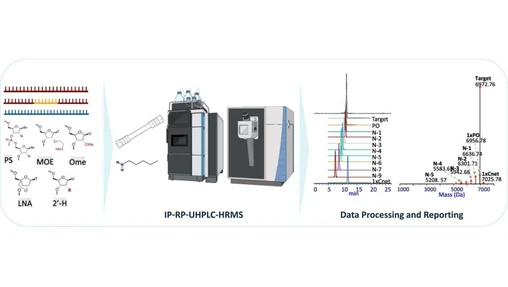
NIBRT researchers first developed an ion-pair reversed-phase LC-MS workflow capable of characterizing antisense oligonucleotides with different chemical modifications. They then challenged that workflow with forced degradation studies designed to generate increasingly demanding analytical samples.
To identify the most effective analytical conditions, the researchers evaluated ion-pair chemistry, ion-pair concentration, and buffer concentration while simultaneously measuring signal intensity, chromatographic resolution, peak width, and metal adduct intensity. Rather than maximizing a single analytical response, they selected conditions that balanced all four measurements across four chemically distinct antisense oligonucleotides representing different therapeutic generations and structural modifications.
Refining the LC-MS method
To improve chromatographic performance, the researchers evaluated a new analytical platform that paired a monodisperse, supermacroporous reversed-phase column with a fully inert UHPLC system. The column’s chemistry was designed to increase chromatographic resolution while maintaining high efficiency for oligonucleotide separations, while the inert flow path minimized interactions between oligonucleotides and metal surfaces, reducing metal adduct formation and producing cleaner mass spectra.
Rather than changing one experimental parameter at a time, the researchers used a design of experiments approach to evaluate the combined effects of ion-pair chemistry, ion-pair concentration, and buffer concentration. They measured four responses throughout the study: signal intensity, chromatographic resolution, peak width, and metal adduct intensity. Because changes that improved one response could negatively affect another, they selected conditions that balanced all four measurements rather than maximizing a single result.
The final method combined hexylamine and hexafluoroisopropanol as the ion-pairing system with the monodisperse reversed-phase column and inert UHPLC platform.
Characterizing more complex oligonucleotide samples
The researchers applied the workflow to four chemically distinct antisense oligonucleotides and to samples generated under oxidative, acidic, and thermal stress. These forced degradation studies produced increasingly complex mixtures containing degradants, truncated sequences, and other closely related impurities.
 Thermo Fisher Scientific - Separating Closely Related Species in Complex Oligonucleotide Samples 2.webp
Across these samples, the workflow improved the separation of low-abundance impurities while reducing metal adduct formation in the mass spectra. Cleaner spectra simplified intact mass analysis and supported the identification of degradation products that would otherwise be more difficult to distinguish. The study also demonstrated excellent retention-time precision and mass accuracy across the oligonucleotides.
As the number of closely related species increased, chromatographic selectivity became progressively more difficult to manipulate, increasing the importance of high-resolution chromatographic separation before mass spectrometric detection.
Looking beyond individual method parameters
The NIBRT study showed that chromatographic performance depends on more than mobile phase composition or column chemistry alone. The researchers combined an inert UHPLC system, a monodisperse reversed-phase column, and a carefully selected ion-pairing system to reduce metal adducts, improve chromatographic resolution, and preserve signal intensity across multiple antisense oligonucleotides. Rather than relying on a single experimental change, they balanced the factors that most directly affected separation and detection.
For complex oligonucleotide samples, that balance determines how many individual species scientists can separate and identify. As therapeutic modalities continue to evolve, advances in chromatographic separation will remain central to characterizing impurities, degradation products, and other closely related variants that define product quality.
Want to learn more about this study? Register for the on-demand webinar, Characterizing Complex Biotherapeutics Based on New Modalities: Uncover New LC-MS Workflow Strategies. For additional guidance on selecting columns, ion-pairing reagents, and LC-MS conditions, download our tip sheet for oligonucleotide and mRNA analysis.
Frequently asked questions
Why is separating closely related species so difficult in oligonucleotide analysis?
Closely related oligonucleotide species often differ by only minor structural changes, including truncated sequences, degradation products, or chemical modifications. These compounds can elute very close together, making them difficult to distinguish chromatographically. As more species appear in a sample, chromatographic selectivity becomes increasingly important for separating impurities before they reach the mass spectrometer.
Why are forced degradation studies important in oligonucleotide characterization?
Forced degradation studies expose oligonucleotides to oxidative, acidic, or thermal stress to generate degradation products and related impurities. These studies help researchers evaluate whether an analytical method can separate, detect, and identify closely related species under challenging conditions. They also provide insight into molecular stability and impurity profiles.
What affects chromatographic selectivity in oligonucleotide LC-MS analysis?
Several factors influence chromatographic selectivity, including stationary phase chemistry, ion-pair chemistry, mobile-phase composition, and interactions between oligonucleotides and metal surfaces. Researchers often evaluate these parameters together because changes that improve one aspect of a separation can affect signal intensity, peak shape, or mass spectral quality.
How can researchers improve the separation of closely related oligonucleotide species?
Improving the separation of closely related species requires balancing chromatographic resolution, signal intensity, peak width, and metal adduct formation. Researchers can refine ion-pair chemistry and mobile phase conditions while selecting chromatographic columns and LC systems designed to minimize unwanted analyte interactions. Together, these factors help distinguish impurities, degradation products, and sequence variants more effectively.
Visit us on LinkedIn: #oligonucleotide