

Go beyond what you thought possible with native mass spectrometry
The Thermo Scientific™ Q Exactive™ UHMR is the first hybrid quadrupole-Orbitrap™ mass spectrometer designed specifically for ultra-high mass range (UHMR) native MS and top-down protein analysis. It combines exceptional sensitivity, ultra-high resolution at high m/z, and unique pseudo-MS³ capabilities, enabling detailed characterization of intact protein assemblies and complex biological systems.
🔬 Breakthrough in Native Mass Spectrometry
Native mass spectrometry preserves the non-covalent structure and interactions of proteins and protein complexes, making it an indispensable tool for structural biology and biopharma. The Q Exactive UHMR system enables direct mass analysis of intact macromolecules, including membrane proteins, virus capsids, and ribosomal particles—with unrivaled detail.
- Ultra-high mass range detection up to 80,000 m/z
- Native top-down analysis of protein complexes and assemblies
- High sensitivity for precious or low-abundance samples
- Resolve mass differences even in heterogeneous megaDalton assemblies
⚙️ Technological Innovations
The Q Exactive UHMR system integrates multiple hardware advancements to overcome the historical limitations of native MS:
- In-source trapping for efficient desolvation and controlled dissociation
- Advanced quadrupole mass filter with selection up to 25,000 m/z
- Reduced RF frequencies across the ion path for better high-mass transmission
- Pseudo-MS³ capability: fragment large complexes into subunits, then sequence them in HCD cell
🧬 Applications and Capabilities
Confident characterization of complex biological systems:
- Virus capsid analysis: Differentiation and sequencing of 3–4 MDa hepatitis B virus capsids
- Ribosome studies: Resolution of substoichiometric proteins in E. coli 70S particles
- Membrane proteins: Gentle liberation from micelles and native top-down sequencing (e.g., AmtB trimer)
- Chaperonin complexes: Native top-down analysis of GroEL tetradecamer
Detect and resolve small differences in high-mass species:
- Post-translational modifications
- Ligand binding
- Protein truncations and isoforms
💡 Software for Confident Data Interpretation
Maximize the power of native MS with industry-leading software:
- BioPharma Finder™ Software – For intact mass confirmation, top-down analysis, and PTM localization
- ProSightPC™ Software – Advanced top-down proteomics with integrated UniProt database search
🧪 Who Is It For?
Ideal for research groups and industry labs focused on:
- Structural biology
- Biotherapeutic development
- Native and top-down proteomics
- Protein-ligand interaction studies
🧭 Summary of Key Features
- Mass range: Up to 80,000 m/z
- Quadrupole isolation: Up to 25,000 m/z
- Sensitivity: Orders of magnitude higher at high m/z
- Fragmentation: HCD, pseudo-MS3 for native top-down
- In-source trapping: Yes, optimized for membrane protein assemblies
- Software: BioPharma Finder, ProSightPC
- Compatible analyses: Native MS, top-down, intact mass, charge detection
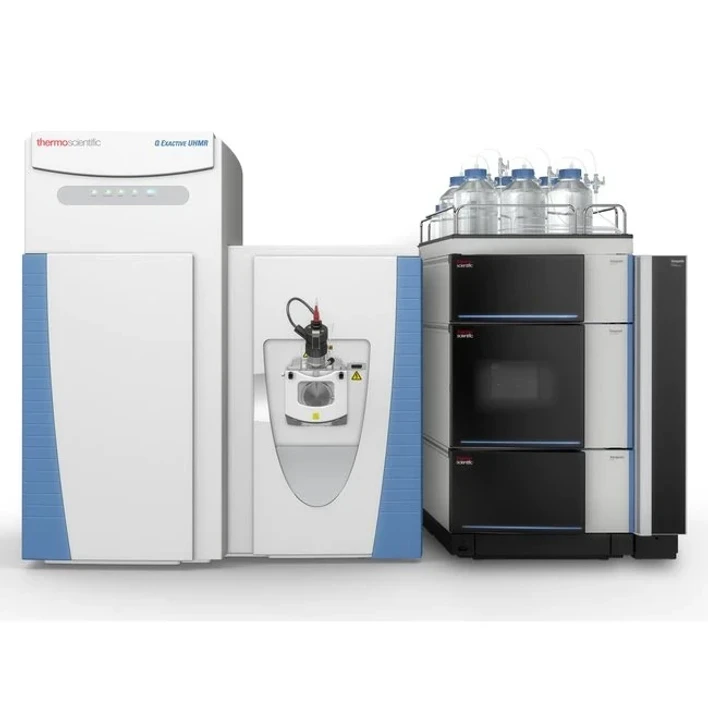 Thermo Scientific™ Q Exactive™ UHMR Hybrid Quadrupole Orbitrap™ Mass Spectrometer