Tu, 27.10.2026 15:00 CET
In this webinar, Jun Qu showcases his workflow for spatial proteomics using the Thermo Scientific OptiSpray ion source, cartridge column and the Thermo Scientific Orbitrap Astral MS.Go to the webinar
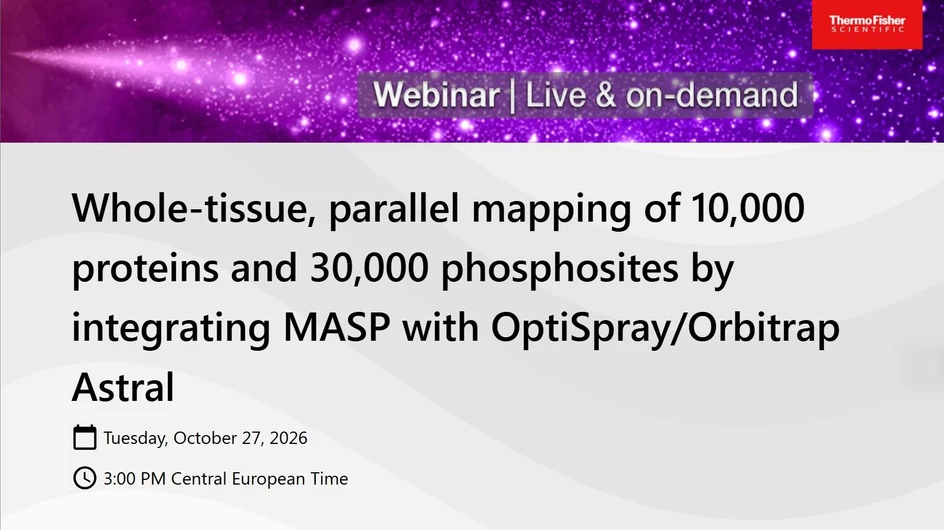
The investigation of the spatially organized regulation of protein phosphorylation across whole tissue is critical to facilitate an accurate, comprehensive understanding of disease mechanisms and therapeutic effects. Here, we introduce Phos-MASP (micro-scaffold-assisted spatial phosphoproteomics), the first-ever spatial phosphoproteomics method enabling reproducible, in-depth mapping of phosphosites at the whole-tissue level. Uniquely, Phos-MASP also allows parallel profiling of both the proteome and phosphoproteome from the same tissue.
Leveraging the robust, reproducible separation of OptiSpray and the ultra-sensitive quantification capabilities of the Orbitrap Astral, this workflow achieves exceptional mapping depth and accuracy. By applying Phos-MASP to an Alzheimer’s Disease model, we reliably mapped ~10,000 proteins and ~30,000 phosphosites, revealing disease-specific intra-brain distributions that offer unprecedented spatial insights into disease mechanisms and therapeutic interventions.
If you cannot attend the live webinar, please register anyway to automatically receive the link to the recording.
Presenter: Jun Qu (Professor, Dept of Pharmaceutical Sciences, University at Buffalo, The State University of New York (SUNY))
Jun Qu is a professor in the Department of Pharmaceutical Sciences of SUNY-Buffalo and the director of the Proteomics and Pharmaceutical Analysis Group in the New York Center of Excellence in Bioinformatics and Life Sciences. His research is directed toward the innovations in both global and targeted analysis of proteins, in the context of pharmaceutical and clinical investigations. His group is one of the international leaders in LC-MS-based study of biotherapeutics and drug targets in pre-clinical models, as well as MS1-based, large-cohort quantitative proteomics. He has >160 peer reviewed publications and >80 grants funded as PI or co-I.