We, 25.11.2026 | Original article from: LabRulezGCMS Library
This week we bring you brochure by Agilent Technologies, application notes by LECO, Shimadzu and technical note by Thermo Fisher Scientific!News from LabRulezGCMS Library - Week 48, 2026
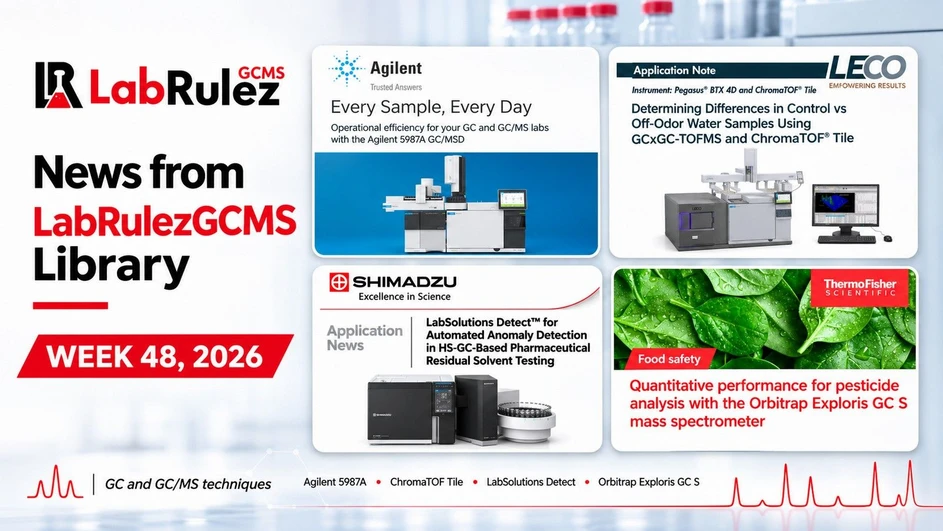
LabRulez / AI: News from LabRulezGCMS Library - Week 48, 2026
Our Library never stops expanding. What are the most recent contributions to LabRulezGCMS Library in the week of 23rd November 2026? Check out new documents from the field of the gas phase, especially GC and GC/MS techniques!
👉 SEARCH THE LARGEST REPOSITORY OF DOCUMENTS ABOUT GCMS AND RELATED TECHNIQUES
👉 Need info about different analytical techniques? Peek into LabRulezLCMS or LabRulezICPMS libraries.
1. Agilent Technologies: Every Sample, Every Day
Operational efficiency for your GC and GC/MS labs with the Agilent 5987A GC/MSD
- Brochures and specifications
- Full PDF for download
The Agilent 5987A GC/MSD is a next-generation gas chromatography–mass spectrometry system designed to improve analytical performance, laboratory productivity, and operational efficiency. Its new Extended Range (ER) detector provides a tenfold improvement in dynamic range and extends electron multiplier lifetime by up to three times. With scanning speeds reaching 25,000 u/s and acquisition rates of approximately 54 spectra/s, the system supports fast chromatography, narrow peak detection, and reliable spectral library matching. A gold-plated monolithic quartz quadrupole provides long-term tuning stability, while a versatile portfolio of ion sources, including HES 2.0, Inert Plus EI, CI, and HydroInert, supports applications ranging from routine testing to ultratrace analysis.
The system incorporates Agilent GC Assist, an intelligent monitoring and diagnostic platform that provides real-time information about instrument health, supports preventive maintenance, and guides users through troubleshooting procedures. Features such as automated peak evaluation and Retention Time Locking (RTL) help maintain analytical consistency and simplify method transfer between instruments. MassHunter Acquisition 14.0 further enhances productivity through automated method optimization, Dynamic SIM (dSIM), and simultaneous dSIM/Scan acquisition. These functions improve sensitivity, optimize data collection, and enable both targeted quantification and retrospective compound identification. MassHunter Unknowns Analysis additionally supports automated spectral deconvolution and library searching.
Several technologies are designed to minimize maintenance requirements and instrument downtime. QuickVent enables faster, controlled venting of the vacuum system, reducing the time required for ion source maintenance and filament replacement. JetClean self-cleaning technology can reduce manual ion source cleaning frequency by 80% or more, while the oil-free IDP-4 dry scroll pump provides efficient vacuum generation with a smaller footprint and simplified servicing. Agilent Capillary Flow Technology (CFT) also supports reliable fluidic connections and column backflush, helping remove unwanted high-boiling compounds, shorten analytical cycles, and reduce column maintenance.
Sustainability is another important aspect of the 5987A GC/MSD platform. The HydroInert ion source supports the use of hydrogen as an alternative to helium while minimizing unwanted chemical reactions, sensitivity losses, and spectral distortions. A helium conservation module can extend helium cylinder lifetime by up to 30 times by switching to an alternative gas when the GC is idle. The system has also received the My Green Lab ACT Ecolabel, providing independently assessed environmental information. Together with Agilent J&W GC columns, inert flow path components, and CrossLab services for installation, training, maintenance, and method optimization, the 5987A offers an integrated solution for reliable and efficient GC/MS laboratory workflows.
2. LECO: Determining Differences in Control vs Off-Odor Water ® Samples Using GCxGC-TOFMS and ChromaTOF Tile
- Application note
- Full PDF for download
Across many markets and types of samples, a common analytical goal can be to distinguish one sample from another and to determine the specific chemical differences between the samples. This type of information can be relevant for a wide range of purposes and can help with characterization of the samples as well as many different problem-solving tasks. Generally, a combination of analytical hardware and software tools are useful to achieve this type of non-targeted comparison.
GCxGC-TOFMS is a great choice for the hardware as it provides exceptional analyte coverage for the volatile and semi-volatile components of a sample of interest. Using two dimensions of separation with GCxGC improves the peak capacity and, therefore, more chemical detail can often be uncovered than with a standard GC separation. TOFMS provides sensitive detection with full m/z range non-skewed spectral data that can be readily searched against mass spectral databases. This combination leads to detailed chemical data about a sample. ChromaTOF Tile is a useful software tool for quickly highlighting differences within this detailed GCxGC-TOFMS data. With ChromaTOF Tile, all m/z of the raw data are compared with chromatographic tile grids to highlight the retention windows and masses of sample differences. This rapidly points to the most interesting regions of the data, which can then be explored to determine the associated chemical features related to these differences.
In this work, GCxGC-TOFMS hardware and ChromaTOF Tile software were used to investigate an off-odor water sample compared to a control water sample. Both samples were analyzed with HS-SPME and GCxGC-TOFMS, and the associated data were compared with the fold-change option in ChromaTOF Tile. Analytes higher in the off-odor sample were efficiently determined, leading to a list of analytes that may be associated with the off-odor.
Experimental
Two water samples, one control and one with an odor, were analyzed with HS-SPME and GCxGC-TOFMS. For each sample, 2.0 mL were added to a 20 mL SPME vial. Each vial was incubated for 2 min at 40 °C and extracted with the tri-phase fiber (PDMS, DVB, C-WR) for 5 min at the same temperature. The samples were then analyzed by GCxGC-TOFMS with LECO’s Pegasus BTX 4D. An alkane standard was also analyzed with the same methods for retention index (RI) determinations. The samples were compared with ChromaTOF Tile using the fold-change comparison mode.
- Auto Sampler: LECO L-PAL 3 Autosampler
- Gas Chromatograph: LECO QuadJet™ GCxGC
- Columns:
- Rxi-5ms, 30 m x 0.25 mm i.d. x 0.25 µm coating
- Rxi-17Sil ms, 0.6 m x 0.25 mm i.d. x 0.25 µm coating
- Mass Spectrometer: LECO Pegasus BTX
Conclusion
In this work, LECO’s Pegasus BTX 4D GCxGC-TOFMS and ChromaTOF Tile software were used to efficiently find chemical differences between a control water and off-odor water sample. GCxGC-TOFMS provided an increased peak capacity and sensitive detection for the volatile and semi-volatile components of the water samples. ChromaTOF Tile software streamlined the comparison of the data to quickly highlight differences. Several specific analytes were determined and tentatively identified. While this application specifically focused on comparing a control and off-odor sample, the analytical tools and workflow are applicable for the direct comparison of any two samples for other types of non-targeted comparison work.
3. Shimadzu: LabSolutions Detect for Automated Anomaly Detection in HS-GC-Based Pharmaceutical Residual Solvent Testing
- Application note
- Full PDF for download
User Benefits
- LabSolutions Detect anomalous peak detection functionality improves the reliability and productivity of quality control operations.
- Reporting functionality and compatibility with LabSolutions DB/CS help maintain data integrity and ensure analytical data can be recorded reliably.
Pharmaceutical quality control is critically important for protecting human health and safety. For organic solvents that may adversely affect human health, pharmacopeias, such as the USP, EP, and JP, specify limits for residual solvent levels in pharmaceutical products, which requires stringent controls. In addition to controlling the content of known regulated substances, pharmaceutical quality controls increasingly require monitoring unexpected or unknown components and assessing their concentration levels. However, in quality control operations that involve analyzing large numbers of samples using the same test method, it can be difficult and time-consuming to inspect and manage vast amounts of data without overlooking anomalousresults.
LabSolutions Detect is software that can automatically detect anomalies in sample data based on reference data. It can analyze large volumes of data in a single operation, providing efficient and robustsupport for quality control operations. This Application News article describes an example of using LabSolutions Detect for data obtained using headspace gas chromatography (Headspace sampler HS-20 NX and gas chromatograph Nexis GC-2060), a method used for pharmaceutical residualsolvent testing.
LabSolutions Detect Software Features
LabSolutions Detect visualizes differences between accumulated reference data and target data acquired during routine testing and provides the following three functions for reviewing analytical results: (1) comparison of chromatogram shapes using automatic retention-time correction, (2) detection of potential impurities common to multiple data sets by identifying similar peaks, and (3) centralized management of difference-analysisresults and report generation.
Conclusion
LabSolutions Detect was used to automate anomaly detection in data from HS-GC analysis of residual solvents in pharmaceuticals. By automating data analysis, LabSolutions Detect streamlines the manual visual review process traditionally required for rigorous pharmaceutical quality control, even for large data sets. Furthermore, its reporting functionality and compatibility with LabSolutions DB/CS enable the reliable recording and reporting of results while supporting compliance with data integrity requirements.
4. Thermo Fisher Scientific: Quantitative performance for pesticide analysis with the Orbitrap Exploris GC S mass spectrometer
- Technical note
- Full PDF for download
Pesticide residue analysis in food is essential to ensure consumer safety and regulatory compliance. However, this analysis is particularly challenging in complex food matrices, such as highly pigmented vegetables, where co-extracted matrix components can lead to interferences and ion suppression. In addition, evolving regulations and expanding analyte lists require analytical methods that not only achieve low detection limits but also provide high selectivity and flexibility to address both known and emerging contaminants.
Traditionally, gas chromatography coupled to tandem mass spectrometry (GC-MS/MS) has been widely used for targeted pesticide analysis due to its excellent sensitivity and quantitative performance. However, these methods rely on predefined SRM transitions measured at unit mass resolution, limiting their ability to resolve coeluting or isobaric compounds and restricting the scope to known analytes unless methods are re-optimized. In contrast, the Orbitrap Exploris GC S mass spectrometer leverages high-resolution accurate-mass (HRAM) full-scan acquisition, enabling simultaneous quantitation and screening within a single analysis. The combination of high resolving power (up to 60,000 FWHM at m/z 200) and sub-ppm mass accuracy allows confident discrimination of coeluting and isobaric compounds in complex matrices, improving selectivity and reducing false positives/negatives.
Furthermore, full-scan HRAM data enables retrospective data analysis, allowing laboratories to reprocess datasets for additional or emerging compounds without re-injecting samples—an important advantage in dynamic regulatory environments and for comprehensive food safety monitoring. The Orbitrap Exploris GC S MS is equipped with the Thermo Scientific™ NeverVent™ Advanced Electron Ionization (NVAEI) Source, which enhances ionization efficiency and ion transmission resulting in improved sensitivity, robustness, and instrument uptime, supporting high-throughput routine analysis while maintaining consistent performance across complex matrices.
In this study, the performance of the Orbitrap Exploris GC S MS was evaluated for the quantitative analysis of pesticides in highly pigmented matrices such as spinach, demonstrating its capability to deliver sensitive, selective, and flexible analysis in challenging food safety applications.
Experimental
Instrumentation
In the experiments described here, an Orbitrap Exploris GC S MS was coupled to a Thermo Scientific™ TRACE™ 1610 GC, equipped with a Thermo Scientific™ iConnect™ Programmed Temperature Vaporizing (iConnect-PTV) Injector, and a Thermo Scientific™ AI/AS 1610 Liquid Autosampler. Chromatographic separation was achieved using a Thermo Scientific™ TraceGOLD™ TG-5SILMS Analytical Column, 30 m × 0.25 mm i.d. × 0.25 µm with 5 m integrated SafeGuard column (Cat. No. 26096-1425). The Orbitrap Exploris GC S MS was operated using the optimized emission current of 25 µA and electron energy of 50 eV, and applying the settings in the autotune procedure. Data were acquired in full scan mode (m/z range: 50–600) at 60,000 resolving power (at m/z 200 FWHM). A complete list of instrument settings is reported Appendix Table A1. Linear range, as well as response factors (RF) and ion ratios (IR) across the entire calibration curve, calculated amounts versus expected and percentage recovery were evaluated by spiking purified QuEChERS extracts of spinach matrix with a mixture of 185 pesticides.
Data acquisition, processing and reporting
Data was acquired, processed, and reported using the Thermo Scientific™ Chromeleon™ Chromatography Data System (CDS), which provides integrated instrument control, automated workflows, an intuitive interface for data analysis, customizable reporting, and compliant data management in accordance with FDA 21 CFR Part 11 and European Commission (EU) Annex 11. Its advanced reprocessing capability and Environmental Analysis Extension Pack streamline sequence setup, data review, and reporting, offering the possibility to easily flag and check compliance with the current regulations.
Conclusion
The results obtained in these experiments demonstrate that the Orbitrap Exploris GC S MS equipped with the NeverVent AEI ion source represents a reliable tool for analysis of pesticides in complex matrices:
- The Orbitrap Exploris GC S MS offers a simple approach for the multiresidue analysis of pesticides using full-scan acquisition combined with high mass resolving power.
- Confident identification of compounds can be easily achieved through (i) high spectral quality, allowing for high Match and R match search scores for compound identification by comparison with spectral libraries; (ii) high spectral fidelity, ensuring consistent spectra independent of concentration; and (iii) consistent mass accuracy across the entire concentration range, with average mass error maintained <3 ppm.
- Sensitive and robust analytical performance was demonstrated with R2 >0.993, RF %RSD across the entire calibration curve <20, and IRs within ±30% of the average of calibration standards.
- System suitability for quantitative analysis was demonstrated with calculated amounts within 20% the expected values and percentage recovery (%) ranging from 96 to 104.
- The NeverVent AEI ion source is designed for ultra-trace concentration detection, making it ideal for challenging applications ensuring detection limits at levels at or below 0.5 µg/kg for most of the investigated pesticides.