We, 23.9.2026 | Original article from: LabRulezGCMS Library
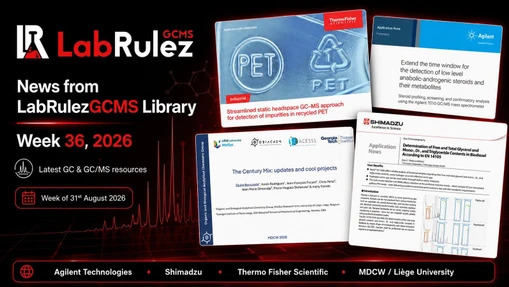
This week we bring you application notes by Agilent Technologies, LECO and Thermo Fisher Scientific and poster by Shimadzu / AOAC!News from LabRulezGCMS Library - Week 39, 2026
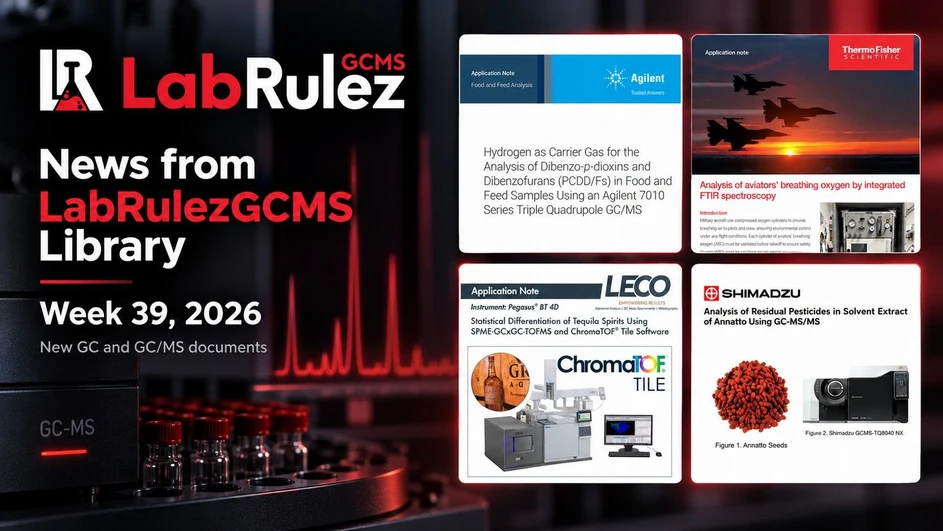
LabRulez / AI: News from LabRulezGCMS Library - Week 39, 2026
Our Library never stops expanding. What are the most recent contributions to LabRulezGCMS Library in the week of 21st September 2026? Check out new documents from the field of the gas phase, especially GC and GC/MS techniques!
👉 SEARCH THE LARGEST REPOSITORY OF DOCUMENTS ABOUT GCMS AND RELATED TECHNIQUES
👉 Need info about different analytical techniques? Peek into LabRulezLCMS or LabRulezICPMS libraries.
This week we bring you application notes by Agilent Technologies, LECO and Thermo Fisher Scientific and poster by Shimadzu / AOAC!
1. Agilent Technologies: Hydrogen as Carrier Gas for the Analysis of Dibenzo-p-dioxins and Dibenzofurans (PCDD/Fs) in Food and Feed Samples Using an Agilent 7010 Series Triple Quadrupole GC/MS
- Application note
- Full PDF for download
Polychlorinated dibenzo‑p‑dioxins (PCDDs) and polychlorinated dibenzofurans (PCDFs), together with dioxin‑like (DL, including non-ortho (NO) and mono-ortho (MO) substituted) and non‑dioxin‑like (NDL) PCBs, are persistent organic pollutants of major toxicological concern that can bioaccumulate in the food chain and are regulated in the European Union through maximum levels in food under Regulation (EU) 2023/915, supported by official sampling and analytical requirements under Regulation (EU) 2017/644, with corresponding control provisions for feed under Regulation (EU) 709/2014. Based on legislation, the confirmation and quantitation of dioxins, furans, and dioxin-like polychlorinated biphenyls (dl-PCB) in food/feed samples had to be accomplished by isotope dilution capillary gas chromatography/high-resolution mass spectrometry (GC/HRMS). Since triple quadrupole GC/MS shows similar performance to high-resolution mass spectrometry (GC/HRMS) revisions have been initiated and accepted to allow GC/MS/MS as an adequate confirmatory method in an amendment to EU legislation 589/2014 and 709/2014 for checking compliance with maximum levels (ML) of PCDD/Fs in food and feed stuff.5 On this basis, and with novel state-of-the-art technology, going one step further—converting the carrier gas from helium to hydrogen in ultra-trace level analysis—appears to be the next logical step.
The main objective of this study was to convert a PCDD/F analysis method for food and feed samples from helium to hydrogen as carrier gas without compromising analytical performance and shortening the analysis time. Therefore, in this study: (i) the 7000 series and 7010 series triple quadrupole systems were compared under helium conditions as a baseline study to specifically investigate the benefits for PCDD/F analysis generated by the 7010 technique, (ii) the PCDD/F method was converted to hydrogen as carrier gas, and system performance was observed by assessing initial stability, sensitivity, separation efficiency, mass spectra, and LOQs, (iii) the PCDD/F method was optimized for hydrogen application by developing novel chromatographic conditions (column and flow) and evaluating and verifying the system performance, (iv) method performance criteria were applied to food/feed samples as part of the validation (matrix effects), and (v) the method was applied in routine analysis for six months to assess robustness and stability of the system.
Experimental
Instruments and analysis All investigations were carried out using an Agilent 7890B gas chromatograph coupled to an Agilent 7000C triple quadrupole MS and an Agilent 7010 series triple quadrupole MS, equipped with a Gerstel MPS auto sampler system and a cold injection system (CIS) with programmed temperature vaporization (PTV). The comparison of both MS/MS systems (7000C versus 7010) for PCDD/Fs was performed under helium conditions. It should be noted that although the same 7890 B GC was used throughout, the 7000C MS was converted (upgraded) to the 7010 series during the study. The 7010 series triple quadrupole system was used for measurements applying hydrogen as carrier gas. Measurements were carried out in Multiple Reaction Monitoring (MRM) mode. Two precursor ions and their respective product ions were monitored.
Results and discussion
Baseline study: 7000C versus 7010 series triple quadrupole technique
The 7010 series triple quadrupole GC/MS system operating in MRM mode (MS/MS) offers lower detection limits and higher sensitivity due to an increased ionization efficiency enabled with the HES source. Higher signals were achieved with the 7010 series GC/TQ when compared to the 7000 series GC/TQ resulting in improved ion ratios providing better qualitative information. Since this was a mandatory requirement for the application of hydrogen as carrier gas in ultra-trace analysis of PCDD/Fs in food and feed samples, the performance of the 7000 series and 7010 series GC/TQs were first compared under helium conditions. Linearity, sensitivity, precision, repeatability, and LOQs for the existing analytical helium method were assessed in order to evaluate the quantitative improvement of the 7010's detector for dioxin and furan analysis (Table 4).
Excellent linearity was observed with both systems, with R2 values > 0.995 for all analytes. The relative standard deviation of the calibration procedure was found to be 1.1–3.1% and 2.4–5.9% for the 7010 and 7000 systems, respectively. The residues of the model linear function were more stable within the 13-point calibration curve for the 7010 system; while stability (low residues) was reached down to the lowest calibration point of 1.73 fg/µL for the 2,3,7,8-TetraCDD, the 7000C system showed higher residues at the two lowest calibration points and was therefore only stable to 6.33 fg/µL (2,3,7,8-TetraCDD). The RRFs (relative response factors) of the calibration for all dioxin and furan compounds were also found to be more stable within the calibration of the 7010 system and ranged from 14–23% and 18–30% for the 7010 and 7000C systems, respectively.
The sensitivity of both triple quadrupole GC/MS systems was assessed based on the signal-to-noise ratio of the three lowest calibration points (1.73, 2.71, and 6.33 fg/µL). The 7000 series detector exhibited a clearly identifiable signal, different from noise, at the third lowest calibration point (6.33 fg/µL, S/N ratio = 3.4 for 2,3,7,8-TetraCDD). At the lowest and second lowest calibration points, no peak was detectable. In contrast, a S/N ratio of 13 (2,3,7,8-TetraCDD) was found at the lowest calibration point (1.73 fg/µL) using the 7010 series GC/TQ.
The TMS with a mean concentration of the calibration was used to evaluate the measurement precision. The TMS was consecutively injected 10 times (n = 10) and the normalized precision, based on area ratios of native to 13C12-labeled compounds, was consistent across all congeners on both systems, with the same trend observed for absolute precision (peak ares). The RSD of the normalized precision was ~2% higher for the 7000 series MS/MS and vice versa for the absolute precision of the 7010 series MS/MS. The RSD of repeatability (pg absolute) ranged from 0.5–2.5% for the 7010 series detector.
Conclusion
This comparison of the 7000 and 7010 series triple quadrupole systems successfully demonstrates that all parameters tested showed an improvement for the analysis of polychlorinated dibenzo-p-dioxins (PCDDs) and polychlorinated dibenzofurans (PCDFs). The positive outcome of the baseline study in terms of an obvious sensitivity benefit was a fundamental requirement to proceed with hydrogen as carrier gas. Since enhanced detection of ions is facilitated with the 7010 series GC/TQ, its potential for cost and resource saving application may not solely result from the use of hydrogen as carrier gas. If appropriate conditions are met, the 7010 series GC/TQ equipped with the HES source allows for possible redesign and acceleration of the analytical process as well as improved analytical quality.
Overall, it was straightforward to convert the existing PCDD/F helium method for food and feed samples to hydrogen conditions, provided that all analytical needs were known, the system was given enough time for rearrangement, and familiarization with the best practices for using hydrogen as carrier gas was completed. The analytical drawbacks that may need to be faced when changing to hydrogen, e.g., reduced signal-to-noise ratio, are to a certain extent predictable. In this study, we successfully proved that hydrogen is applicable at ultra-trace levels provided the known decrease in sensitivity can be compensated for. Other compounds of interest may exhibit other unique challenges. For example, their mass spectra/fragmentation pattern might be different because they react with hydrogen. With proper consideration of these analytical factors, hydrogen may be applicable not only for PCDD/Fs but also for a range of other organic compounds.
For PCDD/F analysis, the use of hydrogen as carrier gas offers several advantages over helium if the GC/TQ instrumentation is capable of detection limits around 10 fg on column (using He) or better, as is the case for the 7010 series GC/TQ. In addition to improved analytical quality at comparable or slightly better separation, there is a high potential for saving analytical runtime as well as analytical costs due to lower purchase price of hydrogen, especially considering possible helium shortages in the future. In any case, the decision to use hydrogen should be based on full consideration of the possible implications on GC and MS performance. Also, reactions such as dechlorination cannot be excluded, even if the presented application appears to produce those effects to an insignificant degree.
2. LECO: Statistical Differentiation of Tequila Spirits Using ® SPME-GCxGC-TOFMS and ChromaTOF Tile Software
- Application note
- Full PDF for download
Tequila, one of Mexico's most iconic distilled spirits, is produced by fermenting and distilling sugars obtained from Agave tequilana Weber var. azul. Current regulations permit producers to use a minimum of 51% agave-derived sugars and up to 49% from other sources, while "100% agave" tequila must be made exclusively from agave sugars. Its designation of origin is legally protected, restricting production to specific regions of Mexico, including Jalisco, Nayarit, Tamaulipas, Michoacán, and Guanajuato.
The production process consists of several stages. The first is harvesting the agave stem and removing its leaves, followed by cooking to hydrolyze inulin into fermentable sugars. Fermentation is then carried out, typically by Saccharomyces cerevisiae, converting these sugars into alcohols. A double distillation and dilution step produces a spirit with an alcohol content of approximately 40–50%. Tequilas are classified according to their maturation stage: blanco (silver or white) are bottled immediately after distillation; joven, or gold, produced by blending tequila blanco with aged tequilas or adding caramel to color them golden amber; reposado (less aged) is aged in oak barrels for at least two months; añejo (aged) has matured for a minimum of one year; and extra-añejo (extra aged) has been aged for more than three years. These production differences play a key role in the wide variability of flavors and aromas that define tequila. Other factors, including geographical region of production, can also contribute to the variability of different tequila products.
This application note presents the analytical workflow for evaluating ten different commercial tequila samples using headspace solid-phase microextraction (HS-SPME) combined with a comprehensive two-dimensional gas chromatography (GCxGC) system coupled to time-of-flight mass spectrometry (TOFMS). The LECO Pegasus BT 4D GCxGC-TOFMS system delivers excellent separation capacity, wide dynamic range, and high sensitivity, enabling the detection of aroma-relevant compounds. Data processing was carried out with ChromaTOF Tile Software, which supports mass spectral (MS) and retention index (RI) library searches and generates a composite feature table for the entire sample set, facilitating the identification of trends, patterns, and significant differences among the tequilas.
Experimental
- SPME: 120 um coated DVB/CAR/PDMS
- GCxGC: Agilent 8890 with LECO Cryogen Free QuadJet Thermal Modulator
- TOFMS: LECO Pegasus BT
Conclusion
GCxGC-TOFMS combined with ChromaTOF Tile was used to analyze the aroma profile of different commercial tequila in a time-effective manner. The analytical workflow, based on LECO's Pegasus BT 4D GCxGC-TOFMS technology, generates rich, high-quality data. Compounds of interest were identified based on the comparison of mass spectral information within ChromaTOF Tile, using NIST MS libraries and RI calculations. Through the PCA analysis, it was possible to find geographical discrimination between the set of samples as well as compounds that can be used as aging markers in these beverages. This study shows important implications for beverage production, quality monitoring, and reformulation, since better knowledge of the volatile compounds present in tequila aroma were obtained.
3. Shimadzu / AOAC: Analysis of Residual Pesticides in Solvent Extract of Annatto Using GC-MS/MS
- Poster
- Full PDF for download
Annatto is an orange-red condiment and food colorant derived from the seeds of the achiote tree (Bixa Orellana) (Figure 1). It is often used to impart a yellow to red-orange color to foods, but sometimes also for its flavor and aroma. Similar effects can be obtained by extracting some of the color and flavor principles from the seeds, which are then added to the food. Annatto and its extracts are now widely used in an artisanal or industrial scale as a coloring agent in many processed food products, such as cheeses, butter, baked goods, potatoes, snack foods, breakfast cereals, smoked fish etc. In these uses, Annatto is a natural alternative to synthetic food coloring compounds.
Owing to its large culinary uses and other diverse applications, use of chemical pesticides for its production in large quantities is imperative. Dye extraction process may result in concentration of pesticides and in turn contribute to adverse impact on human health when incorporated in various preparations. Hence quantitation of residual pesticides in Annatto extract becomes very important. As the oleoresin is a complex matrix, it is required to develop a rugged, sensitive and efficient method for extraction of residual pesticide and its analysis.
This study reports a highly sensitive method for simultaneous quantification of multiple pesticides in highly pigmented complex matrix of Annatto using modified QuEChERS[1] with triple quadrupole gas chromatography (GC-MS/MS) system.
Analytical conditions
- Instrument: GCMS-TQ8040 NX
- Auto-injector: AOC-20i
- Column: SH-I-5Sil MS (30 m × 0.25 mm I.D., df = 0.25 μm)
- Liner: Restek ® Topaz Splitless Liner, Single Taper w/wool
Conclusion
- This study shows that the modified QuEChERS method combined with GC-MS/MS system is a reliable and efficient tool to quantify residual pesticides in Annatto extract sample.
- Although Annatto extract is a highly pigmented complex matrix, the modified QuEChERS method significantly reduces interference.
- Also, extremely sensitive Shimadzu GC-MS/MS allows trace level detection even after multifold dilution of sample. This helps in reducing contamination and enhancing ruggedness resulting in reproducible detection of analytes.
4. Thermo Fisher Scientific: Analysis of aviators’ breathing oxygen by integrated FTIR spectroscopy
- Application note
- Full PDF for download
Military aircraft use compressed oxygen cylinders to provide breathing air to pilots and crew, ensuring environmental control under any flight conditions. Each cylinder of aviators’ breathing oxygen (ABO) must be validated before takeoff to ensure safety. Validation involves analyzing both oxygen and contaminant concentrations, and an incorrect assessment of either can unnecessarily ground flights. The oxygen production and distribution process must be carefully controlled to maintain high-purity O₂, free from contaminants like methane (CH₄) or acetylene (C₂H₂), which pose combustion or explosion risks. Other common contaminants include chlorofluorocarbons and hydrochlorofluorocarbons (CFC/HCFC, also known as Freons) used as solvents or refrigerants.
Fourier transform infrared (FTIR) spectroscopy is a powerful technique for analyzing gas sample purity in industrial or environmental applications. Many gases have unique infrared signatures, allowing FTIR spectroscopy to analyze multiple compounds in a single analysis. FTIR analysis is fast, precise, and requires minimal sample handling, making it a preferred solution over other analytical techniques. Thermo Fisher Scientific’s FTIR capabilities make it an excellent choice for analyzing ABO for contaminants.
Deployment
The Thermo Scientific™ Antaris™ FTIR Gas Conditioning and Analysis System is designed for immediate deployment. It ships in a custom-designed ruggedized case with racks for the FTIR gas analyzer and an optional O₂ analyzer. All necessary sample handling regulators, manifolds, and gauges are integrated into the unit. Startup requires only removing the case panels and attaching purge lines. This integrated design simplifies shipment and deployment, enabling rapid and reliable measurements.