We, 26.8.2026 | Original article from: LabRulezLCMS Library
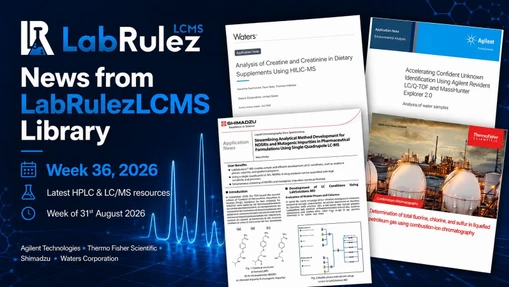
This week we bring you application notes by Agilent Technologies, Thermo Fisher Scientific, Shimadzu and Waters Corporation!News from LabRulezLCMS Library - Week 35, 2026
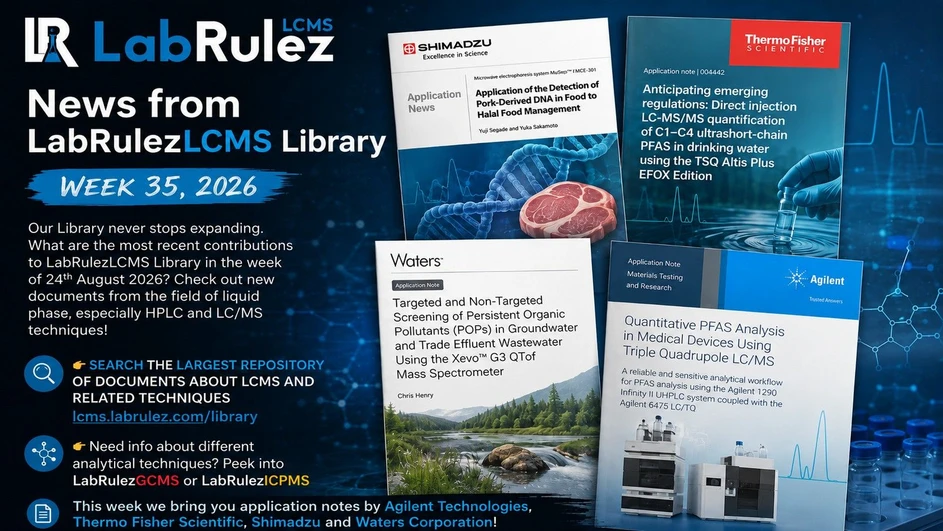
LabRulez / AI: News from LabRulezLCMS Library - Week 35, 2026
Our Library never stops expanding. What are the most recent contributions to LabRulezLCMS Library in the week of 24th August 2026? Check out new documents from the field of liquid phase, especially HPLC and LC/MS techniques!
👉 SEARCH THE LARGEST REPOSITORY OF DOCUMENTS ABOUT LCMS AND RELATED TECHNIQUES
👉 Need info about different analytical techniques? Peek into LabRulezGCMS or LabRulezICPMS libraries.
This week we bring you application notes by Agilent Technologies, Thermo Fisher Scientific, Shimadzu and Waters Corporation!
1. Agilent Technologies: Quantitative PFAS Analysis in Medical Devices Using Triple Quadrupole LC/MS
A reliable and sensitive analytical workflow for PFAS analysis using the Agilent 1290 Infinity III UHPLC system coupled with the Agilent 6475 LC/TQ
- Application note
- Full PDF for download
Per- and polyfluoroalkyl substances (PFAS) are widely used in medical device materials due to their exceptional chemical stability, low friction, and biocompatibility. These intrinsic properties are essential for ensuring optimal performance requirements of medical device materials used in applications, including catheters, blood collection devices, contact lenses, and implantable cardiovascular systems.
Regulatory agencies worldwide are intensifying oversight of PFAS in medical devices, driven by increasing concerns over environmental persistence, potential human health impacts, and the need for improved transparency and control of PFAS use throughout the medical device life cycle. The U.S. Food and Drug Administration (FDA) states that PFAS in medical devices are subject to ongoing scientific review and regulatory evaluation, reflecting heightened oversight and scrutiny compared to previous decades.1 North American Science Associates (NAMSA), a global Contract Research Organization focusing on medical devices, directly addresses the global regulatory pressure affecting medical device manufacturers, triggering increased monitoring, testing, and regulatory engagement.2 Meanwhile, the Advanced Medical Technology Association (AdvaMed), the world’s largest trade association for medical technology companies, highlights expanding regulatory requirements, reporting obligations and scrutiny related to PFAS use in medical devices and packaging across global markets.3 Under the EU REACH PFAS restriction initiative (REACH 2.0), medical device applications are included within the scope of a class‑based PFAS regulatory framework. While immediate bans are not foreseen for critical medical uses, regulatory oversight is intensifying, with time‑limited derogations anticipated where suitable alternatives are unavailable, alongside additional controls required to minimize emissions and ensure compliance.4,5
So, there is an urgent need for reliable, sensitive analytical methods capable of monitoring PFAS throughout the entire medical device life cycle, from raw material qualification through finished product evaluation.
This application note presents a comprehensive analytical workflow for the screening and quantification of 73 native PFAS in medical device materials using ultrahigh‑performance liquid chromatography (UHPLC) coupled with triple quadrupole mass spectrometry (LC/MS/MS). The workflow leverages the Agilent 1290 Infinity III UHPLC system for PFAS analysis, equipped with the purpose-built Agilent 1290 Infinity III High-Speed Pump and Agilent 1290 Infinity III Hybrid Multisampler, and coupled to the Agilent 6475 LC/TQ. Together, this integrated solution delivers enhanced PFAS readiness and substantially reduced background contamination, and supports sensitive and reliable PFAS monitoring in medical device research and analytical method development.
Experimental
Instrumentation
Chromatographic separation was achieved on an Agilent ZORBAX RRHD Eclipse Plus C18 column (2.1 × 100 mm, 1.8 µm) installed on an Agilent 1290 Infinity III UHPLC system configured for PFAS analysis. This UHPLC system is purpose built to aggressively reduce fluorinated materials in the flow path, minimizing PFAS background contribution. The system was equipped with a 1290 Infinity III Hybrid Multisampler, enabling large-volume Feed Injection of high-organic samples. This capability allowed direct injection of methanolic extracts while maintaining excellent peak shape and sensitivity. Analyses were performed using the Agilent 6475 LC/TQ operated in negative electrospray ionization (ESI) mode.
Conclusion
This application note demonstrates a comprehensive analytical workflow for quantitative PFAS analysis in medical device materials using an Agilent 1290 Infinity III UHPLC system for PFAS analysis coupled with an Agilent 6475 LC/TQ. The purpose-built system, featuring an Agilent 1290 Infinity III High-Speed Pump and 1290 Infinity III Hybrid Multisampler, achieved ultralow background contamination and exceptional sensitivity for 73 native PFAS analytes. Method reproducibility was excellent, with all analytes showing %RSD values below 20% across all QC levels, providing reliable data for regulatory compliance in medical device manufacturing. This integrated approach combines advanced instrumentation with optimized method parameters to establish a robust platform for PFAS monitoring throughout the medical device life cycle, supporting manufacturers in meeting evolving regulatory requirements while ensuring product safety and environmental stewardship.
2. Shimadzu: Application of the Detection of Pork-Derived DNA in Food to Halal Food Management
- Application note
- Full PDF for download
User Benefits
- Fingerprinting analysis allows for the objective identification of the animal species in meat products.
- It can detect even a 0.0001% admixture of pork.
- It is a useful tool for quality control and certification.
From the perspective of ensuring food safety and traceability, the importance of verifying ingredients in food and identifying animal species is increasing. In processed meat products, in particular, verifying the species of the raw meat and detecting the contamination of meat from other species are critical quality control issues. Additionally, for foods subject to religious restrictions, such as halal foods, strict control over the contamination of pork-derived ingredientsisrequired.
The PCR method, which utilizes DNA analysis, is widely used for animal species identification. Although agarose gel electrophoresis is commonly used to visualize PCR products, this method requires visual assessment of the presence or absence of bands, presenting challenges in terms of subjectivity, reproducibility, and data recording.
The MultiNA II microchip electrophoresis system automates the separation and detection of DNA fragments and allows results to be obtained as digital data. Also, the fingerprinting analysis function built into the analysis software enables automatic identification of DNA band patterns.
In this application, we investigated a method for identifying animal species in food using the MultiNA II. Specifically, we performed animal species identification on halal-certified foods and general processed foods, and evaluated detection sensitivity using modelsamples containing pork contamination.
Conclusions
We investigated a method for identifying animal species in food using MultiNA II.
In this method, PCR products are analyzed using microchip electrophoresis, and by further applying fingerprinting analysis, it has become possible to perform objective identification that does not rely on visual assessment using conventional agarose gel electrophoresis. Furthermore, since the results can be saved as digital data, this contributes to improved reproducibility and record-keeping.
In species identification tests targeting halal foods and processed foods, we were able to clearly detect the DNA of each animal species. Furthermore, in contamination tests, we confirmed that this highly sensitive analysis method is capable of detecting pork contamination as low as 0.0001%. This method is expected to be useful in the field of food analysis for applications such as raw material verification, quality control, and halal food inspection.
3. Thermo Fisher Scientific: Anticipating emerging regulations: Direct injection LC-MS/MS quantification of C1–C4 ultrashort-chain PFAS in drinking water using the TSQ Altis Plus EFOX Edition
- Application note
- Full PDF for download
Application benefits
- Robust quantification of ultrashort-chain PFAS at low ng/L levels
- Improved retention and separation of highly polar PFAS such as TFA
- Dual-CID fragmentation capability enabling MS3-like selectivity through sequential ion activation and dissociation
- Compatible with routine drinking water monitoring workflows
- Ready for future regulatory expansion
Ultrashort-chain PFAS—emerging regulatory and analytical priorities
Per- and polyfluoroalkyl substances (PFAS) are a large group of persistent anthropogenic chemicals that have been widely used in industrial and consumer applications for decades. Growing awareness of their environmental persistence, mobility, and potential health impacts has led to increasingly stringent drinking water regulations worldwide.1,2 While regulatory attention has historically focused on long- and short-chain PFAS,3,4 ultrashortchain PFAS (USC-PFAS) emerge as contaminants of concern due to their high-water solubility and mobility. In this work, USCPFAS are defined as C1–C4 perfluorinated and polyfluorinated compounds, including acids, sulfonates, and selected neutral precursors relevant for drinking water monitoring. Their short carbon chain length results in high polarity, low sorption potential, and rapid environmental transport, while also making them difficult to remove by conventional treatment processes.5 Reliable quantification of USC-PFAS at the ultra-trace levels at which they are typically present requires exceptional analytical sensitivity, selectivity, and robustness.
However, the analysis of USC-PFAS remains technically challenging. Their high polarity leads to weak retention on conventional reversed-phase columns, early elution near the void volume, and increased susceptibility to matrix effects and ion suppression. To address these challenges, this application note presents a sensitive and robust LC-MS/MS method for the quantification of USC-PFAS (C1–C4) in drinking water using a Hypersil GOLD HILIC column coupled to a Vanquish UHPLC system and a TSQ Altis Plus EFOX Edition Triple Quadrupole Mass Spectrometer.
Enhanced chromatographic retention achieved through HILIC separation, combined with highly selective detection using selected reaction monitoring (SRM) and dual stage reaction monitoring (DSRM) generated through dual-CID fragmentation, enables accurate quantification at low ng/L levels. Internal standard (IS) correction (i.e., isotope dilution) further compensates for matrix effects and signal suppression commonly observed for highly polar PFAS. The method demonstrates excellent linearity, precision, and robustness across a broad concentration range and is well-suited for routine monitoring of emerging USC-PFAS, including challenging analytes such as trifluoroacetic acid (TFA), in drinking water matrices.
Experiment
LC-MS/MS system configuration
The LC setup consists of a Thermo Scientific™ Vanquish™ Duo Flex UHPLC Binary Pump, a Thermo Scientific™ Vanquish™ Dual Split Sampler, and a Thermo Scientific™ Vanquish™ Column Compartment. The TSQ Altis Plus EFOX Edition triple quadrupole mass detector was used in SRM mode and dual-CID (MS3-like) for negative ionizing USC-PFAS. Thermo Scientific™ Chromeleon™ Chromatography Data System (CDS) software 7.3.2 was used for full control of the LC-MS/MS configuration, data acquisition, and processing of all data required for compound quantification. The software supports guided, efficient, and compliant data review and reporting. The hardware configuration schematics can be seen in Figure 1 and Table 1.
Conclusion
This application note:
- Demonstrates a reliable and forward-looking LC-MS/MS method for analyzing USC-PFAS in drinking water with a Vanquish UHPLC system coupled with a TSQ Altis Plus EFOX Edition Triple Quadrupole Mass Spectrometer
- Applies HILIC chromatography to significantly improve retention and separation of highly polar PFAS, overcoming limitations of conventional reversed-phase methods
- Employs highly selective SRM detection with DSRM transitions generated by dual-CID fragmentation (MS3-like)
- Enables robust quantification of challenging analytes such as TFA
- Achieves excellent sensitivity, accuracy, and long-term stability at low ng/L concentrations
- Maintains performance in water matrices affected by inorganic salt-related ion suppression
- Provides a scalable and regulation-ready solution suitable for routine environmental monitoring laboratories addressing current and emerging USC-PFAS requirements
- Leverages the unique EFOX Edition configuration to seamlessly integrate USC-PFAS and conventional PFAS analysis on one high-performance platform thanks to the Vanquish Duo UHPLC system
4. Waters Corporation: Targeted and Non-Targeted Screening of Persistent Organic Pollutants (POPs) in Groundwater and Trade Effluent Wastewater Using the Xevo™ G3 QTof Mass Spectrometer
- Application note
- Full PDF for download
Benefits
- Analysis of environmental water sample contaminants using targeted and untargeted workflows by direct injection
- DIA enables the identification of PFAS compounds lacking commercially available standards
- Routine sub 2 ppm mass accuracy identification and quantitation of PFAS
- Flexible ready-made workflows within UNIFI™ Software for easy data screening and visualization
- Pattern analysis application enabling pattern-based discovery of PFAS and any homologous compound class
Persistent organic pollutants (POPs) are causing global concern due to their sustained presence in the environment, ability to travel long distances, and capacity to bioaccumulate in the fatty tissues of humans and wildlife.1 Attempts to mitigate the negative impact of traditional POPs, such as polychlorinated biphenyls (PCBs) used in sealants and paint, and DDT (dichlorodiphenyltrichloroethane, a synthetic insecticide),2 resulted in the widespread introduction of PFAS as ‘safer’ alternatives. These compounds are now known to be toxic, persistent, and mobile.3 Concerns have accelerated the need to screen ‘raw’ water sources that may be used for drinking water to ensure POPs levels are safe.
A major challenge to the targeted monitoring of PFAS is that out of the ~10,000 known and commercially relevant species, high-purity, quantitative reference standards are available for only about 6%.4 QToF mass spectrometry utilizing DIA enables the acquisition of both high and low energy data to provide precursor ion and fragment ion information on all species detected.5 This technology provides scientists with a valuable tool enabling the unbiased acquisition of all detectable molecules. DIA creates a comprehensive, retrospective digital archive of complex environmental matrices, allowing researchers to mine for emerging compounds, transformation products, and novel isomers.
This application note describes the direct injection and comprehensive screening of two trade wastewater samples (WW1/WW2) and a GW sample collected in the United Kingdom using the Waters Xevo G3 QTof Mass Spectrometer, coupled with ultra-performance liquid chromatography (UPLC™). An initial targeted workflow was based on a PFAS screening library using waters_connect Software. Any library hits were assayed against a calibration curve of PFAS standards and the mean (n = 3) result reported. Further to this initial screening, discovery workflow was carried out on the ‘WW2 sample’ exploiting innate properties of PFAS compounds using pattern analysis application on waters_connect Software to identify other pollutants in the samples not included in the initial screening library.
Experimental
- LC system: Waters ACQUITY Premier UPLC I-Class System equipped with PFAS solution installation kit
- Column: ACQUITY Premier CSH™ C18 1.7 µm 2.1 x 100 mm Column (p/n: 186009461
- MS system: Waters Xevo G3 QTof Mass Spectrometer
- Data Management: waters_connect Version: 4.1.0
Conclusion
Using targeted library-based workflows, known PFAS have been identified and quantified in all samples tested. Using DIA, precursor and fragment ions were collected in one analysis for confident, rapid characterization. Water samples were analyzed by direct injection, reducing the bias of sample preparation methods. The instrument performance with sub 2 ppm mass accuracy measurements increase the confidence of identification.
Complementary untargeted screening using the pattern analysis application provided a further layer of analytical scrutiny, enabling the putative identification of five members of a homologous PFAS series with mass errors ranging between -1.0 and -2.5 ppm. The relatively high ppm error of -2.5 (peak 1) can be attributed to the low intensity of this compound which leads inevitably to poor ion statistics, i.e., as the signal approaches the baseline detection limit the standard error in ppm naturally widens.10
This was achieved purely on the physical properties of perfluorinated analytes with the software designed to clearly distinguish between those species already detected using UNIFI Software.
By combining quantitative performance with comprehensive screening capabilities, the Xevo G3 QTof Mass Spectrometer provides environmental testing laboratories with a future-proof solution for monitoring POPs, supporting regulatory compliance, environmental risk assessment, and contaminant discovery in water and wastewater matrices.