We, 9.9.2026 | Original article from: LabRulezLCMS Library
This week we bring you application notes by Agilent Technologies, Thermo Fisher Scientific, Shimadzu and Waters Corporation!News from LabRulezLCMS Library - Week 37, 2026
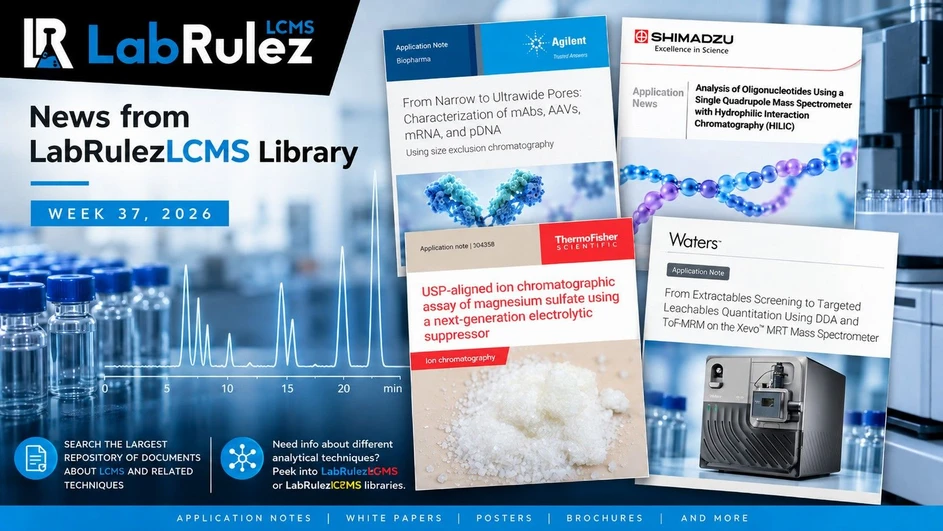
LabRulez / AI: News from LabRulezLCMS Library - Week 37, 2026
Our Library never stops expanding. What are the most recent contributions to LabRulezLCMS Library in the week of 7th September 2026? Check out new documents from the field of liquid phase, especially HPLC and LC/MS techniques!
👉 SEARCH THE LARGEST REPOSITORY OF DOCUMENTS ABOUT LCMS AND RELATED TECHNIQUES
👉 Need info about different analytical techniques? Peek into LabRulezGCMS or LabRulezICPMS libraries.
This week we bring you application notes by Agilent Technologies, Thermo Fisher Scientific, Shimadzu and Waters Corporation!
1. Agilent Technologies: From Narrow to Ultrawide Pores: Characterization of mAbs, AAVs, mRNA, and pDNA
Using size-exclusion chromatography
- Application note
- Full PDF for download
The pharmaceutical industry has undergone a profound transformation over the past four decades, driven by successive waves of innovation in therapeutic and prophylactic modalities. The introduction of recombinant proteins and monoclonal antibodies (mAbs) in the 1980s marked a paradigm shift from small molecules to complex biologics, enabling highly specific targeting of disease pathways. More recently, the emergence of nucleic acid‑based medicines, including messenger ribonucleic acid (mRNA)-loaded lipid nanoparticles (LNPs) and deoxynucleic acid (DNA)-carrying adeno-associated viruses (AAVs), has further expanded the landscape by allowing in vivo protein synthesis and gene modulation.1 The molecular weight of these products, including their aggregates and potential degradation products (fragments) is spanning over several orders of magnitude—approximately 150 kDa (~ 5 nm) for mAbs, 300 kDa to 3 MDa (several tens of nm) for mRNA, 3.8 MDa (~ 25 nm) for AAVs and a few to several tens of MDa for plasmid DNA (pDNA) (up to several hundreds of nm depending on topology). Studying size heterogeneity of these modalities is essential to evaluate their quality, safety, and efficacy. Aggregates and fragments have shown to reduce therapeutic effectiveness, trigger adverse immunogenic responses, and impact product stability and shelf life.
Size-exclusion chromatography (SEC) is the method-of-choice to provide robust size-based information under native conditions. In recent years, a new generation of SEC columns has been introduced with (1) sub-3 µm particle size, (2) optimized stationary-phase chemistry and column materials to limit nonspecific interaction and bleeding, (3) increased pore size beyond 300 Å, and (4) improved mechanical stability of the packed bed to extend the maximum pressure tolerability of the column to 400 bar and above. This improves the separation performance and allows various detection approaches to be explored like ultraviolet (UV), fluorescence, multi-angle light scattering (MALS) and mass spectrometry (MS).2 Importantly, pore size expansion broadens the applicability of SEC and allows larger modalities to be studied.
This application note evaluates the Agilent AdvanceBio SEC columns with pore sizes 130 Å to 1000 Å for the characterization of mAbs, AAVs, mRNA, and pDNA. Several relevant applications are highlighted to demonstrate the usability of an optimal pore size for a given biopharmaceutical sample.
Experimental
Instrumentation
- Pump: Agilent 1260 Infinity II Bio-Inert Pump (G5654A)
- Autosampler: Agilent 1260 Infinity II Bio-Inert Multisampler (G5668A)
- Column Compartment: Agilent 1260 Infinity II Multicolumn Thermostat (G7116A)
- Detector (DAD): Agilent 1260 Infinity II Diode Array Detector (G7115A)
- UV Flow Cell: Agilent Bio-Inert Flow Cell, 13 µL, 10 mm path length (G5615–60022)
- Detector (FLD): Agilent 1260 Infinity II Fluorescence Detector (G7121B)
- FLD Flow Cell: Agilent FLD Flow Cell, standard 8 µL (G1321-60005)
- Column:
- 4.6 × 300 mm, Agilent AdvanceBio SEC 2.7 µm, 130 Å/500 Å/1000 Å
- 4.6 × 150 mm, Agilent AdvanceBio SEC 2.7 µm, 1000 Å (p/n PL1580-3302)
- Data acquired and processed: Agilent OpenLab CDS (version 2.7).
Conclusion
SEC is ideally suited to study size heterogeneity associated with biopharmaceuticals. Careful selection of pore size allows for optimal separation of different prophylactic or therapeutic modalities, which can vary over several orders of magnitude in MW and coincidentally also in hydrodynamic diameter. To demonstrate the applicability of the Agilent AdvanceBio SEC columns, intriguing cases were selected related to mAbs, AAVs, mRNA, and pDNA. The same running buffer was used for all applications, allowing analytical scientists to select a go-to choice of mobile phase which can be further fine-tuned for a given application. FLD allows for the sensitive detection of aggregate species in AAV samples. A 1000 Å–300 Å dual‑pore size combination of columns can greatly improve the resolution of mRNA coformulations or digests. By profiting from the slow elastic relaxation time of linear pDNA under high shear-flow conditions, topological profiling of pDNA samples can be achieved by slalom chromatography.
2. Shimadzu: Analysis of Oligonucleotides Using a Single Quadrupole Mass Spectrometer with Hydrophilic Interaction Chromatography (HILIC)
- Application note
- Full PDF for download
User Benefits
- Synthetic oligonucleotides and impurities can be analyzed using HILIC.
- Comprehensive characterization of synthetic oligonucleotides can be executed using LCMS-2050 single quadrupole mass spectrometer and LabSolutions Insight Biologics.
- Purity calculations for target components can be performed by utilizing MS spectra simultaneously acquired with UV chromatogram.
In recent years, oligonucleotide therapeutics have been rapidly developed and have attracted attention as a new drug discovery modality. Comprehensive detection and identification of impurities generated during the synthesis process and having different base lengthsfrom the target product are required1).
Reverse-phase ion-pair chromatography is widely used for the separation of target compounds from impurities. Liquid chromatography-mass spectrometry (LC-MS) is commonly used as well since complete separation of the target product and all impuritiesseems almost impossible.
However, the development of analytical methods without using ion-pair reagents is expected because ion-pair reagents such as triethylamine have safety concerns and issuesrelated to flow pass contamination of the instrument2) .
In this article, HILIC was focused on as the separation mode because it does not require ion-pair reagent and employs a mobile phase suitable for liquid chromatography-mass spectrometry then impurity analysis of synthetic oligonucleotides using HILIC with the LCMS-2050 high-performance liquid chromatography-mass spectrometry system and LabSolutions Insight Biologics was performed.
Analytical Conditions
Nexera XS inert and LCMS-2050 were used for the analyses. HPLC conditions are shown in Table 2 and MS conditions in Table 3.
Conclusion
In this article, simulated samples of the FLP supplemented with the n-1(5’) and the n-3(5’) variants as impurities were analyzed using HILIC on a high-performance liquid chromatographymass spectrometry LCMS-2050. Obtained data were processed with LabSolutions Insight Biologics, and each contained component was successfully identified. Furthermore, good linearities between concentrations and the component peak areas exhibited were observed across a relative concentration range of 2% to 50% to the FLP.
MS sensitivity was reduced by approximately one-fifth to onetenth compared to reverse-phase ion-pair chromatography. There still remains a challenge of application to the lowconcentration range.
However, it was demonstrated that combination use of this instrumentation and software makes it entirely possible to evaluate synthetic oligonucleotides. Furthermore, there is no need to dedicate the analytical system setup to this specific application as HILIC analysis does not require ion-pair reagents, resulting in the advantage of easily applying the instrument to other analytical uses.
3. Thermo Fisher Scientific: USP-aligned ion chromatographic assay of magnesium sulfate using a next-generation electrolytic suppressor
- Application note
- Full PDF for download
Magnesium sulfate is an inorganic compound widely used in both pharmaceutical and industrial applications due to its versatile chemical properties and therapeutic efficacy. In pharmaceuticals, it is commonly employed as an electrolyte replenisher, anticonvulsant, and osmotic laxative, with formulations tailored for both parenteral and non-parenteral use. The compound exists in various hydrated forms— anhydrous, monohydrate, and heptahydrate—each with distinct physicochemical characteristics that influence its analytical evaluation and quality control parameters.1 Owing to its broad pharmacological relevance, precise quality control standardization and assays of magnesium sulfate are vital to ensure consistent potency and safety across formulations.
Recent advancements, such as the modernization of magnesium oxide monographs using ion chromatography, have demonstrated the effectiveness of cation-exchange columns and suppressed conductivity detection for precise assay and impurity control in similar matrices.2 Also, in Thermo Fisher Scientific AN120, we demonstrated an effective approach for quantifying trace levels of calcium and magnesium in complex matrices like brine using ion chromatography with matrix elimination techniques, highlighting the importance of selective retention and suppression technologies in achieving accurate results.3
Magnesium sulfate is used in various dosages. Its quantification is critical for ensuring compliance with pharmacopeial standards. A U.S. Pharmacopeia (USP) monograph outlines a conductivitybased ion chromatographic assay using methanesulfonic acid (MSA) as the eluent and suppression techniques to enhance detection specificity.4 Here, we detail the integration of the NGES-C suppressor into the USP method, evaluating its impact on assay performance and reliability. The suppressor ensures accurate magnesium ion detection by minimizing background conductivity from the mobile phase, which consists of 48 mM MSA. The system suitability requirements include a resolution of no less than 3.0 between magnesium and calcium ions, a tailing factor of no more than 2.0, and a relative standard deviation of no more than 1.0% for the standard solution. These parameters confirm that the suppressor and overall system maintain precision and reliability during the assay, ensuring accurate quantification of magnesium sulfate.
Materials and methods
Instrumentation
Thermo Scientific™ Dionex™ Integrion™ HPIC™ System (Part No. 22153-60305), including:
- Thermo Scientific™ Dionex™ EGC 500 MSA (Methanesulfonic Acid) (Part No. 075779)
- CD detector
- Thermostatted column oven
- Thermo Scientific™ Dionex™ AS-AP Autosampler (Part No. 074926) with Thermo Scientific™ Dionex™ AS-AP Autosampler Tray, 1.5 mL (Part No. 074936)
- Thermo Scientific™ Dionex™ AS-AP Autosampler Vial Kit, 1.5 mL polypropylene with caps and split septa (Part No. 079812)
- Thermo Scientific™ Dionex™ IonPac™ CS16 Guard Column, 5 × 50 mm (Part No. 057574, USP L84 designated column)
- Thermo Scientific™ Dionex™ IonPac™ CS16 Analytical Column, 5 × 250 mm (Part No. 079805, USP L84 designated column)
Software
Thermo Scientific™ Dionex™ Chromeleon™ Chromatography Data System (CDS), software version 7.3.2.14225 MUe
Conclusion
Here, we showed that an ion chromatography method incorporating the NGES-C suppressor can provide precise and accurate quantification of magnesium sulfate. The approach aligns with USP requirements while leveraging advanced suppression technology to enhance analytical performance.
The integration of NGES-C suppression significantly improves key parameters such as baseline stability, noise reduction, and overall robustness of the assay. These enhancements contribute to greater reliability and efficiency, making the method well-suited for high-throughput environments.
Given its accuracy, consistency, and alignment with regulatory standards, this method is highly applicable for routine quality control and regulatory testing of pharmaceutical-grade magnesium sulfate. Its adoption can streamline workflows and ensure dependable results across diverse pharmaceutical and regulatory laboratories.
4. Waters Corporation: From Extractables Screening to Targeted Leachables Quantitation Using DDA and Tof- MRM on the Xevo™ MRT Mass Spectrometer
- Application note
- Full PDF for download
Benefits
- Screening and quantitation on one high-resolution platform - The Xevo MRT Mass Spectrometer enables extractables characterization and targeted leachables quantitation on the same instrument
- Highly specific MS/MS data for fragment ion selection for quan optimization - DDA mode generates clean, precursor-specific MS/MS spectra.
- Highly sensitivity quantitation using scheduled Tof-MRM - Tof-MRM with enhanced duty cycle improves sensitivity whilst retaining the advantages of high-resolution mass spectrometry (HRMS).
- Integrated acquisition-to-results workflow - The waters_connect™ Software Platform with UNIFI™ Software and MS Quan Application provides an integrated workflow from acquisition to data processing and reporting.
Medical devices, pharmaceutical packaging, and manufacturing components, contain different chemicals, including polymers, polymer additives such as antioxidants, slip agents, colorants, and other compounds. These chemicals, their impurities, and degradation products can migrate out of the materials resulting in potentially unsafe substances. Due to this, there are regulations, standards, and guidance in place to ensure that safety limits for the consumer are met.1-3
Worst case studies are undertaken to find extractables at levels above the analytical evaluation threshold, and these must be identified and reported for toxicological assessment.4 Extractables then deemed to be leachables under normal use need to be routinely quantified. Analytical instrumentation needs to be highly sensitive to detect low level chemical species to meet expected screening thresholds.
Historically, extractables screening has been undertaken using HRMS, whilst leachables quantitation has been done with tandem quadrupole mass spectrometry due to the increased sensitivity and linear dynamic range. Multi-reflecting time-of-flight mass spectrometry (MRT-MS), however, now demonstrates comparable sensitivity and linearity.5 High mass accuracy is combined with the selectivity of Tof-MRM6 meaning that screening and quantitation can be undertaken on one instrument.
While quantitation is typically undertaken using product to precursor transitions, the data are not always readily available for the vast variety of potential E&L compounds that could arise. Using the Xevo MRT Mass Spectrometer System, DDA can be used to determine markers of interest in a complex mixture providing highly specific MS/MS spectra (Figure 1). The resulting product ions can then be utilized for targeted quantitation of leachables with Tof-MRM.
This application note describes a DDA approach to qualitatively determine markers. Curated fragment ions were then packaged for a targeted leachable quantitative analysis which was subsequently undertaken with the highly sensitive Tof-MRM acquisition mode.
Experimental
- LC system: ACQUITY Premier System
- Column: CORTECS™ C18 Column, 90Å, 1.6 µm, 2.1 x 100 mm (p/n: 186007095)
- MS system: Xevo MRT Mass Spectrometer
- Data Management: waters_connect Software Platform
Conclusion
Compared with MSE , DDA produced more specific MS/MS spectra by substantially reducing fragment ion peaks that were not associated with the selected precursor. For E&L analysis, DDA isolates key fragment ions that can then be utilized to optimize targeted Tof-MRM methods. When combined with EDC acquisition, Tof-MRM enables highly sensitive, targeted quantitation using HRMS. Calibration curves and standard addition workflows in the MS Quan Application were used to calculate spiked concentrations in the nasal spray solution, with measured values within 10% of the expected concentrations.
The Xevo MRT Mass Spectrometer is an effective platform for both characterization of extractables with high mass accuracy data for confident identifications and also for targeted leachables analysis with the highly sensitive TofMRM mode.