We, 23.9.2026 | Original article from: LabRulezLCMS Library
This week we bring you application notes by KNAUER and Shimadzu, technical note by Thermo Fisher Scientific and poster by Waters Corporation / SOFT!News from LabRulezLCMS Library - Week 39, 2026
LabRulez / AI: News from LabRulezLCMS Library - Week 39, 2026
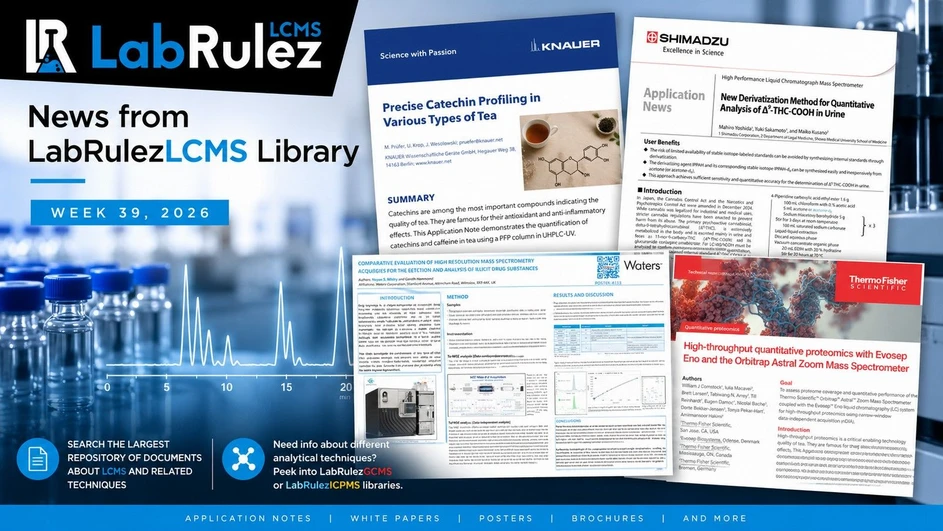
Our Library never stops expanding. What are the most recent contributions to LabRulezLCMS Library in the week of 21st September 2026? Check out new documents from the field of liquid phase, especially HPLC and LC/MS techniques!
👉 SEARCH THE LARGEST REPOSITORY OF DOCUMENTS ABOUT LCMS AND RELATED TECHNIQUES
👉 Need info about different analytical techniques? Peek into LabRulezGCMS or LabRulezICPMS libraries.
This week we bring you application notes by KNAUER and Shimadzu, technical note by Thermo Fisher Scientific and poster by Waters Corporation / SOFT!
1. KNAUER: Precise Catechin Profiling in Various Types of Tea
- Application note
- Full PDF for download
Fresh tea leaves contain high concentrations of catechins, which have many beneficial properties. These include antioxidant, anti-inflammatory as well as antimicrobial effects, and it is even claimed that they have the potential to prevent cancer [1]. In addition, the taste and mouthfeel of a tea strongly depend on its catechin profile. The catechin content of tea leaves varies based on cultivation area, age and variety, as well as on how they are fermented, processed and packed. Therefore, the catechin content is an important marker for the quality of tea.
The analysis of catechins can be challenging. The structural similarity of the catechin isomers and other closely related compounds result in similar behavior and a difficult separation (Fig. 1). Catechins possess many phenolic hydroxyl groups, which are prone to secondary interactions, like hydrogen bonding. Classical as well as highly endcapped C18 columns offer only limited retention and selectivity for catechins. Therefore, the KNAUER column portfolio has been expanded to include a pentafluorophenyl (PFP)-modified stationary phase (Eurospher II 100-3 PFP column 50 x 2 mm). It offers optimal separation of the catechins based on hydrophilic, hydrophobic and π-π-interactions. The column withstands acidic eluents (pH 1.5–10) as well as 100 % aqueous conditions, which are beneficial for the retention of hydrophilic compounds. The KNAUER Gradient Prediction Tool assisted with the challenging method development which is described in detail in the TechNote “The Gradient Prediction Tool: Method Development for the Separation of Catechins from Tea”. Here, the application of the optimized method for the identification and quantification of catechins in tea extracts is shown. The seven compounds specified in ISO-14502-2 (2005), as well as two additional catechins known as (+)-gallocatechin and (–)-gallocatechin gallate, were quantified.
MATERIAL AND METHODS
- Pump: P8.1L; high pressure gradient
- Liquid Handler: LH 8.1L With FastWash station, and Robotic cooler. Loop: 20 µl.
- Thermostat: CT 2.1L
- Detector: DAD 6.1L
- Flow cell: Analytical LightGuide flow cell (50 mm, 6 µl)
- Software: ClarityChrom 10.1
CONCLUSION
The application note demonstrates the reliable separation and quantification of catechins and caffeine in tea extracts using the new KNAUER PFP column. Using an optimised gradient predicted with the KNAUER Gradient Prediction Tool, nine tea-related compounds were separated in under 23 minutes. The tested tea samples showed different catechin content highlighting how strongly tea composition depends on the product type and processing.
2. Shimadzu: New Derivatization Method for Quantitative Analysis of Δ⁹-THC-COOH in Urine
- Application note
- Full PDF for download
User Benefits
- The risk of limited availability of stable isotope-labeled standards can be avoided by synthesizing internal standards through derivatization.
- The derivatizing agent IPPAH and its corresponding stable isotope IPPAH-d6 can be synthesized easily and inexpensively from acetone (or acetone-d6).
- This approach achieves sufficient sensitivity and quantitative accuracy for the determination of Δ⁹-THC-COOH in urine.
In Japan, the Cannabis Control Act and the Narcotics and Psychotropics Control Act were amended in December 2024. While cannabis was legalized for industrial and medical uses, stricter cannabis regulations have been enacted to prevent harm from its abuse. The primary psychoactive cannabinoid, delta-9-tetrahydrocannabinol (Δ⁹-THC), is extensively metabolized in the body and is excreted mainly in urine and feces as 11-nor-9-carboxy-THC (Δ⁹-THC-COOH) and its glucuronide conjugates. Consequently, Δ⁹-THC-COOH must be analyzed to confirm cannabis use. For LC-MS/MS quantitation, the stable isotope-labeled internal standard Δ⁹-THC-COOH-d3 is commonly used to correct for matrix effects. However, most suppliers of stable isotope standards are located in the U.S., making these standards difficult to obtain due to import procedures. Furthermore, there may be additional importrelated supply risks for stable isotope standards in the future.
This Application News describes a technique for quantitating Δ⁹-THC-COOH using an internal standard that is synthesized easily and inexpensively by derivatization with IPPAH (1- isopropylpiperidine carboxylic acid hydrazide), which characteristically reacts with carboxyl groups, and its corresponding stable isotope IPPAH-d6.
Analysis Conditions
LC-MS/MS analysis conditions are shown in Table 1. The Nexera XR and LCMS-8050 systems were used.
Conclusion
Derivatization with IPPAH and its stable isotope analog, IPPAHd6, enabled the simple and inexpensive preparation of an internal standard. This approach provides sufficient sensitivity and accuracy for the determination of Δ⁹-THC-COOH in urine. Most stable isotope-labeled standards are supplied by foreign manufacturers, creating a risk of delays or difficulties in procurement due to import/export regulations. By synthesizing the internal standard through derivatization, this risk can be minimized.
3. Thermo Fisher Scientific: High-throughput quantitative proteomics with Evosep Eno and the Orbitrap Astral Zoom Mass Spectrometer
- Technical note
- Full PDF for download
High-throughput proteomics is a critical enabling technology for large clinical studies, high-content drug screening, and systems biology research, allowing for comprehensive and quantitative analysis of complex proteomes across large sample cohorts within practical timeframes. As biological and translational studies expand in scale and complexity, the ability to generate deep and reproducible proteome measurements across thousands of samples has become increasingly essential for robust biomarker discovery, network-level systems modeling, and downstream analyses. In these contexts, accurate and precise protein quantitation must be maintained without sacrificing throughput, placing stringent demands on the performance and robustness of both LC instruments and mass spectrometers.
To meet these increasing analytical demands, the Evosep Eno was developed as a high‑throughput LC system that combines robustness, ease of use, and highly reproducible chromatography. It offers six standardized methods: 30, 60, 100, 200, 300, and 500 samples per day (SPD), allowing users to select the throughput that aligns best with their study goals.1 These predefined methods ensure consistent gradient delivery, highly stable retention times, and reproducible system performance across instruments and laboratories.2 By reducing LC‑related variability and simplifying everyday operation, the Evosep Eno offers a strong and consistent foundation for large‑scale proteomics workflows, particularly those relying on short gradients and high reproducibility required for downstream quantitative analysis.
Experiment
Instrumentation
- Evosep Eno
- Orbitrap Astral Zoom Mass Spectrometer
- Thermo Scientific™ EASY-Spray™ Ion Source
- Evosep™ Pod for EASY-Spray Ion Source
Software
- Biognosys Spectronaut® 19.7 software
- MacCoss Lab Software Skyline-Daily V25.1
Summary
Seamless and easy integration for high-throughput proteomics
Evosep Eno integrates seamlessly with the Orbitrap Astral Zoom Mass Spectrometer, supported by EASY-Spray source-compatible columns, emitters, and the Evosep Pod column oven for a simple, streamlined, high-throughput workflow.
Deep proteome coverage at 500 SPD
Optimized MS parameters for the standard 500 SPD Evosep Eno gradient enabled identification of more than 6,500 protein groups and 71,000 modified peptides from three replicates of 200 ng Pierce HeLa Digest/PRTC Standard.
Reproducible quantitation across standard gradients
Across all standard Evosep Eno gradients, the workflow delivered highly reproducible label-free quantification, with median protein group %CVs at or below 5.2%, while identifying more than 10,500 protein groups and 190,000 modified peptides from five replicates of 200 ng Pierce HeLa Digest/PRTC Standard at 30 SPD.
Robust chromatography at ultra-high throughput
Chromatographic performance remained stable and robust at 500 SPD, with nearly 100 consecutive runs showing PRTC retention time standard deviations below 0.4 seconds and a median of 6 DPPP.
Strong linearity for confident quantitation
Quantitative performance remained strong at 500 SPD, with PRTC peptides showing excellent linearity across the active gradient (R² >0.98) when spiked from attomolar to femtomolar concentrations.
4. Waters Corporation / SOFT: COMPARATIVE EVALUATION OF HIGH RESOLUTION MASS SPECTROMETRY ACQUISITION STRATEGIES FOR THE DETECTION AND ANALYSIS OF ILLICIT DRUG SUBSTANCES
- Poster
- Full PDF for download
The poster compares two high-resolution time-of-flight mass spectrometry acquisition strategies for toxicology screening: targeted Tof-MRM and data-independent Tof-MSE, both implemented on a Waters Xevo MRT MS coupled to an ACQUITY UPLC I-Class FTN PLUS System. The aim was to determine whether these approaches could meet routine service requirements for drug testing while also broadening the number of substances that can be detected beyond conventional targeted panels. Urine samples were prepared across a wide concentration range for 20 target analytes, and the methods were also applied to 20 anonymized authentic urine samples.
Both workflows used a 15-minute LC separation on an ACQUITY HSS C18 column under positive electrospray ionization. In the targeted Tof-MRM mode, selected precursor ions were isolated and fragmented, with quantifier and qualifier ions monitored for sensitive quantitative analysis. In contrast, Tof-MSE operated in a data-independent mode, alternating between low and elevated collision energies to collect accurate-mass precursor and fragment-ion information for a broad range of compounds. Data were processed in the waters_connect platform using MS Quan for Tof-MRM and UNIFI with the Waters Toxicology Library, containing more than 2,100 drugs and metabolites, for Tof-MSE.
The targeted Tof-MRM method provided the highest sensitivity, with limits of detection ranging from 0.05 to 0.5 ng/mL in fortified urine. The broader Tof-MSE workflow achieved LODs of approximately 0.5 to 5 ng/mL. When both strategies were applied to authentic urine samples, they showed excellent qualitative agreement. Importantly, Tof-MSE detected additional compounds outside the predefined target panel, including commonly encountered medications, benzodiazepines, antidepressants, and illicit drug substances that would not have been captured by the targeted method alone.
Overall, the study shows that Tof-MRM can deliver sensitivity comparable to conventional tandem-quadrupole LC-MS/MS for targeted urinary drug analysis, while Tof-MSE adds broader sample characterization and retrospective screening capability. Used together, the two acquisition strategies provide a flexible approach that combines sensitive quantification of predefined analytes with expanded screening for unexpected or previously untargeted drug substances in complex biological samples.