

AAV and Large Biomolecule Aggregate Analysis
Biozen dSEC-7 columns are packed with 700 Å large pore silica coupled with a proprietary hydrophilic diol-type bonded surface chemistry that ensures silica surface interactions are mitigated. Designed with optimized column dimensions, dSEC-7 conserves valuable sample consumption, facilitates faster run times, and maximizes resolution for AAVs and large biomolecule separations.
Robust and reliable aggregate analysis:
- Baseline resolution of monomer/aggregate species through 700 Å pore size
- Reduction in sample consumption by up to 90 % compared to traditional SEC columns
- Reduction in method times by up to 50 % when compared to traditional SEC columns
 Phenomenex: Biozen-dSEC-7
- Separation Mode: Gel Filtration Chromatography (GFC)
- Pore size: 700
- Recommended Use: Aggregate analysis of AAVs and other large biomolecules using specific molecular weights that conserves sample consumption, facilitates faster run times, and maximizes resolution.
An SEC Column for AAV Aggregate Analysis
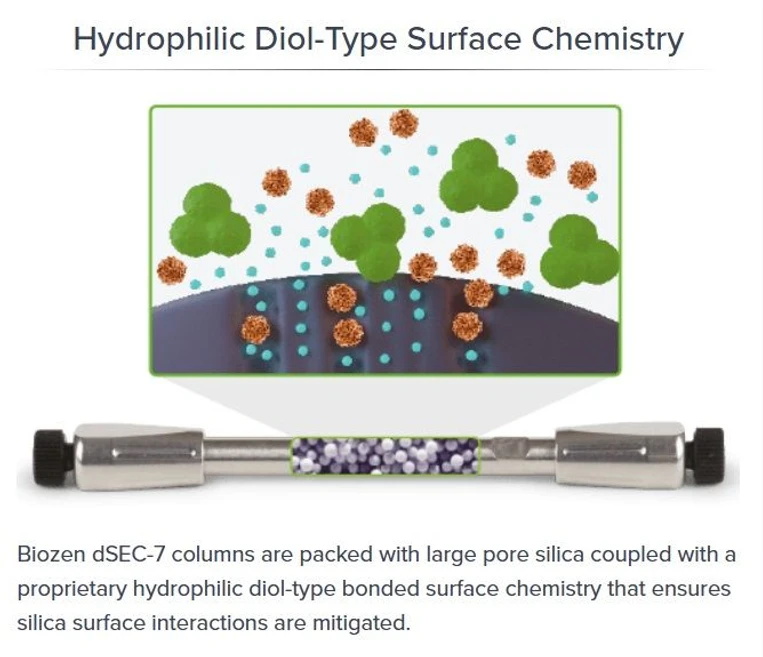 Phenomenex: Biozen dSEC-7 Column
Biozen dSEC-7 Features
Improved Loading
- dSEC-7 addresses the challenge of aggregate analysis by offering accurate detection and separation with injections as low as 0.5 µL. Unlike traditional methods that demand large sample volumes, dSEC-7 conserves valuable samples, allowing for replicate analyses and ensuring availability for other CQA tests.
Mobile Phase Flexibility
- dSEC-7’s particle properties facilitate robust separation of monomer from aggregate species, regardless of which mobile phase best suits your sample. This ensures reproducible results while accommodating unique sample demands, easing the burden of method condition optimization during development.
Serotype Versatility
- With its robust performance and 700 Å pore size, dSEC-7 effectively resolves monomer from aggregate peaks across various AAV serotypes. This capability is crucial for evaluating appropriate serotype candidates, each varying in its unique tissue and cell tropisms, to ensure desired therapeutic outcomes are achieved.
Instrument Agnostic Performance
- Despite differences in dwell volume and dispersion across various sites and departments, dSEC-7 consistently delivers robust and reproducible performance across commercially available LC instrumentation. This ensures reliable results regardless of variations in equipment, setup, or location.
Outperforms Trending Solutions
- dSEC-7 excels in providing superior resolution over market alternatives, particularly when characterizing higher-level aggregates in AAV analysis. Unlike current market solutions with insufficient particle pore size, dSEC-7 ensures accurate and reproducible separation of AAV monomer from aggregates.
Enhanced Detector Flexibility
- Conquer sample limitations using SEC-FLR for heightened sensitivity, SEC-MALS for precise molecular weight determination, or SEC-UV for routine analysis. Achieving comprehensive AAV characterization insights by transferring methods across detector technologies with unique benefits is now seamless.
Phenomenex Biozen Biologics LC Columns
With a new titanium BioTi™ biocompatible hardware to minimize priming, four particle platforms for optimal versatility and nine particle chemistries to maximize selectivity and sensitivity, Biozen UHPLC/HPLC columns for protein analysis are seamlessly designed to bring peace of mind to your analysis of biologics through:
- Charge Variant Analysis
- Aggregate Analysis
- Peptide Mapping
- Intact Mass Analysis
- Intact and Subunit Analysis
- Glycan Analysis
- Peptide Quantitation
- Drug Antibody Ratio (DAR)
- Oligonucleotide Characterization
Biocompatible Flow Path with BioTi™ Hardware
Keep your mind at ease knowing that we’ve minimized the need for priming with a new titanium infused biocompatible hardware and frit that doesn’t interfere with protein or peptide integrity!
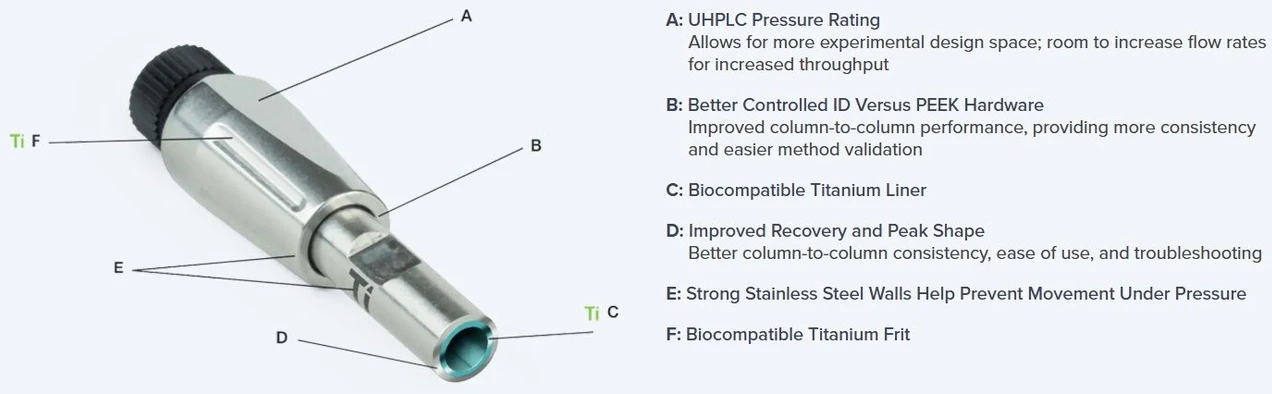 Phenomenex: BioTi Hardware
4 Advanced Particle Platforms
All four of the Biozen particle platforms were individually designed and built by Phenomenex to take advantage of integral levels of performance, ruggedness, and reproducibility for protein characterization applications. Individually, each platform differs in the proprietary processing techniques used to control particle size and morphology.
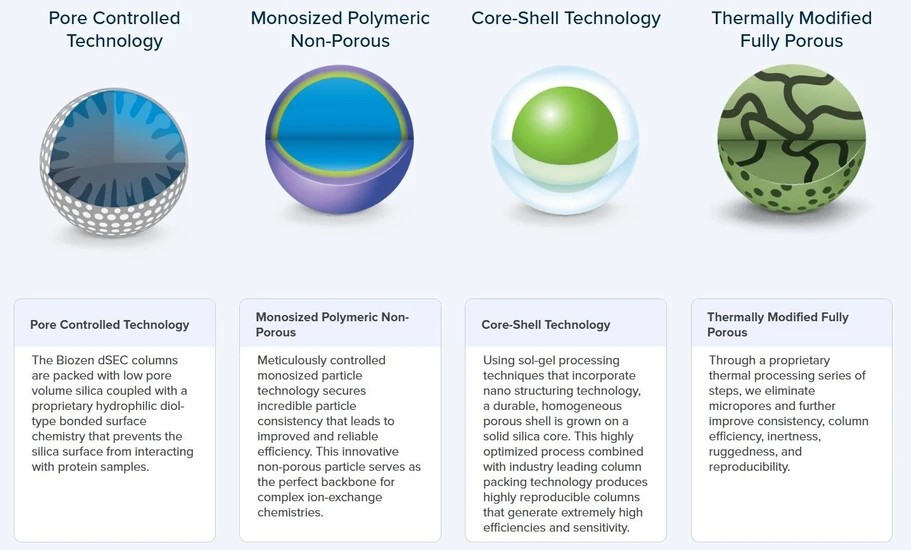 Phenomenex: Advanced Particle Platforms