

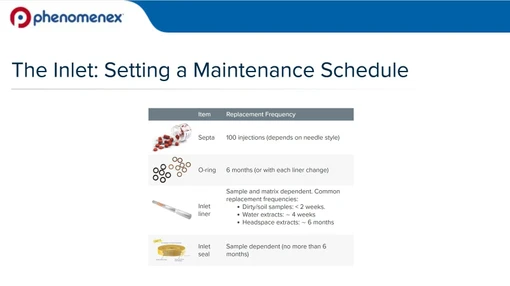
GC Technical Tip - The Inlet: Setting a Maintenance Schedule
GC performance often declines due to worn or contaminated inlet parts. Regular replacement of liners, septa, and key components reduces failures, prevents downtime, and keeps results consistent.

What is the most appropriate way to approach scaling up your analytical method when transferring it to preparative chromatography scale? Part 1
Learn how to balance purity, yield, and throughput when scaling analytical HPLC methods to preparative chromatography.
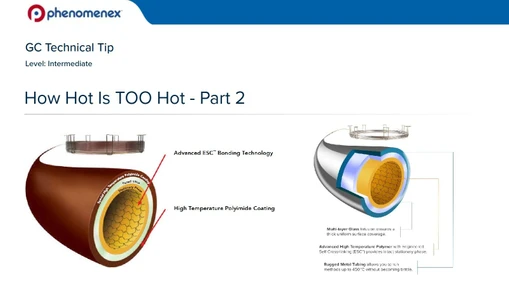
How Hot is TOO Hot? - Part 2
A clear guide to GC column temperature limits: how maximum and minimum temperatures affect stability, when damage occurs, and how high-temperature Zebron columns extend performance for demanding analyses.

Basic Analytes and the Use of High pH Stable Stationary Phases
Discover how hybrid HPLC materials extend pH stability up to 12, improving retention and peak shape for basic compounds. Learn how Gemini™ and Kinetex™ EVO columns enhance LC-MS/MS performance.
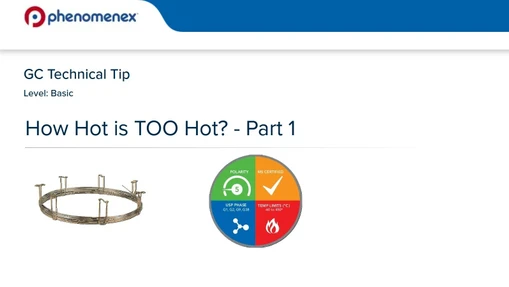
How Hot is TOO Hot? - Part 1
Learn how to safely operate GC columns at high temperatures. Discover the effects of overheating, key temperature limits, and why Zebron™ and Inferno™ columns offer superior thermal stability.

Overcoming Peak Tailing of Basic Analytes: Silica Type A Stationary Phases RP
Learn how to minimize peak tailing when analyzing basic compounds on type A silicas. Explore pH adjustment, mobile phase modifiers, and modern type B silica columns for sharper, more symmetrical peaks.
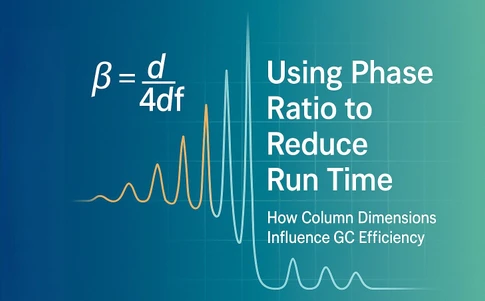
Using Phase Ratio to Reduce Run Time
Learn how column length, internal diameter, and film thickness work together to optimize phase ratio in GC. Discover how adjusting these parameters reduces run time while maintaining separation efficiency.

The Role of End-Capping in Reversed-Phase
Learn how silica end-capping improves HPLC column performance. Discover how C18, PS-C18, Polar C18, and XB-C18 chemistries enhance retention, peak shape, and selectivity for various analytes.

GC Technical Tip: Retention Times Prolonged or Shortened
Learn how to diagnose and fix retention time shifts in GC. This guide explains common column performance issues, their causes, and practical remedies for consistent chromatographic results.
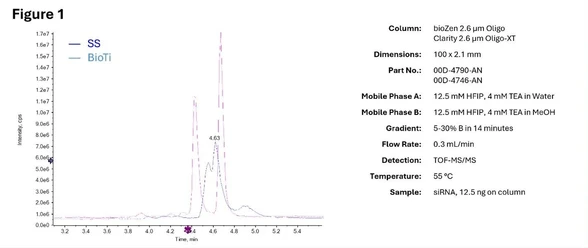
The Use of Bio-Inert Hardware in the Analysis of Oligonucleotides
Discover how bio-inert HPLC hardware enhances oligonucleotide analysis. Learn how BioTi™ columns improve resolution, sensitivity, and reduce adduct formation compared to stainless steel.