How Hot is TOO Hot? - Part 1

We, 12.11.2025 | Original article from: Phenomenex
Learn how to safely operate GC columns at high temperatures. Discover the effects of overheating, key temperature limits, and why Zebron™ and Inferno™ columns offer superior thermal stability.
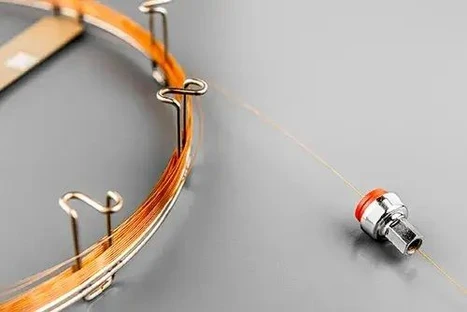
  • Photo: Phenomenex: How Hot is TOO Hot? - Part 1
  • Video: Phenomenex: Meet Zebron: Quality GC Columns By Design

For gas chromatographers, dealing with high temperatures is a routine requirement. One of the most common questions we receive from customers is: What is the maximum temperature a GC column can reach? In this technical tip, we will cover this topic... along with some recommendations.

Polar stationary phases are more susceptible to damage and degrade at a faster rate when exposed to excessively high temperatures. Thermal damage is evident by excessive column bleed and peak tailing of active compounds. Loss of retention and efficiency (resolution) may also be observed for severe cases of thermal damage. Temperature limits do not have any extra safety factors built in, so maintaining the column within its temperature limits should be practiced to ensure reasonable column lifetime and performance.

Column temperature limits may differ slightly between the same phase with different film thickness. There is an inverse relationship between the film thickness and the upper temperature limit when working with the same stationary phase. For example:

  • ZB-1 (30 m x 0.32 mm x 0.25 µm) – 360/370 °C isocratic/gradient
  • ZB-1 (30 m x 0.32 mm x 5.00 µm) – 340/360 °C isocratic/gradient

Note also that sometimes, even when the phase and the dimensions are the same, the column temperature limits may be different among different manufacturers. Usually, Zebron™ columns have limits that are 10 °C - 20 °C above those of competitor columns.

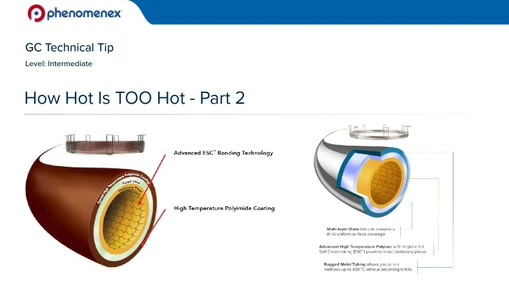
Be careful to distinguish between a high-temperature version of a stationary phase and the regular version, including all the related accessories. A standard silica column may reach up to 360 °C depending on various parameters as discussed above. The high-temperature Zebron-HT line, called Inferno™, can be distinguished from the regular line by the black color of the silica tubing. These offer temperature limits of up to 430 °C. If you need to develop a method at higher temperatures because you are dealing with compounds with very high boiling points, you have to choose our Zebron-1XT Sim Dist column that has a metal capillary tube and can reach 450 °C!

When working with high temperatures we highly recommend using only accessories designed for high-temperature analyses such as SilTite® ferrules, HT Guard Columns, and last but not least, Zebron gas management filters, which ensure that all gases that reach the GC systems and columns are free from oxygen and other contaminants that may break the column - especially when working with high temperatures.


Phenomenex
LinkedIn Logo
 

Related articles

Good Column Selection: Polarity vs Selectivity
Article | Academy

Good Column Selection: Polarity vs Selectivity

Understanding GC column polarity and selectivity is key to achieving optimal separations. Learn how to choose the right stationary phase for your compounds and improve chromatographic performance.
How Hot is TOO Hot? - Part 2
Article | Academy

How Hot is TOO Hot? - Part 2

A clear guide to GC column temperature limits: how maximum and minimum temperatures affect stability, when damage occurs, and how high-temperature Zebron columns extend performance for demanding analyses.
Water Injections in GC: Is it Safe?
Article | Academy

Water Injections in GC: Is it Safe?

Injecting water into a GC system can cause backflash, poor vaporization, detector issues, and stationary phase degradation. Learn how to minimize these risks with the right column and injection setup.
GC Columns - Troubleshooting & Maintenance
Article | Academy

GC Columns - Troubleshooting & Maintenance

A practical guide to GC column troubleshooting. Learn how to identify and resolve peak tailing, loss of resolution, ghost peaks, baseline drift, sensitivity issues, and retention time shifts.
 

Related articles

Good Column Selection: Polarity vs Selectivity
Article | Academy

Good Column Selection: Polarity vs Selectivity

Understanding GC column polarity and selectivity is key to achieving optimal separations. Learn how to choose the right stationary phase for your compounds and improve chromatographic performance.
How Hot is TOO Hot? - Part 2
Article | Academy

How Hot is TOO Hot? - Part 2

A clear guide to GC column temperature limits: how maximum and minimum temperatures affect stability, when damage occurs, and how high-temperature Zebron columns extend performance for demanding analyses.
Water Injections in GC: Is it Safe?
Article | Academy

Water Injections in GC: Is it Safe?

Injecting water into a GC system can cause backflash, poor vaporization, detector issues, and stationary phase degradation. Learn how to minimize these risks with the right column and injection setup.
GC Columns - Troubleshooting & Maintenance
Article | Academy

GC Columns - Troubleshooting & Maintenance

A practical guide to GC column troubleshooting. Learn how to identify and resolve peak tailing, loss of resolution, ghost peaks, baseline drift, sensitivity issues, and retention time shifts.
 

Related articles

Good Column Selection: Polarity vs Selectivity
Article | Academy

Good Column Selection: Polarity vs Selectivity

Understanding GC column polarity and selectivity is key to achieving optimal separations. Learn how to choose the right stationary phase for your compounds and improve chromatographic performance.
How Hot is TOO Hot? - Part 2
Article | Academy

How Hot is TOO Hot? - Part 2

A clear guide to GC column temperature limits: how maximum and minimum temperatures affect stability, when damage occurs, and how high-temperature Zebron columns extend performance for demanding analyses.
Water Injections in GC: Is it Safe?
Article | Academy

Water Injections in GC: Is it Safe?

Injecting water into a GC system can cause backflash, poor vaporization, detector issues, and stationary phase degradation. Learn how to minimize these risks with the right column and injection setup.
GC Columns - Troubleshooting & Maintenance
Article | Academy

GC Columns - Troubleshooting & Maintenance

A practical guide to GC column troubleshooting. Learn how to identify and resolve peak tailing, loss of resolution, ghost peaks, baseline drift, sensitivity issues, and retention time shifts.
 

Related articles

Good Column Selection: Polarity vs Selectivity
Article | Academy

Good Column Selection: Polarity vs Selectivity

Understanding GC column polarity and selectivity is key to achieving optimal separations. Learn how to choose the right stationary phase for your compounds and improve chromatographic performance.
How Hot is TOO Hot? - Part 2
Article | Academy

How Hot is TOO Hot? - Part 2

A clear guide to GC column temperature limits: how maximum and minimum temperatures affect stability, when damage occurs, and how high-temperature Zebron columns extend performance for demanding analyses.
Water Injections in GC: Is it Safe?
Article | Academy

Water Injections in GC: Is it Safe?

Injecting water into a GC system can cause backflash, poor vaporization, detector issues, and stationary phase degradation. Learn how to minimize these risks with the right column and injection setup.
GC Columns - Troubleshooting & Maintenance
Article | Academy

GC Columns - Troubleshooting & Maintenance

A practical guide to GC column troubleshooting. Learn how to identify and resolve peak tailing, loss of resolution, ghost peaks, baseline drift, sensitivity issues, and retention time shifts.