

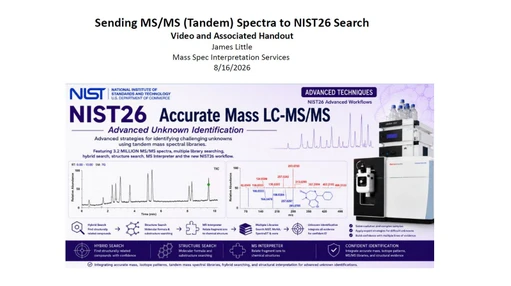
Sending MS/MS (Tandem) Spectra to NIST26 Search
Learn how to send MS/MS spectra directly from Agilent, Waters, Thermo, and other vendor software to NIST26 for fast library searching without full chromatogram processing.
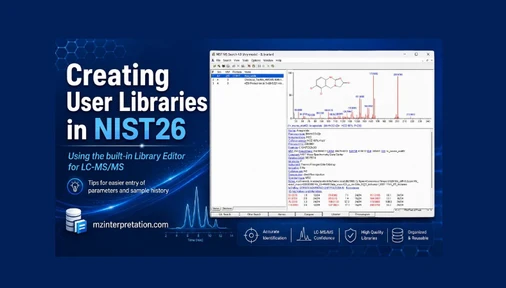
Creating MS/MS User Libraries in NIST26
Learn how to create custom MS/MS user libraries in NIST26, add structures and metadata, manage high- and low-resolution spectra, and improve laboratory-specific compound identification.

Using Free Public Libraries in NIST26 Chromatogram and Lib Search
Learn how free MoNA and MS-DIAL MS/MS libraries can complement NIST26, expand spectral search coverage, and support compound identification in LC-MS/MS workflows.
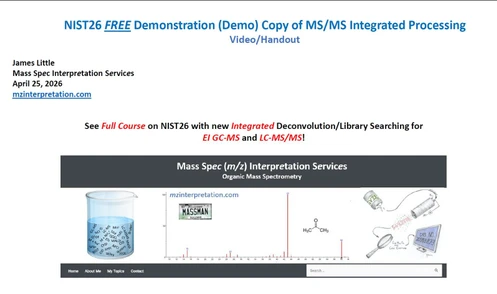
NIST26 FREE Demonstration (Demo) Copy of MS/MS Integrated Processing
Explore the free NIST26 demo for integrated LC-MS/MS processing, including MS/MS deconvolution, library searching, test files, and support for NIST, MoNA, and MS-DIAL libraries.
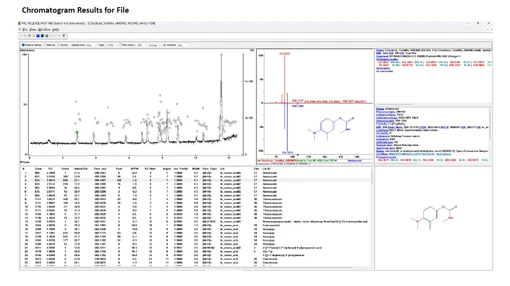
Identifications Folder: Raw Files Created in MS/MS NIST26
Explore the NIST26 Identifications folder and learn how XIC traces, MS/MS searches, isotope information and intermediate “check” files support more confident LC-MS/MS identifications.
Conversion to mzML Format for NIST26 Chromatogram Processing
Learn how to convert LC-MS and GC-MS vendor data to mzML for NIST26 chromatogram processing using ProteoWizard MSConvert, including correct centroiding and Peak Picking settings.
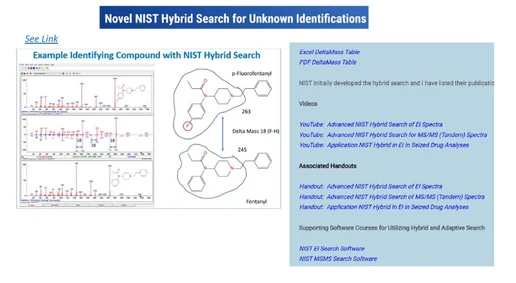
Manual and Automated Hybrid Searches in NIST26
Learn how manual and automated Hybrid MS/MS Searches in NIST26 use spectral similarity, mass differences, dForm, and fragmentation to investigate unknown compounds beyond exact library matches.
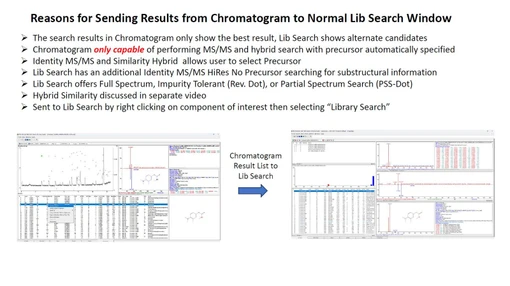
Searching Normal NIST Search with Chromatogram Results
Learn how moving chromatogram results into the NIST Library Search window enables deeper candidate review, flexible precursor settings, and alternative spectral matching strategies.
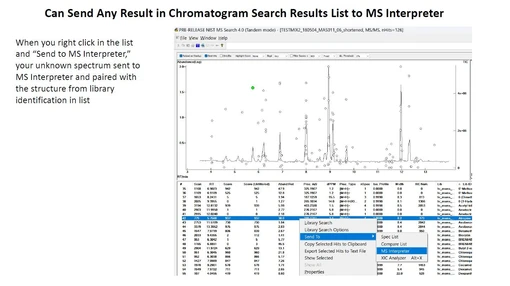
MS Interpreter for Accurate Mass Data: Correlating Structure to m/z
Learn how NIST MS Interpreter connects accurate-mass MS/MS fragments with molecular structure, enabling substructure assignment, ppm evaluation, candidate modification, and improved unknown identification.
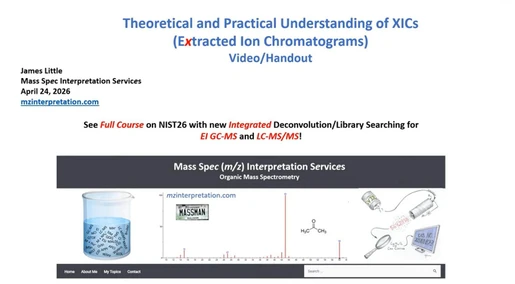
Theoretical and Practical Understanding of XICs (Extracted Ion Chromatograms)
Learn how extracted ion chromatograms support LC–MS/MS identification, quantitation, isotope validation, and troubleshooting in the NIST XIC Analyzer workflow.