We, 25.11.2026 | Original article from: LabRulezICPMS Library
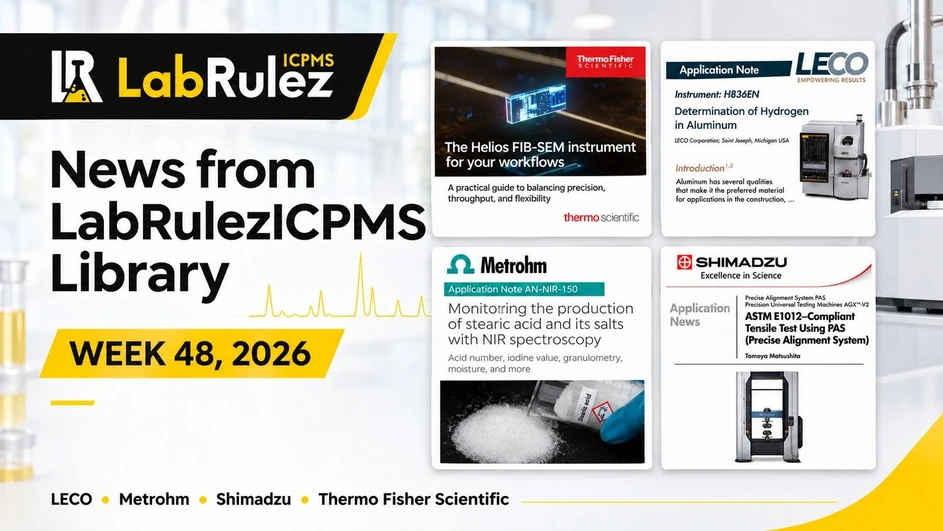
This week we bring you application notes by LECO, Metrohm and Shimadzu.News from LabRulezICPMS Library - Week 48, 2026
LabRulez / AI: News from LabRulezICPMS Library - Week 48, 2026
Our Library never stops expanding. What are the most recent contributions to LabRulezICPMS Library in the week of 23rd November 2026? Check out new documents from the field of spectroscopy/spectrometry and related techniques!
👉 SEARCH THE LARGEST REPOSITORY OF DOCUMENTS ABOUT SPECTROSCOPY/SPECTROMETRY RELATED TECHNIQUES
👉 Need info about different analytical techniques? Peek into LabRulezLCMS or LabRulezGCMS libraries.
1. LECO: Determination of Hydrogen in Aluminum
- Application note
- Full PDF for download
Aluminum has several qualities that make it the preferred material for applications in the construction, aerospace, electronics, container, and automotive industries. These qualities include low density, high strength, high conductivity, a desirable appearance, and superior corrosion resistance. Unfortunately, Aluminum also has some disadvantages, including a relatively high cost and unfavorable Hydrogen solubility characteristics.
Hydrogen gas has a high solubility in molten Aluminum and is readily introduced during processing. Once solidification begins, the solubility decreases approximately twenty-fold, and Hydrogen is forced out of the Aluminum. Although most of the Hydrogen is diffused, a small percentage may get trapped, creating Hydrogen-filled voids. This remaining Hydrogen gas is the root cause of numerous failure mechanisms in Aluminum products, such as voids in casting and blisters in sheets. As a result, the determination of total, surface, and bulk Hydrogen content in Aluminum is a critical quality control procedure for ensuring material integrity and performance.
Instrument Model and Configuration
The LECO H836EN is a Hydrogen determinator that utilizes an electrode furnace, Argon carrier gas, and thermal conductivity detection to meet the needs of the Aluminum industry. The H836EN software takes advantage of the existing ability to perform stepped furnace analysis and incorporates it in such a way that separation of surface and bulk Hydrogen can be performed and corresponding results reported.
2. Metrohm: Monitoring the production of stearic acid and its salts with NIR spectroscopy
Acid number, iodine value, granulometry, moisture, and more
- Application note
- Full PDF for download
Stearic acid and its derivatives (e.g., magnesium, calcium, and zinc stearates) are widely used in the lubricants, pharmaceutical, cosmetics, plastics, and food industries. Producing these materials involves several steps: clarification, hydrogenation, cleavage, and distillation, followed by converting stearic acid into its respective stearates. This Application Note demonstrates how the OMNIS NIR Analyzer can be used to monitor the stearic acid iodine value, acid value, moisture, ash content, melting point, and granulometry during the production process and in the final product. Near-infrared (NIR) spectroscopy is a rapid, nondestructive analytical technique that is fast becoming a preferred method over other slower, more costly alternatives.
EXPERIMENTAL EQUIPMENT
CONCLUSION
The results obtained in this study demonstrate the strong applicability of NIR spectroscopy for quantitative analysis of both process samples and final products across multiple parameters during the production of stearic acid and its salts.
The OMNIS NIR Analyzer offers significant operational advantages by combining liquid and solid measurement modules in a single instrument, making sample analysis simple and efficient. The liquid module’s ability to heat samples up to 80 °C with precise temperature control ensures complete melting of samples with higher melting points, which improves measurement accuracy and reproducibility. The final Mg, Ca, and Zn stearates are widely used in pharmaceuticals (as tablet lubricants and excipients), cosmetics (in creams, lotions, and soaps), food (as emulsifiers and coating agents), lubricants (as thickeners and stabilizers), and other sectors such as plastics and rubber (as stabilizers and release agents). This versatility shows the importance of robust analytical solutions like NIRS for quality control across diverse industries.
3. Shimadzu: ASTM E1012–Compliant Tensile Test Using PAS (Precise Alignment System)
- Application note
- Full PDF for download
User Benefits
- Tensile testing can be performed with alignment accuracy compliant with ASTM E1012 by using PAS.
- Data scatter can be reduced by easily aligning the axes of the upper and lower grips.
- Alignment adjustment can be easily performed even after fixtures are removed and reinstalled.
In the aerospace field, it is required to internationally ensure the quality of parts and materials as well as the reliability of test results. One of the representative frameworks for this purpose is the National Aerospace and Defense Contractors Accreditation Program (NADCAP), which is widely adopted. NADCAP plays an important role in maintaining and improving quality levels throughout the supply chain by establishing common certification standards for special processes and material testing in the aerospace industry.
To obtain and maintain NADCAP accreditation, it is necessary to conduct testing in compliance with specified international standards. In the field of materials testing, tensile testing must be performed using a system configuration that conforms to ASTM E1012. ASTM E1012 emphasizes the importance of minimizing unintended bending stresses on the specimen and explicitly states that tensile tests must be carried out using fixtures that ensure precise alignment of the loading axis1) . Misalignment is a critical factor that can adversely affect test results, and strict control is therefore required in NADCAPcompliant tests. By utilizing the Precise Alignment System (PAS), it is possible to achieve a high level of alignment accuracy in accordance with ASTM E1012. In this Application News, the effect of PAS on improving alignment accuracy is demonstrated through a comparison of test data obtained with and without PAS. In addition, tensile tests of A7075 material were conducted using a system combining the AGX -V2 precision universal testing machine and PAS.
Conclusion
In this application, the PAS axis alignment system—capable of ensuring alignment accuracy in accordance with ASTM E1012— was introduced, and the difference in alignment accuracy with and without PAS was demonstrated through experimental results. The results confirmed that the use of PAS improves axis alignment accuracy. Furthermore, tensile testing of A7075 was carried out using PAS, and the elastic modulus, 0.2 % proof stress, and tensile strength were successfully measured with high reproducibility.
4. Thermo Fisher Scientific: The Helios FIB-SEM instrument for your workflows
- Brochures and specifications
- Full PDF for download
The Thermo Fisher Scientific Helios FIB-SEM portfolio combines scanning electron microscopy (SEM) with focused ion beam (FIB) technology in DualBeam systems designed for semiconductor analysis, materials characterization, and failure analysis. These instruments support site-specific cross-sectioning, preparation of ultra-thin lamellae for transmission electron microscopy (TEM), three-dimensional structural analysis, and precise layer-by-layer material removal (delayering). The brochure provides a practical guide to selecting the appropriate FIB-SEM configuration based on analytical requirements, throughput, precision, and workflow flexibility.
Choosing the right FIB-SEM depends on the application, required resolution, processing speed, and material properties. The brochure identifies four main semiconductor technology segments: Logic, Memory, Packaging, and Power. Advanced logic devices and ultra-thin TEM lamella preparation require exceptional precision at low ion beam currents, while larger structures and complex material stacks demand higher milling rates, wide cross-sections, and automated processing. The selection process also considers gallium-free preparation, multi-material performance, and integrated analytical capabilities such as energy-dispersive X-ray spectroscopy (EDS) and electron backscatter diffraction (EBSD).
The Helios portfolio includes several instrument families optimized for different applications. Helios 5 CX and UC support routine cross-sectioning, sample preparation, and versatile laboratory workflows, while Helios 5 UX and FX offer advanced precision and automation for more demanding applications, including TEM lamella preparation. Helios 6 HD and HX are designed for advanced semiconductor technologies and high-throughput automated workflows. For rapid removal of larger material volumes, Helios 5 PFIB uses a xenon plasma ion source, enabling efficient large-area cross-sectioning and delayering. Helios Hydra Multi-Ion PFIB-SEM provides additional flexibility through multiple ion species, including xenon and argon, allowing processing conditions to be adapted to different materials and complex structures.
Software automation and advanced data processing are essential components of the Helios workflow. AutoTEM 5 and AutoTEM 6 support automated TEM lamella preparation, with advanced versions incorporating machine learning and AI-assisted endpoint detection. Auto Slice & View enables automated data acquisition for three-dimensional reconstruction, while Avizo 3D provides visualization and AI-based segmentation tools for complex datasets. The brochure compares instrument capabilities and software compatibility, helping laboratories select a suitable combination of hardware and automation tools to balance analytical precision, productivity, and flexibility across semiconductor research and manufacturing applications.