Mo, 23.11.2026 | Original article from: Int. J. Coal Geol. 2026, Volume 326, 105105
Multi-element TD-ICP-OES enables germanium speciation in lignite and gasification products and reveals selective arsenic desorption below 730 °C.A novel multi-elemental thermal desorption ICP–OES technique to analyze the germanium speciation in lignite
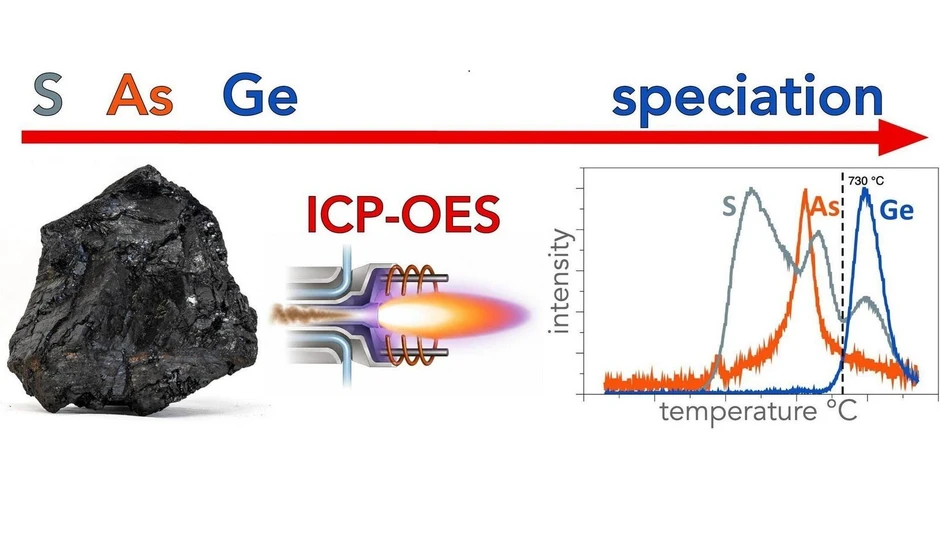
Int. J. Coal Geol. 2026, Volume 326, 105105: Graphical abstract
This study introduces a multi-element thermal desorption ICP-OES method for investigating germanium speciation in lignite and lignite gasification products. The approach monitors thermally released Ge together with technologically relevant elements such as arsenic and sulfur, providing information on the chemical forms and transformations of Ge during processing.
Application to lignite, fly dust, and tar fractions revealed distinct Ge species and showed that controlled heating can selectively remove arsenic with a cutoff temperature of 730 °C. The method offers an alternative to sequential extraction and X-ray absorption techniques and may support more efficient processing of Ge-bearing coal materials.
The original article
A novel multi-elemental thermal desorption ICP–OES technique to analyze the germanium speciation in lignite
Jan Rohovec, Marek Tuhý, Olga Bičáková, Bohdan Kříbek, Michal Poňavič
Int. J. Coal Geol. 2026, Volume 326, 105105
licensed under CC-BY 4.0
Selected sections from the article follow. Formats and hyperlinks were adapted from the original.
In summary, traditional speciation techniques suffer limitations due to the indirect characterization (extraction techniques), spectroscopic complexity (advanced X-ray absorption techniques), spectral interferences (EXAFS) or limited accessible chemical information (SEM, EPMA, TEM). These limitations provided the rationale for developing a new method for studying germanium speciation.
In the field of speciation analysis, a new technique of thermal desorption (TD) is being developed for determining the speciation of volatile elements. This technique is based on the controlled heating of the sample and monitoring the response associated with the thermal release of the element of interest. TD has been extensively developed and successfully applied several times in the case of mercury (Rumayor et al., 2013; Tuhý et al., 2020; Meloni et al., 2024), while for other technologically important elements, the application of TD–ICP–OES is still in its early stages. Tuhý et al. used TD–ICP–OES to study the remobilization and mineralogical transformation of metals and metalloids (Pb, Zn, As) in smelter-polluted savanna soils, the vaporization of arsenic from fly dust trapped on the biomass during forest fires, and to determine As speciation in secondary minerals (Tuhý et al., 2021; Tuhý et al., 2025). In both cases, the study of TD–ICP–OES for arsenic provided valuable insights into the potential environmental risks associated with heating materials containing arsenic and into environmental technologies for decontaminating materials with this element.
In this study, we aimed to develop a novel germanium TD–ICP–OES technique for the speciation analysis of Ge in solid materials and demonstrate its feasibility and effectivity. A preliminary report on the progress of this research was published by Kříbek et al. (2023), who recognized the application potential of thermal desorption approach for germanium. The newly developed method was applied to (1) lignite (LIG) and (2) lignite gasification products (LGPs) with the objective of identifying the main germanium species present. We describe the interrelationships in the thermal behavior of Ge, As, and S uncovered by TD–ICP–OES and draw environmentally and technologically relevant conclusions for the lignite gasification process, revealing the interactions between Ge and As relevant for Ge separation.
2. Materials and Methods
2.2. Thermal desorption method (TD–ICP–OES)
The experimental setup for the TD–ICP–OES of germanium and other elements from the lignite samples was adapted from the unit used in our previous studies of the thermal desorption of Hg and As (Tuhý et al., 2021; Tuhý et al., 2025). A diagram of the apparatus is shown in Fig. S4. The apparatus comprises a horizontal tubular furnace surrounding a fused quartz combustion tube. The sample is fed into the combustion tube on a quartz boat. An argon carrier stream is introduced into the tube at a flow rate of 12 L·min−1 and a pressure of 25 psig. The tube is heated in the tubular furnace at a rate of 50 °C·min−1 from room temperature (25 °C) to 950 °C. The temperature is measured, and the furnace is controlled by a K-type thermocouple (Ni vs NiCr) placed directly below the sample. The elements released from the sample are transported by the Ar stream to the Inductively Coupled Plasma Optical Emission Spectrometry (ICP–OES) torch of a Thermo Electron Corporation IRIS Intrepid II XSP ICP–OES instrument (manufacturer Thermo Electron Corp.) for detection. Germanium detection is performed in the axial configuration of the instrument at wavelength of 206.8 nm (rel. Int. 150,000 A.U., observed in the UV section of the spectrum). In the multi-elemental experiments, signals of As (189.0 nm, rel. Int. 150,000 A.U.) and S (182.0 nm, rel. Int. 140,000 A.U.), both in the UV section of the spectrum, are observed simultaneously. The relative intensities are obtained from the Teva program package (Thermo Electron Inc.).
3. Results and Discussion
3.2. Multi-elemental TD study of lignite and delineation of Ge-bearing species
The TD–ICP–OES methodology allows for the simultaneous monitoring of the thermal release of multiple elements. This feature was exploited for the LIG samples, and the TD–ICP–OES signals of arsenic and sulfur were recorded alongside the Ge signal. A typical multi-elemental TD–ICP–OES recording is shown in Fig. 2 for sample LIG10, with further examples shown in Fig. S6. Sample LIG10 was chosen as an example because it allows the intensities of all the observed elements to be plotted on a common scale.
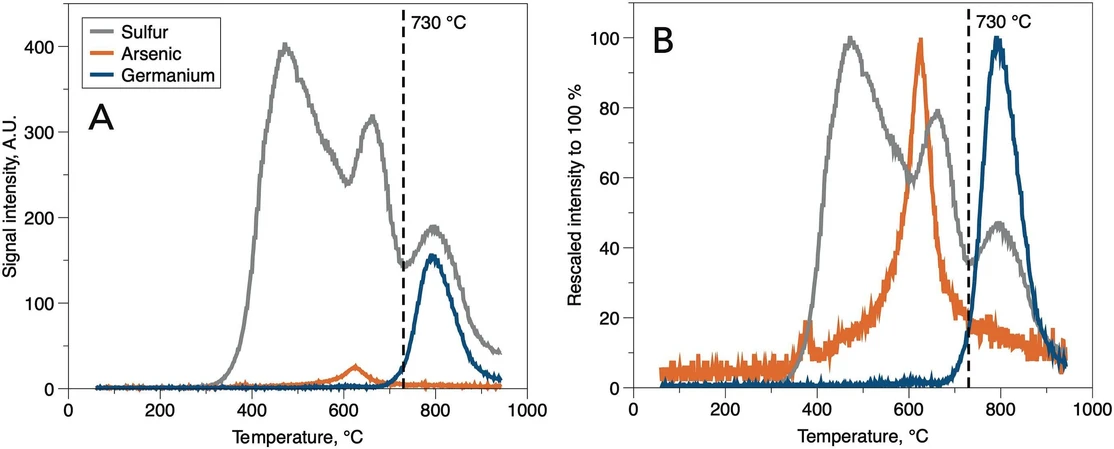 Int. J. Coal Geol. 2026, Volume 326, 105105: Fig. 2. Multi-elemental record of the TD–ICP–OES, sample LIG10, common scale for intensities of all the elements (A), rescaled to an arbitrary 0–100% intensity scale (B).
In the simultaneous TD–ICP–OES records of Ge, S, and As, the most intense signals in terms of area are observed for S (Fig. 2A). This is not surprising given the high S content of lignite (Table S1). For all the lignite samples, the sulfur TD–ICP–OES records are similar to the representative record shown in Fig. 2A and B. Three areas of sulfur release can be distinguished in the sulfur TD–ICP–OES records, represented as broadband signals.
3.3. Multi-elemental TD–ICP–OES study of the fly dust and synthetic Ge species
The fly dust sample LGP1 was obtained during the controlled gasification of a 100 g sample of lignite LIG11 under a limited technical air supply of 19 L·h−1 at a temperature set to 900 °C as a very fine gray powder, deposited on the cold walls of the upper part of the quartz combustion vial in the primary cooling line (Fig. S2). Its chemical composition is given in Table 2. The fly dust LGP1 consisted of a solid mixture of quartz, aluminosilicates, lignite fragments, and other particles according to the Powder X-ray Diffraction (PXRD) and electron microscopy (Fig. S3).
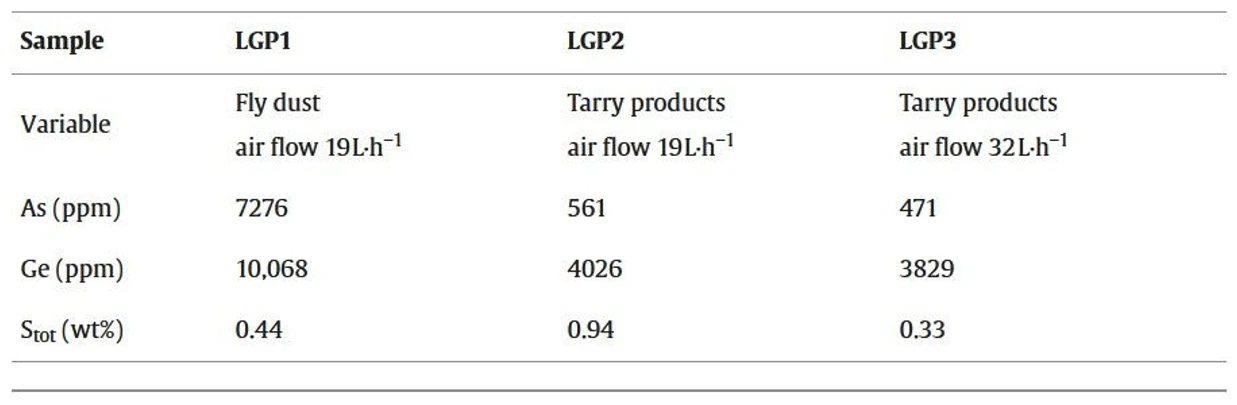 Int. J. Coal Geol. 2026, Volume 326, 105105: Table 2. Concentrations of As, Ge and Stot in the lignite gasification products LGP 1–3, as formed.
As expected, there is significant Ge enrichment in the fly dust sample LGP1 compared to the starting lignite sample LIG11. The Ge content in sample LGP1 was 10,068 ppm, i.e., highly exceeding the Ge content of 136 ppm found in the starting sample LIG11. According to the classification of trace elements described by Senior et al. (2020), Ge belongs to a group of partially volatile elements, enriched in the fly dust. On the other hand, the Ge concentration of the bottom ash remaining after gasification was below the detection limit of the ICP–OES analytical method. At the same time, the Ge enrichment process is accompanied by a decrease in the As and S content.
The germanium TD–ICP–OES record of sample LGP1 is shown in Fig. 5. In contrast to the initial lignite sample LIG11, where only a single signal at 800–810 °C is seen on the germanium TD–ICP–OES record, the record of sample LGP1 contained a larger number of signals over a broader range of temperatures. The release of Ge from this material began at 510 °C. The main peaks were found at 658, 677, 700, 718, and 810 °C. The observed behavior is reproducible for fresh samples, as shown in Fig. S5B, Fig. S5D. A comparison with the feed lignite sample LIG11, depicted in Fig. 5, shows that, in a controlled gasification process under limited air supply, Ge escapes in species chemically different from those formerly present in sample LIG11. The new species are much more volatile and are released at distinctly lower temperatures than the germanium (810 °C) of the feed sample LIG11. Nevertheless, one minor species remains visible in the record at a temperature close to the TD for sample LIG11, appearing as a shoulder at 810 °C.
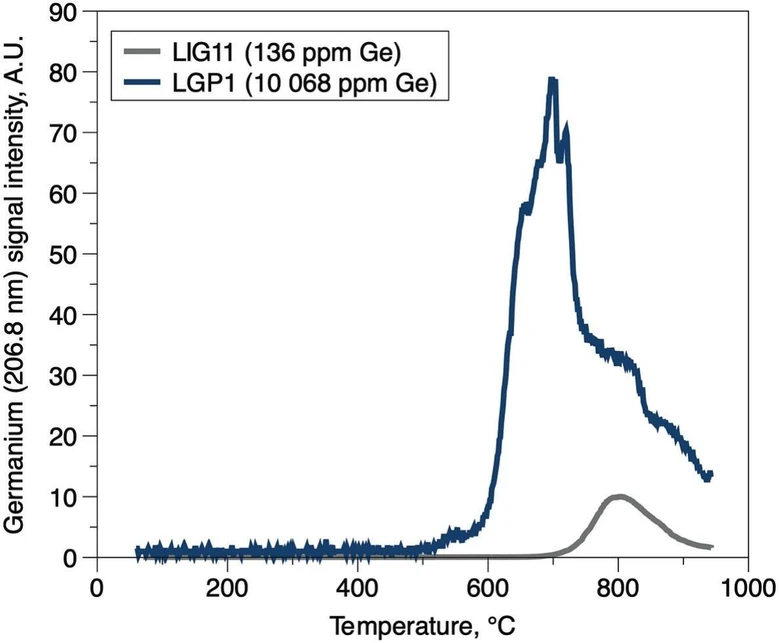 Int. J. Coal Geol. 2026, Volume 326, 105105: Fig. 5. Germanium TD–ICP–OES record of the fly dust sample LGP1 after gasification of the lignite LIG11.
4. Conclusions
- A new TD–ICP–OES method suitable for studying Ge speciation in various solid materials has been developed and tested. The method is easy to perform, fast and does not require expensive specialized equipment. It can serve as a complementary research method to EXAFS in cases where the EXAFS technique faces limitations arising from insufficient sensitivity (e.g., low Ge concentrations) or spectral interferences.
- The method is sensitive enough for the direct analyses of coal/lignite samples with a Ge content in the range of tens of ppm Ge, without the need for extensive sample preparation (dissolution, extraction, etc.).
- The germanium TD–ICP–OES technique is a sensitive approach for detecting changes in the oxidation, bonding, and ligation state of Ge, e.g., the oxidation state of Ge-sulfides.
- The multi-elemental TD–ICP–OES approach, combining Ge and As release profiles, is applicable as a novel research tool for technology-oriented studies focused on the separation of Ge and As.
- The viability of the germanium TD–ICP–OES method was demonstrated using lignite samples with Ge concentrations ranging from 0.1 to 411 ppm. All the samples showed a single Ge signal at a relatively high temperature (810 °C), suggesting that Ge may occur in a common type of chemical species similarly in nature in all samples.
- Multi-elemental TD–ICP–OES analysis of Ge and S showed that Ge is associated with sulfur-containing organic compounds in lignite.
- In the course of controlled dynamic heating, Ge is released at appreciably higher temperatures than As. A cutoff temperature of 730 °C between As and Ge release was recorded.
- Application of this finding could be of technological interest, as it points to the possibility of further development toward a simple separation of As and Ge during the initial coal processing by controlled dynamic heating without requiring additional auxiliary agents.
- The Ge species in the lignite gasification product, fly dust, were tentatively assigned by multi-elemental TD–ICP–OES to the approximate formula GeOᵧSₓ, x + y = 2, x > > y. The tarry products transported in the aerosol from the gasification oven also probably have a GeOᵧSₓ speciation with x + y = 1. The marked sensitivity of these species to the air atmosphere was noted. The obtained findings shed light on the chemical transformations of the Ge speciation during the gasification of lignite when transformed into lignite gasification products.
- The method presented here is applicable for identification of Ge compounds with distinguished vaporized temperature, for example, Ge—bearing organics in lignite, Ge—sulfides in gasification ash. It has limitation in identification of non-volatile Ge species, like germanium dioxide or germanates existing in the combustion ash.