Mo, 2.11.2026 | Original article from: J. Hazard. Mater. Adv., 101071, Volume 21, 2026
Analysis of plants, fungi, soils, water, and sediments shows persistent nutrient imbalances in an industrially polluted area, with no clear direct effect of extreme climate events.Nutrient imbalances caused by industrial pollution were not affected by extreme climate events
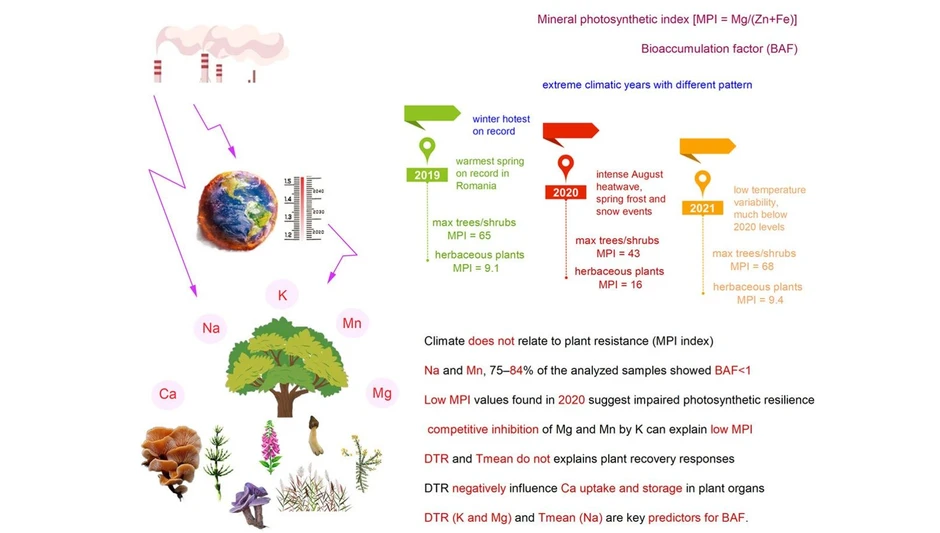
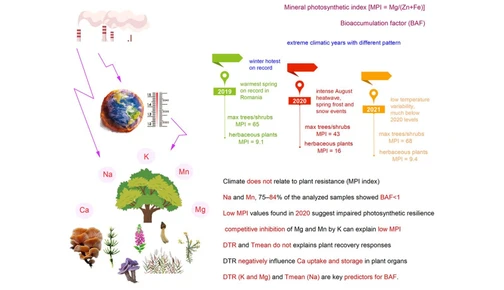
J. Hazard. Mater. Adv., 101071, Volume 21, 2026: Graphical abstract
This study investigates nutrient dynamics and biochemical imbalances in a heavily industrialized area of Copșa Mică, Romania, during 2019–2021. Plant, fungal, litter, soil, water, and sediment samples were analyzed for K, Ca, Mg, Mn, and Na to assess mineral uptake, enrichment, and physiological stress under changing climatic conditions.
Persistent nutrient deficiencies and disrupted mineral relationships were observed, including evidence of competition between K, Mg, and Mn and a progressive decoupling of biogeochemical cycles. Although no direct relationship with extreme climate events was established, plant resistance declined during the warmer year 2020, suggesting that elevated temperatures may further influence mineral uptake and storage in already stressed ecosystems.
The original article
Nutrient imbalances caused by industrial pollution were not affected by extreme climate events
Constantin Nechitaa1, Andreea Maria Iordacheb1, Carmen Robac, Tomas Pluhacekd, İsmail Koçe, Roxana Elena Ioneteb, J. Julio Camarerof
J. Hazard. Mater. Adv., 101071, Volume 21, 2026
licensed under CC-BY 4.0
Selected sections from the article follow. Formats and hyperlinks were adapted from the original.
Industrial and urban activities are a significant source of pollution in soil, water, and living organisms, impacting ecosystems (Ali et al., 2021a; Boukich et al., 2025a; Iordache et al., 2020; Iordache et al., 2024a; Iordache et al., 2024b). Severe human and environmental issues occur due to toxicity, persistence, and non-degradability of mineral elements (Ben-tahar et al., 2025b; Kumar et al., 2020; Souza et al., 2021). Systematic pollution from multiple sources, combined with climate change, negatively affects terrestrial and aquatic resources through contamination (Boukich et al., 2025b; Boukich et al., 2025c; Chowdhary et al., 2020; Iordache et al., 2022a). However, we still do not know how pollution interacts with extreme climate events impacting the distribution of essential minerals in ecosystem components.
Essential minerals are required for the functioning of biological processes, such as activating enzyme reactions and stabilizing cation (e.g., Mn and Mg) exchange (Ben-tahar et al., 2025a; Li et al., 2021). Macro minerals (e.g., Na, Mg, K, Ca) maintain the ionic balance of structural compounds, amino acids, and nucleic acids, and are associated with toxicological effects after interactions with biological systems (Ali, 2023). They act as cofactors of vital enzymes involved in physiological and biochemical processes. The synergistic and antagonistic interactions among minerals in plants reflect cumulative effects and irreversible damage, as seen with Mn vs. K (Xie et al., 2021); however, the primary focus remains on critical nutrient concentrations (Jin et al., 2023).
Essential minerals serve as vectors for transporting potentially toxic elements within the biotic chain through complex associations and binding. Strategies to accumulate chemical elements and the adaptation process are species-specific (Nechita et al., 2025a). Complex mechanisms cope with coupled climatic and potentially toxic elemental stress, including changes in their structure and function mediated by molecular mechanisms (Kosakivska et al., 2021). Phytohormones generate signals that regulate physiological and molecular responses to growth and development, documenting advanced strategies for resilience (Das et al., 2025). In contrast, macro minerals may play a crucial role in alleviating abiotic stress by upregulating the defense system, promoting the production of secondary metabolites, and protecting cellular membranes (Nazir et al., 2023). Under stress conditions, essential minerals involved in photosynthesis are depleted, indicating low stress resilience (Daud et al., 2025; Leitão et al., 2021). Deficiencies and excesses of essential elements affect the plant's immune response and further alter rhizosphere microbial communities.
The mechanisms by which defense pathways are activated differ across nutrients. Potassium (K) controls stomatal closure and is involved in jasmonic acid production, which contributes to systemic resistance (Pandey and Saharan, 2025; Sulaman et al., 2025). Calcium (Ca) ions participate in signaling pathways (Wdowiak et al., 2024). Manganese (Mn) helps neutralize reactive oxygen species generated during stress (Sharma et al., 2025). Magnesium (Mg) functions in the electron transport chain within chloroplasts, transferring energy from photosystem II to NADP, and also alleviates high-light stress (Jeevanraj et al., 2025). Environmental monitoring identified early warning signs across different system layers, from abiotic to biotic, encompassing aspects like thresholds, coping mechanisms, recovery, adaptability, and transformative capacity (de Graaf-van Dinther and Ovink, 2021). Under long-term industrialization, natural resilience appears to decrease as resistance diminishes, indicating that adaptive and restored resilience are not achieved (Nechita et al., 2021).
Assessing changes in essential minerals is key for determining ecosystem pollution levels. For instance, the mineral photosynthetic index (MPI = [Mg/(Zn+Fe)]) is used to assess tolerance to heavy metals and abiotic stress by reflecting the balance between key photosynthetic processes, particularly chlorophyll activity (Mg) and electron transport (Fe, Zn) (Diatta et al., 2021). Deficiencies in these nutrients reduce electron flow and the maximum quantum yield of photosystem II. Mg and Fe are essential for photosynthesis, while Zn and Fe support antioxidant defense and nutrient stability (Shinozaki and Yoshimoto, 2021; Singh et al., 2024). Imbalances suggest higher stress vulnerability or tolerance (Rahim et al., 2025). Mg acts directly in photosynthesis by supporting chlorophyll structure and activating enzymes such as Rubisco, and indirectly supports protein synthesis and reactive oxygen species scavenging (Jeevanraj et al., 2025). A high Zn/Fe ratio indicates effective downstream processes and a strong antioxidant system, showing resilience to stress (Ali et al., 2021b). Overall, this ratio indicates how metabolic functions are affected by mineral nutrition on photosynthesis and stress response (Saudy et al., 2022).
However, there remains a lack of global monitoring studies to understand the behavior and evolution of macronutrients in plants following the closure of industrial facilities and under current warming trends, which can increase vegetation stress. Earlier research focused on toxic metals (Hg, Cd, and As), overlooking the roles of nutrients (Bartha et al., 2020; Harja et al., 2023; Hoaghia et al., 2022; Nechita et al., 2021; Vlad et al., 2019). K, Ca, Mg, Mn, and Na can function as mediators in heavy metal toxicity and act as indicators of biogeochemical remediation, which is essential for nutrient management to improve plant resistance to environmental stress. Most studies used retrospective approaches based on tree rings to evaluate changes in growth resilience (Nechita et al., 2021; Nechita et al., 2025a). An alternative methodology for evaluating plant recovery after environmental stress employs the MPI, which enables assessment across multiple substrates (trees, shrubs, and herbaceous plants) (Diatta et al., 2021). In this context, the objectives of this study were to: (i) evaluate the contents of macro minerals (K, Ca, Mg, Mn, and Na) in 40 environmental substrates or matrices (plants, fungi, water, soil, and sediments), (ii) find patterns between macro elemental content and climatic variables over three years of monitoring (2019‒2021), (iii) evaluate the enrichment and bioconcentration factors in soil and plants, and (iv) model the mineral photosynthetic index as a function of climatic factors to assess recovery patterns. This study aims to assess the effects of mineral deficiency and imbalance resulting from climatic stress on plant mineral nutrition and resilience in a highly industrialized and polluted region.
Methods
2.2. Sample preparation and analysis
The content of essential minerals was determined using the recently published inductively coupled plasma optical emission spectroscopy (ICP-OES) method (Iordache et al., 2022b; Iordache et al., 2024a; Iordache et al., 2024b; Nechita et al., 2025b). Briefly, biotic and abiotic samples were digested in a closed-vessel microwave digestion unit (MARS6, CEM Corporation, Matthews, NC, USA, One Touch) using a mixture of concentrated acids according to either the US EPA 3015, the NPDES, or sand digestion methods. Total macro mineral levels were measured using an ICP-OES Plasma Quant 9100 Elite (Analytik Jena, Germany) with five-point external calibration. All ICP-OES measurements were performed in five technical replicates. The ICP-OES method was validated for linearity, limit of detection, trueness, and precision. The Standard Reference Material (SRM) 2710a Montana I soil, NIST 1570A (trace elements in spinach), and BRC679 (white cabbage trace elements) were used for the ICP-OES method validation in terms of trueness and precision. Moreover, they served as QC samples, which were regularly analyzed within each batch to ensure the reliability of the acquired data. Detailed information on the ICP-OES parameters, method validation, and quality control samples is provided in the Supplementary Material.
Results
3.2. Nutrient ratios
The values of K/(Ca + Mg) in soil and water were very low across all three years (range 0.15-0.58), which explains the imbalances found in trees and shrubs (1.67) and herbaceous plants (2.88). The imbalances were higher in 2020 (1.24) and 2021 (1.56) than in 2019 (2.23). A K/Mg ratio of 7.61 in plants remained relatively consistent over three years. The K/Mn soil ratio (2019: 4.97, 2020: 14.41, and 2021: 7.32) also indicated nutrient imbalance and reduced Mn absorption. The mean Ca/Mg ratio in trees and shrubs was 8.16, and in herbaceous plants, 1.96. However, the Ca/Mg maximum values of 96 (R. pseudoacacia leaves) and 33 (C. monogyna branches) are very high, indicating severe imbalances.
The Bayesian Kendall's Tau correlation coefficient indicated positive associations among macro minerals in abiotic matrices, with only two statistically significant values observed in 2019 (K vs. Ca) and 2020 (K vs. Na) (Fig. 2a–c). In biotic matrices, the correlation intensity was weak, ranging from negative to positive, with only two significant values observed for K vs. Mg and Na in 2019 (Fig. 2d–f). Only Ca was significantly negatively correlated with DTR.
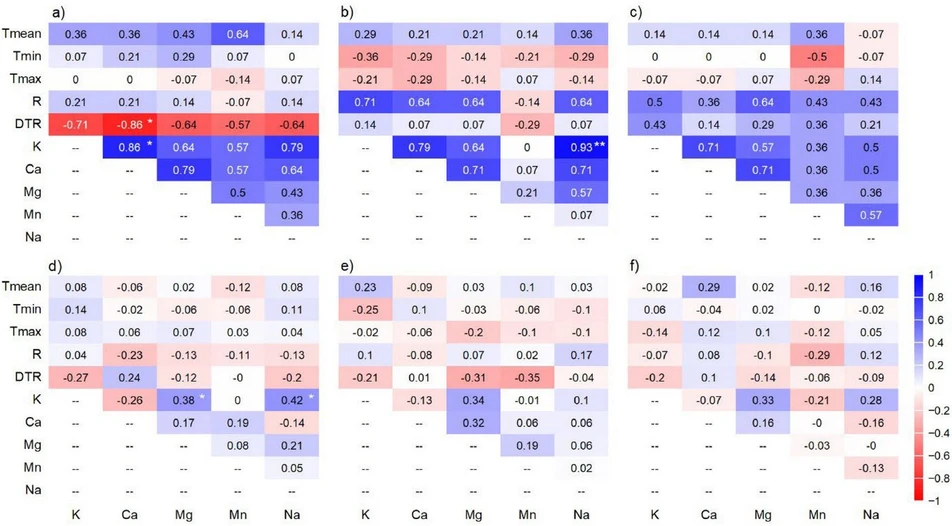 J. Hazard. Mater. Adv., 101071, Volume 21, 2026: Fig. 2. Bayesian Kendall's Tau coefficient for assessing relationships between macro minerals in abiotic (a‒c) and biotic (d‒f) matrices during 2019‒2021. The significance level was established using *BF10 > 10 and **BF10 > 30.
3.5. Climate conditions and changes in minerals
The content of macro minerals in environmental matrices changed over time in relation to climatic variables (Fig. 4a–c). The cumulative inertia on the first component was high and increased in 2020 and 2021. Additionally, in 2019, macro minerals showed a positive correlation with Tmean and R, and a negative correlation with DTR. In 2020, R and Ca, Mg, and Na formed a group with a positive relationship among them and were negatively associated with maximum temperature. Only Ca, Na, and K were negatively influenced by Tmax in 2021.
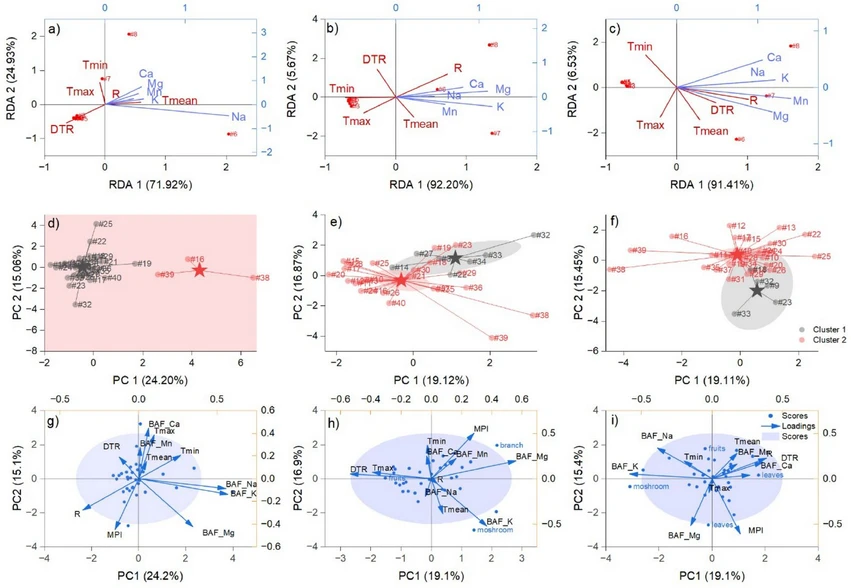 J. Hazard. Mater. Adv., 101071, Volume 21, 2026: Fig. 4. The graphical representation of RDA analysis to assess the macro minerals relationship with climatic variables in the period 2019‒2021 (a‒c). The labels annotated with # followed by a number represent the forty matrices evaluated, as described in the Materials and Methods chapter.
Segmentation of the biota dataset and dimensionality reduction revealed a low degree of climate inference in macro-mineral bioaccumulation and photosynthetic resilience (Fig. 4d–f). ANOVA results indicated that variables with significant contributions to the formation of K-means clusters were the MPI (F = 120, 68 and 66 in 2019, 2020, and 2021, respectively; p < 0.0001 in all cases), Tmean (F = 13, p < 0.05 in 2019), BAF Mg (F = 14 and 4.5 in 2020 and 2021, p < 0.05 in both cases), and Tmin (F = 4.1, p < 0.05 in 2021). The PCA analysis indicated that MPI and precipitation had negative loadings in 2019. In 2020, MPI exhibited positive loadings, whereas climatic variables did not consistently load positively or negatively on PC1 and PC2. Different loading was observed in 2021 for MPI, with PC1 being positive and PC2 negative.
Conclusions
We aimed to assess in situ ecosystem resilience under current climate change and historical pollution stressors, using mineral (K, Ca, Mg, and Na) deficiency and imbalance as indicators. Results indicated a high K content, supporting the hypothesis that an imbalance with other minerals disrupts the equilibrium of essential elements. Levels of macro minerals in plants varied by year, organ, matrices, and location. Compared to optimal ranges, essential nutrients were deficient in all matrices. The EF showed depletion or minimal enrichment in the litter and 25-cm deep soil. Except for K, plant element levels were low, and BAF values indicated limited bioaccumulation. In 2020, characterized by extreme climatic events, the MPI was low, suggesting that climate extremes may exacerbate stress induced by mineral deficiencies. Although long-term environmental pollution is characterized by a decreased mineral content, our findings indicate a gradual increase since 2019 following the cessation of industrial activities; however, MPI and BAF remain low, and the mineral ratio accentuates biochemical imbalance. Fitted models showed a weak link between BAF values of K versus Mg and Na with the diurnal temperature range and the mean temperature, respectively. Our findings highlight the need for improved monitoring of macronutrients in polluted areas under climate-warming conditions.