Mo, 21.9.2026 | Original article from: Journal of Archaeological Science, 2026, 106594, Volume 191
A combined ATR-FTIR, ICP-MS, Py-GC-MS, and THM-GC-MS approach identifies organic and inorganic components in Ancient Egyptian mummification balms.Combining elemental analysis and molecular techniques to characterize Ancient Egyptian mummification balms
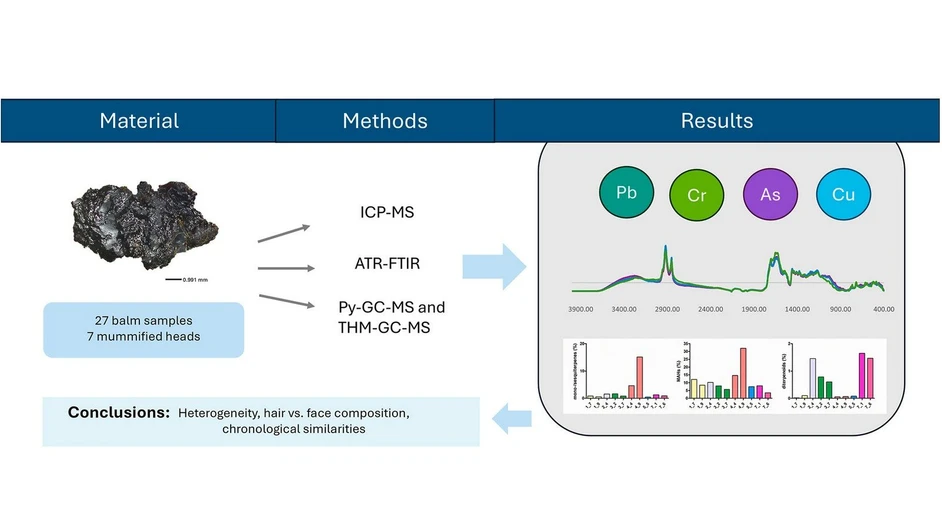
Journal of Archaeological Science, 2026, 106594, Volume 191: Graphical abstract
This study combines ATR-FTIR spectroscopy with ICP-MS, Py-GC-MS, and THM-GC-MS to characterize mummification balms from seven Ancient Egyptian mummified heads. The analyses identified fats and oils, Pinaceae resin, beeswax, bitumen, natron, soil particles, and possible cosmetic pigments containing arsenic, copper, and lead.
Multivariate analysis showed substantial compositional heterogeneity, with samples from similar periods displaying greater similarity and differences also observed between balms applied to the hair, face, and neck. The combined non-destructive and micro-destructive workflow provides detailed chemical characterization while minimizing sample consumption from valuable cultural heritage objects.
The original article
Combining elemental analysis and molecular techniques to characterize Ancient Egyptian mummification balms
Marta Colmenares-Prado, Antonio Martínez Cortizas, Joeri Kaal, María Benito Sánchez, María García Velasco, Olalla López-Costas
Journal of Archaeological Science, 2026, 106594, Volume 191
licensed under CC-BY 4.0
Selected sections from the article follow. Formats and hyperlinks were adapted from the original.
Mummification was a complex process with many steps and different balm recipes were found for different periods, social class, and even sex or age of the deceased. Differences in composition of balms sampled from different body parts are documented in the literature (Tchapla et al., 2004; Oras et al., 2020; Evershed and Clark, 2021). A recent publication proved that these differences were not only due to the heterogeneity of the material, but it had different purposes and significance (Rageot et al., 2023). They found that in that workshop some ingredients or mixes of ingredients were used specifically for embalming the head. Also, Rageot et al. (2023) found some vessels with specific instructions for the purpose of their content: i.e. washing, reducing body odour and softening the skin. Thus, every balm had its own purpose, both with practical and symbolic/religious significance. Thereby, by sampling different areas of the head (including balms at different dephts for one of the mummies) we aim to find out if even within the head there were differences in balm composition in the present collection.
Biogeochemical studies of the mummification balms can provide valuable information on the ingredients used in the mummification ritual and resolve questions regarding the provenance of the samples. In particular, ATR-FTIR is a non-destructive technique easy to use and highly informative when combined with multivariate analysis such as Principal Component Analysis (Łucejko et al., 2026). This technique irradiates infrared light into the sample, which excites the chemical bonds of the molecules making them vibrate in different manners. Depending on the bonds present on the sample, they vibrate at different wavenumbers and the equipment registers this and generates an absorbance spectrum with different absorbance's intensities depending on the amount of each type of bond within the molecules in the sample (Larkin, 2011). This technique provides information on the molecular composition of the samples (both organic and mineral fractions). We have selected a small batch of samples for complementing ATR-FTIR analysis with ICP-MS, Py-GC-MS and THM-GC-MS. ICP-MS provides qualitative and quantitative information on the elemental composition of the samples. Thereby, it allows to determine the concentrations of chemical elements, and thereby, provides information on the mineral ingredients or dust particles inclusions present in the balm. Py-GC-MS and THM-GC-MS are two chromatographic methods with high sensibility that allow for the detection of biomarkers of organic constituents (Łucejko et al., 2026), yielding a more precise and specific identification of the organic ingredients used in the mummification balms, that can be related to the source of plant resins and beeswax.
Here, we aim to use elemental (ICP-MS) and molecular analysis (ATR-FTIR and analytical pyrolysis) to understand more about the mummified heads curated on ‘Museo de Antropología Médica, Forense, Paleopatología y Criminalística - Profesor Reverte Coma’. The objectives of this study were to: i) characterize the elemental and molecular composition of the balms, ii) determine if the composition of the embalming materials is heterogeneous or homogeneous within the same mummy, and iii) deepen into the provenance of the mummified individuals of the “Colección Velasco”, focusing in the differences between individuals and the origin of the products used. Indeed, this is the first of a series of studies to address archaeological information and develop preservation strategies for this collection.
2. Material and methods
2.2. Methods
2.2.2. Inductively coupled plasma mass spectrometry (ICP-MS)
Samples were digested with 1 ml of HNO3 2% (Hiperpur, Panreac) and 0.5 ml H2O2 (Panreac) in a microwave system (Ultrawave) at 230 °C for 30 min. After digestion, MilliQ water was added to a final volume of 5 ml. Then, element concentrations were measured using an Agilent 7700 ICP-MS, equipped with an introduction system with a Micromist glass low-flow nebulizer, Scott spray chamber with Peltier (2 °C) and a quartz torch. The equipment is hosted at the Unidade de Análise Instrumental, Área de Infraestruturas de Investigación facility (Lugo, Universidade of Santiago de Compostela, Spain). Concentrations for 23 major, minor and trace elements were determined. Calibration standards were prepared in a matched acid solution with the concentrations for Al, Fe, Na, Mg, Sr, K, As, Ti, Ni, Cu, V, and Pb (Multi IV-MERCK) between 0.2 and 10 000 μg/l, for Si between 0.1 and 10 mg/l and for Ca, P and S (Panreac) with concentrations from 1 to 100 mg/l. Samples were analysed together with five procedural blanks. All samples and blanks were analysed in triplicate, with Ir 20 μg/l as the internal standard. Calibrations were performed daily by analysis of fresh standard solutions. In all cases, linear responses were obtained with correlation coefficients higher than 0.999, and a relative standard deviation (RSD) lower than 5%. To monitor the overall performance of the system, four reference materials (BCR277R, NIST1486, NIST1400 and 02704-50, estuarine sediment measured 1 time, bone meal, measured 2 times, bone ash measured 1 time, and apple leaves, measured 1 time, respectively), were analysed along with the samples obtaining acceptable recovery percentages (91-100%) except for Si in the NIST1400 reference material, with a recovery of 62 %.
2.2.3. Fourier transformed infrared spectroscopy - attenuated total reflectance (ATR-FTIR)
We used an Agilent Technologies Cary 630 FTIR spectrometer (EcoPast, Universidade de Santiago de Compostela). The spectra were collected using attenuated total reflectance (ATR) in the mid infrared region (MIR), ranging from 4000 to 400 cm−1, at a resolution of 4 cm−1. A background was collected before each sample, and 100 scans were performed to obtain each spectrum. Thorough cleaning with ethanol was done between samples to remove lipidic residues. The R statistic package {andurinha} (Álvarez-Fernandez and Martínez-Cortizas, 2020) was used to obtain standardized IR spectra, second derivative spectra and determine the location (i.e., wavenumber) of the main absorbances/peaks for all samples. Peak attribution to the different functionalities was done based on literature (Coates, 2000; Socrates, 2001; Larkin, 2011).
2.2.4. Pyrolysis-gas chromatography-mass spectrometry (Py-GC-MS) and Thermally assisted hydrolysis and methylation (THM-GC-MS)
Ten samples (MAMF1.7, MAMF1.9, MAMF2.4, MAMF3.2, MAMF3.7, MAMF4.4, MAMF4.9, MAMF5.5, MAMF7.1 and MAMF7.6) were analysed by Py-GC-MS and THM-GC-MS. These analyses were performed as supporting tools for the molecular identification of organic constituents. For this purpose, a Pyroprobe (CDS Analytical) coupled to an 8860 GC and 5977 MSD (Agilent Technologies) was used. The preparation of the samples consisted of the embedding of the samples in glass wool-containing fire-polished quartz tubes. Then, the samples were pyrolyzed at 650 °C for 20 s with a heating rate of 10 °C/ms. The pyrolysis-GC interface, GC inlet, and GC-MS interface were set at 325 °C. The GC was equipped with a non-polar HP-5MS 5% phenyl, 95% dimethylpolysiloxane column (length 30 m; internal diameter 0.25 mm; film thickness 0.25 μm). The carrier gas employed was helium with a constant gas flow of 1 ml/min. The GC oven was heated from 60 to 325 °C at 20 °C/min. The ion source of the MS operated in electron impact mode (70 eV) at 230 °C and the quadrupole detector was held at 150 °C, measuring fragments in the m/z 50-500 range. Compounds were identified based on existing literature on pyrolysis fingerprints (Colombini and Modugno, 2009; Van den Berg, 2003) and personal mass spectral libraries.
3. Results
3.1. Digital microscope
Based on the external appearance two types of balm samples were identified (Fig. 1): blackish with white/yellow inclusions of mineral appearance (1A, 1B, 1E, 1F), and orange/amber soft and sticky samples (1C), with a more heterogeneous appearance. MAMF4.9 sample is an exception, which presented a black, hard, crystalline and shiny appearance with few yellowish inclusions (Fig. 1D). Also, in some of the samples, soft tissue (Fig. 1A), bandages (Fig. 1E) and hair (Fig. 1A and F) were observable.
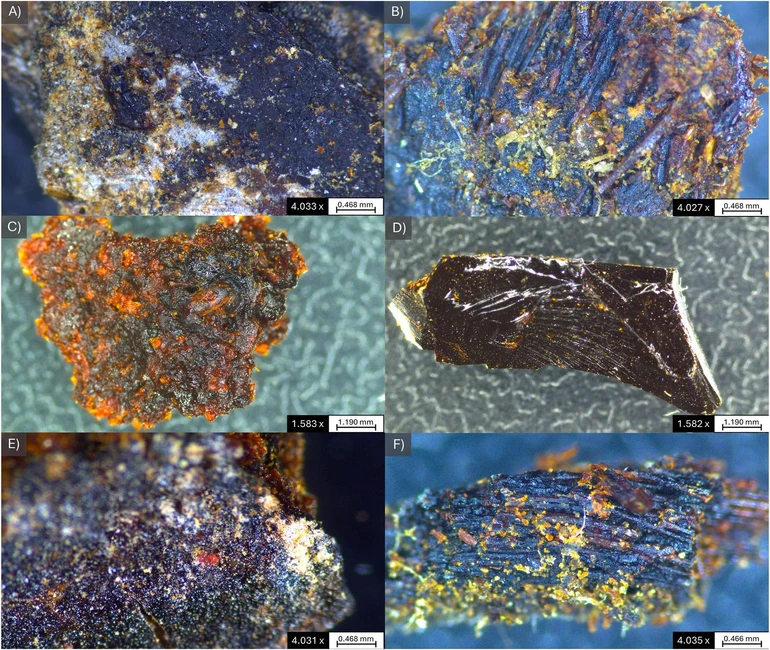 Journal of Archaeological Science, 2026, 106594, Volume 191: Fig. 1. Digital microscope images of some of the mummification balms of the MAMF collection. A) MAMF1, B) MAMF2, C) MAMF3, D) MAMF4, E) MAMF5, F) MAMF7.
3.3. Fourier transformed infrared spectroscopy coupled to attenuated total reflectance (FTIR-ATR)
The standardized spectra of the 27 samples are represented in Fig. 2A, the average standardized spectrum and the standard deviation spectrum are shown in Fig. 2B, and the average second derivative spectrum is depicted in Fig. 2C. We observed large-to-moderate absorbance in the regions between 2958 and 2850, 1735-1540, 1460-950 and 800-500 cm−1 (Fig. 2A). The standard deviation spectrum shows that the regions with higher variation between samples are the aliphatic (2991-2838 cm−1), the carbonyl (C=O stretching) (1735-1670 cm−1), the amide I and amide II (1664-1510 cm−1) and the polysaccharides/aluminosilicates (1080-870 cm−1) regions. Peaks at 2958, 2929 and 2850 cm−1 (aliphatic functionalities) could correspond to fat, oil, beeswax or plant resin (Łucejko et al., 2012; Ménager et al., 2014). Peaks at 1737 and 1703, and 1687 cm−1 are indicative of carbonyl containing compounds, therefore, this suggests the presence of plant resin or beeswax. CH-bending vibrations at 1463 and 1377 cm−1 and COOH bending at 1161 cm−1 (Łucejko et al., 2012; Marković et al., 2020) are characteristic of aromatic compounds. Absorbances related to amide I (1655, 1638, 1623, 1606 cm−1) and amide II (1562, 1545, 1524 cm−1), probably from proteinaceous material such as collagen in skin or soft tissues (Ménager et al., 2014), were also observed. Furthermore, bands at 1364, 1055, 999 and 658 cm−1 may indicate the presence of polysaccharides (Ménager et al., 2014). Finally, peaks characteristic of mineral compounds such as 1031, 999, and 658 cm−1, point to the presence of aluminosilicates (Martínez Cortizas et al., 2021).
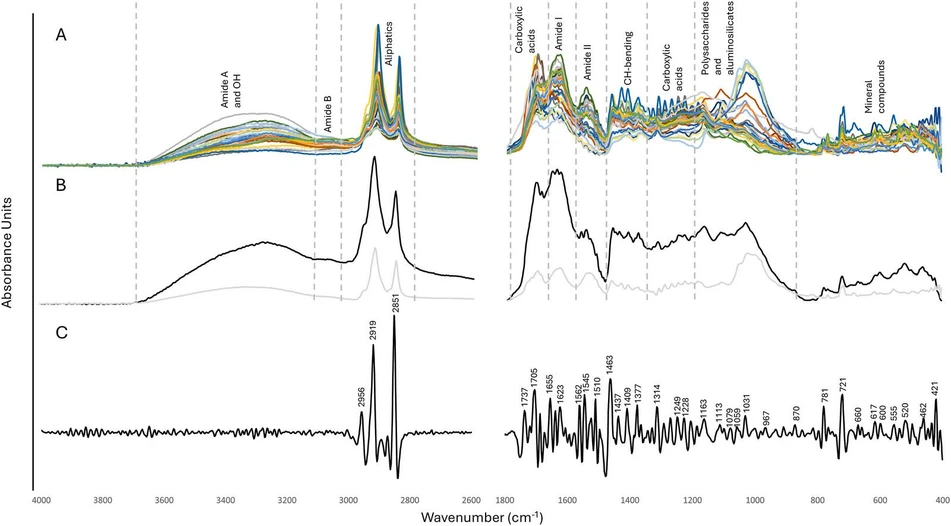 Journal of Archaeological Science, 2026, 106594, Volume 191: Fig. 2. (A) Background-corrected ATR-FTIR spectra with functionalities groups, (B) average (black) and standard deviation (grey) spectra, (C) second derivative spectrum with the most representative absorbance bands.
5. Conclusions
Ancient Egyptians cared about beauty, and the afterlife was not an exception. In this investigation we have found evidence of the use of possible cosmetics in some of the samples: presence of lead, differences in the external balm signal in respect to the one close to the skin, differences in the composition between samples in the hair region compared with those of the face. Thus, the chemical signal of the samples may originate from cosmetics and not only embalming materials. Embalming materials are complex mixtures, and their biogeochemical assessment is challenging. Here, we have proved the usefulness of combining different techniques (elemental analyses: ICP-MS, and molecular analyses: ATR-FTIR, and Py-GC-M, THM-GC-MS, in combination with chemometrics) to better understand the ingredients used in mummification. ATR-FTIR enabled exploring the general chemical composition of the samples (main components, including mineral ingredients) but it is not as specific as to discriminate the balm ingredients, so complementary techniques such as Py-GC-MS and THM-GC-MS and elemental analyses (i.e., ICP-MS) in selected samples, provide a high quality profile of the composition of the balms with a minimally invasive methodology. The multivariate analysis of the ATR-FTIR results allowed for the detection of some of the embalming material ingredients: fats and oils, natron, beeswax, Pinaceae resin, polysaccharides - probably from the bandages and gums -, protein - probably from the soft tissues of the mummies -, silicates - probably from dust particles - and bitumen; as well as their distribution among the samples. We found that PC2 could be used as an indicator of the preservation state of the mummies. The use of THM-GC-MS and Py-GC-MS allowed for a more precise identification of the organic constituents, in particular Pinaceae resin, castor oil and beeswax. Also, the use of ICP-MS allowed for the confirmation of bitumen in the samples, heavy metal containing materials, and natron. We detected differences in balms ingredients, not only among individuals but also in different regions of the mummified heads. The composition of the balms was different between MAMF individuals, partially reflecting the chronology, and possibly indicating that that they may come from different archaeological sites, or social contexts. Finally, by analysing the balms of these individuals, we were able to reconstruct parts of their history to understand their past and treat them with the respect they deserve. Also, we now better understand their preservation state and aim to design and establish curation strategies to ensure their adequate preservation paying special attention - and resources - to those individuals with poorer preservation state: MAMF2, MAMF7, and especially MAMF5.