Mo, 23.11.2026 | Original article from: J. Mass Spectrom. 60, no. 11 (2025): e5188
A selective LC-MS³ method detects 17 native steroid esters in dried blood spots at sub-ng/mL levels, providing a simpler strategy for doping control.Simplified Analysis of Native Steroid Esters in Dried Blood Spots by LC–MS3
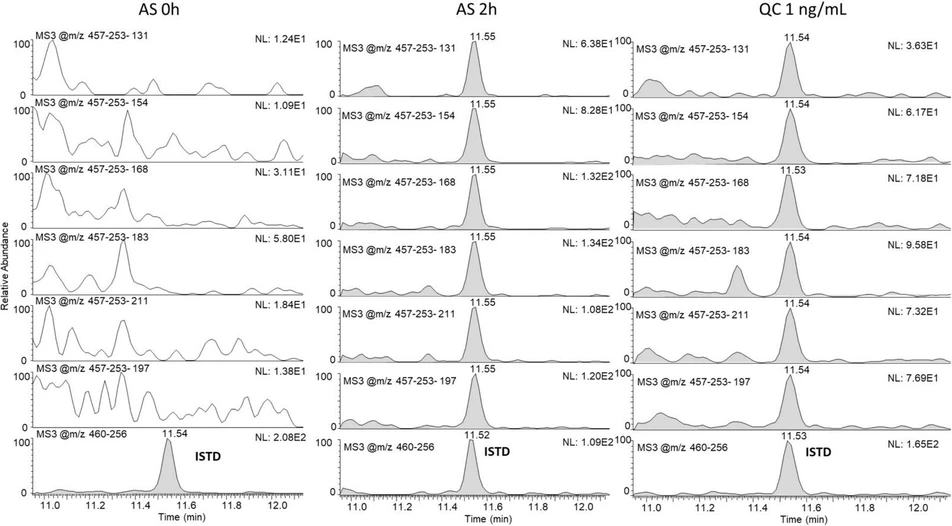
J. Mass Spectrom. 60, no. 11 (2025): e5188: Figure 3 Extracted MS3 chromatograms for testosterone undecanoate of a blank DBS sample (AS 0 h), a post-administration sample (AS 2 h), and a quality control sample (QC, fortified at 1 ng/mL).
This study develops a simplified LC-MS³ method for direct analysis of 17 underivatized testosterone, nandrolone, and boldenone esters in dried blood spots. Most analytes showed detection limits below 0.1 ng/mL from a single blood spot, with recoveries of 40–80% and stable isotope-labelled internal standards used for analytical control.
The method performed similarly with cellulose-based DMPK cards and polymer-based TASSO devices. Analysis of authentic samples collected after testosterone undecanoate administration confirmed its practical applicability, demonstrating that direct detection of exogenous steroid esters in DBS can provide a sensitive and less resource-intensive alternative for doping control.
The original article
Simplified Analysis of Native Steroid Esters in Dried Blood Spots by LC–MS3
Andreas Thomas, Jasmin Thelen, Panagiotis Sakellariou, Mario Thevis
J. Mass Spectrom. 60, no. 11 (2025): e5188
https://doi.org/10.1002/jms.5188
licensed under CC-BY 4.0
Selected sections from the article follow. Formats and hyperlinks were adapted from the original.
The detection of anabolic androgenic steroids (AAS) in sports drug testing remains an important and critical component of anti-doping efforts worldwide. Traditionally, urine has served as the primary biological matrix for the detection of steroid abuse; however, alternative matrices such as dried blood spots (DBS) are gaining traction due to their minimally invasive sampling, ease of transport and potential for improved analyte stability [1]. Steroid esters, commonly administered via intramuscular injection or oral administration (e.g., testosterone undecanoate), are among the most misused AAS [2]. These esters are lipophilic derivatives of anabolic steroids, typically esterified at the 17β-hydroxyl group (e.g., testosterone, nandrolone or boldenone). The esterification prolongs the steroids' half-life by increasing their lipophilic properties and, thus, allowing for sustained release from muscle depots after injection. In blood, steroid esters are generally susceptible to enzymatic hydrolysis by esterases, converting them into their active free steroid forms [2-4]. This hydrolysis can occur rapidly in whole blood, particularly when stored at room temperature, more slowly under cold storage at 4°C or −20°C, respectively, and this hydrolysis is significantly suppressed in DBS due to reduced enzymatic activity in dry conditions [4].
While these nonnatural esters are commonly not observed as intact analytes in urine, the analysis for those compounds in urinary specimens focuses on the deesterified steroids, followed by dedicated analyses that allow for differentiating these from their endogenous counterparts (where necessary). These follow-up analyses for endogenous AAS mainly rely on isotope-ratio-mass spectrometry (IRMS) [5]. The direct measurement of the nonnatural ester form in DBS represents a much easier and faster approach, [2, 3] with the limitation that the detection window for steroidal esters in DBS has been found to be substantially shorter than urine analyses employing IRMS [6]. Nevertheless, several assays to detect steroid esters in DBS by means of liquid chromatography coupled to mass spectrometry (LC–MS/MS) have been developed recently [3, 4, 6-12]. The main challenges arise from the complex matrix in combination with the required sensitivity due to the very low levels of steroidal esters in blood. Recent application studies with different steroid esters have demonstrated that the whole blood concentrations usually fall within the low nanogram per milliliter range, and most analytical methods have accordingly been designed to target these levels [10, 13]. To reach these requirements, most assays use derivatisation agents to enhance the ionisation efficiency of the target analytes in electrospray ionisation (ESI) in combination with sophisticated chromatographic conditions [5, 9-13]. Notably, also automated extraction of DBS (cellulose cards only) with subsequent analysis of native steroid esters was published recently [8].
The introduction of new advancements in mass spectrometry, particularly high-resolution and tandem mass spectrometry (HRMS and MS/MS), has enabled the sensitive and specific detection of these esters even at trace levels. When coupled with micro-sampling techniques like DBS, mass spectrometry offers a promising approach for out-of-competition and in-competition testing, especially where traditional sample collection is impractical.
This study focuses on the development and validation of a robust analytical method for the detection of native steroid esters from DBS using LC–MS3. Emphasis was placed on method sensitivity, selectivity and its application to realistic doping control scenarios.
2. Experimental
2.5 Liquid Chromatography/Mass Spectrometry (LC–MS)
LC–MS was performed on a Vanquish UHPLC liquid chromatograph coupled to a Thermo Stellar mass spectrometer (both Thermo Fisher Bremen, Germany). Solvent A was 0.1% formic acid in water, and 0.1% formic acid in methanol was used as solvent B. The gradient started at 40% of B, increased to 99% of B in 10 min, ran isocratic at 99% of B for 2.5 min, with subsequent re-equilibration at 40% of B for 2.5 min. Thus, the overall runtime was 15 min, with a flow rate set to 350 μL/min, using an Accucore C18, 100 × 2.1 mm with 2.6 μm particle size analytical column (Thermo Fisher Bremen, Germany). A volume of 10 μL of the sample was used for injection.
The mass spectrometer was equipped with a HESI auto ready ion source supported with nitrogen as spray gas. The temperatures were set to 550°C for the vaporizer and at 325°C for the ion transfer tube. Positive capillary voltage was set to 3.5 kV. The gas supply for the collision cells was nitrogen and helium of 5.0 grade. The instrument was used in tMSn mode with a quadrupole isolation window of 1.5 Da, and both activation types (higher energy collision-induced dissociation: HCD, and collision-induced dissociation: CID) were enabled (see Table 1). The precursors were first activated by CID, and the resulting product ions were further processed with HCD. For precursor ions, the CID activation time was set to 2 ms and the activation Q at 0.25. HCD and CID collision energies were set as shown in Table 1. For the dissociation of the product ion, the CID activation time was set to 10 ms with an activation Q of 0.25. For all experiments, the expected retention times of the respective esters were scheduled applying a time window of 2 min. Exemptions were made for testosterone and the respective ISTD (2H3-testosterone), which were analysed in MS2 mode.
3. Results and discussion
The here presented assay employs MS3 experiments coupled to (low-resolution) mass spectrometry for sensitive detection of steroid esters from DBS for doping controls without derivatisation. In comparison to existing assays (mainly employing derivatisation steps and/or high resolution mass spectrometry), the sensitivity in this assay is competitive or even better [7, 11-13]. Noteworthy, the required specificity under the chosen conditions was reached in MS3 mode for nearly all of the target esters only. The analysis in MS2 mode does not enable the effective measurement in the sub nanogram per milliliter range due to lack of specificity. A comparative measurement of a fortified QC sample (at 0.1 ng/mL) in MS3-resp. MS2-mode is shown in Figure S1. Here, the gain in specificity is demonstrated for the analysis of testosterone propionate, yielding significantly better signal-to-noise for the selected product ions in MS3-mode. Another benefit of the native analysis (without derivatisation) is the potential to expand the assay to several other classes of doping substances [7].
3.2 Post-Administration Samples
The analysis of post-administration samples after oral application of 80 mg of Andriol provided authentic test results beyond those obtained from spiked test method validation samples. The respective extracted ion chromatograms are shown in Figure 3. Here, six diagnostic ion traces from different MS3-derived product ions are shown, which impressively enable the detection (and confirmation) of testosterone undecanoate in the sample collected 2 h after administration. Notably, the data shown are extracted from the original initial testing procedure as described above (not a targeted confirmation method), including all target esters. The analysis of the samples after oral administration of testosterone undecanoate showed rather short detection windows; after 6 to 8 h post-administration, the drug was no longer detectable in DBS (< 50 pg./mL). This is in accordance with earlier studies, and other routes of application (e.g., intramuscular injection) will certainly yield much longer detection windows.
J. Mass Spectrom. 60, no. 11 (2025): e5188: Figure 3 Extracted MS3 chromatograms for testosterone undecanoate of a blank DBS sample (AS 0 h), a post-administration sample (AS 2 h), and a quality control sample (QC, fortified at 1 ng/mL).
3.3 Doping Control Aspects
As already mentioned before, the detection of steroid esters in blood samples represents a direct adverse analytical finding (AAF) and, accordingly, an anti-doping rule violation. In case of a suspicious result in the initial testing, WADA requirements mandate a subsequent confirmatory analysis dedicated to the individual steroid ester from another spot [14, 15]. WADA technical documents provide detailed criteria for the liquid chromatographic as well as the mass spectrometric parameters, which must be fulfilled before the final identification of a prohibited substance in a doping control sample can be confirmed [15]. Besides the evaluation of the (relative) retention times of the analyte peak in the sample and the quality control sample (fortified with the respective target analyte), several distinct mass spectrometric criteria are also specified. One such criterion is the acceptance range for the product ion peak area ratios of at least two diagnostic product ions, and thus, stable and reproducible conditions in the collision cell are crucial. The herein employed mass spectrometer composed of hyphenated quadrupole, multipole and dual-pressure linear ion trap units allows for combined activation types (CID and HCD), for which such stability data have been scarce [16]. To obtain at least presumptive information about the stability of the peak area of product ion ratios relevant to this project, the standard deviations for six product ion ratios (exemplarily for testosterone undecanoate, see Figure 3) were computed for all samples of the LOI measurements (at 1.0, 0.5, 0.25 and 0.1 ng/mL, n = 28). Figure 4 shows the obtained data with the most abundant signal at m/z 457-253-197 set as 100%. The calculated standard deviations are shown as black bars and all range below 15%, with no significant bias due to the different concentrations (in the working range from 0.1 to 1 ng/mL). These data strongly suggest that the approach will provide stable peak area ratios of product ions as required for confirmatory analyses, especially considering that the obtained data in Figure 4 were recorded from the analysis of the validation samples using the described multi-target method (> 20 esters including ISTDs). In case of applying targeted confirmation methods dedicated to a single steroid ester only, the increased number of acquired data points over the peak is expected to further improve the robustness of the determined peak area ratios.
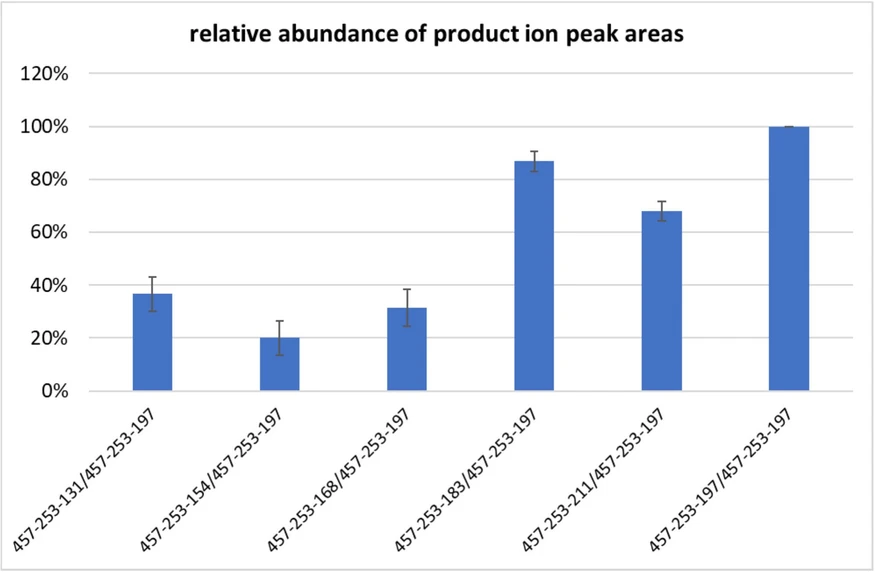 J. Mass Spectrom. 60, no. 11 (2025): e5188: Figure 4 Mean product ion peak area ratios in MS3 (data acquired over the working range of the method from 0.1 to 1 ng/mL) computed from the precursor ion at m/z 457 and the first product ion at m/z 253 for testosterone undecanoate (see also Figure 3). The black bars indicate standard deviation for the peak areas for the respective product ion pair.
4. Conclusion
DBS sampling offers an interesting new tool in sports drug testing due to several significant benefits in the doping control process (minimally invasive, easy to transport, high analyte stability, etc.). However, from the laboratory's perspective, new challenges arise with respect to the very low sample volume (< 20 μL, 3–4 spots) and the complex matrix (whole blood). Although enormous progress in the analysis of DBS has already been made in recent years, there is still a need for more sensitivity and specificity. The present approach demonstrates how these requirements can be met by applying a hybrid quadrupole/multipole/ion trap-based mass spectrometer in MS3 mode for the analysis of prohibited steroid esters. The method presented here for native steroids yields comparable or even better results compared to earlier assays, without using analyte derivatisation [7]. This enables analysing the same extract for numerous additional prohibited substances from other classes of the Prohibited List, without the need of preparing another DBS, which significantly increases the effectiveness of the approach [7].