Tu, 27.10.2026 | Original article from: Thermo Fisher Scientific / Edward Goucher PhD
Modern anti-doping laboratories use LC-MS, GC-MS/MS, HRMS and IRMS for broad screening, confident confirmation and detection of emerging prohibited substances.Advancing Anti-Doping Science: Analytical Strategies for the Evolving Fight Against Doping

Thermo Fisher Scientific: Advancing Anti-Doping Science: Analytical Strategies for the Evolving Fight Against Doping
The integrity of sport depends on the ability to detect prohibited substances accurately, reliably and with confidence. However, as doping strategies become increasingly sophisticated, the analytical demands placed on anti-doping laboratories continue to evolve.
Thermo Fisher Scientific - Advancing Anti-Doping Science - Analytical Strategies for the Evolving Fight Against Doping.webp
Today’s laboratories must do more than test for a static list of known compounds. They need broad analytical strategies capable of addressing hundreds of substances across multiple chemical classes, identifying emerging threats and supporting defensible confirmation and reporting of adverse analytical findings.
For more than 25 years, Thermo Fisher Scientific has worked globally with World Anti-Doping Agency (WADA)-accredited laboratories to advance the analytical science supporting modern anti-doping programs.
Anti-doping testing is a moving target
The World Anti-Doping Agency publishes an annually updated Prohibited List that provides a global framework for testing programs. Yet the list is non-exhaustive, meaning laboratories may also need to detect structurally related compounds and substances across several categories, with similar chemical structure and biological activity.
That creates a significant analytical challenge.
Anti-doping laboratories must be prepared to monitor a broad range of compounds while maintaining the sensitivity, specificity, and confidence required for both initial testing and confirmation.
At the same time, the landscape continues to change. Emerging substances, rapidly expanding doping strategies and new approaches to sample collection and analysis are creating multiple considerations for anti-doping laboratories to consider.
Dried blood spots (DBS), for example, have gained attention as a complementary approach to traditional urine and venous blood collection supporting applications such as detecting steroid esters and monitoring peptides. High-resolution mass spectrometry is also enabling laboratories to consider both targeted analysis and retrospective interrogation of previously acquired data as scientific knowledge and regulations evolve.
From screening to confident confirmation
No single analytical technique can address every anti-doping challenge.
With respect to chemical analysis of toxicologically relevant compounds, modern doping control laboratories employ complementary technologies—including liquid chromatography-mass spectrometry (LC-MS), gas chromatography-mass spectrometry (GC-MS) and isotope ratio mass spectrometry (IRMS)—depending on the compounds and analytical questions involved.
For initial testing, laboratories may need to efficiently screen biological samples for numerous prohibited substances spanning categories such as steroids, stimulants, metabolic modulators, diuretics, narcotics, cannabinoids and peptides.
When an initial Testing Procedure produces a result requiring confirmation, laboratories need analytical approaches capable of supporting confident confirmation.
This combination of broad screening and targeted confirmation has made mass spectrometry central to modern anti-doping science.
Expanding possibilities with LC-MS
High-resolution accurate-mass mass spectrometry can provide precise mass measurements while supporting comprehensive screening of known and suspected substances, while preserving information-rich data that can support investigation of emerging or previously untargeted compounds.
An important advantage of high-resolution mass spectrometry is the ability to revisit previously acquired data. As new substances, metabolites or other analytical targets are identified, laboratories can potentially re-process previously acquired full scan data (and any corresponding MSn experiment) without reanalyzing the original sample. This strategy is currently used by laboratories to support global re-testing programs.
Triple quadrupole LC-MS can complement these workflows by supporting sensitive, targeted quantitation and confirmation of prohibited substances.
Together, these approaches provide laboratories the flexibility needed to address today’s testing requirements while giving laboratories greater flexibility to respond to emerging analytical challenges.
The continuing role of GC-MS/MS
Gas chromatography coupled with triple quadrupole mass spectrometry remains an important technology in anti-doing laboratories, particularly for urinary steroid profiling and the screening and confirmation of anabolic- androgenic steroids and other GC-amenable prohibited substances.
GC-MS/MS can support both screening and confirmation while providing the sensitivity, selectivity and dymanic range required for screening and confirmatory analysis.
The Thermo Scientific TSQ 9610 Triple Quadrupole GC-MS is designed to maximize sample throughput, helping laboratories address the demands of routine testing while maintaining analytical performance across a wide dynamic range. The TSQ 9610 incorporates NeverVent technology, designed to increase instrument uptime by reducing the disruption associated with routine source maintenance.
As anti-doping workflows evolve, bridging screening and confirmation together within robust analytical strategies can help laboratories respond efficiently to increasingly complex testing requirements.
When identifying a steroid isn’t enough
In some anti-doping investigations, simply detecting a compound does not provide the complete answer.
Testosterone, for example, can be produced naturally by the body or administered externally as an anabolic steroid. In cases where laboratories need to distinguish between endogenous and exogenous sources, isotope ratio mass spectrometry can provide another layer of information.
GC-IRMS can help laboratories determine whether selected urinary steroids are consistent with an endogenous or exogenous origin by comparing carbon isotope ratios.
The result is an analytical toolkit in which different technologies answer different questions—from broad screening and sensitive confirmation to determining the origin of a compound.
Putting advanced workflows into practice
Technology is only part of the equation. Real-world anti-doping laboratories also need to manage high sample volumes, turnaround expectations and continually changing analytical requirements.
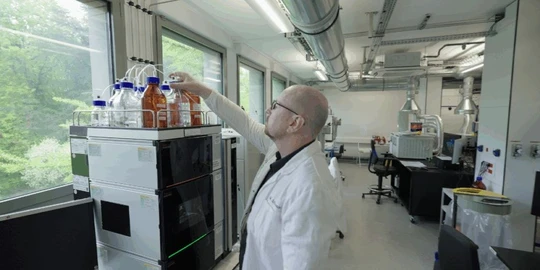
At Laboratoire Anti-Dopage Français (LADF), Director Dr. Magnus Ericsson and his team use advanced mass spectrometry workflows to support anti-doping testing.
According to Ericsson, integration of Thermo Scientific TSQ and Vanquish systems has helped enhance efficiency and turnaround while supporting more than 40,000 sample analyses since 2023.
Experiences like these demonstrate how integrated analytical workflows can help laboratories translate advances in mass spectrometry into routine anti-doping operations.
Preparing for what comes next
Anti-doping science has advanced dramatically—from early testing approaches to today’s sophisticated, — mass spectrometry technologies; including but not limited to GC-MS/MS, LC-MS/MS, high-resolution accurate-mass MS and isotope ratio MS workflows.
But the science cannot stand still.
Emerging compounds, evolving regulations and increasingly sophisticated doping strategies mean laboratories must continually evaluate how they manage and process samples and then screen, identify, quantify and confirm prohibited substances.
The goal remains constant: provide accurate, high-quality analytical results that help protect the integrity of competition.
Explore the technologies, workflows and expert perspectives shaping the next generation of anti-doping testing in our comprehensive eBook, Upholding the Integrity of Sport.
Download the anti-doping eBook
Visit us on LinkedIn: #AntiDoping #MassSpectrometry #SportsIntegrity #WADA