Mo, 23.11.2026 | Original article from: ACS Omega (2026) 11 (26): 38411–38425
GC-MS profiling shows that H. albus hairy roots and callus cultures can enhance tropane alkaloid production, with ZnO-based elicitors further increasing yields.GC-MS Unraveling, Elicitation of Tropane Alkaloids, and Antimicrobial and Antivirulence Activities of Callus and Hairy Root Cultures of Endangered Hyoscyamus albus L.
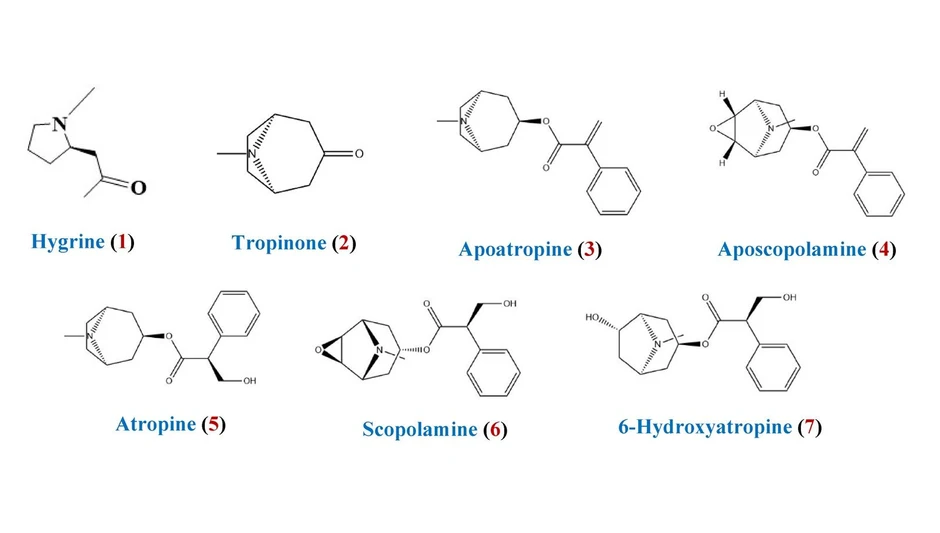
ACS Omega (2026) 11 (26): 38411–38425: Figure 6. Chemical structures of identified alkaloids in the aerial parts, roots, M&S I callus, and hairy roots of H. albus L.
This study uses GC-MS to characterize tropane alkaloids in aerial parts, roots, callus cultures, and hairy root cultures of endangered Hyoscyamus albus. In vitro cultures produced tropinone, while hairy roots accumulated higher levels of scopolamine and aposcopolamine than the parent plant.
ZnO and ZnO nanoparticles were evaluated as abiotic elicitors to enhance alkaloid production, with ZnO promoting atropine accumulation in callus and ZnO nanoparticles improving productivity in hairy roots. The alkaloid extracts also showed antimicrobial and antivirulence activity, supporting tissue culture and nanotechnology as potential tools for sustainable production of pharmaceutically relevant tropane alkaloids.
The original article
GC-MS Unraveling, Elicitation of Tropane Alkaloids, and Antimicrobial and Antivirulence Activities of Callus and Hairy Root Cultures of Endangered Hyoscyamus albus L.
Asmaa M. Arafa*; Esraa A. Mohamed; Rehab H. Abdallah; Ahmed M. Mustafa; Omer I. Fantoukh*; Fatma Al-zahraa A. Yehia; Eman A. M. Ahmed; Samih I. El-Dahmy
ACS Omega (2026) 11 (26): 38411–38425
https://doi.org/10.1021/acsomega.5c11571
licensed under CC-BY 4.0
Selected sections from the article follow. Formats and hyperlinks were adapted from the original.
Antimicrobial resistance (AMR) has been declared a global health threat, as it resulted in five million deaths in 2019, constituting 9% of all global deaths. (29)Escherichia coli, Staphylococcus aureus, Klebsiella pneumoniae, Streptococcus pneumoniae, Acinetobacter baumannii, and Pseudomonas aeruginosa were identified as the leading causes of AMR-associated deaths (73%). These pathogens have a high capability to adapt and survive in either the community or in health care settings. Clinical reliance on existing antimicrobials has led to the emergence of multidrug-resistant bacterial strains. Moreover, limited discovery of new antibiotic classes and cross-resistance between old and new antibiotics within the same class have jeopardized the overcoming of AMR. (30) Aligned with the WHO global action plan, efforts to discover and develop nonantibiotic antimicrobial therapies were intensified.
Alkaloids are well known to be effective therapeutics against multidrug-resistant bacteria, fungi, and viruses, and they have also been shown to inhibit biofilm formation and microbial virulence. (31, 32) Previous studies on the alkaloidal extracts of H. albus have demonstrated notable inhibitory activity against several pathogenic microorganisms, such as P. aeruginosa, S. aureus, Bacillus subtilis, E. coli, and Salmonella typhi. (33, 34) However, evidence regarding their potential activity on microbial biofilms and virulence remains scarce. Accordingly, the current study aims to investigate the antimicrobial, antibiofilm, and antivirulence activities of H. albus alkaloids to provide deeper insight into their therapeutic potential.
To date, there have been no reports on the in vitro propagation, induction of hairy roots (HRs), and elicitation of TAs of Egyptian H. albus L. Hence, this study focuses on in vitro regeneration and HR induction of the Egyptian plant and performs a comparison between the TAs contents of wild plants and in vitro tissues for the first time. In addition, it intends to investigate the effect of abiotic elicitors on the production of TAs in the callus and HR cultures of Egyptian H. albus L. Furthermore, alkaloid extracts of Egyptian H. albus L. were tested for their inhibitory activity against bacterial and fungal growth as well as against bacterial virulence.
2. Materials and Methods
2.7. Alkaloids Extraction and Analysis
The alkaloids were extracted according to the reported method. (10) Briefly, powdered air-dried aerial parts, roots, calli, and hairy roots of H. albus L. (20 g for each) were homogenized separately in 400 mL of 0.1 N HCl (EL-Nasr Chemical Co., Cairo, Egypt) in a Sonorex Super ultrasonic bath (RK 103 H, Bandelin, Germany) at 35 kHz and 140 W for 1 h. The collected acidic solution was filtered and then washed with methylene chloride (SDFCL, Mumbai, India). The aqueous layer was rendered alkaline to reach pH = 9–10 with 33% ammonia (EL-Nasr Chemical Co., Cairo, Egypt) and extracted four times with an equal volume of methylene chloride. The organic layers were collected, dried over anhyd. Na2SO4 (EL-Nasr Chemical Co., Cairo, Egypt), concentrated and stored in tightly sealed dark containers in the freezer until subsequent analysis. The extracted alkaloids were analyzed by HPLC (Waters 2695 Separations Module, Singapore) (47) and GC-MS (Shimadzu GCMS-QP2010 (Kyoto, Japan)) (48, 49) according to the published methods, and their conditions are listed in Table S1.
Results and Discussion
3.6. Unraveling Alkaloids of H. albus L. by GC-MS
A total of seven alkaloids were identified by GC-MS analysis in the aerial parts, roots, M&S I callus, and hairy roots (HRs) of H. albus L. (Figures 5, 6, and S5–S8 and Table 1). The identified compounds are classified as tropane alkaloids (TAs) except for hygrine, which is a pyrrolidine alkaloid. Table 1 revealed the presence of three similar TAs in all samples of H. albus L. Atropine (41.03, 82.46, 64.99, and 34.15%) and scopolamine (19.4, 10.45, 7.74, and 10.81%) are the predominant alkaloids detected in the aerial parts, roots, M&S I callus, and HRs of H. albus L., respectively. Similarly, the main components of flowers, fruits, leaves, stems, and roots of H. albus L. from Egypt were atropine (56.75, 49.44, 57.88, 70.05, and 74.6%) and scopolamine (35.61, 38.77, 33.94, 24.50, and 22.6%), respectively. (10) On the other hand, flowers, seeds, leaves, stems, and roots of Moroccan plants were documented to be rich in atropine (66.3, 80.4, 70.2, 77.8, and 63.8%) and scopolamine (16.5, 6.4, 16.6, 9.1, and 4.2%), respectively. (49) Furthermore, the predominance of atropine and scopolamine in the alkaloids of Egyptian H. muticus, H. desertorum, and H. boveanus was previously reported. (10) Roots are the biosynthetic and storage sites for TAs, (63) which explains why their highest content is detected in H. albus L. roots. Compared with the parent plant organs, callus culture produces low levels of TAs (atropine and scopolamine), consistent with the literature. This was attributed to the fact that cell differentiation is crucial for the biosynthesis of TAs. (14, 64−66) In addition, the auxin added to the culture media can inhibit the enzyme activity that is necessary for TAs biosynthesis. (17, 67) The present study indicated that callus culture is effective in yielding more atropine than the aerial parts. Additionally, M&S I callus and HRs of H. albus L. produced significant amounts of apoatropine (9.23 and 10.58%, respectively) compared with those found in the aerial parts and roots. This agrees with those reported about the higher production of atropine in H. aureus callus than in the parent plant. Type and concentration of phytohormones (auxin and cytokinin) are responsible for the differences in the TAs contents between callus culture and the parent plant. Phytohormones stimulate the production of ornithine, which is the starting point of the TAs biosynthesis. Furthermore, they may have an indirect influence on PMT (putrescine N-methyl transferase) and H6H (hyoscyamine 6β-hydroxylase), which are responsible for the formation of atropine and the conversion of atropine to scopolamine, respectively. (68) The GC-MS technique detected that 6-hydroxyatropine is found in the aerial parts and roots in concentrations of 0.38 and 0.71%, respectively. Also, aposcopolamine (2.18%) and hygrine (0.57%) are the distinctive alkaloids found in the aerial parts and roots, respectively. According to the literature, (10) apoatropine, 6-hydroxyatropine, and aposcopolamine were reported in the aerial parts and roots, while hygrine was detected only in the roots. In contrast to the present study, El-Shazly et al. (10) reported the presence of 24 additional alkaloids, including norhygrine, littorine, and tropinone in H. albus L. Moreover, HRs of H. albus L. induced the production of unique alkaloids: tropinone (2.26%) and aposcopolamine (3.6%). Similarly, atropine, scopolamine, apoatropine, tropinone, and aposcopolamine were produced in the HRs of a German H. albus L. transformed by the A. rhizogenes strain R 1601. (69) Also, HRs of H. albus L. succeeded in producing higher concentrations of scopolamine and aposcopolamine than the parent plant. This finding accords with the higher yield of scopolamine by HR cultures of H. muticus, (70)H. reticulatus, (71) and Datura candida hybrid. (72) Meanwhile, this contrasts with the low content of scopolamine produced by the HRs of a German H. albus L. (63)
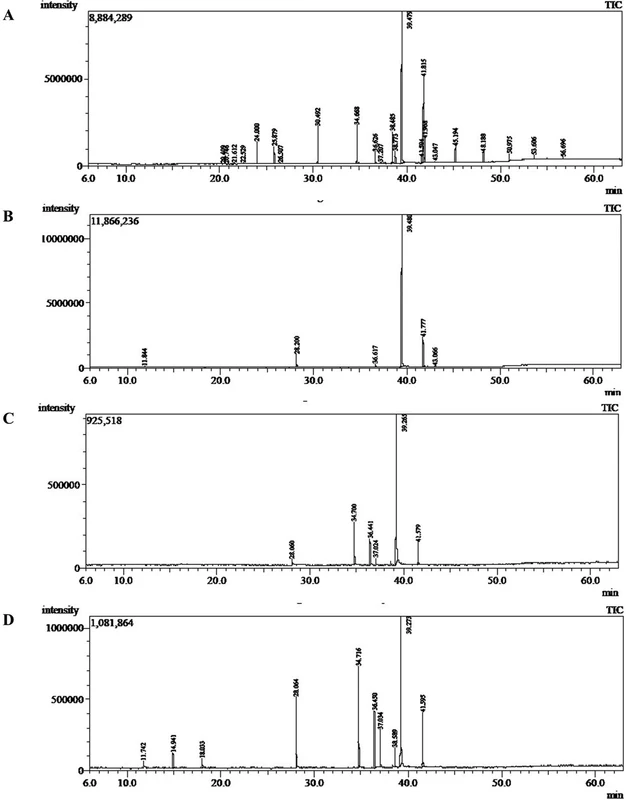 ACS Omega (2026) 11 (26): 38411–38425: Figure 5. GC-MS chromatograms of the aerial parts (A), roots (B), M&S I callus (C), and hairy roots (D) of H. albus L.
ACS Omega (2026) 11 (26): 38411–38425: Figure 6. Chemical structures of identified alkaloids in the aerial parts, roots, M&S I callus, and hairy roots of H. albus L.
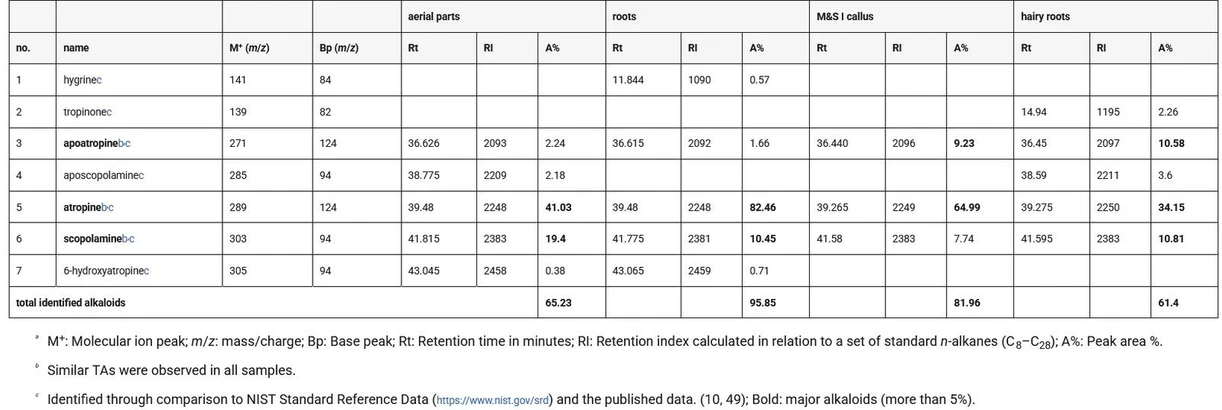 ACS Omega (2026) 11 (26): 38411–38425: Table 1. Alkaloids of the Aerial Parts, Roots, M&S I Callus, and Hairy Roots of H. albus L. Using GC-MS Analysis
3.10. Antivirulence Activity of H. albus L. Extracts
Biofilm-forming pathogens are the leading cause of infectious diseases. Biofilm-embedded bacterial cells are protected from antibiotics and immune cells, which are more challenging to treat. (75) The ability of H. albus L. alkaloidal extracts to interfere with P. aeruginosa and C. albicans biofilm formation was investigated. The highest biofilm inhibition percentage against P. aeruginosa biofilm was observed in M&S I callus extract (85 ± 3.7%), followed by the extracts of aerial parts (49.5 ± 18.9%) and hairy roots (44.76 ± 16%). Moreover, all H. albus L. alkaloidal extracts remarkably disrupted C. albicans biofilm formation (90 ± 7.3, 90 ± 5.2, and 86.5 ± 6.8%, for hairy roots, M&S I callus, and aerial parts, respectively). However, atropine did not exhibit any biofilm inhibitory activity against either P. aeruginosa or C. albicans biofilm, which excludes its role in the biofilm inhibitory activity of H. albus L. extracts (Figure 10A). Consistent with the current study, numerous plant alkaloids have been reported to exhibit potent biofilm inhibitory activity. (76)
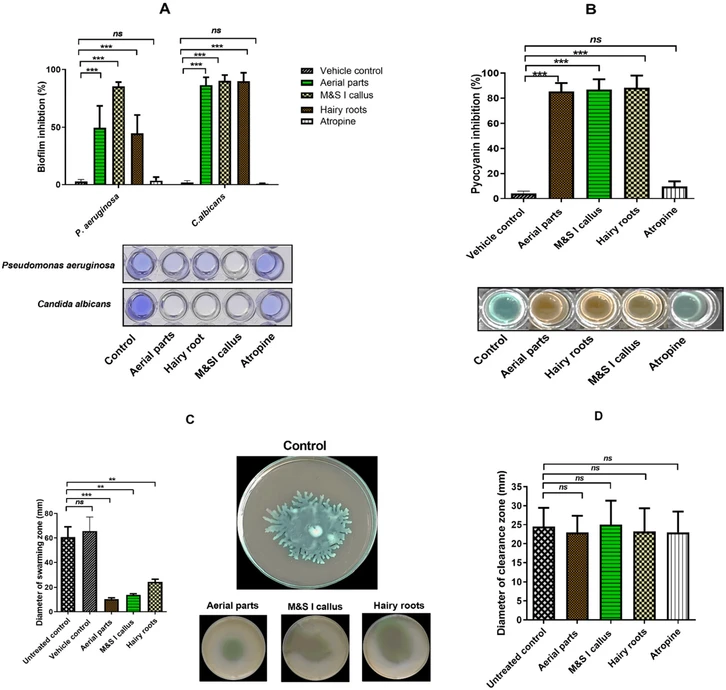 ACS Omega (2026) 11 (26): 38411–38425: Figure 10. Antivirulence activity of the alkaloidal extracts of H. albus L. (aerial parts, M&S I callus, and hairy roots). (A) Antibiofilm activity: (top) Biofilm inhibition percentage of the alkaloidal extracts of H. albus L. against P. aeruginosa and C. albicans; (bottom) photograph of microtiter plate wells stained with crystal violet and solubilized by glacial acetic acid before spectrophotometric measurement. (B) Inhibition of P. aeruginosa pyocyanin production by the alkaloidal extracts of H. albus L.: (top) Percentage of pyocyanin pigment inhibition; (bottom) photograph of supernatant of P. aeruginosa cultured in the absence and presence of the alkaloidal extracts of H. albus L. before spectrophotometric measurement. (C) Inhibition of P. aeruginosa swarming motility by the alkaloidal extracts of H. albus L.: (left) Diameter of swarming zone measured in millimeters; (right) photographs of swarming plates. (D) Effect of the alkaloidal extracts of H. albus L. on protease production. The diameter of the zone of clearance was recorded (mm). Data were the mean ± SD of three independent experiments. All data were analyzed by one-way ANOVA with Dunnett’s post hoc test. **p < 0.01, ***p < 0.001. ns denotes no significant difference.
To establish its pathogenesis, P. aeruginosa utilizes an array of virulence factors, including pyocyanin, protease, siderophores, motility, and toxins. An antivirulence approach has been proposed as an alternative strategy to overcome bacterial antibiotic resistance. Pyocyanin is a potent bioactive pigment that induces strong oxidative stress in host cells. The amount of pyocyanin produced by P. aeruginosa in the presence of H. albus L. extracts was quantified. Pyocyanin was dramatically lost to approximately 88.25, 86.75, and 85.25% by hairy roots, M&S I callus, and aerial parts, respectively, with no superior activity for any of the extracts (Figure 10B). Atropine showed negligible pyocyanin inhibitory activity (9.5 ± 4.2%). Interestingly, there are no previous reports on the antipyocyanin activity of the alkaloidal extract of H. albus L. Some pyrrolidine and piperidine alkaloids have been reported to suppress pyocyanin production. (77, 78) Next, swarming motility, a specialized bacterial movement, was investigated. Swarming zones were significantly inhibited in the presence of the aerial parts extract, showing a reduction of the swarming zone diameter to 1/6th of the control (Figure 10C). Regarding the effect of H. albus L. extracts on protease production, supernatant of P. aeruginosa culture was added to wells of skim milk agar plates, and the zone of clearance was measured. The results showed no significant difference in the diameter of the clearance zone either in the absence or presence of H. albus L. extracts, indicating that H. albus L. extracts and atropine have no effect on protease production (Figure 10D). Regarding the vehicle control group, in which DMSO was used at the same concentration as in the working solutions, no inhibitory activity was observed on any of the assessed virulence factors. It is noteworthy that there were no previous reports on the antivirulence activity of the alkaloidal extracts of H. albus L.
4. Conclusions
This research presents an efficient protocol for the in vitro propagation of H. albus L. For the first time, callus and hairy root cultures of H. albus L. have been established and may serve as alternative biofactories to produce tropane alkaloids. Furthermore, zinc oxide (Z) and zinc oxide nanoparticles (ZNPs) are promising and efficient methods for increasing the production of these compounds. Future studies could focus on the genetic and metabolic engineering of H. albus hairy roots, optimization of elicitation strategies using elicitors either individually or through the investigation of their synergistic effects, as well as scale-up production in bioreactor systems to achieve sustainable and industrial-level production of tropane alkaloids. Ultimately, the alkaloidal extracts of H. albus L. exhibited remarkable inhibitory effects on biofilm formation, pyocyanin production, and swarming motility. As a result, H. albus L. can act as a natural candidate for the development of antimicrobial and antivirulence agents. A limitation of this study is that the antivirulence and antibiofilm activities were evaluated using a crude extract, which precludes identification of the specific active constituents and their underlying mechanisms of action. Nevertheless, assessment of the extract yielded promising inhibitory effects, suggesting a beneficial activity of its components. Further studies will focus on individual testing of extract components that would provide more precise insights into the potency, contribution, and mechanistic roles of each constituent.