Mo, 9.11.2026 | Original article from: Eur. J. Med. Chem., 2026, 118716, Volume 308
Designed steroidal derivatives inhibit efflux pumps in multidrug-resistant S. aureus, enhancing susceptibility to ciprofloxacin and erythromycin.Steroidal hormones and neurosteroids - novel therapeutic strategies in bacterial infections: Design, synthesis, and biological evaluation
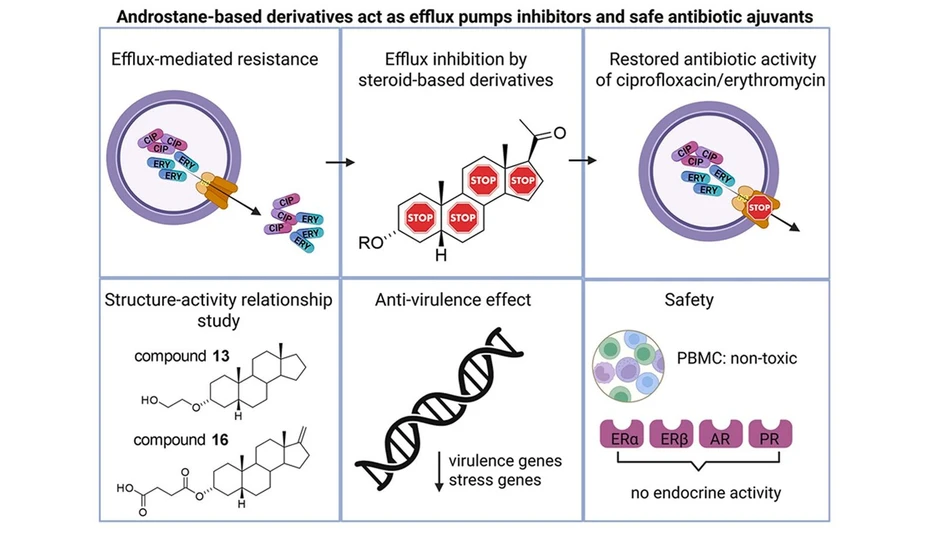
Eur. J. Med. Chem., 2026, 118716, Volume 308: Graphical abstract
This study evaluates endogenous steroidal hormones, neurosteroids, and synthetic derivatives as bacterial efflux pump inhibitors capable of restoring antibiotic susceptibility in multidrug-resistant Staphylococcus aureus. Fluorescence-based ethidium bromide accumulation, broth microdilution, and checkerboard assays identified compounds 13 and 16 as the most promising candidates, markedly reducing the minimum inhibitory concentrations of ciprofloxacin and erythromycin.
Structure–activity analysis identified key substitutions associated with potent efflux inhibition, while transcriptomics showed that compound 13 also downregulated virulence-related genes. The most active derivatives showed no detectable cytotoxicity or endocrine receptor activity, supporting androstane-based steroidal scaffolds as promising antibiotic adjuvants against efflux-mediated resistance.
The original article
Steroidal hormones and neurosteroids - novel therapeutic strategies in bacterial infections: Design, synthesis, and biological evaluation
Daniela Brdová, Bára Křížkovská, Jan Špaček, Zdeněk Míchal, Eva Jablonská, Ondřej Strnad, Hana Chodounská, Eszter Szánti-Pintér, Marina Morozovová, Václav Hanžl, Jan Tkadlec, Martijn Riool, Jan Lipov, Jitka Viktorová, Eva Kudová
Eur. J. Med. Chem., 2026, 118716, Volume 308
licensed under CC-BY 4.0
Selected sections from the article follow. Formats and hyperlinks were adapted from the original.
The classification of “steroid hormones and neurosteroids” reflects not only chemical structure but also distinct biological activities, ranging from the modulation of immune responses and metabolic homeostasis to the regulation of neurobiological processes [5]. Physiological concentrations of steroid hormones can range from picomolar levels, such as estrogens and progesterone [6], to nanomolar levels, as seen in corticosteroids like cortisol [7]. Some hormones, including dehydroepiandrosterone (DHEA) and testosterone, can reach micromolar concentrations, especially in certain tissues [8]. It should also be noted that steroid hormones and neurosteroids undergo profound changes in their concentrations and physiological roles throughout pregnancy [[9], [10], [11]]. In pathological conditions, hormone levels can be significantly altered; for instance, cortisol levels may exceed micromolar concentrations in Cushing's syndrome [12], severe stress or sepsis [13], while estrogens, DHEA, or testosterone can also be elevated or suppressed in various endocrine disorders [14], highlighting their potent biological effects across a wide concentration range.
Recently, significant attention has been paid to steroids for their potential therapeutic value, not only in neurology and psychiatry, but also in modulating immune function and susceptibility to infectious diseases [15]. Many studies have demonstrated the ability of microorganisms to respond to host signaling molecules, including steroid hormones. These hormones interact with bacteria in a complex manner, influencing various aspects of bacterial behavior, including growth, antimicrobial susceptibility, metabolism, stress responses, quorum sensing, and virulence [[16], [17], [18]]. Moreover, recent research has highlighted the role of steroids in personalized medicine, considering gender and hormonal status as key factors in therapeutic strategies. Studies have shown that sex steroid hormones impact bacterial-host interactions and infection susceptibility in a sex-specific manner [19,20]. Additionally, it has been shown that androgens and glucocorticoids affect microbial growth and antibiotic resistance, underscoring the significance of steroid hormones in microbial behavior and antimicrobial susceptibility [21].
Bacterial resistance to antibiotics is a major concern in modern medicine, and one of the fundamental mechanisms of bacterial resistance is the overproduction of efflux pumps, which actively transport antibiotics from the intracellular to the extracellular space, thereby reducing their intracellular concentration below the therapeutic threshold and rendering the antibiotics less effective [22]. Efflux pumps are essential for bacterial survival, as they help eliminate toxic compounds, including both endogenous metabolites and foreign substances like antibiotics.
Human cells also employ efflux pumps to maintain hormonal balance and cellular homeostasis, and they are essential for the active transport of endogenous steroid hormones across biological membranes. This transport is critical not only for the clearance of excess steroids from cells but also for shaping hormone gradients between tissues, controlling local hormone availability, and terminating hormone signaling after receptor activation. Several well-characterized human efflux pumps, particularly those from the ATP-binding cassette (ABC) transporter family, such as P-glycoprotein (MDR1/ABCB1), breast cancer resistance protein (BCRP/ABCG2), and multidrug resistance (MDR)-associated proteins, are known to mediate the export of steroid hormones and their metabolites [23].
Interestingly, several of these human transporters share structural and functional similarity with bacterial efflux pumps, such as those from the resistance-nodulation-division (RND) and ABC families. This similarity raises the intriguing possibility that bacterial efflux systems may also interact with steroid molecules, which could also serve as substrates for bacterial efflux systems [24,25]. Bacteria, such as Staphylococcus aureus, adapt to environmental stress, including exposure to antibiotics, by increasing the production of efflux pumps that actively expel antimicrobial agents. One of the well-characterized examples is the NorA efflux pump, a member of the major facilitator superfamily (MFS), which helps the bacteria resist a broad spectrum of compounds, including fluoroquinolones [22].
Given that human steroid hormones are known substrates for various human efflux pumps, it is conceivable that structurally similar molecules may interact with bacterial efflux systems as well. In this context, steroid hormones could act as competitive inhibitors of bacterial efflux pumps, binding to the transporter and effectively competing with antibiotics for export. This interaction could reduce antibotic efflux, thereby increasing their intracellular concentration and potentially enhancing antibacterial efficacy. The goal of this study was to investigate this hypothesis further and evaluate whether structural modification of endogenous steroids can yield more effective inhibitors of bacterial efflux pumps. If successful, this strategy could represent a novel adjuvant therapy.
2. Materials and Methods
All commercial reagents and solvents were used without further purification. Melting points were determined with a micromelting point apparatus (Helmut Hund, Germany) and are uncorrected. For elemental analysis, a PE 2400 Series II CHNS/O Analyzer (PerkinElmer, MA, USA) was used, with a microbalance MX5 (Mettler Toledo, Switzerland). Optical rotation were measured on a AUTOPOL IV polarimeter (Rudolph Research Analytical, NJ, USA); all samples were measured at 20 °C, at the specified concentration in the indicated solvent at 589 nm. Proton and carbon NMR spectra were recorded on a AVANCE III 400 MHz (Bruker, Germany) spectrometer, with chemical shifts given in parts per million (ppm δ), relative to the residual CDCl3 peak at 7.26 and 77.16 ppm for 1H and 13C nuclei, respectively. Coupling constants (J) are reported in Hz. The high resolution mass spectrometry (HRMS) spectra were obtained on an LTQ Orbitrap XL (Thermo Fisher Scientific, MA, USA) in electrospray ionization (ESI) mode. Thin-layer chromatography (TLC) was performed on silica gel plates (Merck, Czech Republic, 60 μm) and visualized with a phosphomolybdic acid/ethanol stain. For flash chromatography, the puriFlash 5.250 system (Interchim, France) was used, with neutral silica gel (Merck, 40–63 μm) and an evaporative light scattering detector (ELSD) detector. Analytical samples were dried over phosphorus pentoxide at 25 °C and 0.25 kPa.
3. Results and discussion
3.3. Structural modifications of compounds 13 and 16
Building on these findings, subsequent experiments focused on structural modifications of compounds 13 and 16. The synthetic modifications were designed to further explore the structural determinants underlying the observed synergistic effects and to assess whether additional modifications could enhance efflux inhibition or sensitizing potential.
In line with our previous SAR approach, we first examined the structural requirements of the C-3 substituent in compound 16 by comparing a three-carbon substituent (hemimalonate, 17), a four-carbon substituent (hemisuccinate, 16), and a five-carbon substituent (hemiglutarate, 18). Both compounds 17 and 18 showed strong efflux-inhibitory activity, with EtBr accumulation levels comparable to those of the positive control and compound 16 (Fig. 8B). Importantly, their MIC values in the presence of ciprofloxacin decreased to approximately 25 μM, compared with 36 μM for compound 16, indicating that C-3 modification further enhanced the antibacterial potential of the steroid (Fig. 8C).
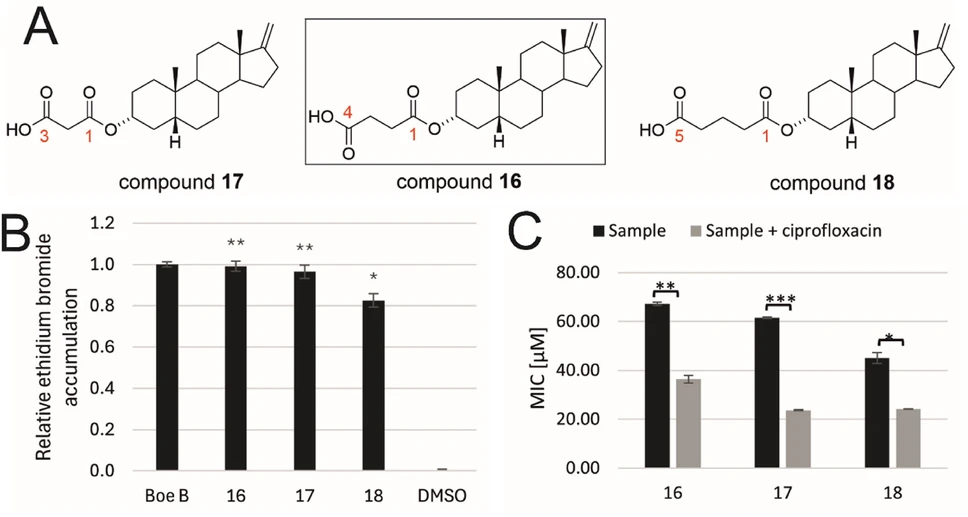 Eur. J. Med. Chem., 2026, 118716, Volume 308: Fig. 8. (A) Structures of compounds 16–18 with various hemiester modifications at position C-3 (A-ring). (B) Relative accumulation of ethidium bromide in ciprofloxacin-induced S. aureus M960 caused by steroid derivatives, boeravinon B (Boe B; positive control, 21 μM), and DMSO (negative control). Steroids were tested at a concentration of 50 μM. The effect of steroids was analyzed using a two-tailed t-test. Statistically significant differences from the negative control are indicated with ∗ (p ≤ 0.01), ∗∗ (p ≤ 0.001). (C) Minimum inhibitory concentration (MIC, μM) of steroidal compounds tested against S. aureus SA4, alone and in combination with ciprofloxacin at its IC50 concentration (0.15 mg/L). Steroids were evaluated in a concentration range of 1.56–50 μM. Data are presented as the average of three replicates ± standard error of the mean (SEM). The effect of steroids was analyzed using a two-tailed t-test. Statistically significant differences between derivative MIC and derivative MIC in the presence of ciprofloxacin are indicated with ∗ (p ≤ 0.01), ∗∗ (p ≤ 0.001), ∗∗∗ (p ≤ 0.0001). For concentrations in μg/mL, see Supplementary Table S10–S11.
As compounds 16–18 exhibited comparable MIC values, the C-3 hemisuccinate moiety was selected for further modifications owing to its convenient synthesis. Accordingly, new derivatives were synthesized bearing a C-3 hemisuccinate moiety in combination with various C-17 subsitituions (compounds 19 and 20; Fig. 9A) and core skeleton modifications while retaining the pregnane C-17 acetyl substituent (compounds 21–23; Fig. 9A). Among these, only compound 19 displayed strong efflux-inhibitory effects, with EtBr accumulation levels comparable to those of the positive control and compound 16. In contrast, compounds 20–23 showed only weak or moderate efflux inhibition and did not alter MIC values under combinatorial conditions. Notably, the MIC value of compound 19 was markedly reduced in the presence of ciprofloxacin, indicating a clear sensitizing effect. These results suggest synergy between the D-ring nonpolar modification and the C-3 hemiester moiety. Therefore, a series of analogues with nonpolar modifications at C-17 bearing a three-carbon substituent (hemimalonate, 24), a four-carbon substituent (hemisuccinate, 25), and a five-carbon substituent (hemiglutarate, 26) was tested (Fig. 9B). Compounds 24–26 exhibited strong efflux-inhibitory effects, with EtBr accumulation levels comparable to those of the positive control and compound 16, as reflected in their low MIC values when tested alone. Notably, compound 25 further enhanced ciprofloxacin efficacy, resulting in a statistically significant MIC reduction.
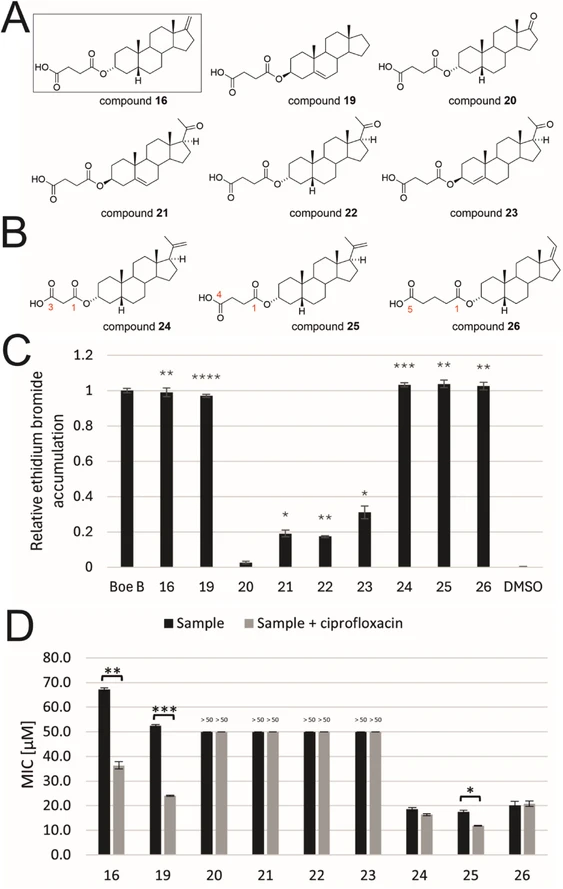 Eur. J. Med. Chem., 2026, 118716, Volume 308: Fig. 9. (A) Structures of analogues 19–26 of compound 16 modified at positions C-17 (D-ring) and both positions C-3 (A-ring). (B) Structures of analogues modified at positions C-17 (D-ring) and C-3 with various hemiesters moieties. (C) Relative accumulation of ethidium bromide in ciprofloxacin-induced S. aureus M960 caused by steroid derivatives, boeravinon B (Boe B; positive control, 21 μM) and DMSO (negative control). Steroids were tested at a concentration of 50 μM. The effect of steroids was analyzed using a two-tailed t-test. Statistically significant differences from the negative control are indicated with ∗ (p ≤ 0.01), ∗∗ (p ≤ 0.001), ∗∗∗ (p ≤ 0.0001), ∗∗∗∗ (p ≤ 0.00001). (D) Minimum inhibitory concentration (MIC, μM) of steroidal compounds tested against S. aureus SA4, alone and in combination with ciprofloxacin at its IC50 concentration (0.15 mg/L). Steroids were evaluated in a concentration range of 1.56–50 μM. Data are presented as the average of three replicates ± standard error of the mean (SEM). The effect of steroids was analyzed using a two-tailed t-test. Statistically significant differences between derivative MIC and derivative MIC in the presence of ciprofloxacin are indicated with ∗ (p ≤ 0.01), ∗∗ (p ≤ 0.001), ∗∗∗ (p ≤ 0.0001). For concentrations in μg/mL, see Supplementary Table S12–S13.
In summary, these findings demonstrate that the 3α,5β-steroidal skeleton permits multiple synthetic modifications that produce strong efflux-inhibitory effects in the EtBr accumulation assay, with activity levels comparable to those of the positive control. The sensitizing effect was further supported by the reduction in MIC values in the presence of ciprofloxacin. Efflux inhibition is preserved across various C-3 hemiester derivatives and can be significantly enhanced through appropriate D-ring modifications with nonpolar substituents. Importantly, C-3 and C-17 modifications are not additive, and a comprehensive series covering all possible combinations would be required to fully evaluate their interactions; an undertaking that poses a considerable synthetic challenge.
3.6. Transcriptomic analysis
Transcriptome analysis was chosen to elucidate the molecular mechanism of action of the most promising derivative, compound 13, on bacterial cells. Transcriptome sequencing of MDR SA4 cultures, including untreated controls and those exposed to ciprofloxacin, erythromycin, compound 13, or their combinations, revealed distinct transcriptional changes. The most significant shift was observed following erythromycin treatment, which was characterized by widespread upregulation of ribosomal protein genes (Fig. 11, Supplementary Fig. S5), consistent with the fact that erythromycin inhibits ribosomal protein synthesis. The first defence mechanism of the cell against erythromycin is therefore the overproduction of its cellular target. Ciprofloxacin alone elicited a limited response, with only two genes, sbcC and uvrA, both involved in DNA repair, showing a significant increase in expression (Supplementary Fig. S45, Supplementary Table S19).
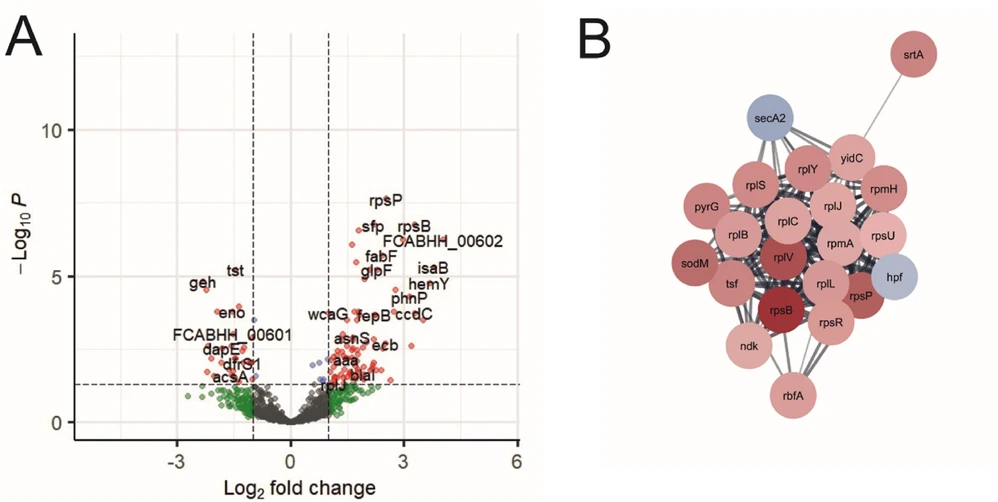 Eur. J. Med. Chem., 2026, 118716, Volume 308: Fig. 11. Effect of erythromycin on S. aureus SA4 transcriptome. (A) Volcano plot - the red dots represent significantly up- and downregulated genes (|log2 FC| ≥ 1 and p < 0.05). (B) Cytoscape network visualization of the nodes that represent genes, and the edges that represent links between genes. Red represents upregulated genes, and blue represents downregulated genes. (For interpretation of the references to colour in this figure legend, the reader is referred to the Web version of this article.)
3.10. Computational analysis of compound 13 - LmrS interactions
To elucidate the potential molecular interactions between the most active steroidal compound and bacterial efflux pump LmrS, a series of computational analyses were performed. These included prediction of the efflux antiporter's three-dimensional structure, identification of possible ligand-binding sites, refinement of ligand poses by docking, and molecular dynamics (MD) simulations to assess complex stability. Each step provided a set of hypotheses rather than definitive conclusions, given the computational limitations and the inherent flexibility of the transporter.
All algorithms produced plausible structures consistent with the expected topology and function of major facilitator superfamily (MFS) transporters. However, most methods predicted only an outward-open conformation, whereas functional antiporters undergo large scale conformational changes between outward- and inward-open states. Notably, Boltz 2 yielded two distinct conformational clusters corresponding to these states with minimal structural variability within each cluster (Fig. 14). The Boltz 2 models were thus selected for further analyses as the most representative of the transporter's conformational range.
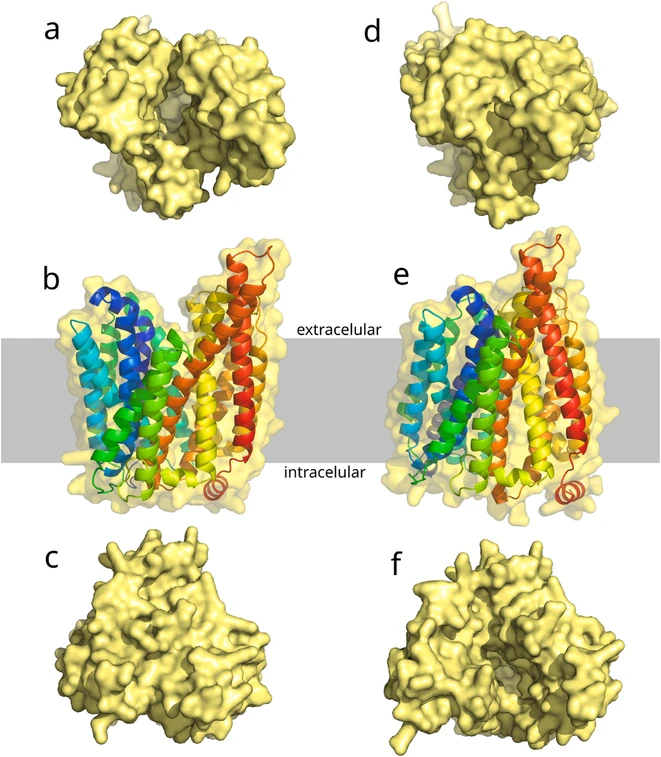 Eur. J. Med. Chem., 2026, 118716, Volume 308: Fig. 14. Predicted conformations of the efflux antiporter by Boltz 2. (A,B,C) outward-open state, (D,E,F) inward-open state. Looking at the cell from the outside is depicted in (A,D); from the inside on (C,F). View alongside the cell membrane is at (B,E). Protein's N-terminal is blue, C-terminal is red. (For interpretation of the references to colour in this figure legend, the reader is referred to the Web version of this article.)
AlphaFold 3 and DiffDock consistently located potential binding pockets within the transmembrane channel region, while Boltz 2 predicted binding near the extracellular vestibule. These results collectively suggested that the steroid derivative may interact either within the substrate translocation pathway or at its extracellular entrance, potentially modulating efflux efficiency. Since AI-based binding predictions are approximate, we refined the ligand poses using conventional molecular docking with AutoDock Vina. The predicted AI-derived pockets served as initial search regions. The docking simulations revealed several energetically favorable orientations of the steroid scaffold compatible with hydrophobic and hydrogen-bonding interactions involving residues lining the transport channel. These results support a plausible binding mode consistent with the proposed inhibitory mechanism.
4. Conclusion
The aim of this study was to verify the hypothesis that endogenous steroid hormones, neurosteroids, and their synthetic analogues influence the activity of bacterial efflux pumps and are thus capable of increasing the efficacy of antibiotics. To assess their activity, two complementary assays were performed: an EtBr accumulation assay for direct efflux measurement, and an antibiotic sensitization assay (with ciprofloxacin or erythromycin) for functional MIC reduction. We demonstrated that certain endogenous steroid hormones and neurosteroids possess measurable, though limited, efflux pump inhibitory activity in multidrug-resistant Staphylococcus aureus. Pregnanolone, identified as the most active endogenous compound, was selected as the scaffold for the design and synthesis of novel derivatives with markedly improved potency. The subsequent SAR study identified compounds 13 and 16 as lead structures, combining strong inhibition under ciprofloxacin- and erythromycin-induced conditions with significant MIC reduction. Synthetic modifications affording compounds 13 and 16 demonstrated that the 3α,5β-stereochemistry, which defines the bent steroidal skeleton, is preferable. Polar, endogenous substitutions of the D-ring at position C-17 proved suboptimal, whereas nonpolar modifications such as exomethylene or ethylidene were favored. The most promising synthetic modification at position C-17 was the removal of all substituents. In contrast, the C-3 hydroxyl group requires polar modifications to achieve strong efflux pump inhibition and low MIC values in combination with ciprofloxacin. Such polar modifications can be introduced through hemiester substituents, tolerating hemimalonate, hemisuccinate, and hemiglutarate moieties. Additionally, polar modifications at position C-3 can be achieved via an ethylene glycol linker further derivatized at the secondary hydroxyl group, for example, with l-pyroglutamic acid or 6-oxopiperidine acid. Finally, we demonstrated that modifications at positions C-3 and C-17 are crucial for potent efflux pump inhibition and sensitization to ciprofloxacin, yet their effects are not additive. Checkerboard assays confirmed additive interactions when combined with antibiotics. Transcriptomic profiling of compound 13 revealed substantial transcriptional reprogramming, including marked downregulation of multiple stress- and virulence-associated genes when administered alone or in combination with ciprofloxacin and erythromycin, indicating an additional anti-virulence effect. Importantly, the most active derivatives were non-cytotoxic and lacked measurable endocrine activity, underscoring their potential as safe and effective antibiotic adjuvants. Given that efflux pump systems contribute not only to multidrug resistance but also to bacterial virulence, their inhibition represents a promising approach for restoring antibiotic efficacy. These findings highlight the promise of rationally designed androstane-based scaffolds as a means to overcome efflux-mediated resistance and enhance the clinical utility of existing antibiotics.