Su, 11.10.2026 | Original article from: ACS Omega (2026)
Proteomic LC-MS/MS characterization of a protein-enriched S. commune fraction reveals 64 protein groups and potent selective activity against HeLa cancer cells.Chemical and Proteomic Characterization of Bioactive Protein-Enriched Fraction from Schizophyllum commune with Anticancer Activity in HeLa Cells
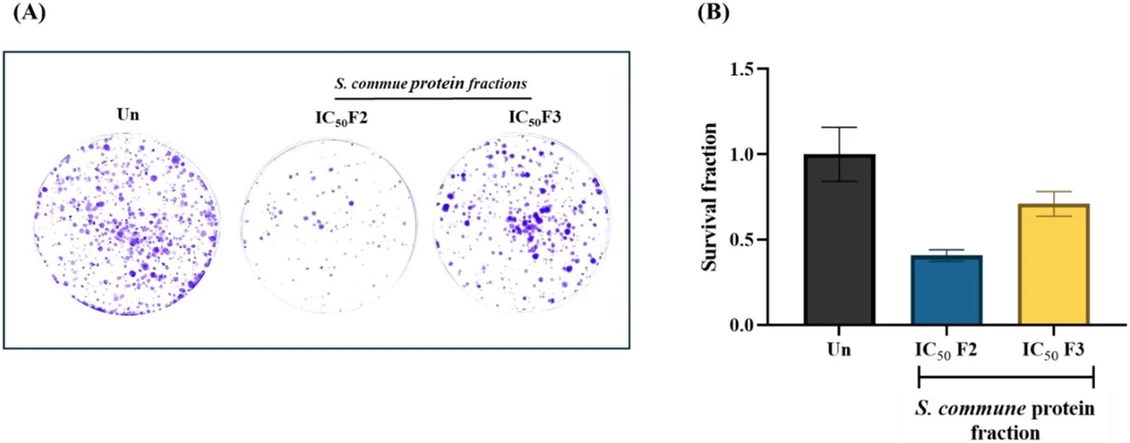
ACS Omega (2026): Figure 3. Effect of protein-enriched fractions of F2 and F3 from the fruiting bodies of S. commune on colony formation by HeLa cells. (A) HeLa cells were treated with IC50 of F2 and F3, the colony formation was monitored; (B) the number of colonies counted, and the survival fraction calculated. Un, untreated cells; F2, protein-enriched fraction 2; F3, protein-enriched fraction 3. Data values are means of the independent triplicate experiments ± SD.
This study isolates bioactive protein-enriched fractions from Schizophyllum commune using ion-exchange chromatography and bioassay-guided fractionation. Fraction F2 showed strong antiproliferative activity against HeLa cells, with an IC50 of 0.37 μg/mL, while having minimal effects on normal HaCaT cells. Flow cytometry and fluorescence staining indicated that apoptosis contributes to its cytotoxic activity.
SDS-PAGE and LC-MS/MS identified 64 protein groups within the active fraction, while gene ontology and physicochemical analyses revealed a heterogeneous protein composition. The findings support further investigation of S. commune as a source of bioactive proteins with potential anticancer applications.
The original article
Chemical and Proteomic Characterization of Bioactive Protein-Enriched Fraction from Schizophyllum commune with Anticancer Activity in HeLa Cells
Saranya Sedtananun*; Lueacha Tabtimmai; Chanapat Butsukon; Chanikan Sonklin; Kiattawee Choowongkomon
ACS Omega (2026)
https://doi.org/10.1021/acsomega.6c03766
licensed under CC-BY 4.0
Selected sections from the article follow. Formats and hyperlinks were adapted from the original.
Edible mushrooms have gained increasing attention as sustainable bioresources rich in diverse bioactive compounds, including polysaccharides, proteins, and peptides, which contribute to their functional and biological properties. (1, 2) Among them, Schizophyllum commune Fr., commonly known as the split gill mushroom, is a widely distributed wood-decaying basidiomycete species. (3) While extensive studies have focused on mushroom-derived polysaccharides, particularly for their immunomodulatory and antioxidant activities, protein-enriched fractions from edible fungi remain comparatively underexplored despite their potential as bioactive components. (4, 5) In the case of S. commune, research has predominantly focused polysaccharides, and only a limited number of functional proteins have been reported, including a fibrinolytic enzyme, (6) hydrolysate peptides, (7) and mycoprotein extracts. (8) However, direct evidence linking specific mushroom proteins to anticancer activity remains limited.
Proteomics is a powerful tool for investigating the nutritional profiles of foods, detecting allergens, and mapping essential biological pathways. It plays a pivotal role in understanding the health impacts of food and improving food safety. (9) Recent advancements in biochemical technologies have made proteomics increasingly important for exploring the diverse potential of edible fungi, especially those with medicinal applications. (10, 11) Proteomics can also be used to identify mushroom proteins with potential health benefits, such as antioxidant, anti-inflammatory, and antimicrobial activities. For example, Lau et al. (12) conducted a proteomic analysis to compare the antihypertensive effects of proteins from edible mushrooms, identifying those with the greatest effects. A study by Domingo et al. (13) reported the proteomic profile of Lentinula edodes (shiitake), revealing proteins involved in metabolism, growth, and replication, including a serine protease inhibitor associated with antioxidant and antibacterial properties. Furthermore, partial purification of mushroom proteins has been explored; for instance, protein-enriched fractions from Phallus indusiatus demonstrated selective cytotoxic activity by effectively inhibiting cancer cell proliferation without affecting normal cells. (14) Investigating mushroom-derived proteins, particularly from under-researched species like S. commune, presents a valuable opportunity for developing novel bioactive components and functional ingredients.
Cancer remains a major global health challenge, ranking as one of the leading causes of mortality worldwide. (15) Despite advances in screening and treatment, conventional approaches such as surgery, radiotherapy, and chemotherapy are often associated with adverse effects and therapeutic resistance. (16−18) These limitations have driven increasing interest in natural products as sources of bioactive compounds with potential biological activities. (19, 20) Among these, mushrooms have long been utilized in traditional medicine, and recent studies have highlighted their diverse functional properties, including antioxidant and antiproliferative activities. (1, 2, 6) In particular, mushroom-derived compounds have been reported to modulate cellular processes such as apoptosis, which plays a critical role in regulation cell survival and proliferation. (21, 22)
Due to their unique bioactivities, mushroom proteins have attracted increasing interest as bioactive components from natural sources. In addition, there is growing interest in using natural extracts as alternatives to pure compounds, driven by their longstanding role in traditional applications and the potential for synergistic effects among multiple active components. (23) This study aims to further explore the potential of partially purified mushroom protein through a bioassay-guided fractionation approach. Protein-enriched fractions were obtained using chromatographic separation and subsequently characterized by SDS–PAGE and LC–MS/MS analyses to determine their protein composition and physicochemical characteristics. The biological activity of the fractions was evaluated using in vitro assays to assess cytotoxic and antiproliferative effects. These findings provide insights into the chemical composition and biological properties of mushroom protein-enriched fractions and support further investigation as bioactive components.
2. Materials and Methods
2.8. Proteomic Profiling Analysis
The protein-enriched fraction F2 sample was cleaned using Biorad P gel spin column and reduced with 10 mM DL-Dithiothreitol (DTT) at 65 °C for 30 min in the dark. Then, sulfhydryl groups were alkylated with 25 mM iodoacetamide (IAA) for 20 min at room temperature in the dark. Protein sample was subsequently digested with a trypsin solution for 16 h. The digestion was terminated by adding 1% formic acid, followed by centrifugation at 14,000 rpm for 10 min. Proteomic analysis was performed using a LC–MS 6545XT QTOF (Agilent Technologies, Santa Clara, CA, USA). The mobile phases consisted of (A) 0.1% formic acid in water and (B) 95% acetonitrile containing 0.1% formic acid. The samples were directly loaded onto Agilent Peptide Map (2.1 × 150 mm, 2.7 μm) maintained at 60 °C and separated over 85 min run with a flow rate of 0.4 mL/min. Data-dependent acquisition (DDA) of MS and MS/MS spectra was performed over m/z ranges of 40–1700 and 25–1000, respectively. The source was operated under the following conditions: capillary voltage, 4000 V; nozzle voltage, 500 V; nebulizer (N2), 35 psi; and drying gas flow rate, 13 L/min. Agilent.d files were converted to mzXML format using MSConvert and OpenMS. The raw data were searched against Schizophyllaceae genome database using MaxQuant software (version 2.6.3). A total of 28,741 protein sequences from the Schizophyllum genome database were included in the analysis. Finally, 64 protein groups were identified (Table S1 in the Supporting Information file).
3. Results and Discussion
3.1. Extraction and Partial Purification of Protein-Enriched Fractions from S. commune
Mushrooms produce a variety of proteins that exhibit important biological and pharmacological properties. (5, 28) In this study, crude proteins were extracted from S. commune fruiting bodies by 80% (NH4)2SO4 precipitation. The crude proteins extract was partial purified by anion-exchange chromatography on a HiTrap DEAE FF column, resulting in four peaks, with fractions F2 and F3 showing the highest absorbance at 280 nm (Figure 1A). SDS-PAGE analysis revealed proteins with molecular weights ranging from approximately 10 to 175 kDa (Figure 1B). Partial purification provides a balance between protein yield and purity while preserving protein bioactivity and reducing processing time and costs. These protein bands may correspond to various proteins from S. commune, consistent with previous studies. (29)
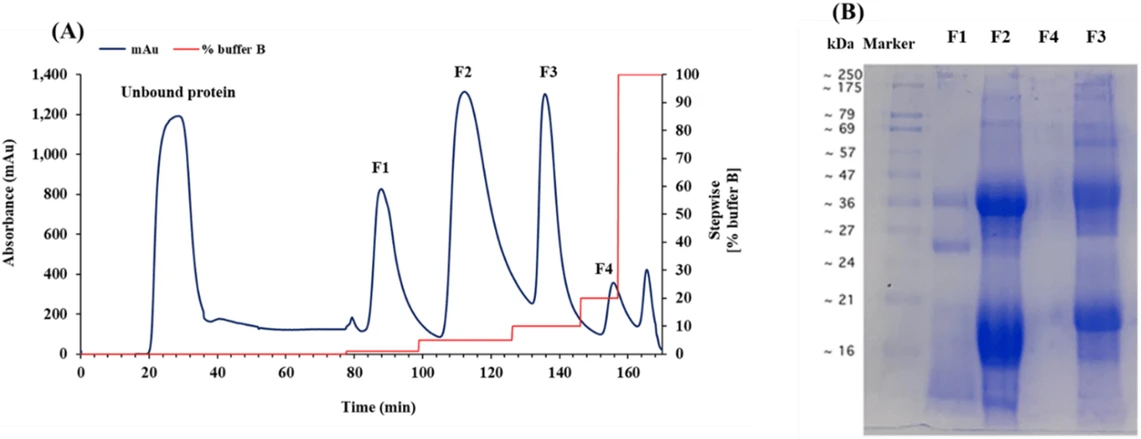 ACS Omega (2026): Figure 1. Partial purified proteins from the fruiting bodies S. commune. (A) Crude protein was fractionated on a HiTrap DEAE FF column with a stepwise increasing concentration of NaCl (0.05 M NaCl, 0.25 M NaCl, 0.5 M NaCl, 1 M NaCl); (B) SDS PAGE results of different chromatographic fractions (Marker, F1, F2, F4, F3).
3.2. Cytotoxicity and Antiproliferative Activity of the Protein-Enriched Fraction in HeLa Cells
The cytotoxic effects of protein-enriched fractions F1, F2, F3, and F4 on HeLa cell lines were evaluated using an MTT assay across different concentrations. As shown in Figure 2A, protein-enriched fractions F2 and F3 exhibited the greatest inhibitory effects at 2.9 μg/mL. Cell viability decreased in a concentration-dependent manner. Interestingly, treatment of HeLa cells with protein-enriched fractions F2 and F3 at concentrations up to 0.73 μg/mL resulted in a measurable reduction in cell viability. In comparison, normal human keratinocytes (HaCaT) cells exhibited relatively higher viability, maintaining approximately 75–80% survival at the lowest concentrations tested (Figure 2B). HaCaT cells were used as a nontumorigenic human keratinocyte model to preliminarily assess the cytotoxic selectivity of the protein-enriched fractions. These findings suggest a degree of differential sensitivity between the two cell lines under the tested conditions. As indicated in Figure 2C,D, a comparison of the growth inhibitory effects between protein-enriched fraction F2 and F3 revealed that fraction F2 (IC50 = 0.37 μg/mL) exhibited a stronger growth inhibitory effect than fraction F3 (IC50 = 2.52 μg/mL). Protein-enriched fractions F2 and F3 indicated preliminary cytotoxic selectivity by inhibiting the proliferation of HeLa cells while exhibiting low cytotoxicity toward HaCaT cells. The selective cytotoxicity of protein-enriched fractions F2 and F3 toward cancer cells, while sparing normal cells, highlights their potential as a promising candidate for therapeutic development. Therefore, protein-enriched fractions F2 and F3 at concentrations of 0.37 and 2.52 μg/mL were used in the subsequent assays.
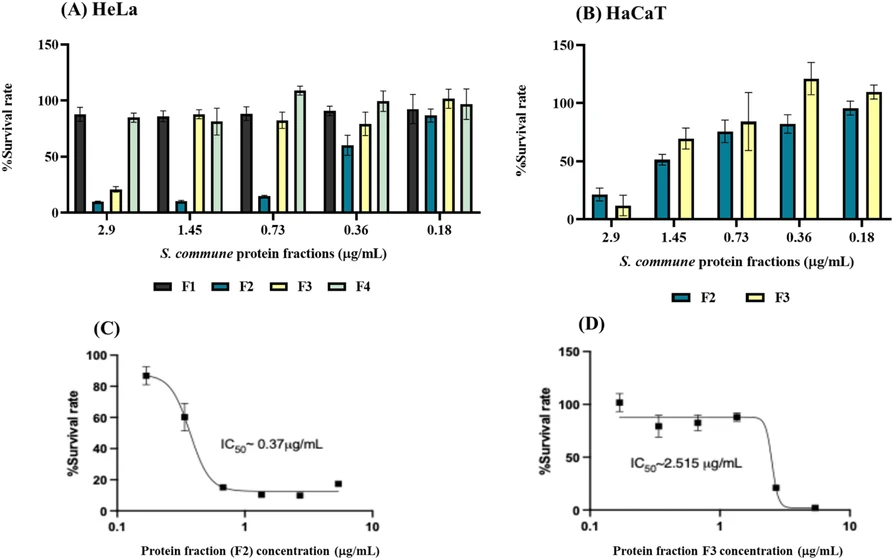 ACS Omega (2026): Figure 2. Effect of the protein-enriched fraction from the fruiting bodies of S. commune on cell survival of HeLa and HaCAT cells. (A) Protein fraction of F1–F4 on survival rate (%) of HeLa cells; (B) Protein-enriched fraction of F2–F3 on survival rate (%) of HaCAT cells; (C, D) IC50 of protein-enriched fraction F2 and F3 on survival rate (%) of HeLa cells. Un, untreated cells; F2, protein-enriched fraction 2; F3, protein-enriched fraction 3. Data values are means of the independent triplicate experiments ± SD.
To further confirm the antiproliferative effects of protein-enriched fractions F2 and F3 against HeLa cells, a clonogenic assay was conducted to assess the colony-forming ability of HeLa cells. The clonogenic assay identifies viable cells capable of proliferating after the protein-enriched fractions are removed from the culture medium. (30) Moreover, clonogenicity serves as an indirect measure of the neoplastic potential of cancer cells. (31) HeLa cells were treated with the IC50 concentration of protein-enriched fractions F2 and F3, and the number of colonies formed was counted. As illustrated in Figure 3A, the number of colonies was reduced following treatment with protein-enriched fractions F2 and F3 compared with the untreated control (Un). The survival fraction was calculated and showed a significant reduction in HeLa cell survival, with the greatest and statistically significant inhibitory effect observed for protein-enriched fraction F2 (Figure 3B). The reduction in colony formation following treatment with protein-enriched fractions F2 and F3 indicates decreased colony-forming ability of HeLa cells, consistent with their antiproliferative activity. (30) The lower surviving fraction observed for protein-enriched fraction F2 is consistent with the MTT assay results showing inhibition of HeLa cell growth. (32) These findings further support the antiproliferative effect of protein-enriched fraction F2.
ACS Omega (2026): Figure 3. Effect of protein-enriched fractions of F2 and F3 from the fruiting bodies of S. commune on colony formation by HeLa cells. (A) HeLa cells were treated with IC50 of F2 and F3, the colony formation was monitored; (B) the number of colonies counted, and the survival fraction calculated. Un, untreated cells; F2, protein-enriched fraction 2; F3, protein-enriched fraction 3. Data values are means of the independent triplicate experiments ± SD.
3.4. Protein-Enriched Fraction F2 Induces Apoptosis in HeLa Cells Assessed by Flow Cytometry
Apoptosis is one of the major mechanisms underlying cytotoxicity. To determine whether protein-enriched fraction F2-induced cell death involved apoptosis, the Muse Annexin V & Dead Cell assay was performed. In this assay, Annexin V was used to detect the externalization of phosphatidylserine on the cell surface, an early hallmark of apoptosis. (35) The dead cell marker 7-AAD was included in the kit to assess cell membrane integrity. Thus, cells negative for both markers (lower left quadrant) were considered viable, cells positive for Annexin V only (lower right quadrant) were in early apoptosis, and cells positive for both Annexin V and 7-AAD were classified as late apoptotic/dead cells (upper right quadrant). Cells positive for 7-AAD only were indicative of necrosis (upper left quadrant).
As illustrated in Figure 5A, treatment with protein-enriched fraction F2 at 1/2IC50 and IC50 concentrations increased the proportion of early apoptotic cells to approximately 5.65–6.27%. At the IC50 concentration, fewer than 4.59% of cells remained viable, while the majority (89%) progressed to late apoptosis (upper right quadrant). Notably, less than 0.15% of cells were positive for 7-AAD alone (upper left quadrant), indicating minimal necrotic cell death, indicating minimal necrotic cell death under the conditions tested. These findings are consistent with apoptosis as a major mode of cell death induced by protein-enriched fraction F2 and agree with the fluorescence staining results observed in HeLa cells (Figure 5B).
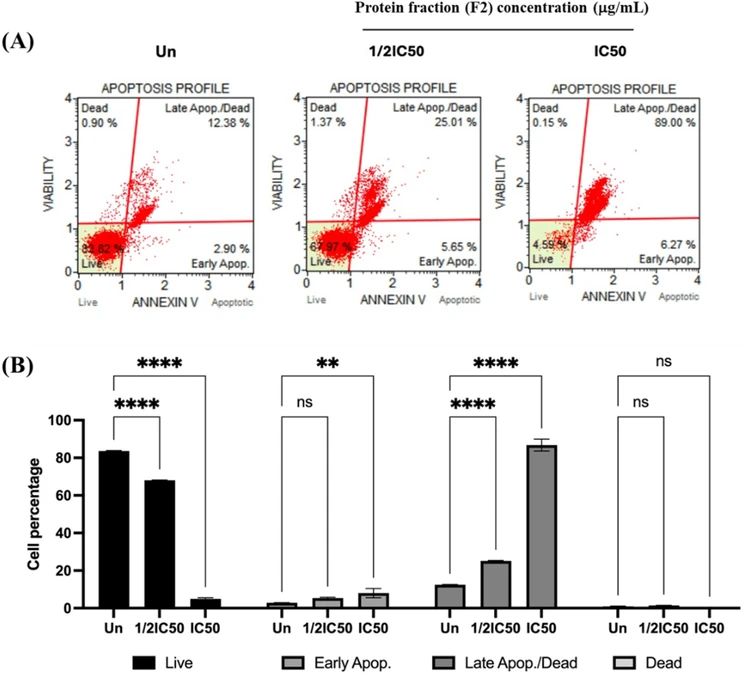 ACS Omega (2026): Figure 5. Flow cytometric analysis of protein-enriched fraction F2 from the fruiting bodies of S. commune induced apoptosis in HeLa cells using annexin V-FITC and PI double staining. (A) The cancer cell lines were treated with 1/2IC50 and IC50 of protein-enriched fraction F2 and after 24 h cells were stained, and flow cytometric analysis was performed; (B) Quantitative presentation of apoptosis induced by 1/2IC50 and IC50 of protein-enriched fraction F2 in HeLa cells. Un, untreated cells; F2, protein-enriched fraction 2;.
4. Conclusions
In summary, the protein-enriched fraction F2 from S. commune, identified through bioassay-guided fractionation, exhibited cytotoxic effects against HeLa cells while showing minimal effects on normal HaCaT cells. LC-MS/MS analysis identified candidate proteins in the bioactive fraction; however, further purification and functional validation are required to determine their direct contribution to the observed anticancer activity. The possible contribution of other coextracted mushroom constituents, including polysaccharides and small metabolites, cannot be excluded. The present study focused on the most bioactive fraction identified through bioassay-guided screening and did not include comparative proteomic analysis across all fractions. Further studies incorporating comprehensive proteomic profiling and functional characterization are needed to clarify the bioactive components and their structure–function relationships.