We, 18.11.2026 | Original article from: LabRulezLCMS Library
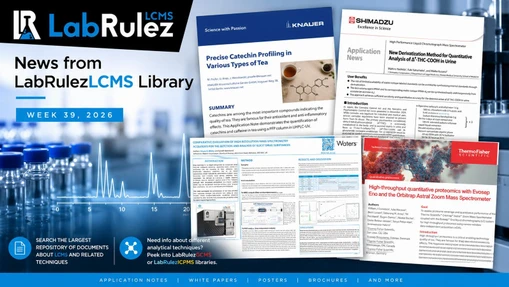
This week we bring you application notes by KNAUER, Shimadzu, Thermo Fisher Scientific and Waters Corporation!News from LabRulezLCMS Library - Week 47, 2026
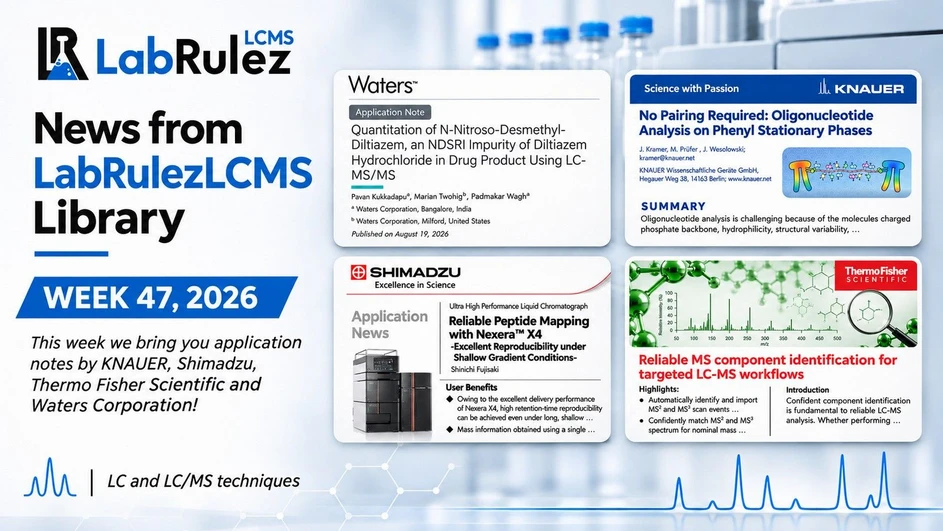
LabRulez / AI: News from LabRulezLCMS Library - Week 47, 2026
Our Library never stops expanding. What are the most recent contributions to LabRulezLCMS Library in the week of 16th November 2026? Check out new documents from the field of liquid phase, especially HPLC and LC/MS techniques!
👉 SEARCH THE LARGEST REPOSITORY OF DOCUMENTS ABOUT LCMS AND RELATED TECHNIQUES
👉 Need info about different analytical techniques? Peek into LabRulezGCMS or LabRulezICPMS libraries.
1. KNAUER: No Pairing Required: Oligonucleotide Analysis on Phenyl Stationary Phases
- Application note
- Full PDF for download
Oligonucleotides are an increasingly important class of therapeutic compounds, but their chromatographic analysis remains challenging because of their highly charged phosphate backbone, pronounced hydrophilicity, sequence-dependent conformation, and frequent chemical modifications. Relevant impurities, including shortmers, sequence variants, and degradation products, often differ only slightly from the full-length product, placing high demands on chromatographic selectivity and efficiency [1-3].
Ion-pair reversed-phase liquid chromatography (IP-RPLC) is widely used for oligonucleotide analysis because alkylammonium reagents mask the negative charges of the phosphate backbone and facilitate retention on hydrophobic stationary phases [1,3]. However, these reagents may contaminate chromatographic and massspectrometric systems, reduce column lifetime, and cause ion suppression [1,2]. Ion-pair-free reversed-phase chromatography using aromatic stationary phases is therefore an attractive, potentially MS-compatible alternative [1,2].
Phenyl-bonded stationary phases can retain oligonucleotides through hydrophobic, dispersive, and aromatic interactions, particularly π–π stacking with exposed nucleobases [1,2]. Retention depends on oligonucleotide length, sequence, chemical modifications, and secondary structure [1-3]. Folded structures may limit nucleobase accessibility and reduce retention, whereas linear oligonucleotides can interact more extensively with the aromatic surface [1].
A conventional phenyl phase and phenyl-hexyl phase provide π–π and hydrophobic interactions, whereas the electron-deficient ring of a pentafluoro phenyl phase (PFP) can additionally promote directional donor-acceptor π, dipolar, and polar interactions [1].
The phases may therefore produce different retention patterns and elution orders for closely related oligonucleotides. Chromatographic performance can also be influenced by ligand density, spacer structure, particle morphology, pore size, endcapping, silica properties, and column hardware [1,2]. This application note compares a PFP, phenyl-hexyl and a conventional phenyl stationary phase for ion-pair-free reversed-phase analysis of oligonucleotides.
Experimental
- Pump: AZURA® P 6.1 L pump LPG, stainless steel, 10 ml/min
- Autosampler: LH 8.1 Liquid Handler, 557 mm version with Robotic Cooler, including injection valve and fast wash station
- Detector: AZURA® DAD 2.1L Diode Array Detector, 190-700 nm
- Thermostat: AZURA® CT 2.1 Column Thermostat for up to 8 HPLC columns with temperature range between 5-85 °C
- Column I: Eurospher II 100-3 PFP, 50 x 2 mm ID
- Column II: Eurospher II 100-2 Phenyl, 50 x 2 mm ID
- Column III: Eurospher II 100-3 Phenyl-Hexyl, 100 x 2 mm ID
Conclusion
The results demonstrate that the pentafluoro phenyl (PFP), conventional phenyl, and phenyl-hexyl stationary phases are suitable for the ion-pair-free RP-HPLC analysis of the investigated oligonucleotides. On the PFP phase, reducing the initial amount of eluent B from 20 to 10 % improved retention of the less-retained samples, particularly SCR Antisense. Increasing the maximum amount of eluent B to 50 % enabled complete elution of the dT24 C12 sample and improved the overall method performance. The transfer of the optimized gradient to the conventional phenyl phase resulted in comparable retention behavior and the same elution order as observed on the PFP phase. Increasing the maximum amount of eluent B to 60 % caused earlier elution of dT24 C12 and improved the peak symmetry of the 64mer, while only minor changes were observed for the SCR Antisense and 20mer samples.
The phenyl-hexyl phase also showed the same general retention pattern and elution order as the PFP and conventional phenyl phases. Because of the different ligand structure, combining an aromatic phenyl group with a six-carbon alkyl linker, it provides a distinct balance of hydrophobic and aromatic interactions. Direct transfer of the phenyl gradient resulted in earlier elution of all oligonucleotides after adjustment of the gradient slope. However, the modified gradient did not produce a significant improvement in peak shape. Under the investigated conditions, the phenyl-hexyl phase therefore did not show a clear performance advantage over the conventional phenyl or PFP phase. The comparable elution order observed on all three columns indicates that the retention behavior was governed not only by the stationary-phase chemistry but also by oligonucleotide length, chemical modification, secondary structure, and nucleobase accessibility. A clear superiority of one phase could not be established for the selected samples.
Compared with the zwitterionic HILIC method described in VBS0090, the phenyl-based phases provide complementary selectivity through hydrophobic, dispersive, and π–π interactions with exposed nucleobases. By avoiding ion-pairing reagents, the phenyl, PFP, and phenyl-hexyl phases offer potentially improved compatibility with downstream mass spectrometry and reduced risk of system contamination or ion suppression. Overall, IP-RPLC, HILIC, and ion-pairfree RP-HPLC on aromatic stationary phases provide complementary options with respect to analysis speed, selectivity, and MS compatibility. The choice between conventional phenyl, PFP, and phenyl-hexyl phases should therefore be based on the oligonucleotide sequence, length, chemical modifications, secondary structure, and the required analytical selectivity.
2. Shimadzu: Reliable Peptide Mapping with Nexera X4
- Application note
- Full PDF for download
User benefits
- Owing to the excellent delivery performance of Nexera X4, high retention-time reproducibility can be achieved even under long, shallow gradient conditions.
- Mass information obtained using a single quadrupole mass spectrometer can be utilized as qualitative data for each peptide fragment, thereby improving the reliability of the results.
Peptide mapping is important for confirming the primary structure of proteins and for evaluating the consistency of their quality. In analyses using LC (reversed-phase chromatography), a large number of peptide fragments generated by digestion are separated using a solvent delivery approach in which the proportion of organic solvent in the mobile phase is gradually increased over an extended period through a shallow gradient. This gradual change in organic solvent enables the separation of peptides with similar hydrophobicity, but the performance of the solvent delivery pump, which precisely controls the organic solvent ratio, is critically important for achieving retention-time reproducibility. Nexera X4 (Fig. 1) inheritstechnologies developed in Shimadzu’s Nexera series and is a next-generation ultra-highperformance liquid chromatography (UHPLC) system that achieves top-class analytical performance. Its solvent delivery pump features independently actuated plungers and a pressure feedback mechanism, enabling precise solvent delivery and excellent reproducibility even under long, shallow gradient conditions. In this article, an example is presented in which Nexera X4 was used to analyze tryptic digests of BSA. Furthermore, by combining the system with a single quadrupole mass spectrometer, the acquisition of mass information as qualitative data for each peptide fragment is also demonstrated.
Qualitative Analysis Using LCMS-2050
Fig. 4 shows the UV chromatograms and MS chromatograms corresponding to the red-boxed region in Fig. 3. The base-peak m/z values corresponding to each peak in the MS chromatograms are also indicated. Peaks detected in the UV chromatograms were also observed in the MS chromatograms, demonstrating that mass information can be utilized as qualitative data for each peptide fragment in addition to retention time. In peptide mapping, a large number of peaks are detected, and small variations in retention time can pose challenges for accurate identification. By combining retention-time information with mass data, which is independent of retention-time fluctuations, the reliability of the results can be improved.
Conclusion
An example of peptide mapping using tryptic digests of BSA was presented. In peptide mapping, shallow gradient conditions, in which the proportion of organic solvent is gradually increased over an extended period, are used to separate the large number of peptide fragments, making the performance of the solvent delivery pump critically important for achieving retention-time reproducibility. Nexera X4 enables precise solvent delivery through independently actuated plungers and a pressure feedback mechanism, ensuring excellent retention-time reproducibility even under long, shallow gradient conditions. Furthermore, by combining the system with a single quadrupole mass spectrometer (LCMS-2050), both retention-time and mass information can be utilized as qualitative data, contributing to improved reliability of the results.
3. Thermo Fisher Scientific: Reliable MS component identification for targeted LC-MS workflows
- Application note
- Full PDF for download
Confident component identification is fundamental to reliable LC-MS analysis. Whether performing targeted quantitation in biopharma, clinical toxicology, environmental testing, or food safety, analysts need confidence that detected components have been correctly identified before quantitative results can be trusted. Traditional confirmation strategies often rely on ion ratios, mostly in selected reaction monitoring (SRM) scan mode, or, in high-resolution accurate mass (HRAM) data, precursor mass accuracy, isotope patterns, or fragment matching. While effective in many applications, these approaches can become challenging when analyzing complex matrices or distinguishing structurally similar compounds.
Thermo Scientific™ Chromeleon™ Software now extends identification confidence by integrating NIST™ Mass Spectral Library searching algorithms directly into LC-MSⁿ data processing. Rather than evaluating only theoretical isotope distributions or a small number of selected ions, the software compares experimentally acquired spectra against curated reference spectra, adding an additional layer of confirmation that helps reduce false positive assignments while increasing confidence in targeted screening workflows.
Built for confident, targeted screening
With integrated library searching, Chromeleon software provides a comprehensive approach to LC-MS component identification that supports confident, targeted screening across biopharmaceutical, clinical, environmental, and food safety workflows. From MS¹ through MSⁿ, analysts can leverage experimentally validated spectral libraries to strengthen identification confidence, help reduce false positives, and generate more robust analytical results—all within the familiar Chromeleon software environment.
4. Waters Corporation: Quantitation of N-Nitroso-Desmethyl- Diltiazem, an NDSRI Impurity of Diltiazem Hydrochloride in Drug Product Using LCMS/ MS
- Application note
- Full PDF for download
Benefits
- Trace level detection of N-nitroso-desmethyl-diltiazem using the Xevo TQ-S micro Tandem Quadrupole Mass Spectrometer exceeds the industry guidelines of 10% of the regulatory AI threshold.
- Chromatographic resolution between diltiazem API and N-nitroso-desmethyl-diltiazem isomers for accurate quantification of the impurities.
- A complete workflow demonstrating the quantitative analysis of N-nitroso-desmethyl-diltiazem isomeric impurities in final drug dosage form at the regulatory set limits.
- waters_connect™ for Quantitation Software offers compliant-ready workflows for the acquisition, processing, review, and reporting of quantitative data for N-nitrosamines.
N-nitrosamines (nitrosamines) have been a major pharmaceutical safety concern since 2018, beginning with small molecule dialkyl nitrosamines such as N-Nitrosodimethylamine (NDMA) and N-Nitrosodiethylamine (NDEA) and later expanding to include Nitrosamine drug substance related impurities (NDSRIs).1-3 NDSRIs, a term used to indicate the structural relationships between active pharmaceutical ingredients (API) and nitrosated impurities, have been detected in multiple drug products.4,5 Nitrosamines can be potentially mutagenic and carcinogenic.6 Therefore, nitrosamine impurities that have been identified by regulatory authorities as requiring risk‑based assessment and control within pharmaceutical products.
Regulatory guidance for assessing pharmaceutical products for nitrosamine impurities was first issued in 2020 and has been revised multiple times as scientific understanding has advanced. This guidance includes risk assessment, establishing acceptable limits for N-nitrosamine impurities, testing and monitoring of pharmaceutical products and mitigation strategies by pharmaceutical manufacturers.7-11
Diltiazem hydrochloride is a widely used benzothiazepine Ca2+ blocking drug (calcium channel blockers). Clinically, it is used to treat cardiovascular diseases such as angina pectoris, hypertension, and cardiacarrhythmias.12 N-nitroso-desmethyl-diltiazem (Figure 1) is an NDSRI impurity derived from diltiazem hydrochloride (Figure 1). Consequently, monitoring of NDD is required during drug formulation. To avoid the need for onwards batch release testing in QC, analytical methods used for the detection of nitrosamines, including NDSRIs, are required to demonstrate the absence of impurities at a lower LOQ of 10% of the limit derived from the acceptable intake (AI) and the API maximum daily dose (MDD). Assuming a MDD of diltiazem of 540 mg, the developed assay exceeded the regulatory requirements for the quantitation of NDD. The AI for NDD was amended to 100 ng/day (using read across from a surrogate [4-(methylnitrosoamino)-1-(3-pyridinyl)-1- butanone (NNK)]).13 For this study, the method was developed when the regulations for this impurity were more stringent, using a threshold limit of 0.05 ppm (ppm = AI (ng)/MDD (mg); 26.5 ng /540 mg), with a 10% threshold of 0.005 ppm. The current regulatory threshold for NDD, based on an AI of 100 ng/day is calculated to be 0.185 ppm (10% threshold of 0.0185 ppm).
This study describes the analysis of NDD in final dosage form (FDF) tablet using ultra-performance liquid chromatography (UPLC™) with electrospray ionisation (ESI) and a Xevo TQ-S micro Tandem Quadrupole Mass Spectrometer.
Experimental
- LC system: ACQUITY™ UPLC H-Class Plus System
- Detection: ACQUITY Photodiode Array (PDA) Detector
- Column: Waters ACQUITY UPLC HSS T3 Column, 1.8 µm, 3.0 x 100 mm
- MS system: Xevo TQ-S micro Tandem Quadrupole Mass Spectrometer
- Software: waters_connect for Quantitation Software
Conclusion
In this study, a robust UPLC-MS/MS method was developed for the quantitation of NDD in drug products. NDD was successfully chromatographically resolved from the diltiazem API, minimizing the potential for matrix effects and helping to ensure accurate impurity quantification. The use of RADAR scans can provide helpful qualitative data to support method development.
The method exceeds the regulatory threshold for detection and quantification of NDD, as determined by the CPCA.13 The method demonstrated at least three orders of linear dynamic range (0.01-10 ng/mL, R² >0.99). The spike recovery for the levels equal to 10-150% of the threshold limits (0.005-0.075 ppb or 0.2-3 ppb (ng/mL)) ranged from 90.67-106.64% with %RSDs from 1.34-9.75 for both detected peaks.
The waters_connect Software with its integrated impurity limits calculation increases the efficiency of the data processing, review and reporting. To support 21 CFR Part 11 compliance, the software ensures data integrity through access restrictions, electronic signature capabilities, and comprehensive automated audit trails.