Mo, 9.11.2026 | Original article from: Environ. Sci. Technol. (2026) 60 (43): 30636–30648
Amendment-assisted phytostabilization reduced dissolved metal concentrations and promoted deeper biological and geochemical stabilization in mine tailings over seven years.Long-Term Biogeochemical Stabilization of Carbonate-Bearing Pb–Zn–Cu Mine Tailings by Amendment-Assisted Phytostabilization
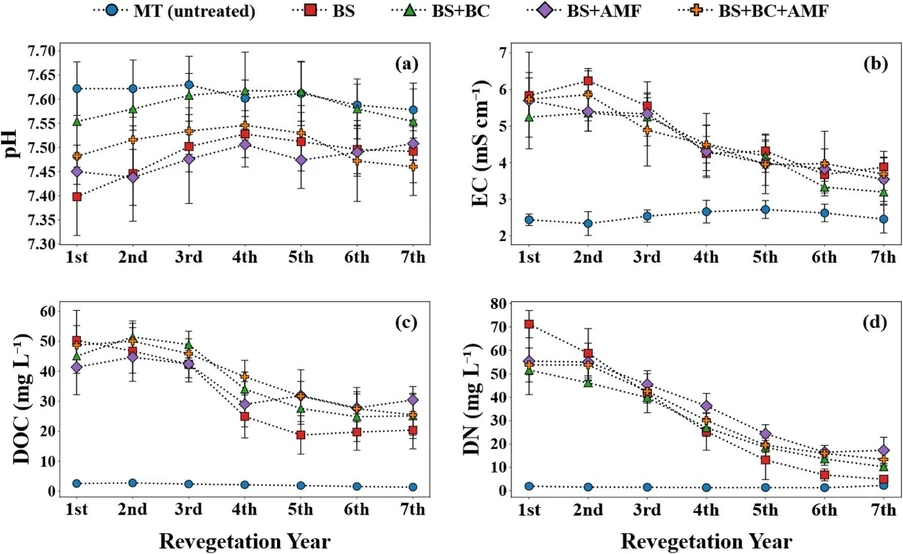
Environ. Sci. Technol. (2026) 60 (43): 30636–30648: Figure 2. Temporal changes in tailings pore-water (a) pH, (b) electrical conductivity (EC), (c) dissolved organic carbon (DOC), and (d) dissolved nitrogen (DN) over seven years of amendment-assisted revegetation.
This study evaluates seven-year biogeochemical stabilization of carbonate-bearing Pb-Zn-Cu mine tailings revegetated with Dalea purpurea and amended with biosolids, biochar, and arbuscular mycorrhizal fungi. Long-term monitoring and depth-resolved analyses showed that biochar- and AMF-containing treatments produced greater reductions in dissolved metal concentrations, while AMF promoted organic carbon accumulation, microbial biomass, and deeper root development below the amended surface layer.
Sequential extraction revealed metal-specific redistribution, with Pb and Zn remaining largely associated with carbonate and Fe/Mn oxide fractions and Cu shifting toward less labile organic/sulfide and residual pools. The results demonstrate that surface-applied amendments and planting can drive sustained biological and geochemical stabilization throughout deeper mine-tailings profiles.
The original article
Long-Term Biogeochemical Stabilization of Carbonate-Bearing Pb–Zn–Cu Mine Tailings by Amendment-Assisted Phytostabilization
Mariam Al-Lami*; Genevieve Sutton; Kwame Awuah-Offei; Lana Alagha; Joel Burken*
Environ. Sci. Technol. (2026) 60 (43): 30636–30648
https://doi.org/10.1021/acs.est.6c08282
licensed under CC-BY 4.0
Selected sections from the article follow. Formats and hyperlinks were adapted from the original.
Legacy mine tailings remain persistent sources of metal exposure because they are not inert waste deposits but reactive geochemical systems. Their low organic matter, poor structure, limited nutrient availability, and elevated metal concentrations restrict plant and microbial establishment while leaving tailings surfaces vulnerable to wind dispersion, runoff, and pore-water transport. (1, 2) In Pb–Zn–Cu tailings, risk is governed not only by total metal concentrations but also by the distribution of metals among pore water, readily labile pools, reactive carbonate- and Fe/Mn oxide-associated phases, organic/sulfide-associated pools, and more stable residual fractions. (3−5) This distinction is particularly important for carbonate-bearing tailings, where circumneutral to alkaline pH can suppress immediate metal solubility, but longer-term mobility may still be influenced by carbonate weathering, dissolved organic carbon, ionic strength, and redox-sensitive mineral phases. (6−8)
Amendment-assisted phytostabilization offers a practical alternative to excavation or engineered capping for large mine-waste areas, but its success is often evaluated too narrowly. Recent restoration approaches increasingly emphasize nature-based strategies that combine contaminant stabilization with development of ecological functions, including carbon cycling and microbial development. (9, 10) Field-based phytomanagement studies have demonstrated that combined amendment and native plant strategies can improve restoration outcomes in metal-contaminated mine residuals. (11, 12) Vegetation can reduce surface erosion, improve surface stability, and initiate organic carbon deposition; however, plant survival or biomass alone does not demonstrate geochemical stabilization or development of broader biological and biogeochemical functions. (13, 14) A more rigorous assessment requires evidence that amendment–plant systems reduce metal lability, promote retention in less mobile solid-phase pools, and support the development of biological and biogeochemical functions. Biosolids (BS) can improve tailings fertility, organic matter content, microbial activity, and metal retention through organic matter inputs and sorption/complexation processes. (15) However, their long-term effectiveness may be limited by decomposition of labile organic matter, redistribution of nutrients, and potential contributions of dissolved organic ligands, salts, and metal inputs that influence pore-water chemistry and metal mobility. (16, 17) Biochar (BC) and arbuscular mycorrhizal fungi (AMF) may complement biosolids by increasing sorptive capacity, improving nutrient retention, promoting aggregation, and supporting root- and mycorrhizosphere-mediated carbon inputs and microbial development. (18, 19) Recent studies have shown that integrated amendment mixtures containing biochar, organic amendments, and microbial inocula can improve plant establishment, modify tailings chemistry, and influence microbial communities in mine rehabilitation settings. (18, 20)
Despite these potential benefits, the time-resolved and depth-dependent coupling between biological development and geochemical stabilization in amended tailings remains insufficiently explored. Previous studies have examined improvements in vegetation establishment, metal bioavailability, microbial indicators, or microbial community structure during tailings and mine-soil rehabilitation. (21−25) Long-term rehabilitation studies have further demonstrated progressive changes in tailings chemistry, organic matter characteristics, and microbial communities following revegetation. (26) However, the persistence and extension of coupled biological and geochemical responses into initially unamended tailings layers remain poorly resolved, particularly when considering long-term changes in pore-water chemistry alongside solid-phase metal partitioning, organic carbon content, and microbial characteristics. This limitation is important because sustained phytostabilization requires not only reduced metal mobility but also development of functional tailings properties beyond the amended surface layer. Biological amendments such as AMF may contribute to belowground development through root-associated processes and microbial activity, potentially facilitating carbon accumulation and microbial development beyond the amended surface layer. The contribution of these processes to sustained geochemical stabilization in initially unamended deeper tailings, however, remains uncertain.
Here, we evaluated the long-term biogeochemical stabilization of carbonate-bearing Pb–Zn–Cu mine tailings under amendment-assisted revegetation with purple prairie clover (Dalea purpurea), a native prairie legume species. Biosolids, biochar, and arbuscular mycorrhizal fungi were applied only to the upper tailings layer, while the underlying tailings remained unamended, providing a depth-resolved framework for evaluating treatment-associated responses beyond the zone of direct amendment incorporation. Over seven years, tailings pore-water was monitored annually for pH, electrical conductivity, dissolved organic carbon, dissolved nitrogen, and dissolved Pb, Zn, and Cu. At the end of the seventh growth season, tailings cores were analyzed for organic carbon, phospholipid fatty acid (PLFA)-based microbial indicators, aqua-regia-extractable metals, sequentially extracted Pb, Zn, Cu, Fe, and Mn fractions, and mineralogy by X-ray diffraction (XRD). We hypothesized that long-term amendment-assisted revegetation would: (i) alter pore-water chemistry and dissolved metal concentrations; (ii) promote organic carbon accumulation and microbial development within and below the amended layer; and (iii) shift Pb, Zn, and Cu among operationally defined fractions in a metal- and depth-dependent manner. Together, this framework evaluates phytostabilization as a coupled aqueous, solid-phase, and biological process rather than vegetation establishment alone.
2. Materials and Methods
2.4. Tailings Pore-Water Collection and Analysis
For annual tailings pore-water (TPW) collection, one Rhizon MOM soil moisture sampler (10 cm porous membrane length, 2.5 mm diameter, 0.15 μm pore size; Royal Eijkelkamp, The Netherlands) was installed in each pot. Samplers were inserted diagonally into the tailings profile, with the porous membrane section extending into the lower unamended tailings layer, as shown in Figure 1. Prior to each extraction, pots were watered to approximately 70% of field capacity and allowed to equilibrate for 24 h under greenhouse conditions. TPW was collected annually at the end of each growing season over the seven-year growth period by applying suction to the sampler tubing. A 50 mL TPW sample was collected from each pot.
Immediately after collection, pH and electrical conductivity (EC) were measured on fresh samples using calibrated pH and EC electrodes (Orion 370, Thermo Fisher Scientific, Inc.; VWR 61161-362, respectively). Dissolved organic carbon (DOC) and dissolved nitrogen (DN) were measured on fresh, nonacidified aliquots using a TOC analyzer (Shimadzu TOC-5000A). A 15 mL aliquot of each TPW sample was acidified to 2% with trace-metal-grade nitric acid for elemental analysis. Dissolved Pb, Zn, and Cu concentrations were determined by inductively coupled plasma optical emission spectroscopy (ICP-OES; PerkinElmer Avio 200).
2.5.1. Organic Carbon and PLFA Analysis
Organic carbon was determined on tailings subsamples using the dichromate wet oxidation Walkley–Black method. (41) This method was selected because the high carbonate content of the tailings complicated organic carbon determination by high-temperature combustion, while Walkley–Black has been shown to provide reliable organic carbon estimates in calcareous soils. (42) PLFA analysis was conducted by the University of Missouri’s Soil Health Assessment Center (SHAC) following the high-throughput method of Buyer and Sasser. (43) Briefly, lipids were extracted using a Bligh–Dyer solvent extraction with an internal standard. Phospholipids were separated from neutral lipids and glycolipids by solid-phase extraction, converted to fatty acid methyl esters, and analyzed by gas chromatography (GC; Agilent 7890A) using the MIDI Sherlock microbial identification system. Individual PLFA peaks were reported as pmol g–1 dry sample and converted to nmol g–1 where appropriate. Total PLFA was used as an index of viable microbial biomass, and microbial groups and fatty acid types were assigned using the MIDI/SHAC classification scheme. AMF-associated PLFA was represented by 16:1ω5c, fungal PLFA by 18:2ω6,9c, and bacterial groups were estimated from assigned Gram-positive, Gram-negative, and actinobacterial markers. PLFA-derived microbial groups were interpreted as broad community indicators rather than direct taxonomic measurements.
2.5.2. Total Metal and Sequential Extraction Analysis
Aqua-regia-extractable metal concentrations were determined by digesting 1 g of tailings with 28 mL of aqua regia (3:1 HCl:HNO3) for 2 h at 120 °C. Metal fractionation was determined using a modified Tessier sequential extraction procedure. (44−46) Briefly, 1 g of air-dried tailings was sequentially extracted with reagents targeting five fractions: F1, exchangeable; F2, carbonate-associated; F3, Fe/Mn oxide-associated; F4, organic/sulfide-associated; and F5, aqua-regia-extractable residual/nonsilicate-bound. After each extraction step, samples were centrifuged, and the supernatant was collected, filtered through a 0.45 μm membrane, and acidified for elemental analysis. The remaining solid residue was rinsed, centrifuged again, and the rinse solution was discarded before proceeding to the next extraction step. Detailed extractants and extraction conditions are provided in Table S1. Aqua-regia digests and sequential extracts were analyzed for Pb, Zn, Cu, Fe, and Mn by triple quadrupole inductively coupled plasma mass spectrometry (ICP-MS; Agilent 8900 ICP-QQQ).
Results
3.1. Temporal Effects of Treatments and Revegetation on Tailings Pore-Water Chemistry
The untreated tailings and amendments differed strongly in properties relevant to pore-water chemistry (Table 1). The tailings were circumneutral to slightly alkaline, low in organic matter and cation exchange capacity, and enriched in Pb, Zn, and Cu, whereas biosolids supplied soluble nutrients, salts, organic matter, and metals, and biochar contributed alkaline, carbon-rich, sorptive material. These contrasts were reflected in the seven-year TPW responses (Figures 2 and 3). Linear mixed-effects models showed significant treatment and year effects for pH, EC, DOC, and DN (all p ≤ 0.0035). Treatment × year interactions were significant for EC, DOC, and DN (p ≤ 0.010), but not for pH (p = 0.417) (Table S3).
Environ. Sci. Technol. (2026) 60 (43): 30636–30648: Figure 2. Temporal changes in tailings pore-water (a) pH, (b) electrical conductivity (EC), (c) dissolved organic carbon (DOC), and (d) dissolved nitrogen (DN) over seven years of amendment-assisted revegetation. Points represent treatment means (n = 5) ± SD. Mixed-effects model results and Tukey-adjusted post hoc treatment comparisons are reported in Tables S3 and S4, respectively.
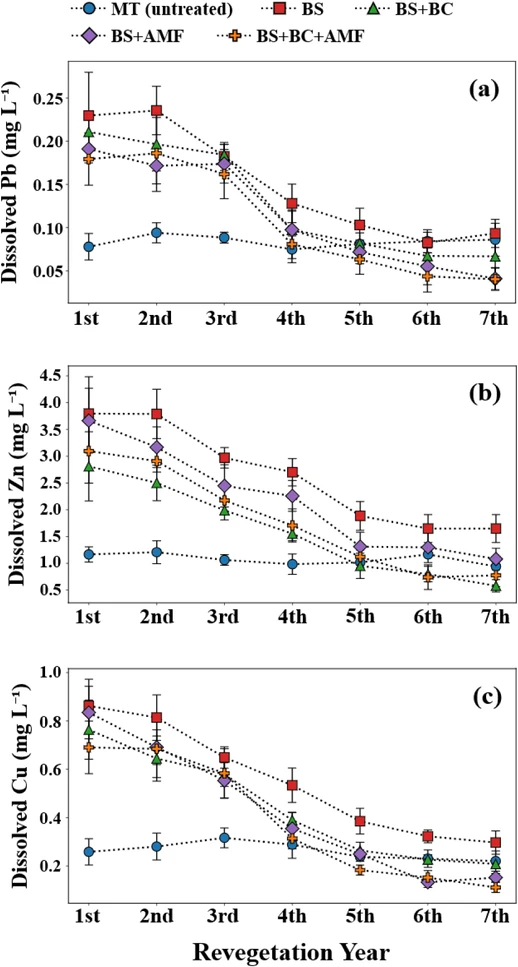 Environ. Sci. Technol. (2026) 60 (43): 30636–30648: Figure 3. Temporal changes in tailings pore-water dissolved concentrations of (a) Pb, (b) Zn, and (c) Cu over seven years of amendment-assisted revegetation. Points represent treatment means (n = 5) ± SD. Mixed-effects model results and Tukey-adjusted post hoc treatment comparisons are reported in Tables S3 and S4, respectively.
TPW pH remained narrowly circumneutral to slightly alkaline, generally around 7.4–7.6. MT and BS+BC had the highest overall pH, whereas BS, BS+AMF, and BS+BC+AMF had lower values (Table S4). This modest pH depression is consistent with the lower pH of the biosolids amendment and may also reflect organic acid production during decomposition and rhizosphere development. (16, 54) However, persistent circumneutral pH is consistent with strong carbonate buffering in the dolomite-rich tailings matrix. (55)
EC, DOC, and DN showed a clear amendment-associated pulse. During the first three years, amended-treatment means were 4.89–6.24 mS cm–1 for EC, 41.4–51.5 mg L–1 for DOC, and 39.8–71.2 mg L–1 for DN, compared with MT means of 2.33–2.54 mS cm–1, 2.39–2.77 mg L–1, and 1.49–1.93 mg L–1, respectively. By year seven, amended-treatment means declined to 3.20–3.88 mS cm–1 for EC, 20.37–30.46 mg L–1 for DOC, and 4.93–17.27 mg L–1 for DN. These trends are consistent with an initially salt-, nutrient-, and DOC-rich TPW environment following amendment application, followed by a decline in readily soluble constituents over time that may reflect processes such as depletion, retention, redistribution, and biological assimilation.
The early elevation of soluble constituents is consistent with the dual role of biosolids as a fertility amendment and a source of labile nutrients, salts, DOC, and metals. (16, 17) However, the later TPW patterns suggest that DOC dynamics were not controlled solely by depletion of biosolids-derived soluble organic matter. Although DOC declined substantially from early year values, DOC remained relatively higher in some combined-amendment treatments than in BS alone by the end of the experiment, consistent with continued contributions from vegetation and microbial processing. Organic carbon amendments and vegetation establishment may influence dissolved organic matter composition, microbial associations, mineral–organic interactions, and aggregation during biogeochemical development in the residuals. (56−58) Thus, the subsequent decline in EC, DOC, and DN may reflect a transition from an initially amendment-dominated soluble phase toward a TPW environment increasingly influenced by biological and mineralogical processes, rather than simple loss of amendment-derived constituents. (59)
3.5. Fe/Mn Fractionation and XRD Provided Geochemical and Mineralogical Context for Metal Retention
Fe and Mn fractionation provided geochemical context for interpreting the distribution of Pb, Zn, and Cu among operationally defined pools (Figures 6a, b and S6). Fe was dominated by the residual/nonsilicate-bound fraction, with a smaller but consistent Fe/Mn oxide-associated pool. This pattern indicates that most Fe occurred in relatively resistant operational pools, whereas the oxide-associated fraction represents a potentially reactive pool that can contribute to trace metal retention through sorption and associated processes. (44, 46, 72) The presence of Pb and Zn in the Fe/Mn oxide-associated fraction is consistent with retention by reactive oxide phases, although sequential extraction cannot distinguish specific mineral hosts or reaction mechanisms. (60, 72, 73) Mn showed more pronounced differences among treatments than Fe in its operationally defined fraction distribution. In untreated tailings, Mn was mainly associated with the reducible Fe/Mn oxide-associated fraction, whereas amended treatments showed a greater contribution from the residual/nonsilicate-bound pool, particularly in the upper amended layer. Because Mn oxides are redox-sensitive and can influence trace-metal retention, this redistribution is consistent with changes in Mn-associated operational pools under amendment-assisted revegetation. (7)
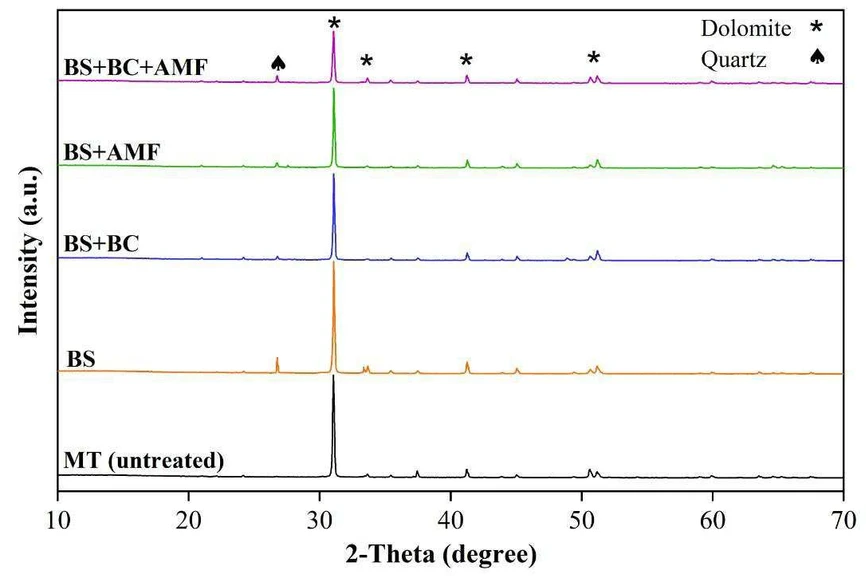 Environ. Sci. Technol. (2026) 60 (43): 30636–30648: Figure 6. Fe and Mn fractionation and mineralogical context of the upper amended tailings layer after seven years of amendment-assisted revegetation. Stacked bars show the mean percentage distribution of (a) Fe and (b) Mn among sequential extraction fractions. Fractions are operationally defined as F1: exchangeable; F2: carbonate-associated; F3: Fe/Mn oxide-associated; F4: organic/sulfide-associated; and F5: residual. Panel (c) shows representative XRD patterns for each treatment.
XRD patterns from the upper, middle, and lower tailings layers were dominated by dolomite, with quartz also present (Figures 6c and S7). Dolomite and quartz were the only clearly identifiable crystalline phases, showing that the carbonate-rich mineral assemblage remained dominated by dolomite after seven years of amendment-assisted revegetation. The dominance of dolomite is consistent with the carbonate-buffered TPW chemistry and provides mineralogical context for the substantial carbonate-associated Pb and Zn pools observed in the sequential extraction. However, carbonate association should not be interpreted as permanent immobilization because F1+F2 represents a potentially labile pool that may respond to changes in pH, rhizosphere chemistry, ionic strength, or dissolved organic matter conditions. (73) The XRD patterns did not reveal clear treatment-related changes in the major crystalline phases that could account for the observed metal repartitioning. Minor or poorly crystalline phases, if present, were not clearly identifiable and may have been masked by the dominant dolomite and quartz reflections. The XRD analysis was qualitative and was not intended to quantify mineral abundances or treatment-related changes in mineral abundance. Therefore, XRD is best interpreted as mineralogical context rather than direct evidence of Pb, Zn, or Cu speciation, while the sequential extraction fractions represent operationally defined pools rather than discrete mineralogical species.
3.6. Environmental Implications and Study Limitations
The seven-year results show that amendment-assisted revegetation was associated with a transition from early amendment-associated mobilization toward greater biological development and metal attenuation. Although biosolids initially increased EC, DOC, DN, and dissolved metals, these responses attenuated over time, particularly in treatments containing BC and/or AMF. Concurrent increases in OC, PLFA-based microbial indicators, and fungal:bacterial ratios in the middle and lower unamended layers, together with metal-specific repartitioning of Pb, Zn, and Cu, indicate that long-term stabilization was associated with coupled aqueous, solid-phase, and biological changes extending beyond the directly amended surface layer (Figures 2–4 and S2). Successful phytostabilization should therefore be evaluated in terms of both contaminant stabilization and substrate development, because surface vegetation alone may overstate restoration progress if deeper tailings remain carbon-poor, biologically inactive, and geochemically labile. Deeper root penetration, AMF-associated PLFA, microbial proliferation, and changes in pore-water chemistry were consistent with biological and geochemical influence extending into underlying unamended tailings, including carbon accumulation, microbial habitat development, and potential C and nutrient cycling. However, the relative contributions of roots, AMF, microbial processes, and pore-water-mediated transport cannot be resolved from the present data.
From a management perspective, the results support complementary amendment strategies that combine fertility, sorption, biological development, and metal retention. Biosolids supported revegetation, but BS alone maintained higher dissolved Zn and Cu by year seven, whereas treatments containing BC and/or AMF showed stronger long-term metal attenuation and biological development. Restoration performance should therefore consider pore-water chemistry, solid-phase lability, OC accumulation, and microbial indicators in addition to vegetation establishment and total metal concentrations. Because the biosolids also contained elevated Pb, Zn, and Cu, their metal loading should be considered as a potential secondary contamination source under environmental conditions that promote remobilization, such as changes in pH or dissolved organic matter. Field-scale economic feasibility will further depend on the local and sustained availability of amendment materials, transport distances, application rates, and site-preparation requirements, and the cost, availability, and scalability of AMF inoculation; these factors require site-specific evaluation before large-scale implementation.
Field-scale restoration should also consider diverse native plant communities rather than relying on the single species evaluated here. Multispecies communities may provide complementary rooting patterns, carbon inputs, and nutrient-acquisition strategies that influence microbial development, ecosystem development, and succession, consistent with field restoration studies showing benefits of AMF-associated plant–microbe interactions for native plant establishment and community development. (74, 75) N-fixing legumes, such as the purple prairie clover used herein, can contribute to nitrogen availability in nutrient-limited tailings, while AMF-mediated belowground interactions may influence nutrient acquisition and interactions among co-occurring plant species. (76, 77) However, the greenhouse pot design does not reproduce field-scale hydrologic variability, preferential flow, seasonal climatic conditions, or spatial root and plant-community development, and the study did not directly quantify leaching fluxes or field-scale metal transport. Accordingly, these responses represent stabilization under the experimental conditions rather than direct evidence of reduced metal export at field scale. Field studies are needed to determine whether they persist under variable hydrologic and climatic conditions and translate into reduced metal transport and sustained ecosystem development.