Mo, 28.9.2026 | Original article from: Forensic Sci. Int.: Synergy, 2026, 100661, Volume 12
ICP-OES and ICP-MS reveal that centuries-old archaeological hair remains chemically distinct from burial soil and retains individual elemental signatures.Elemental analysis of archaeological hair compared to soil composition: A case study of a child and adult female from LaGrange Place, PA
Forensic Sci. Int.: Synergy, 2026, 100661, Volume 12: Graphical abstract
This case study uses ICP-OES and ICP-MS to compare the elemental composition of archaeological hair from a child and an adult female with soil from their burial environment. Fourteen major, trace, and toxic elements were quantified by ICP-OES, complemented by semiquantitative multielement ICP-MS heatmap analysis.
The hair samples were chemically distinct from each other and from the surrounding soil. Although burial substantially altered their mineral composition, individual elemental patterns remained detectable after centuries of soil exposure, highlighting the value of analyzing both hair and burial soil when investigating ante- and postmortem environmental exposure.
The original article
Elemental analysis of archaeological hair compared to soil composition: A case study of a child and adult female from LaGrange Place, PA
Gabrielle DiEmma, Jillian Conte, Kimberlee S. Moran, Karen S. Scott
Forensic Sci. Int.: Synergy, 2026, 100661, Volume 12
licensed under CC-BY 4.0
Selected sections from the article follow. Formats and hyperlinks were adapted from the original.
Hair consists of a keratin biopolymer that has been known to persist for centuries, as exemplified by hair recovered from archaeological contexts [[1], [2], [3]]. As an analytical matrix, hair has the potential to provide insight into who an individual was (e.g., nuclear and mitochondrial DNA), how they lived (e.g., dietary history, evidence of mineral deficiencies), and their environmental exposures (e.g., pollution, heavy metal toxins, soil type, and bacteria involved in human decomposition) [2,4,5]. Soil can also provide valuable information about the past and present as it is formed and altered by the environment and anthropogenic influences over extended periods of time. Soil consists of a non-homogenous mixture of inorganic and organic particulate matter of various sizes and textures; it is full of microorganisms, decomposing organic matter, minerals, nutrients, and water [4,6].
Hair and soil analyses have many applications across industries, such as the development of consumer products and environmental monitoring [[7], [8], [9], [10]]. From an archaeological and forensic perspective, hair and soil are forms of trace evidence that can help establish connections between people and places when compared to reference samples. In forensic toxicology, hair is an alternative matrix that can be used to establish an individual's drug use history to help interpret toxicological findings [11,12]. Additionally, DNA can be extracted from hair and soil to help identify unknown individuals and assess a variety of environmental factors [[13], [14], [15], [16]]. Archaeological and forensic hair analyses involve both microscopic examinations of the hair morphological features (e.g., color, presence/absence of medulla and postmortem root morphologies) as well as the chemical, elemental, and isotopic composition of the hair [5,7,[17], [18], [19], [20], [21], [22], [23], [24], [25], [26], [27]].
The information that can be obtained from hair and soil samples may be limited by the presence of contaminants or interfering substances, sample quantity, the extent of damage or degradation if present, the efficacy of sample preparation procedures, and the sensitivity of the instrumentation used. To analyze hair's endogenous features, the hair must undergo washing procedures to remove exogenous contamination or adhering soil and dust particles that could contaminate a sample and interfere with the analysis. There is no standardized hair washing procedure used throughout the hair analysis field [11,24,[28], [29], [30], [31]]. Studies investigating the elemental composition of human hair and soil matrices employ a variety of sample preparation procedures (e.g., washing, digestion), methods of sample introduction, and instrumentation [[9], [10], [11],23,24,[28], [29], [30]]. Inductively coupled plasma optical emission spectroscopy (ICP-OES) and mass spectrometry (ICP-MS) have often been used for elemental hair and soil analyses, the latter of which has greater sensitivity and lower detection limits [24,32,33].
While previous studies have investigated the microscopic features of archaeological hair and documented the observed degradation characteristics and morphologies, few studies have simultaneously investigated the elemental composition of archaeological hair compared to the surrounding soil composition [1,3,27,34]. During a salvage archaeology project known as the Arch Street Project, the remains of several hundred individuals were recovered from the site of the former First Baptist Church of Philadelphia (FBCP) burial ground, also known historically as LaGrange Place (Philadelphia, PA, USA). [35]. The individuals buried in the FBCP burial ground were reportedly relocated to Mount Moriah cemetery in 1860. However, in 2016, a news article reported that a box of bones had been collected at a construction site at 218 Arch Street in Philadelphia [36]. Local archaeologists saw the article, researched the site, and discovered that the land was that of the FBCP burial ground, active from 1722 to 1859. Limited monitoring of the backhoe excavation was permitted by the property developer until it was clear that there were full coffins and multiple layers of burials at the site. The construction company agreed to halt construction for a week in March 2017 to allow a small team of local archaeologists, students, and volunteers to conduct a salvage excavation. Commingled remains and loose bones were collected in labeled boxes and coffins were removed intact and stored for processing at a later date [35]. Among these remains were two individuals (G-009 and G-033) with intact hair masses that are the focus of this case study. Microscopic and elemental analyses were conducted on portions of these archaeological hair samples and compared to the soil from the FBCP excavation site. This research was approved by the decedent community and the Rutgers IRB (study Pro2022001564).
2. Materials and methods
2.4. Inductively coupled plasma optical emission spectrometry (ICP-OES)
A PerkinElmer Avio® 500 Inductively Coupled Plasma Optical Emission Spectrometer was used for the elemental analyses. The instrument was equipped with a Meinhard Concentric glass nebulizer, Baffled Glass Cyclonic spray chamber, 2.0 mm Alumina Injector, 1 Slot Quartz Torch, and 1500 W power. Method parameters included 10 L/min plasma gas, 0.2 L/min auxiliary gas, 0.65 nebulizer gas with a sample uptake rate of 1.00 mL/min. Three elements – Ca, Mg, Na – used the radial viewing angle while axial was used for the remaining analytes of interest. A seven-point linear calibration curve (0, 0.25, 0.5, 1, 2, 5, and 10 ppm) prepared from NIST traceable single element stock standards was used. Two analytical wavelengths per element were analyzed to check for interferences and confirm the reported parts per million (ppm) concentrations in the solution. A 2-ppm calibration verification standard and five samples spiked with the fourteen elements of interest (As, Ca, Cd, Cr, Cu, Fe, K, Mg, Mn, Na, Ni, P, Pb, and Zn) were prepared from an independent set of NIST traceable single element stock standards.
2.5. Inductively coupled plasma mass spectrometry (ICP-MS)
An Agilent Technologies 7700 Series ICP-MS (G3281A, Serial No. JP09330055) equipped with an ASX-500 Series ICP-MS Autosampler and an Agilent Technologies G1879B Heat Exchanger was used for parts per billion or micrograms per liter (μg/L) elemental analyses. Data collection and processing used the Online ICP-MS MassHunter® software and the system was run in both no gas and helium (He) tune modes depending on the analyte. Calibration standards were made using the Inorganic Ventures IV-ICPMS-71A 3 % v/v HNO3 standard solution containing 10 ppm of Ag, Al, As, B, Ba, Be, Ca, Cd, Ce, Co, Cr, Cs, Cu, Dy, Er, Eu, Fe, Ga, Gd, Ho, K, La, Lu, Mg, Mn, Na, Nd, Ni, P, Pb, Pr, Rb, S, Se, Sm, Sr, Th, Tl, Tm, U, V, Yb, and Zn. Additional standards were made as needed to cover all the elements of interest using the PerkinElmer Pure AA Test Mix containing 50 ppm of Ca, Cr, Cu, Fe, and Ni; 20 ppm of K; and 10 ppm of Na and Zn in 2 % HCl. The Inorganic Ventures IV-ICPMS-71D, 3 % v/v HNO3, solution containing 10 ppm Bi, In, Li6, Sc, Tb, and Y was used as the internal standard.
3. Results and discussion
3.1. Microscopic analyses
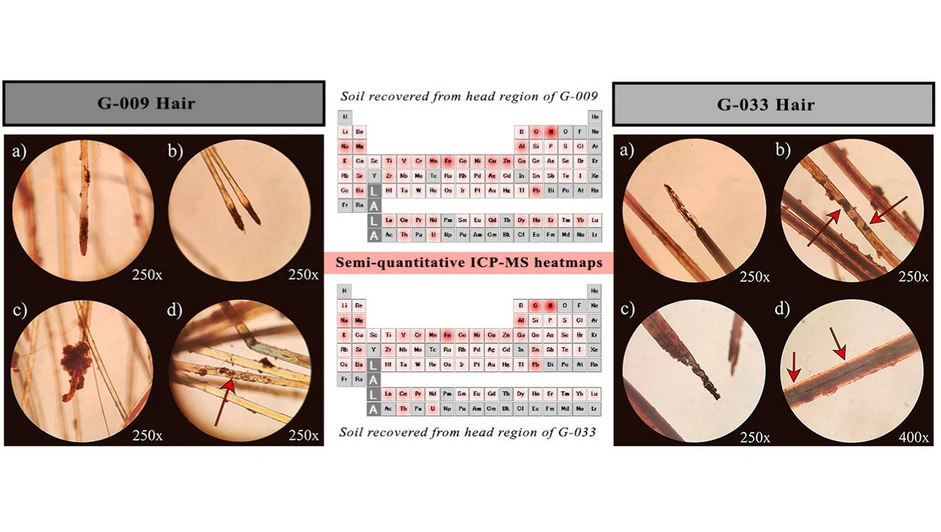
The G-009 (Fig. 1) and G-033 (Fig. 2) hair samples had extensive soil contamination and degradation. The hair samples collected from under the occipital region of the skull of G-009 displayed multiple postmortem root morphologies in the form of hard keratinized points (HKPs) (Fig. 1a and b). These HKPs were easily visualized by their dark discolored, opaque ends resulting from a sharp break at the postmortem root band. The G-009 hair samples had extensive soil contamination that became evident during the washing procedure as it took an additional final acetone wash for the decanted solvent to run clear. In addition, the G-009 hair had plant and fungal material present with hyphae wrapped around the hair shaft (with minimal penetration via tunneling) (Fig. 1c and d).
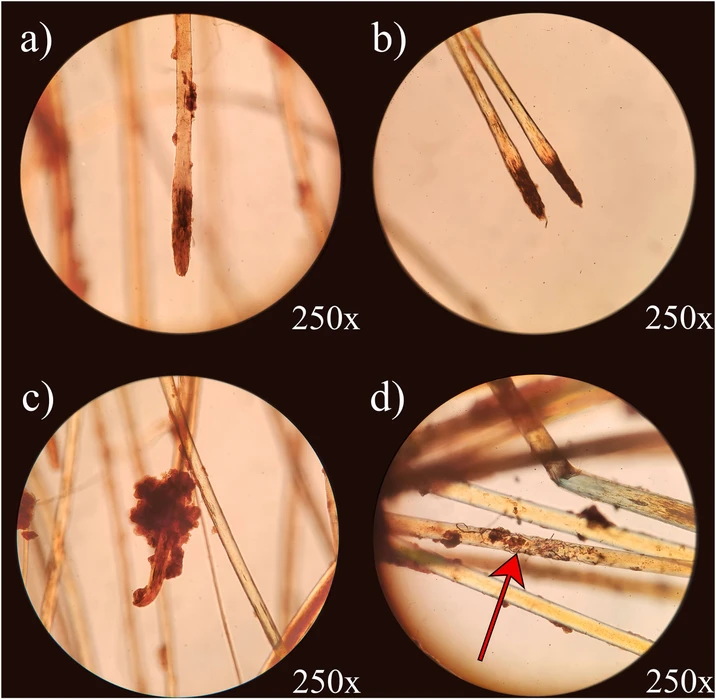 Forensic Sci. Int.: Synergy, 2026, 100661, Volume 12: Fig. 1. G-009 Hair Under the Microscope – Photographs of the G-009 hair from under the occipital bone in plane polarized light depicting a) a hard keratinized point (250x); b) two hard keratinized points (250x); c) soil encased root (250x); and d) plant and fungal activity (250x).
3.3. ICP-OES: Archaeological hair
ICP-OES hair analysis showed the highest concentrated metal is Ca for all samples, followed by Na in the G-033 hair, Fe in both individuals, and Mg, Na, and P in G-009 (Table 2). The least concentrated metal was Ni with multiple replicates below the limit of quantitation and two samples (AHM1 unwashed and AHM2 washed) below detection limits in all five replicates (<DL). Arsenic (As), cadmium (Cd), and chromium (Cr) are not listed in Table 2 as they were below detection limits in all hair samples.
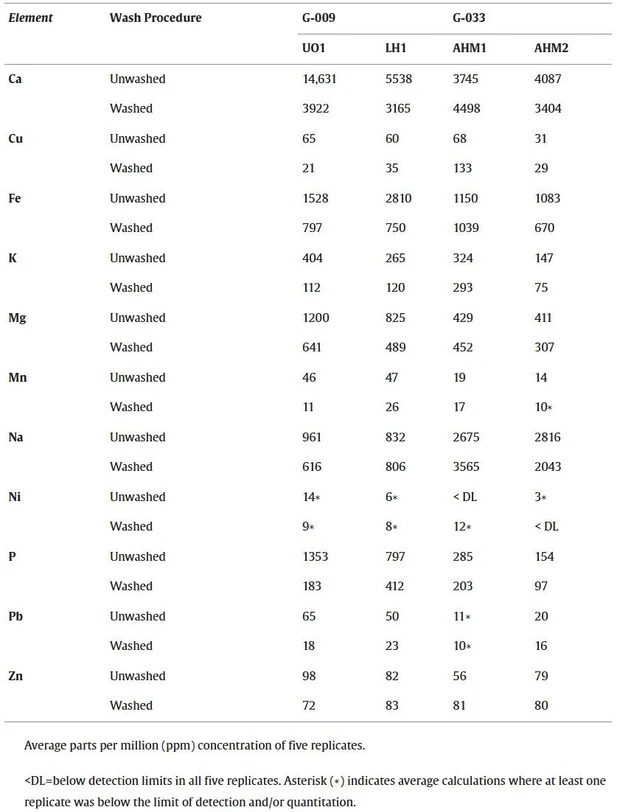 Forensic Sci. Int.: Synergy, 2026, 100661, Volume 12: Table 2. Elemental composition of G-009 and G-033 archaeological hair.
3.4. ICP-MS data comparison
Overall, most reported concentrations in the G-033 samples did not significantly differ between the ICP-OES data and ICP-MS data. There was consistency across ions and modes used for the ICP-MS data. The 75As ion in [No Gas] mode was unsuitable for analysis due to the high background, likely caused by the 40Ar35Cl polyatomic ion. Analysis of the 75As ion in [He] mode led to a slight improvement in response as the helium collision cell helped remove the polyatomic ions that raise the background noise. Although phosphorus was analyzed using this method, the 31𝑃 isotope overlaps with the nitrous oxide 15N16O polyatomic ion in ICP-MS and the results remained highly inconsistent even when the helium collision cell was used. Re-analysis of samples by ICP-MS verified some of the ICP-OES results while demonstrating the differences in the two detection methods’ capabilities for various sample types. The ICP-MS method also had greater sensitivity for the minor and trace elements in the soil samples such as As, Cd, Cr, and Ni that posed issues for the ICP-OES analysis of the same samples.
ICP-MS analysis allowed for a semi-quantitative survey of elements across the periodic table. This data could then be represented in a heat map to view the overall elemental distribution of the sample and to help select the elements of interest for further quantitative analyses. This semi-quantitative technique (Fig. 4) was used to analyze two additional soil samples collected from and associated with the head region of the G-009 and G-033 remains, referred to as head soil in this paper. The two soil samples have similar elemental distributions while G-009 (Fig. 4a) has greater levels of Ti, Cu, Zn, Ag, and several of the lanthanides while G-033 has elevated Sn (Fig. 4b).
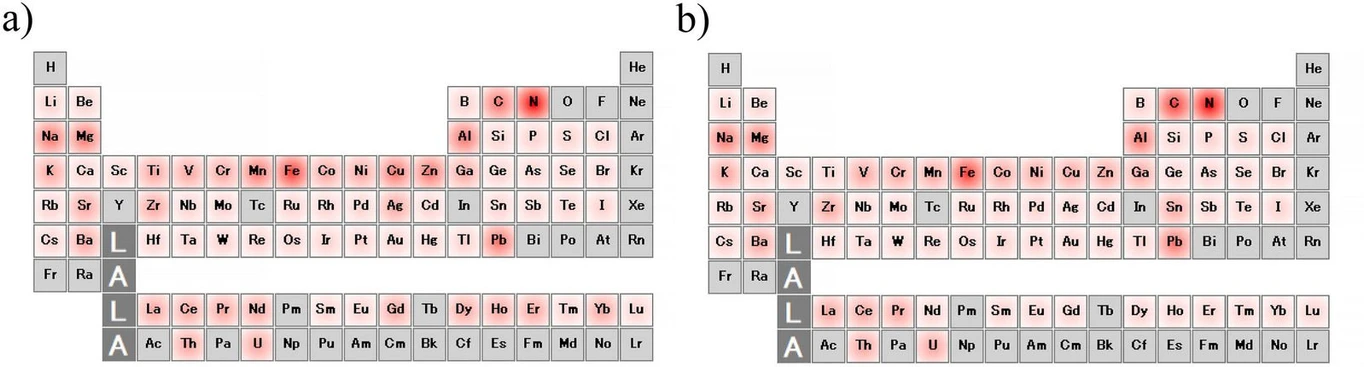 Forensic Sci. Int.: Synergy, 2026, 100661, Volume 12: Fig. 4. Semi-Quantitative Heat Maps – ICP-MS semi-quantitative heat maps for a) G-009 Area C head soil and b) G-033 adult head soil. The greater the intensity of the red color over the element, the higher the levels of that element detected in the sample.
4. Conclusion
While the elemental composition of the surroundings affected the distribution of elements in the hair (e.g., elevated Fe, Ca, Na, and Mg concentrations), the hair retained unique, individual elemental information even after over 200 years buried in the soil. There was significant intra-individual variation for both the washed (Cu, Mg, Mn, and Na for the G-009; Cu, Fe, Mn, and Na for G-033) and unwashed (K, Mg, and P for G-009; K only for G-033) archaeological hair samples. Inter-individual variation was demonstrated by significant differences in the elemental content of the G-009 and G-033 washed (Mg, Na, P, Pb) and unwashed (Ca, Fe, Mg, Mn, Na, P, Pb) hair.
Additionally, both the G-009 and G-033 hair were different in content and relative elemental distributions from the AS- and RU-designated soils (Fe, Mn, and Na in all samples) while the AS- and RU- designated soil were also distinct from each other (As, Ca, Cu, Fe, K, Mg, Mn, P, Pb, and Zn). The archaeological hair, RU-designated soil, and head soil samples contained elevated concentrations of Fe and Pb. To interpret these findings, it is important to note that many of the remains were recovered with coffins, and the associated coffin hardware (e.g., metal material culture such as pins, nails, coffin handles, and engraved decorations) could contribute to some of the elevated iron concentrations observed in the excavated soil [41]. The elevated concentrations of Pb could reflect industrial lead pollution in Philadelphia in the 18th and 19th centuries and the presence of various material culture and coffin hardware leaching heavy metals into the soil over time [42,43]. However, due to the small sample size in this case study, it is not possible to generalize these hair and soil findings to all individuals and samples recovered from LaGrange Place or the greater Philadelphia area without additional data.
While the ICP-MS data was comparable to the ICP-OES data when samples were re-run, additional sample preparation and method development was required to account for matrix effects and interferences in the digests. The semi-quantitative heat maps provided an initial survey of elements that was unfortunately unable to be pursued in this study due to time and resource constraints.
Archaeological hair and soil samples contain a wealth of information for forensic investigations. While the time scale of exposure is much larger for archaeological samples, these insights could also potentially apply in forensic contexts, such as in clandestine burials, historical identifications, and cold cases. Hair and soil as trace evidence can provide knowledge about the way people lived and the environments they were exposed to in life and death. As this is a case study of only two historical individuals, it is recommended that additional studies be conducted to determine the rate and extent of elemental exchange in soil-exposed hair samples over shorter timeframes.
Both ICP-OES and ICP-MS were useful tools for studying the hair and soil mineral snapshots in this case study. In general, more standardization of sample preparation and analytical techniques is needed to allow for direct data comparisons in forensic and archaeological hair and soil analyses. To allow for the greatest level of interpretation of the data, it is important to also study the soil composition data when analyzing the elemental composition of hair recovered from buried human remains in forensic or archaeological contexts. This research showed that hair recovered from archaeological contexts can retain unique chemical signatures that can provide insight into an individual's life and exposure to the environment ante- and postmortem.