Mo, 12.10.2026 | Original article from: ACS Omega (2026) 11 (38): 57016–57025.
A bioflocculant derived from açaí seed tannins achieves 91–100% removal of several toxic metals, with FTIR and ICP-MS supporting optimization under alkaline conditions.Optimizing the Production of a Condensed Tannin-Based Bioflocculant for Toxic Metal Remediation
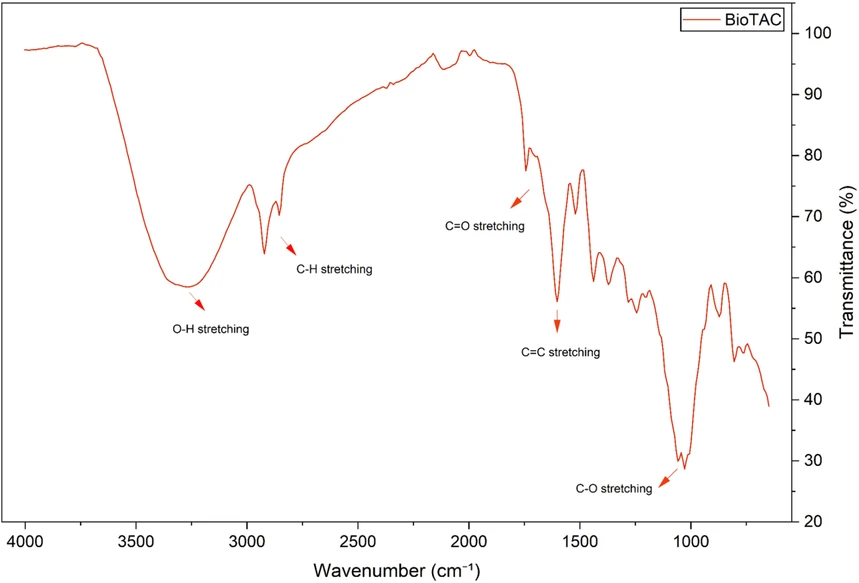
ACS Omega (2026) 11 (38): 57016–57025: Figure 2. Mid-infrared spectroscopy of BioTAC.
This study evaluates BioTAC, a cationic bioflocculant produced from açaí seed tannins via the Mannich reaction, for removing toxic metals from aqueous media. MIR-FTIR was used for structural characterization, while ICP-MS quantified metal removal across different bioflocculant concentrations and pH conditions.
BioTAC achieved removal efficiencies of 91–100% for Al, Ti, Fe, Cu, Zn, and U at concentrations of 69–87 ppb under alkaline conditions. Higher pH promoted deprotonation of phenolic hydroxyl groups and enhanced metal chelation, demonstrating the potential of this renewable bioflocculant for sustainable treatment of metal-contaminated water.
The original article
Optimizing the Production of a Condensed Tannin-Based Bioflocculant for Toxic Metal Remediation
Sara Raissa Lobato Ferreira * ; Jéssica Lyssa Araújo; Camilla Mariane Moura de Souza; Carlos Gabriel da Silva de Souza; Kleber Raimundo Freitas Faial; Neirivaldo Cavalcante da Silva; Nilton Akio Muto
ACS Omega (2026) 11 (38): 57016–57025.
https://doi.org/10.1021/acsomega.6c04045
licensed under CC-BY 4.0
Selected sections from the article follow. Formats and hyperlinks were adapted from the original.
Water is one of the most abundant natural resources on Earth and is essential for human survival. In Brazil, approximately 4.8 million people still lack access to potable water. (1) The country’s water and wastewater treatment is commonly performed using technologies based on chemical coagulants and flocculants. The most widely used of these include aluminum sulfate, iron salts, and synthetic polymers. Among these compounds, aluminum sulfate is widely used as a coagulant in drinking water and wastewater treatment due to its effectiveness, availability, and relatively low operational cost. (2, 3)
However, the extensive use of chemical coagulants and flocculants can result in environmental impacts and potential risks to human health. The large-scale application of these compounds may contribute to the accumulation of residual metals and other chemical contaminants in treated water. Exposure to these substances has been associated with adverse health outcomes, including cancer associated with arsenic contamination and neurodegenerative diseases, such as Alzheimer’s disease and Parkinson’s disease, which have been linked to chronic exposure to aluminum and other neurotoxic metals. (3−7)
In this context, bioflocculants emerge as a promising and sustainable solution, exhibiting coagulant and flocculant properties similar to conventional agents but with a lower environmental impact. Tannins extracted from the seeds of açaí (Euterpe oleracea), an abundant agro-industrial byproduct in the Amazon region, demonstrate significant potential for water treatment applications. (8−12) In recent years, tannin-based matrices have been extensively investigated for the remediation of highly toxic heavy metals. Among these studies, modified biopolymers derived from natural tannins have been successfully applied to the rapid removal of trace elements such as copper (Cu), chromium (Cr), and mercury (Hg), outperforming conventional inorganic coagulants under various pH conditions. (13, 14) Furthermore, tannin matrices have demonstrated remarkable chelating affinity for the selective recovery of critical metals from industrial effluents, driven by the strong complexation capacity of their abundant phenolic hydroxyl groups. (15)
Despite its promising potential, gaps remain in scientific knowledge regarding the production and application of a cationic bioflocculant derived from açaí seeds (BioTAC) in the removal of trace elements. Therefore, this study aims to address these gaps by evaluating the flocculation performance of the synthesized cationic bioflocculant (BioTAC) in the simultaneous removal of 20 trace elements from a multimetallic aqueous solution under different pH conditions.
Materials and Methods
Characterization of BioTAC by Mid-Infrared Fourier Transform Spectroscopy (MIR-FTIR)
The identification of the functional groups present in the bioflocculant was performed using mid-infrared spectroscopy (MIR) on an Agilent Cary 630 FTIR spectrometer (Santa Clara, CA, USA). The equipment operated with an attenuated total reflectance (ATR) module equipped with a zinc selenide (ZnSe) crystal and a deuterated triglycine sulfate (DTGS) detector.
Prior to analysis, BioTAC was subjected to a lyophilization process to ensure the complete removal of residual moisture while preserving the structural integrity of the polyphenols. The lyophilized material was deposited directly onto the crystal, and the spectra were obtained.
Chemical and Statistical Analyses
Quantification of Metals by ICP-MS
The samples were analyzed in triplicate by inductively coupled plasma mass spectrometry (ICP-MS, Agilent Technologies 7900). The analyses were performed on the basis of a calibration curve ranging from 1 to 160 ppb. The curve was prepared in a multimetallic mix matrix, and each point was analyzed in triplicate to ensure data reproducibility. Recovery tests were also conducted by adding the 1640a certified standard (16) to contaminated samples to evaluate the analytical accuracy. The obtained recoveries were within the limits recommended by Standard Methods 3000/3125, (20) thus validating the reliability of the results. The analyzed metals were the same as those previously described in the synthetic multimetallic solution. The limit of detection (LOD) and limit of quantification (LOQ) values are presented in Supporting Table S1.
Results
Chemical Characterization by MIR-FTIR
Structural characterization of BioTAC by mid-infrared Fourier transform spectroscopy (MIR-FTIR) revealed the presence of functional groups that are determinant for its activity (Figure 2). The broad band centered at approximately 3400 and 3300 cm–1 reflects the axial stretching vibrations of hydroxyl (O–H) groups from alcohol structures intensely associated via intermolecular hydrogen bonding. In the 3100–2760 cm–1 range, a discrete peak with lower amplitude was identified between ∼2930 and ∼2880 cm–1, corresponding to the stretching of aliphatic C–H bonds. (22−25)
ACS Omega (2026) 11 (38): 57016–57025: Figure 2. Mid-infrared spectroscopy of BioTAC.
In the region of oxygenated groups and carbon skeleton (1800–1000 cm–1), a characteristic signal was recorded at 1750 cm–1, attributed to carbonyl (C═O) stretching. (23−25) Additionally, the absorption profile around 1610 cm–1 evidenced axial stretching vibrations of the C═C skeleton, confirming the presence of aromatic structures in the sample. (22, 23, 25) Finally, the strong absorption zone between 1200 and 900 cm–1 indicated axial stretching profiles of phenolic C–O bonds at ∼1130 cm–1 and alcohol-associated C–O linkages at ∼911 cm–1, (22, 23, 27) consolidating the macromolecular and polyfunctional nature of the material.
Metal Removal Efficiency
Control Assays
The inductively coupled plasma mass spectrometry (ICP-MS) analyses confirmed that the ultrapure water used in the experiments detected metal concentrations below the limits of detection (LOD). Meanwhile, the tannin extract revealed trace concentrations of V (0.0134 ppb), Mn (0.178 ppb), Zn (5.57 ppb), Rb (0.078 ppb), Mo (0.040 ppb), and Ba (0.031 ppb).
Removal by Metal Group
At bioflocculant dosages of 52, 69, and 87 ppb across pH levels of 4, 7, and 10, no statistically significant reductions were observed for the elements As, Rb, and Sb. For these three metals, under specific conditions (notably pH 10 and pH 4), the final concentrations remained near or even exceeded initial levels.
The performance analysis of BioTAC for V, Mo, and Se indicated that the highest removal efficiencies were achieved at pH 4 (Figure 3). V and Mo showed average reductions of approximately 33 and 40%, respectively, at the Bio II (69 ppb) and Bio III (87 ppb) concentrations, while Se removal was more significant, reaching approximately 52% at pH 4. Conversely, an increase in concentrations was observed for these three metals when treated at pH values of 7 and 10, indicating the bioflocculant ineffectiveness in neutral and alkaline media.
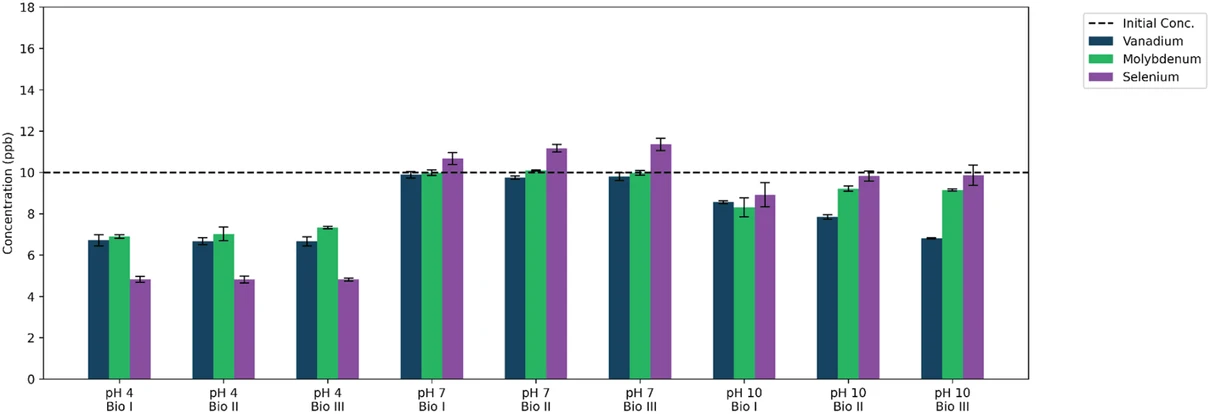 ACS Omega (2026) 11 (38): 57016–57025: Figure 3. Residual concentrations of vanadium, molybdenum, and selenium after the treatment of contaminated water with different bioflocculant dosages (Bio I─52 ppb, Bio II─69 ppb, Bio III─87 ppb) under acidic (pH 4), neutral (pH 7), and alkaline (pH 10) conditions.
The metals Cr, Co, Ni, Cd, and Pb showed removal efficiencies between 85 and 89% at pH 10 with the highest dosage of Bio III (87 ppb) (Figure 5). Specifically, the reduction was 88.6% for Cr, 87.9% for Co, 89.6% for Ni, 87.1% for Cd, and 86.5% for Pb. Ba exhibited 87.8% removal with the lowest concentration (Bio I─52 ppb) at pH 10, and 85% removal at pH 7 with the use of Bio III (87 ppb).
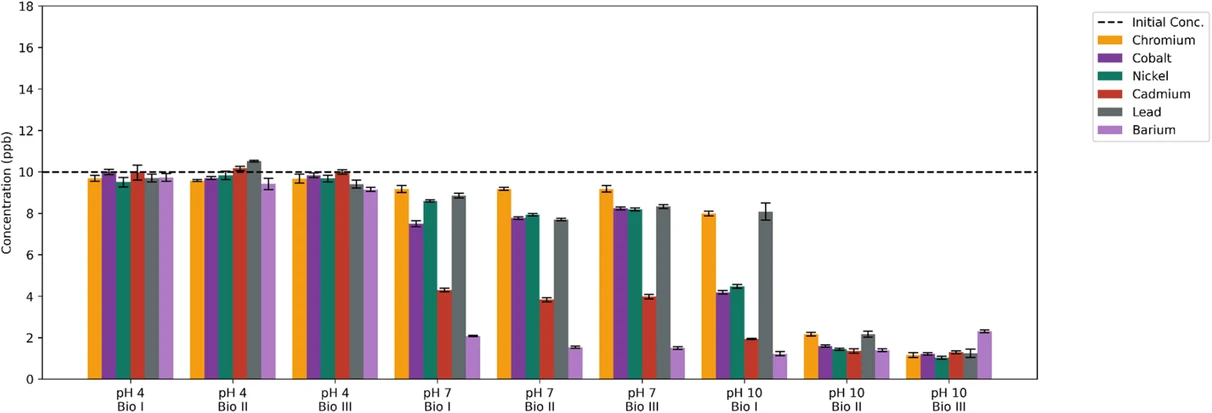 ACS Omega (2026) 11 (38): 57016–57025: Figure 5: Residual concentrations of chromium (Cr), cobalt (Co), nickel (Ni), cadmium (Cd), lead (Pb), and barium (Ba) after treatment of the contaminated water with the BioTAC bioflocculant, under different pH conditions (acidic─4, neutral─7, and alkaline─10) and concentrations (Bio I─52 ppb, Bio II─69 ppb, and Bio III─87 ppb).
Conclusion
BioTAC demonstrated high efficacy in the selective removal of various heavy metals, through a mechanism combining charge neutralization and optimized metal chelation by ionized phenolic hydroxyl groups. This environmentally friendly and low-cost alternative is a promising solution for treating contaminated water, with the potential to benefit vulnerable communities. However, it is essential to consider the bioflocculant’s selectivity towards different metals and pH ranges. Future research should focus on further characterizing the post-flocculation solids, evaluating its application to real industrial wastewater, investigating its integration with other treatment technologies, and conducting toxicological assessments to ensure the efficacy and safety of the process under practical operating conditions.