We, 4.11.2026 | Original article from: LabRulezLCMS Library
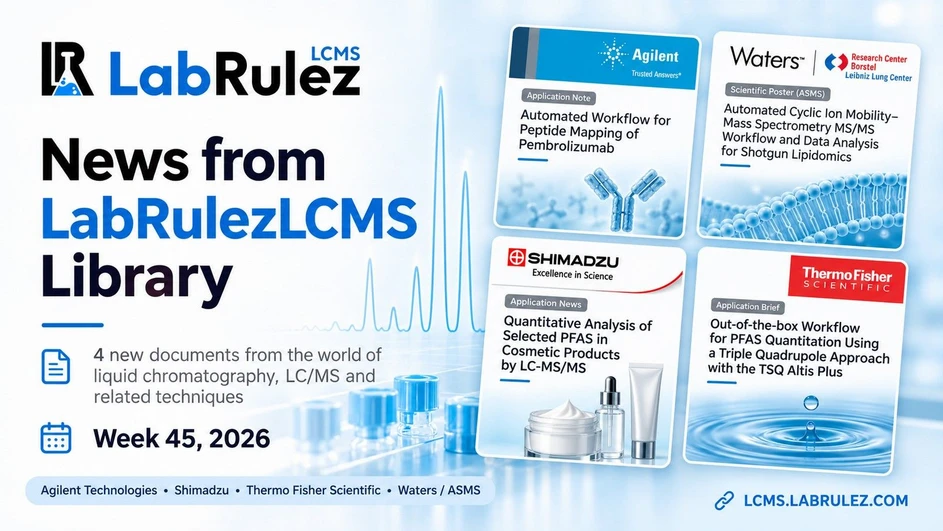
This week we bring you application notes by Agilent Technologies, Shimadzu, Thermo Fisher Scientific and poster by Waters Corporation / ASMS!News from LabRulezLCMS Library - Week 45, 2026
LabRulez / AI: News from LabRulezLCMS Library - Week 45, 2026
Our Library never stops expanding. What are the most recent contributions to LabRulezLCMS Library in the week of 2nd November 2026? Check out new documents from the field of liquid phase, especially HPLC and LC/MS techniques!
👉 SEARCH THE LARGEST REPOSITORY OF DOCUMENTS ABOUT LCMS AND RELATED TECHNIQUES
👉 Need info about different analytical techniques? Peek into LabRulezGCMS or LabRulezICPMS libraries.
1. Agilent Technologies: Automated Workflow for Peptide Mapping of Pembrolizumab on the Agilent 6545XT AdvanceBio LC/Q-TOF
- Application note
- Full PDF for download
Therapeutic monoclonal antibodies (mAbs) are structurally complex biopharmaceuticals that require detailed characterization to ensure safety, efficacy, and batch‑to‑batch consistency. Due to their heterogeneity, arising from post‑translational modifications (PTMs) such as glycosylation, oxidation, and deamidation, comprehensive analytical strategies are essential.
By digesting the therapeutic protein into peptides and analyzing them using LC/MS/MS, this workflow delivers comprehensive sequence-level characterization and a high‑resolution molecular fingerprint, enabling:
- Confirmation of primary amino acid sequence
- Identification and localization of PTMs
- Monitoring critical quality attributes (CQAs) throughout development and manufacturing
The Agilent AssayMAP Bravo Protein Sample Prep platform automates mAb sample preparation workflows, including digestion and peptide cleanup, to improve reproducibility, reduce hands-on time, and increase throughput. Automated processing ensures consistent peptide mapping results and supports reliable characterization of CQAs in biotherapeutics.
Experimental
Instruments
- Agilent 1290 Infinity III bio high-speed pump (G7132A)
- Agilent 1290 Infinity III bio multisampler (G7137A) with Agilent InfinityLab sample thermostat (G7167A-60201)
- Agilent 1290 Infinity III multicolumn thermostat (G7116B)
- Agilent 6545XT AdvanceBio LC/Q-TOF with Agilent Dual Jet Stream ESI source
- Agilent AssayMAP Bravo system (G5542A) – for reduced and nonreduced analysis
Software
- Agilent MassHunter data acquisition software for LC/TOF and LC/Q-TOF version 11.1
- Agilent MassHunter BioConfirm software version 12.1
- Agilent VWorks version 13.1
Conclusion
A comprehensive workflow has been demonstrated, encompassing automated sample preparation on an Agilent AssayMAP Bravo platform, LC separation using an Agilent 1290 Infinity III bio LC system, data acquisition with an Agilent 6545XT AdvanceBio LC/QTOF, and data analysis through Agilent MassHunter BioConfirm software. This approach enables amino acid sequence identification and confirmation, verification of the intended S228P mutation, terminal sequence analysis, as well as characterization of PTMs including the low-abundance oxidation form and disulfide linkages in pembrolizumab mAb.
The high-quality MS/MS spectra, combined with extensive coverage of low-abundance peptides, underscore the strong performance of the Agilent 6545XT AdvanceBio LC/QTOF for peptide mapping applications.
2. Shimadzu: Quantitative Analysis of Selected Per- and Polyfluoroalkyl Substances (PFAS) in Cosmetic Products by LC-MS/MS
- Application note
- Full PDF for download
User benefits
- Accurate quantification of multiple PFAS in complex cosmetic matrices is possible using LC-MS/MS with internal-standard calibration.
- QuEChERS extraction combined with SPE cleanup provides effective matrix removal, enabling reliable PFAS analysis in diverse cosmetic products.
- The PFAS-targeted method can be expanded to include additional PFAS compounds as analytical requirements evolve.
Per- and polyfluoroalkyl substances (PFAS) are a diverse group of synthetic chemicals that have been intentionally used in certain cosmetic products because of their unique physicochemical properties and functional characteristics, including water and oil resistance, conditioning, and film formation1. These properties can contribute to the performance and sensory characteristics of cosmetic products. However, concerns regarding the persistence and potential environmental and health impacts of certain PFAS have increased the need for reliable analytical methods to identify and quantify these compounds in cosmetic products2. This Application News presents a workflow for the quantitative analysis of selected PFAS in cosmetic products using Shimadzu’s LCMS-8060RX triple quadrupole mass spectrometer coupled with the Nexera LC-40 ultra-high-performance liquid chromatography system (Fig. 1).
Conclusion
The developed workflow provides a simple and effective approach for the extraction and quantitative analysis of PFAS in cosmetic products. The QuEChERS-based extraction combined with SPE cleanup provides effective matrix reduction, although it does not eliminate matrix-related effects. The cleanup helps minimize matrix components that can contribute to ion suppression and contamination of the LC-MS/MS ion source. The use of PFAS-free materials throughout the analytical workflow further minimizes the risk of background contamination. Combined with the high sensitivity of the LCMS-8060 RX, the developed workflow demonstrated good analytical performance for the targeted PFAS compounds in cosmetic matrices. The developed sample preparation protocol can be extended to HRMS platforms such as the LCMS-9050 for non-targeted PFAS analysis, enabling the screening and identification of a broader range of PFAS beyond the targeted compounds evaluated in this study.
3. Thermo Fisher Scientific: Out-of-the-box workflow for PFAS quantitation using a triple quadrupole approach with the TSQ Altis Plus mass spectrometer
- Application note
- Full PDF for download
Application benefits
- Quantitation of a large panel of 61 PFAS compounds with performance and robustness proved with the applied analytical strategy.
- Designed to comply with current European regulations (0.1 µg/L sum of 20 PFAS; 0.5 µg/L total PFAS), and with many local regulations.
- The sensitivity of our method is compatible with major sample preparation techniques, including solid phase extraction (SPE). Limits of Quantification (LOQs) are achieved in solvent ranges from 50 ng/L for over 80% of targets to 500 ng/L for fewer than 5% of targets. Corresponding LOQs in matrices range from 0.1 ng/L to 1 ng/L with 500-fold concentration.
- Challenging PFAS (FTOH, FTAB) on the same method with a single HPLC separation.
Per- and polyfluoroalkyl substances (PFAS) are a large group of synthetic chemicals known for their resistance to heat, water, and oil. Due to these properties, PFAS have been widely used in various industrial and consumer products. However, PFAS are often referred to as "forever chemicals" because they do not break down easily and can accumulate in the environment and in human and animal tissues over time. This persistence, along with their widespread use, has led to extensive environmental contamination, particularly in water sources.1 As a result, analyzing PFAS in different matrices, especially drinking water, has become increasingly important. Analyzing PFAS is critical for understanding their distribution, concentration, and potential risks to human health and the environment.2 To address these health risks, various governmental regulatory agencies have established validated methods to quantify individual or collective PFAS levels in drinking water.
Regulatory framework in Europe
In Europe, the main regulation governing drinking water quality is the Drinking Water Directive (2020/2184/EU), which sets two thresholds for PFAS:
- 0.1 µg/L for the sum of a group of 20 PFAS
- 0.5 µg/L for the totality of PFAS3
Some countries, such as Denmark and Italy, test additional compounds. In the United Kingdom, the testing is based on tiered results with different countermeasures depending on PFAS concentrations (Tier 1: <0.01 µg/L, Tier 2: 0.01 µg/L – 0.1 µg/L, Tier 3: >0.1 µg/L). Additionally, several European countries have established limits for the sum of four PFAS compounds to which the population has been most exposed: PFOA, PFNA, PFHxS, and PFOS.4
Analytical approach and methodology
Liquid chromatography coupled with mass spectrometry provides high sensitivity and specificity for detecting a wide range of PFAS compounds. In previous work, we demonstrated the ability to meet regulatory requirements for PFAS analysis using large volume injection and high-end triple quadrupole technology for drinking water analysis.6 Nevertheless, other types of water need sample preparation, which is often critical, to concentrate PFAS from large volumes and to remove potential interferences. We have previously demonstrated the capabilities of an automated dispersive liquid-liquid microextraction (DLLME) procedure using a Thermo Scientific™ TriPlus™ RSH SMART autosampler for the extraction and analysis of PFAS in drinking water.7 The DLLME protocol offers advantages such as automation and the use of small sample and reagent volumes. However, the most common approach for PFAS extraction and pre-concentration is based on solid phase extraction (SPE)8,9 and is compatible with our method.
Experimental
Instrument configuration and method
A Thermo Scientific™ Vanquish™ Flex Binary UHPLC pump with a Thermo Scientific™ Vanquish™ Duo Autosampler is used, coupled to a TSQ Altis Plus triple quadrupole mass spectrometer. The gradient uses a combination of water and methanol as the mobile phases. The hardware configuration schematics can be seen in Figure 1 and Table 1. A single combination of delay column/ analytical column is used here. The second channel is kept for flexibility for additional or complementary applications. Table 2 recaps the main instrument parameters.
Conclusions
Our method offers significant advantages for PFAS analysis, ensuring accurate, reliable, and compliant results. The major customer benefit is that we provide a ready-to-go solution, already optimized to meet regulatory limits in terms of performance, designed to comply with regulatory criteria, fully tested for robustness, applicable to any environmental sample type, and extremely easy to handle with a user-optimized interface.
- Accurate PFAS quantitation: The method enables the precise quantitation of a broad range of PFAS compounds using the targeted approach of the TSQ Altis Plus mass spectrometer, demonstrating high sensitivity, selectivity, and robustness.
- Well-established configuration: The TSQ Altis Plus configuration is well-established and widely used, ensuring reliability and familiarity.
- Regulatory compliance: Designed to comply with current European regulations for PFAS in drinking water (0.1 µg/L sum of 20 PFAS; 0.5 µg/L total PFAS); it can be extended to other regional PFAS lists.
- Robust method: Proven robustness with consistent performance across multiple injections and different matrices (drinking water, surface water, groundwater, wastewater), maintaining accuracy and stability without the need for maintenance or MS tuning.
- Validated performance: Meets stringent validation criteria, including linearity (R² > 0.990), accuracy, precision, and robustness, with relative amount deviations well within acceptable limits.
- Practical application: Applicable for the analysis of extracted water samples, including drinking water, surface water, groundwater, and wastewater, supporting environmental and public health monitoring.
4. Waters Corporation / ASMS: Automated Cyclic Ion Mobility–Mass Spectrometry MS/MS Workflow and Data Analysis for Shotgun Lipidomics
- Poster
- Full PDF for download
Shotgun lipidomics is a powerful approach for comprehensive lipid profiling, but the identification and quantification of individual lipid species remain challenging due to the presence of isomeric and isobaric compounds. Researchers from the Research Center Borstel – Leibniz Lung Center and Waters Corporation developed an automated workflow combining cyclic ion mobility–mass spectrometry (cIM-MS) with tandem mass spectrometry (MS/MS). By introducing ion mobility separation alongside mass-to-charge ratio (m/z), the approach reduces spectral complexity, improves lipid identification and enables the differentiation of closely related lipid species that conventional mass spectrometry cannot easily resolve.
The analytical workflow employed the Waters SELECT SERIES Cyclic IMS mass spectrometer, coupled with an Advion Triversa NanoMate nanoelectrospray ionization (nano-ESI) system for direct sample infusion. Lipids were prepared using a modified methyl tert-butyl ether (MTBE) extraction protocol, with five independent extractions performed. Measurements were conducted in positive-ion mode using cyclic ion mobility MS (cIM-MS) and quadrupole-selected cyclic ion mobility tandem MS (Q-cIM-MS/MS). The combination of precursor ion selection, ion mobility separation and fragmentation provided multidimensional information for lipid characterization.
An automated data-processing pipeline was developed to handle two-dimensional datasets containing m/z and ion mobility drift-time information. Waters MassLynx 4.2 and DriftScope 3.0 were used for data acquisition and review, while ApexRT 1.17 supported peak detection. Python libraries, including Pandas and NumPy, facilitated drift-time calculations, and prototype versions of LipidXplorer 1.5 and lxPostman enabled lipid identification, annotation and quantitative data processing. This integrated workflow supported automated feature detection and reduced interference from overlapping lipid signals.
The results demonstrated that cyclic ion mobility separation can distinguish overlapping lipid species, including phosphatidylcholines (PC), ether-linked phosphatidylcholines (PC-O), sphingomyelins (SM) and triglycerides (TG). The system acquired 250 Q-cIM-MS/MS measurements within six minutes, highlighting its potential for rapid lipid characterization. In the proof-of-principle experiment, 166 lipid species from eight lipid classes were quantified using positive-ion shotgun lipidomics. The study establishes a promising framework for automated multidimensional lipid analysis, with future developments focusing on expanded MS/MS coverage, integration of positive- and negative-ion measurements and application to larger sample cohorts.