We, 28.10.2026 | Original article from: LabRulezGCMS Library
This week we bring you application notes by LECO, Shimadzu and Waters Corporation!News from LabRulezGCMS Library - Week 44, 2026
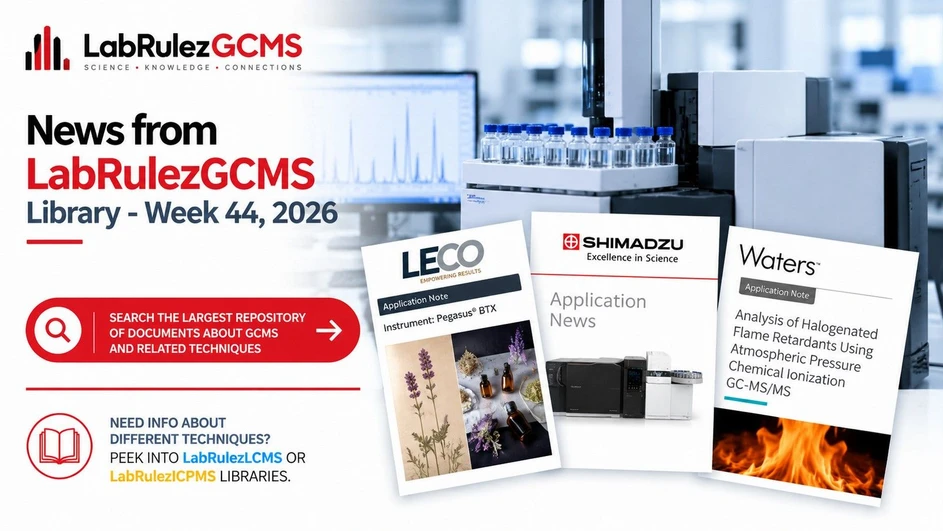
LabRulez / AI: News from LabRulezGCMS Library - Week 44, 2026
Our Library never stops expanding. What are the most recent contributions to LabRulezGCMS Library in the week of 26th October 2026? Check out new documents from the field of the gas phase, especially GC and GC/MS techniques!
👉 SEARCH THE LARGEST REPOSITORY OF DOCUMENTS ABOUT GCMS AND RELATED TECHNIQUES
👉 Need info about different analytical techniques? Peek into LabRulezLCMS or LabRulezICPMS libraries.
1. LECO: Characterization and Comparison of Lavandin Essential Oil Aroma Profiles by Using Fast GC-TOFMS and ChromaTOFSync
- Application note
- Full PDF for download
The qualitative characterization of essential oil volatiles is commonly performed using GC-MS; however, conventional methods often rely on long capillary columns, slow oven temperature ramps, and helium as the carrier gas. These factors typically result in analysis times exceeding one hour, higher operational costs, and limited sample throughput. Detailed aroma profiling, such as for lavandin essential oil, is nonetheless critical for understanding complex chemical composition, identifying key aroma-active compounds, and assessing compositional variability between samples.
Fast GC-TOFMS, using hydrogen (H2) as the carrier gas, offers an effective solution for the rapid analysis of complex essential oil matrices. Optimized temperature programming and high oven heating rates significantly reduces analysis time while maintaining chromatographic resolution. The Pegasus BTX GC-TOFMS system generates highly detailed datasets, which are efficiently processed using ChromaTOF Sync software for automated peak detection, chromatographic alignment, and non-targeted comparison across multiple samples. Here three lavandin oil varieties (Lavandin Oil Abrialis, Grosso, and Super) were analyzed and compared using this workflow to investigate compositional differences and identify discriminant compounds, with selected results highlighting some relevant findings.
Experimental
Three varieties of lavandin essential oil samples, namely Abrialis, Grosso, and Super, were analyzed using fast GC-TOFMS (LECO Pegasus BTX) after appropriate dilution in n-hexane. Auto Sampler - LECO L-PAL 3, Gas Chromatograph - Agilent 8890.
Conclusions
This application note demonstrates that fast GC-TOFMS using the Pegasus BTX system is a powerful and reliable solution for the rapid characterization of lavandin essential oils. The use of H, and fast temperature programming dramatically reduces run time while maintaining analytical performance.
The integration of ChromaTOF Sync is critical for handling complex datasets, enabling efficient peak alignment, non-targeted profiling, and robust comparison of multiple samples. Together, this workflow supports rapid aroma profiling, identification of key discriminant compounds, and confident differentiation of lavandin essential oil varieties.
2. Shimadzu: Characterization and Temporal Monitoring of Volatile Organic Compounds (VOCs) Released in Response to Plant Stress
- Application note
- Full PDF for download
User Benefits
- MonoTrap is well suited for field sampling because it is easy to transfer and store, enabling collection of plant-derived VOCs.
- Plant-derived VOCs can be analyzed without the complicated pretreatment procedure such as solvent extraction.
- This analysis system is ideal for measuring time-dependent changes in VOCs associated with plant stress responses
Plants release volatile organic compounds (VOCs) in response to stressors such as changes in growing conditions and physical damage. These VOCs are known to have various physiological functions, including repelling herbivorous insects, enhancing resistance against pathogens, and facilitating plant-to-plant communication. For example, green leaf volatiles (GLVs) are a group of fatty acid-derived C6 VOCs released in response to stressors such as herbivore damage and pathogenic infection, and are reported to play an important role in plant defense response.1) However, VOCs sampling from living plants is labor-intensive because collection equipment must be carried in the field.
This Application News describes the collection of VOCs released from plant leaves in response to cutting and ultraviolet stress using MonoTrap, followed by analysis using a thermal desorption GC-MS system. VOC profiles generated under different stress conditions were compared, and time-dependent changesin VOCs emissions were evaluated.
Advantages of MonoTrap
MonoTrap is an adsorbent consisting of a monolith silica substrate and characterized by its ability to efficiently collect VOCs. Its large surface area enables the adsorption of a wide range of compounds from small molecules to medium- and high-boiling point components. MonoTrap is compatible with various desorption techniques, including solvent extraction and thermal desorption. Because it is small in size, and easy to handle, MonoTrap is ideal for sampling in the field, offering excellent ease of use, transport, and storage, making it well suited for field sampling of VOCs and environmental gases. In this study, a MonoTrap RGC18 TD (Cat.No.:1050-74201, GL Sciences) designed for thermal desorption-based analysis was used. After VOC collection, the MonoTrap was simply placed in a glass thermal desorption tube for analysis (Fig. 2). This approach simplifies the workflow from sampling to analysis, and helps reduce the variability between operators.
Analysis Conditions
The MonoTrap was placed in a glass tube for thermal desorption, which was set in a TD-30R thermal desorption system.
- GC Model: Nexis GC-2030
- MS Model: GCMS-QP2050
Conclusion
VOCs released from plant leaves in response to cutting and ultraviolet stress were collected using MonoTrap and analyzed by thermal desorption GC-MS system. The results showed that both the stress response compounds and the amounts of VOCs released varied depending on the stress conditions. GLVs such as 3-hexenal and 3-hexen-1-ol were detected under cutting stress. In addition, time-dependent changes in response compounds during UV irradiation were successfully monitored. MonoTrap for thermal desorption does not require complicated sample processing such as solvent extraction, and can be combined with a thermal desorption GC-MS system to streamline proceduresfrom sampling to qualitative analysis.
3. Waters Corporation: Analysis of Halogenated Flame Retardants Using Atmospheric Pressure Chemical Ionization GC-MS/MS
- Application note
- Full PDF for download
Benefits
- The ability of the atmospheric pressure gas chromatography APGC™ ionization source on the Xevo™ TQ Absolute System to tolerate high carrier gas flow and an increased number of MRM transitions helps the implementation of the N2 carrier gas method using the same analytical column, reducing the need for reanalysis of samples, and contributes to a more matrix-independent method
- Operator training is reduced to weeks from months through conversion of the method from a magnetic sector to a tandem quadrupole mass spectrometer
- Use of a single, inexpensive, readily available gas for chromatographic separation, ionization and MS/MS fragmentation provides an overall simpler, more sustainable analysis
Despite both voluntary and regulatory bans on the continued use of many HFRs, there remains a need to monitor for their presence in environmental matrices because of their previous widespread use, persistence, environmental transport, and potential toxicity. For decades, analysts have relied on magnetic sector EI GCHRMS instruments for this work due to the sensitivity, specificity and dynamic range they provide. In recent years, however, these systems have increasingly been hindered by inherent limitations of the technology such as slow acquisition rates, operational complexity and a lack of adaptability to more sustainable methods. Tandem quadrupole MS/MS is well established in its ability to perform highly accurate, precise and reproducible quantification of analytes in complex matrices across a wide dynamic range. Commercial GC-APCI systems have demonstrated highly sensitive analysis of persistent organic pollutants (POPs) for over a decade.1,2 Combining these two techniques in a single system has demonstrated the ability to replace magnetic sectors in challenging analyses such as dioxin and polychlorinated biphenyl (PCB) monitoring.3-5 In this work, a list of 21 HFRs was analyzed on a Xevo TQ Absolute Mass Spectrometer using the APGC ionization source with nitrogen (N2) carrier gas. A discussion of adapting existing methods for the use of N2 carrier gas is included, as well as a database of MRM transitions that were developed.
Experimental
The instrumental method for this work has been described previously.6 As in that method, a Xevo TQ Absolute tandem quadrupole mass spectrometer coupled with an 8890 gas chromatograph (Agilent) and fitted with the APGC ionization source was used for the measurements. The column was an Rtx®-1614, 15 m x 0.25 mm ID x 0.10 µm film (Restek) using an initial temperature of 110 °C then ramped to 210 °C at 10 °C/min, ramped to 260 °C at 20 °C/min held 1 minute, ramped to 310 °C at 10 °C/min, ramped to 330 °C at 40 °C/min with a final hold of 5 minutes for a total 24.5 minute runtime. One microliter pulsed splitless injections on the split/splitless (SSL) injector at 260 °C were used with a 0.5 minute pressure pulse to 20 psi. The use of a pressure pulse during injection is an important adaptation when converting He-based carrier gas methods to N2 carrier since the optimum linear velocity, and thus flowrate, for N2 is lower than He.
Conclusion
An all-nitrogen configuration with APGC on a Xevo TQ Absolute System was successfully applied to the analysis of HFRs by adapting a He carrier gas reference method previously used on magnetic sector EI GC-HRMS systems. Total runtime and separation efficiency of the N2 carrier gas method was comparable to the He-based reference method without the need for column scaling. This was achieved through the use of carrier gas flow ramping using flow rates that cannot be accommodated by conventional vacuum-source EI GC/MS systems.
The move to tandem quadrupole MS from high resolution MS updates the method for improved performance measures such as higher acquisition speeds and high specificity MS/MS while also requiring reduced training time and expertise as compared with magnetic sectors. Future work will investigate the method in more detail and explore the possible combination of HFRs and PBDEs into a single analytical method.