We, 26.8.2026 | Original article from: LabRulezGCMS Library
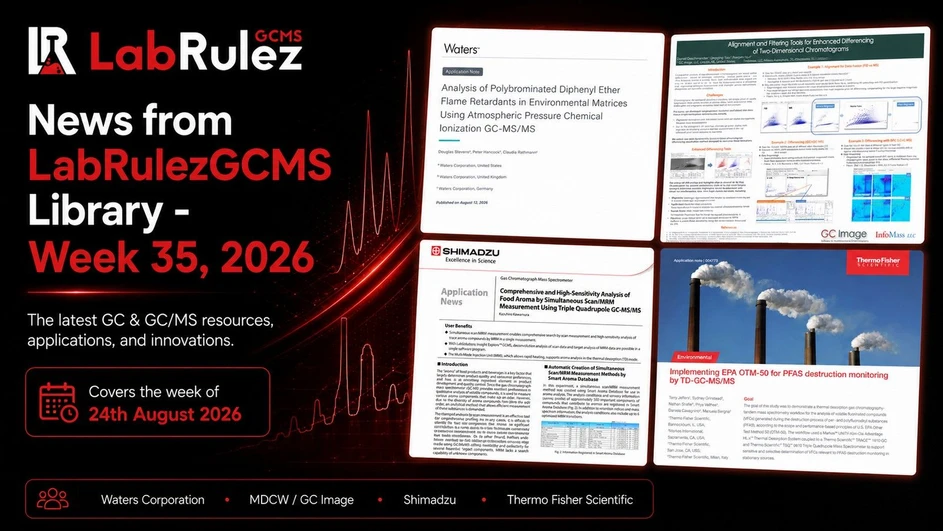
This week we bring you application notes by Shimadzu, Thermo Fisher Scientific and Waters Corporation and poster by MDCW / GC Image!News from LabRulezGCMS Library - Week 35, 2026
LabRulez / AI: News from LabRulezGCMS Library - Week 35, 2026
Our Library never stops expanding. What are the most recent contributions to LabRulezGCMS Library in the week of 24th August 2026? Check out new documents from the field of the gas phase, especially GC and GC/MS techniques!
👉 SEARCH THE LARGEST REPOSITORY OF DOCUMENTS ABOUT GCMS AND RELATED TECHNIQUES
👉 Need info about different analytical techniques? Peek into LabRulezLCMS or LabRulezICPMS libraries.
This week we bring you application notes by Shimadzu, Thermo Fisher Scientific and Waters Corporation and poster by MDCW / GC Image!
1. MDCW / GC Image: Alignment and Filtering Tools for Enhanced Differencing of Two-Dimensional Chromatograms
- Poster
- Full PDF for download
Challenges
Chromatogram-like visual differencing is intuitive, yet simple pixel-to-pixel subtraction often produces noisy artifacts, fails to correct retention-time shifts, and can obscure low-intensity but meaningful differences.
Previously, we developed comparative visualization methods [1] based on classic image-comparison techniques, including:
- Alignment with specialized color maps to visually highlight discrepancies between chromatograms
- Interactive matching across two chromatograms [2], enabling both qualitative and quantitative side-by-side assessment at the individual-peak level
We extend this work by presenting a more robust chromatogram differencing visualization method designed to overcome these limitations
Example 1: Alignment for Data Fusion (FID vs MS)
- Data Set: GCxGC data of a diesel fuel sample
- Instruments: Agilent 7890A GC/InfoMass L10 thermal modulator/Hexin TOFMS
- Detectors: FID (350 C, 200 Hz), MS (45-450 m/z, 50 Hz)
- Modulation: 6 seconds with programmable cold jet gas flow (15L/min to 6 L/min)
Example 2: Differencing (GC×GC-MS)
- Data Set: GCxGC-TOFMS data set of different dark chocolates [3].
- Instruments: JEOL AccuTof GC mass spectrometer with an Agilent 7890 GC
Example 3: Differencing with BPC (LC×LC-MS)
- Data Set: LCxLC-MS data of different types of beer [4].
- Instruments: Agilent 1290 Infinity 2D-LC solution coupled with an Agilent 6530 Accurate-Mass Q-TOF LC/MS system
2. Shimadzu: Comprehensive and High-Sensitivity Analysis of Food Aroma by Simultaneous Scan/MRM Measurement Using Triple Quadrupole GC-MS/MS
- Application note
- Full PDF for download
User benefits
- Simultaneous scan/MRM measurement enables comprehensive search by scan measurement and high-sensitivity analysis of trace aroma compounds by MRM in a single measurement.
- With LabSolutions Insight Explore GCMS, deconvolution analysis of scan data and target analysis of MRM data are possible in a single software program.
- The Multi-Mode Injection Unit (MMI), which allows rapid heating, supports aroma analysis in the thermal desorption (TD) mode
The “aroma” of food products and beverages is a key factor that largely determines product quality and consumer preferences, and thus is an extremely important element in product development and quality control. Since the gas chromatograph mass spectrometer (GC-MS) provides excellent performance in qualitative analysis of volatile compounds, it is used to measure various aroma components that make up an odor. However, due to the diversity of aroma compounds and their wide concentration range, which extends from the ppm to the ppt order, an analytical method that allows efficient measurement of these substances is demanded.
Non-targeted analysis by scan measurement is an effective tool for comprehensive profiling, but in many cases, it is difficult to identify the trace components that make a significant contribution to aroma due to the limits of instrument sensitivity and matrix interference. On the other hand, although widetarget analysis by the MRM (Multiple Reaction Monitoring) mode using GC-MS/MS offers high sensitivity and selectivity for several hundred target components, MRM lacks a search capability for unknown components.
Therefore, this Application News article reports a technique that satisfies both comprehensive non-targeted search and highsensitivity detection of trace components in a single analysis by combining the GCMS-TQ 8040 RX, which supports simultaneous data acquisition in simultaneous multi-component analysis measurements by scan measurement and the MRM mode, and the Smart Aroma Database for use in aroma analysis. In addition, in this experiment, the thermal desorption (TD) mode of the Multi-Mode Injection Unit (MMI) was adopted for sample introduction. This enablesintroduction of componentstapped on the adsorbent without using a dedicated TD device, thereby achieving a simplified system configuration.
Conclusion
This Application News article showed that it is possible to achieve both a comprehensive non-targeted analysis of food aroma and a high-sensitivity wide-target analysis of trace components in a single analysis, without carrying out complicated operations, by simultaneous scan/MRM measurement combining the GCMSTQ8040 RX and the Smart Aroma Database. This article also demonstrated that use of the Multi-Mode Injection Unit (MMI) enables measurements in the thermal desorption (TD) mode without using dedicated TD instrumentation, and also allows a flexible response in case of budgetary or installation space limitations. A comprehensive aroma evaluation based on this approach will facilitate the discovery of important aroma components that were easily overlooked in the past, and is expected to make important contributions to product development and quality control in the food and beverage industries.
3. Thermo Fisher Scientific: Implementing EPA OTM-50 for PFAS destruction monitoring by TD-GC-MS/MS
- Application note
- Full PDF for download
Per- and polyfluoroalkyl substances are used across a broad range of industrial and consumer applications. As PFAS-containing materials are treated or destroyed, incomplete decomposition can generate volatile fluorinated compounds, including short-chain and ultra-volatile species. These volatile compounds are important because they may provide evidence of incomplete mineralization once emitted from stationary sources.
EPA OTM-50 was developed to provide a consistent approach for collecting and quantitatively analyzing target VFCs from emissions originating from known industrial products with incomplete thermal destruction. The EPA method uses passivated stainlesssteel canisters followed by GC-MS analysis and is applicable to gas samples collected from industrial source ducts, vents, stacks, and related emission points.
The method is performance-based, allowing laboratories flexibility in GC column selection, GC conditions, and MS conditions, provided that GC-MS remains the basis for separation and quantitation and the required performance criteria are met. This flexibility is important because OTM-50 analytes span a challenging volatility range and may occur in complex matrices containing CO2 , water vapor, acid gases, and other volatile organic compounds.
Gas chromatography-based approaches are well suited to volatile and neutral fluorinated compounds. Thermal desorption enables preconcentration of trace-level analytes from air samples, improving sensitivity and enabling detection at relevant levels for environmental studies.
This application note describes implementation of EPA OTM-50 using cryogen-free thermal desorption coupled to triple quadrupole GC-MS/MS. The workflow addresses key analytical challenges: trapping ultra-volatile compounds such as CF4 , managing high levels of CO2 and humidity, achieving sub-ppbv sensitivity, and maintaining repeatable quantitative performance in support of PFAS destruction monitoring.
Experimental
Instrument configuration
The analytical system consisted of a Markes UNITY-Kori-CIA Advantage HL-xr thermal desorption system coupled to a TSQ 9610 Triple Quadrupole GC-MS/MS equipped with a Thermo Scientific™ NeverVent™ AEI Ion Source (Figure 1). The Markes thermal desorber configuration included cryogen-free focusing, controlled canister introduction, and water and CO2 management strategies.
Conclusions
This work demonstrates implementation of EPA OTM-50 using thermal desorption coupled to triple quadrupole GC-MS/MS for the analysis of volatile fluorinated compounds in air, with solutions helping to solve key analytical challenges for this type of analysis.
- Alignment with EPA OTM-50 scope: supports canisterbased analysis of VFCs emitted from stationary sources, including compounds associated with incomplete PFAS destruction.
- Cryogen-free preconcentration: enables practical trapping and transfer of volatile analytes without reliance on liquid cryogens, reducing operational complexity.
- Improved selectivity through MS/MS: SRM acquisition on the TSQ 9610 Triple Quadrupole GC-MS/MS improves confidence in target identification and quantitation in complex emission matrices.
- Dual-method strategy for broad volatility coverage: separate sample volumes for CF4 and the remaining VFCs enable analysis across the challenging OTM-50 volatility range.
- CO2 and humidity management: controlled dilution, selective trap purging, and Kori-xr water management address two of the most significant matrix challenges in stationary source emissions.
- Robust quantitative performance: calibration across 0.1–100 ppbv (0.125–50 ppbv for CF4 ) showed R2 ≥ 0.998 for reported compounds or < 20% RSD for Average Response Factor, with pptv MDLs and repeatability generally consistent with OTM-50 precision expectations.
- Industrial relevance: the workflow supports chemical manufacturing, PFAS treatment, and waste management facilities seeking defensible data to evaluate destruction efficiency and identify products of incomplete destruction.
Overall, the combination of Markes thermal desorption technology with the Thermo Scientific TSQ 9610 Triple Quadrupole GC-MS/MS provides a practical, selective, and robust analytical approach for laboratories implementing EPA OTM-50 for volatile PFAS and VFC monitoring in air.
4. Waters Corporation: Analysis of Polybrominated Diphenyl Ether Flame Retardants in Environmental Matrices Using Atmospheric Pressure Chemical Ionization GC-MS/MS
- Application note
- Full PDF for download
Benefits
- The performance of atmospheric pressure gas chromatography (APGC ™) on Xevo™ TQ Absolute Mass Spectrometer for the analysis of PBDEs is equal-to or better-than traditional analysis using electron impact magnetic sector making it well suited for use in the most challenging regulatory and standard methods.
- The ability of APGC to tolerate high carrier gas flow helps improve method performance for the most challenging members of this class inlcuding BDE 209 which reduces the need for maintenance and reanalysis of samples.
- Operator training is reduced to weeks from months through conversion of the method from a magnetic sector to tandem quadrupole mass spectrometer.
- Use of a single, inexpensive, readily available gas for chromatographic separation, ionization and MS/MS fragmentation provides a simpler, more sustainable system.
With the 2001 signing of the Stockholm Convention, the stage was set for global harmonization of efforts to monitor for POPs in the environment.1 By 2004, when countries began implementing the convention, measures aimed at reducing or eliminating intentional and unintentional release of POPs into the environment were supported by annexes that defined the different chemical classes of highest interest which included PBDEs. To date, 185 states plus the European Union have joined in this effort which includes requirements for monitoring for POPs in multiple environmental matrices. Because the implications of unintentional or intentional noncompliance may be subject to enforcement action, high confidence data is needed to support surveillance and reporting efforts. Furthermore, high sensitivity analysis is required due to the possibility of steadily increasing trace levels of PBDEs across years of time through transport in the environment that tends to increase concentrations of persistent organic pollutants such as these in cooler Arctic regions of the globe through the grasshopper effect.2 These requirements initially led to the development of gas chromatography electron ionization high resolution magnetic sector based analytical methods. The performance of EI GC-HRMS in the hands of a well-trained operator and a lab with rigorous quality control procedures has proven to provide the sensitivity and specificity required of the forensic data used in legal actions, for compliance reporting and for providing the greatest protection to populations and the environment.
However, GC-HRMS has several limitations, including extensive education and training requirements, slow acquisition speeds, and significant laboratory space demands. In contrast, more modern techniques such as tandem quadrupole (TQ) mass spectrometry (MS/MS) offer broad improvements in these areas. Additionally, limitations imposed by EI such as frequent source maintenance and shortcomings caused by carrier gases other than helium hamper this time-honored technique. The more recent combination of APCI with TQ has demonstrated promise in overcoming these limitations while providing data of equivalent confidence to EI GCHRMS.
After having been deployed in many labs, GC-APCI has continued to contribute to the study of PBDEs in multiple matrices and applications. An evaluation of the first generation of GC-APCI MS/MS, analyzing PBDEs in marine and food samples, reported higher response for higher brominated (Br8-10) congeners than GC-EI-HRMS.3 Later work reported GC-APCI MS/MS LODs comparable or better than EI MS/MS for plasma extracts.4 Recent work reported on the use of GC-APCI HRMS (QTof) as part of the continuation of a 20 year study analyzing aquatic organisms to evaluate environmental PBDE trends.5 In this work, 24 PBDEs plus hexabromobiphenyl were analyzed on a XevoTM TQ Absolute Tandem Quadrupole Mass Spectrometer using the APGC ionization source.
Experimental
- GC system: 8890 (Agilent Technologies, Inc.)
- Column: Rtx®-1614, 15 m x 0.25 mm ID x 0.10 µm film (Restek Corporation)
- MS system: Xevo TQ Absolute Mass Spectrometer
- Software: waters_connect™ for Quantitation Software
Conclusions
An all-nitrogen configuration for APGC on Xevo TQ Absolute Mass Spectrometer was successfully applied to the analysis of PBDEs in environmental matrices by adapting a reference method previously used on magnetic sector EI GC-HRMS. All performance criteria were equal-to or better-than those typically achieved by magnetic sector which demonstrates feasibility of GC-APCI MS/MS as an alternative for the most challenging regulatory and standard analytical methods. Furthermore, the change from a vacuum source to the atmospheric ionization source makes the use of high nitrogen carrier gas flow practical which has advantages for operating cost versus helium while achieving similar chromatographic separation and sensitivity. The move to tandem quadrupole mass spectrometry from high resolution mass spectrometry updates the method for improved performance measures such as higher acquisition speeds and high specificity MS/MS while also requiring reduced training time and expertise as compared with magnetic sectors.