We, 2.9.2026 | Original article from: LabRulezGCMS Library
This week we bring you application notes by Agilent Technologies, Shimadzu, Thermo Fisher Scientific and presentation by MDCW / Liège University!News from LabRulezGCMS Library - Week 36, 2026

LabRulez / AI: News from LabRulezGCMS Library - Week 36, 2026
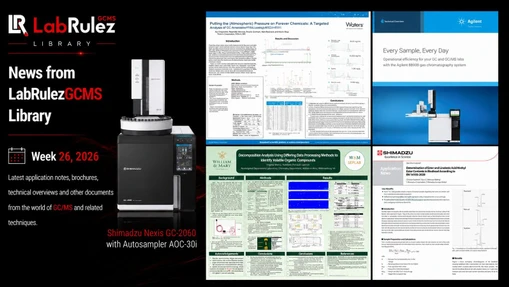
Our Library never stops expanding. What are the most recent contributions to LabRulezGCMS Library in the week of 31st August 2026? Check out new documents from the field of the gas phase, especially GC and GC/MS techniques!
👉 SEARCH THE LARGEST REPOSITORY OF DOCUMENTS ABOUT GCMS AND RELATED TECHNIQUES
👉 Need info about different analytical techniques? Peek into LabRulezLCMS or LabRulezICPMS libraries.
This week we bring you application notes by Agilent Technologies, Shimadzu, Thermo Fisher Scientific and presentation by MDCW / Liège University!
1. Agilent Technologies: Extend the time window for the detection of low level anabolic‑androgenic steroids and their metabolites
Steroid profiling, screening, and confirmatory analysis using the Agilent 7010 GC/MS mass spectrometer
- Application note
- Full PDF for download
Doping laboratories want to have lower detection limits to be able to identify and quantitate illegal drugs for a longer time window between doping and urine sample collection. This Application Note describes how the doping control lab in Kreischa, Germany used the Agilent 7010 Triple Quadrupole GC/MS System (TQ) for enhanced targeted detection of anabolic‑androgenic steroids in urine samples. The 7010 TQ enabled higher sensitivity, longer maintenance-free intervals, and more stable operation than earlier models, and satisfied all measurement specifications required by the World Anti‑Doping Agency (WADA). The 7010 TQ GC/MS ion source produces more ions, and provides exceptional sensitivity for the detection of low intensity metabolites weeks after drug ingestion. However, this higher sensitivity may lead to saturation of endogenous components naturally present at higher concentrations. This method provides a sensitive and robust operation over a wide concentration range, permitting the detection of low-concentration exogenous species in the presence of high‑concentration endogenous species, which can vary with ethnicity.
Experimental
The Agilent 7010 GC/TQ system consists of an Agilent 7890 GC with multimode inlet and backflush, an Agilent 7993A, and the Agilent 7010 TQ mass spectrometer.
Conclusions
Based on the method optimization and thorough testing at the Kreischa lab, an Agilent 7010 GC/MS-based protocol was developed. This protocol fulfills the screening and confirmation requirements of steroid measurements in doping control labs. With this method, it is possible to detect traces of exogenous anabolic steroid metabolites while quantifying small concentrations of testosterone and epitestosterone typical in Asian populations. It permits the measurement of high‑abundance endogenous steroids such as androsterone and etiocholanolone in the same injection, while analyzing testosterone/epitestosterone and androsterone/etiocholanolone ratios without suppression.
The backflush capability of the system protects the analytical column, and consequently the mass spectrometer, by removing heavy matrix components. This allowed more than 6,000 samples to be analyzed on the same column without requiring ion source cleaning or filament change. It also demonstrated that the higher, 130 eV electron energy did not sacrifice the filament lifetime. It performed reliable measurements of both trace (0.2 pg on‑column) and high (10,000 pg on‑column) concentration analytes in the same run.
The method validation revealed that the exceptional sensitivity offered by the 7010 GC/MS can be used to:
- Improve the trace detection ability of the method
- Reduce the amount of sample injected
- Extend maintenance-free intervals
2. MDCW / Liège University: The Century Mix: updates and cool projects
- Presentation
- Full PDF for download
The presentation “The Century Mix: updates and cool projects” introduces the Century Mix, a standardized reference mixture developed for comprehensive two-dimensional gas chromatography (GC×GC). The mixture contains 100 compounds representing a broad range of chemical classes, including alkanes, alcohols, ketones, esters, lactones, phthalates, and aromatic compounds. Stability was a key criterion in compound selection, and the mixture was developed through cross-laboratory collaboration for column characterization, method assessment, and quality control. Its structured chromatographic behavior also makes it useful for studying how different compound classes behave in GC×GC separations.
A major part of the work examined the factors influencing retention indices (RI) in GC×GC systems, which are important for reliable compound annotation in non-targeted analysis. An inter-laboratory study involved 11 GC×GC systems using cryogenic, Peltier, and flow modulation, different detectors, and both normal and reversed column configurations. Principal component analysis showed clear grouping according to normal versus reversed orthogonality, confirming the strong influence of stationary-phase configuration. A subsequent design-of-experiments study evaluated 140 combinations of temperature ramp rate, carrier-gas flow rate, modulation period, and secondary-oven temperature offset.
The results showed that the influence of experimental conditions is strongly compound dependent. Of the compounds evaluated in the statistical model, 33 showed RI variation that could be linked to the investigated parameters, whereas 43 did not follow the model well. Compounds such as quinoline, phthalates, lactones, terpenes, and some aromatic compounds showed particularly pronounced effects. For quinoline, for example, the model explained about 93% of RI variability, with differences of approximately 75 RI units across the tested conditions, while 2-hexanone showed considerably weaker dependence. Overall, temperature ramp rate and flow rate emerged as particularly important parameters, although the magnitude of their effect depended on compound chemistry and column configuration.
The Century Mix is therefore being developed not only as a characterization mixture but also as a tool for system quality control and more reliable retention-index prediction. Repeated standardized QC measurements demonstrated very low RI variability and can be used to monitor system stability, experimental effects, and potential instrument drift. The broader goal is to better understand the fundamental chemistry governing GC×GC retention and ultimately improve method development, data processing, and identification of unknown compounds by combining high-quality separations, mass spectra, and predicted retention information.
3. Shimadzu: Determination of Free and Total Glycerol and Mono-, Di-, and Triglyceride Contents in Biodiesel According to EN 14105
- Application note
- Full PDF for download
User benefits
- Nexis GC-2060 offers reliable analysis of biodiesel samples regarding their free and total glycerol and mono-, di-, and triglyceride contents, using hydrogen as a cost-effective carrier gas
- Hydrogen carrier gas can be used safely through built-in safety measures
- The multi-mode injection unit (MMI) allows selection of the preferred injection mode – direct (simple OCI) or convenient splitless PTV mode – both delivering excellent instrument performance in line with the standard’s requirements
Playing a vital part in countries’ efforts to lower greenhouse gas emissions, biofuels can be manufactured from various feedstocks such as vegetable oils, animal-derived fats, and recycled cooking oils. Biodiesel production predominantly uses rapeseed, soybean, and palm oils. Because feedstocks are so varied, ongoing quality monitoring is essential - since the raw material’s quality greatly influencesthe final biodiesel quality.
The EN 14105:2024 describes the determination of free and total glycerol contents and mono-, di-, and triglyceride contents in biodiesel by means of gas chromatography with flame ionization detection (GC-FID). Injection shall be performed via on-column injector or an equivalent device1.
This study shows the analysis of biodiesel originating from rapeseed, soybean, and palm oil using the Nexis GC-2060 gas chromatograph and its multi-mode injection unit (MMI).
Configuration and Analysis Conditions
Gas chromatograph Nexis GC-2060 with multi-mode injection unit (MMI), flame-ionization detector (FID) and autosampler AOC -30i.
Conclusion
Nexis and AOC are trademarks of Shimadzu Corporation or its affiliated companies in Japan and/or other countries.. Nexis GC-2060 provides reliable analysis of biodiesel samples for glycerol and glyceride contents according to EN 14105:2024 across the commonly used feedstocks. It supports hydrogen as a cost-effective carrier gas, while the multi-mode injection unit (MMI) offers selection of the injection mode based on user preference: direct mode representing simple on-column (OCI) analysis or splitless programmed temperature vaporization (PTV) mode as a convenient alternative that delivers comparable performance.
4. Thermo Fisher Scientific: Streamlined static headspace GC–MS approach for detection of impurities in recycled PET
- Application note
- Full PDF for download
Polyethylene terephthalate (PET) is a widely used thermoplastic polymer valued for its strength, low weight, durability, and adaptability. Owing to these properties, it is extensively applied in packaging, textile fibers, and electronic components. PET is particularly suitable for recycling because it can be melted and reshaped multiple times with minimal loss of performance, and it is easily recognizable by the recycling code “1” (♳). The recycling of PET involves several stages, including collection, sorting, transport, processing, washing, pelletizing, and remanufacturing into new products [1]. However, during these steps, contaminants such as plasticizers, residual monomers, and degradation byproducts may be introduced.
The presence of such substances can pose potential risks to both environmental and human health, making the identification and characterization of contaminants in recycled PET essential for evaluating material quality and safety. Among the non-intentionally added substances (NIAS), benzene, acetaldehyde, and limonene are of particular relevance. Benzene is a recognized carcinogen and represents a serious health concern if present in PET. It may form as a degradation product of PET, with the reaction catalyzed by acidic compounds released at high temperatures by polymer impurities such as polyvinyl chloride (PVC). Poor temperature control or overheating can increase benzene formation as a degradation byproduct. Acetaldehyde, another degradation product of PET generated during bottle manufacturing, can alter the sensory properties of bottled beverages. Limonene, a flavor compound commonly present in soft drinks, may be absorbed into recycled PET and subsequently migrate into packaged beverages, potentially affecting product quality.
Gas chromatography coupled to headspace sampling is a fast and simple technique that enables the extraction of volatile and semivolatile compounds from solid and liquid samples without the need for time-consuming sample preparation.
In this study, headspace sampling coupled to single quadrupole mass spectrometry was used to assess the overall quantitative performance for analysis of acetaldehyde, benzene, and limonene in recycled PET packaging.
The capability of the Thermo Scientific™ ISQ™ 7610 single quadrupole GC–MS of combining the simultaneous acquisition of both single ion monitoring (SIM) and full scan (FS) allowed for sensitive targeted analysis as well as screening of unknown contaminants possibly present in recycled PET bottles.
Experimental
In all experiments, a TriPlus 500 HS autosampler was coupled to a Thermo Scientific™ TRACE™ 1610 Gas Chromatograph (GC), configured with a Thermo Scientific™ iConnect™ Split/splitless Injector Module (iConnect-SSL), and connected to an ISQ 7610 single quadrupole mass spectrometer.
The separation of the target analytes was achieved using a Thermo Scientific™ Trace GOLD™ TG-624 SILMS capillary column, 60 m x 0.25 mm x 1.4 µm (Part No. 26059-3330). This column provides a low to mid polarity phase with high thermal stability (maximum operating temperatures up to 320 °C) and high inertness, enabling Gaussian peak shapes for analysis of volatile organics. The TriPlus 500 HS autosampler is connected directly to the analytical column, removing the use of a long external transfer line. In this configuration, the SSL injector module is used only for the pneumatic control of the carrier gas and split flow.
Conclusions
The results presented in this work demonstrate that headspace coupled to GC–MS provides a suitable and simple solution for analysis of contaminants in rPET, with no complex sample preparation required.
- The capability of combining FS with SIM acquisition allows for qualitative and quantitative analysis, increasing confidence in compound identification through spectral comparison with NIST library and allowing for the detection of possible analyte co-elution.
- The TriPlus 500 HS autosampler provides highly repeatable solventless extraction from solid samples with absolute area counts RSD < 5%, permitting reliable and consistent quantitative data.
- The ISQ 7610 single quadrupole GC–MS demonstrates an extended linear response (≥ 4–5 orders of magnitude) with R2 ≥ 0.997, calculated amounts within ± 20% the expected value, and ion ratio deviation ≤ 15% across the calibration curve.
- Sensitivity was demonstrated with overall calculated LOD ≤ 0.03 ng/µL.
- Chromeleon CDS helps ensure data integrity, traceability, and effective data management from instrument control to the final report streamlining analysis and data review processes.