Mo, 19.10.2026 | Original article from: Chem. Res. Toxicol. (2026)
Correcting in vitro effect concentrations for freely dissolved exposure reveals substantially higher relative potencies for hydrophobic, protein-bound BPA alternatives.In Vitro Exposure Assessment Improves Hazard Ranking of Bisphenol A Alternatives

Chem. Res. Toxicol. (2026): Figure 3. Comparison of measured (EXP) and modelled (MBM) (A) bovine serum albumin-water distribution ratios (DBSA/w) and (B) membrane or liposome-water distribution ratios (Dm/w or Dlip/w), (C) dependence of measured (EXP) and modelled (MBM) free fractions (ffree) in assay medium (OptiMEM base medium +2% cs-FBS) of the test chemicals on the membrane-water distribution ratio (Dm/w), (D) comparison of average measured (EXP) and modelled (MBM) ffree, (E) comparison of measured freely dissolved concentrations (Cfree) with dosed nominal concentration (Cnom), (F) comparison of measured (EXP) and modelled (MBM) Cfree. Solid lines in A, B, D, E and F indicate the 1:1 line, the dotted lines indicate the 1:10 and 10:1 lines. AAFE (absolute average fold error).
This study examines how freely dissolved concentrations influence the comparative hazard ranking of bisphenol A (BPA) and 24 alternative chemicals in in vitro assays. Chemical stability and bioavailable concentrations were assessed experimentally and modeled, with predicted freely dissolved concentrations generally agreeing with measurements within one order of magnitude.
Exposure correction had little effect for hydrophilic compounds but substantially increased the apparent potency of hydrophobic, highly protein-bound alternatives. For example, BPAF and TCBPA ranked considerably higher when freely dissolved rather than nominal concentrations were used. The findings show that accounting for actual in vitro exposure is essential for reliable hazard assessment of BPA alternatives.
The original article
In Vitro Exposure Assessment Improves Hazard Ranking of Bisphenol A Alternatives
Luise Henneberger*; Sophia Bardehly; Arina Kremser; Vanessa Srebny; Beate I. Escher
Chem. Res. Toxicol. (2026)
licensed under CC-BY 4.0
Selected sections from the article follow. Formats and hyperlinks were adapted from the original.
Bisphenol A (BPA) was used for decades as a plastic chemical, but due to its endocrine disrupting properties it is now banned for food-contact materials (1) and thermal paper (2) in the European Union. Numerous BPA replacement chemicals have therefore been developed, but for most of them effects to human and environmental health have not been thoroughly assessed. (3, 4) Cell-based in vitro bioassays allow a fast screening for adverse effects and can help to identify which alternatives show similar toxicity compared to BPA itself and which ones can be considered more benign. Numerous in vitro toxicity studies have been published, but the majority has either focused on only a few of the BPA alternatives or few specific end points like estrogenicity and androgenicity (5, 6) or adipogenesis. (7, 8) The most comprehensive in vitro toxicity datasets for BPA and its alternatives can be found in the recent publication by Srebny et al. (9) that reports data from six assays for BPA and 26 alternatives and in the Tox21 database, which contains data from various assays for BPA and 15 alternatives as reviewed by Adamovsky et al. (4)
To date, comparative hazard assessment using in vitro toxicity data for BPA and its alternatives was exclusively done based on nominal effect concentrations. (9−12) However, nominal concentrations do not necessarily correlate with the bioactive concentration, because the test concentration of the chemicals added at the beginning of the bioassay can be reduced by plastic sorption, volatilization, cellular metabolism, abiotic degradation and binding to cell culture medium constituents (Figure 1). (13) Some of these binding and loss processes are only relevant for certain compound classes or assay types. For example, plastic sorption was shown to be negligible for assays that use a high serum content, i.e., 10% fetal bovine serum (FBS) in 384-well plates. (14) Furthermore, many cell lines applied in high-throughput screening assays (e.g., HEK293 cells) have limited metabolic capacity, which makes this loss process also less relevant. (15) Volatility can be evaluated using the medium-air partition constant (Kmedium/air) of the test chemicals. Previous studies have shown that chemicals with log Kmedium/air <4 are lost from the assay plates or even cross-contaminate neighboring wells and cannot be tested in open well plate formats. (16, 17)
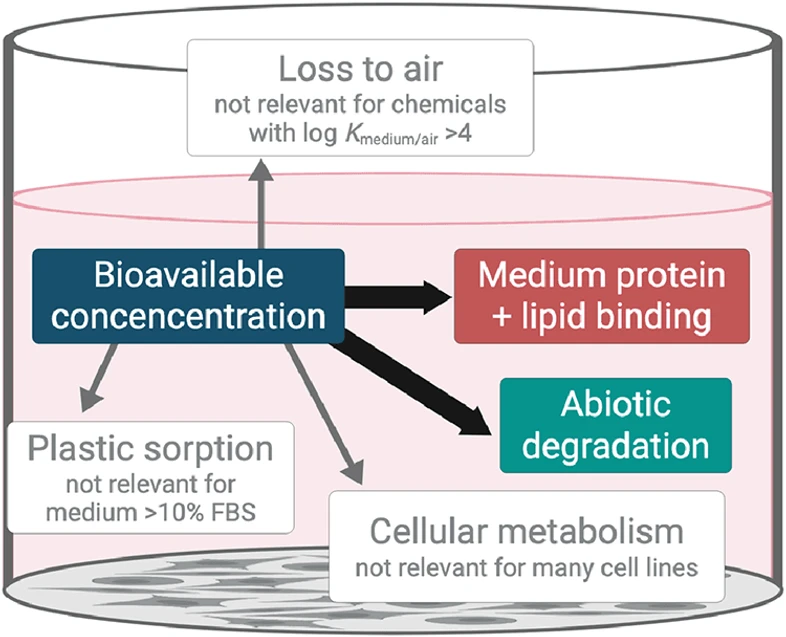 Chem. Res. Toxicol. (2026): Figure 1. Binding and loss processes in cell-based in vitro bioassays and their relevance for BPA and its alternatives. Created in BioRender. Henneberger, L. (2026)
Following these considerations, previous studies identified abiotic stability as a key parameter for in vitro exposure assessment that should always be measured in the first place. (18−20) Unfortunately, stability measurements in bioassay medium are rarely published. For BPA and its two alternatives Bisphenol S (BPS) and F (BPF), medium concentrations were recently measured over time by Brenner et al. (21) and were found to be stable for 24 h. The diglycidyl ether of BPA (BADGE) was reported to hydrolyze quickly in aqueous solution, (9, 22, 23) which will occur in medium as well. However, for most BPA replacement chemicals the stability in assay medium is not known.
For stable compounds the binding to medium proteins and lipids will determine the bioavailable concentration. In previous studies, free fractions (ffree) in cell culture medium were measured for BPA, BPS and BPF, (21, 24) but experimental data for other BPA alternatives are lacking. Prediction of ffree is also possible with a variety of different in vitro distribution models, (13) but the required chemical input parameters for protein and lipid binding are also not available experimentally for the majority of the BPA alternatives, which may lead to high prediction errors.
To address the aforementioned data gaps, BPA and 24 of its alternatives with diverse physicochemical properties were tested for their chemical stability in cell culture medium in the present study. For the subset of stable chemicals, binding to bovine serum albumin (BSA) and phospholipid membranes was quantified. BSA is the most abundant protein in FBS and can be considered to be the predominant sorptive phase for BPA and its alternatives. (25−27) The measured distribution ratios to proteins and lipids were used to validate the quantitative structure-activity relationships (QSARs) reported in previous studies (28, 29) that allow a prediction of protein and lipid binding from the octanol-water partition constant (Kow) and speciation of the BPA alternatives. Additionally, ffree in cell culture medium was measured and compared to ffree predicted using a simple mass balance model. (30) The experimental ffree were used to calculate relative effect potencies (REPs) of the BPA alternatives based on freely dissolved concentrations and the derived REPs were compared to published REPs based on nominal concentrations.
Materials and Methods
Instrumental Analysis
Chemical concentrations in the PBS samples after SPME extraction, in the corresponding sample extracts, as well as in the samples from the stability and membrane partitioning experiments were determined using a liquid chromatography instrument (1260 Infinity II, Agilent) coupled to either a fluorescence detector (1100/1200 FLD), a diode array detector (DAD) or a triple quadrupole mass spectrometer (Triple Quad 6420, Agilent). Further details on the instrumentation including column types, instrumental conditions and limits of quantification (LOQs) are provided in the SI Tables S2-4. Calibration standards with a concentration range of 1–10.000 ng/mL in desorption solvent or PBS (for the determination of isotherms, pin-water distribution and membrane-water partitioning) and acetonitrile blanks were measured together with the samples. The PBS samples were diluted 1:1 or 1:10 with acetonitrile according to the composition of the calibration standards.
Results
Stability Measurements in Bioassay Medium
BPA and 22 of its alternatives were found to be stable in bioassay medium (OptiMEM base medium supplemented with 2% cs-FBS). The total medium concentration for these chemicals determined after 48 h of incubation at 37°C differed less than 20% from the total medium concentration determined in the freshly prepared medium (Fig. 2). For the most hydrophobic test chemical Bisphenol PH (BPPH) losses of 37% and 10% were observed in assay medium with 2% and 10% FBS, respectively. BADGE was completely degraded within 48 h in both types of media (Fig. 2).
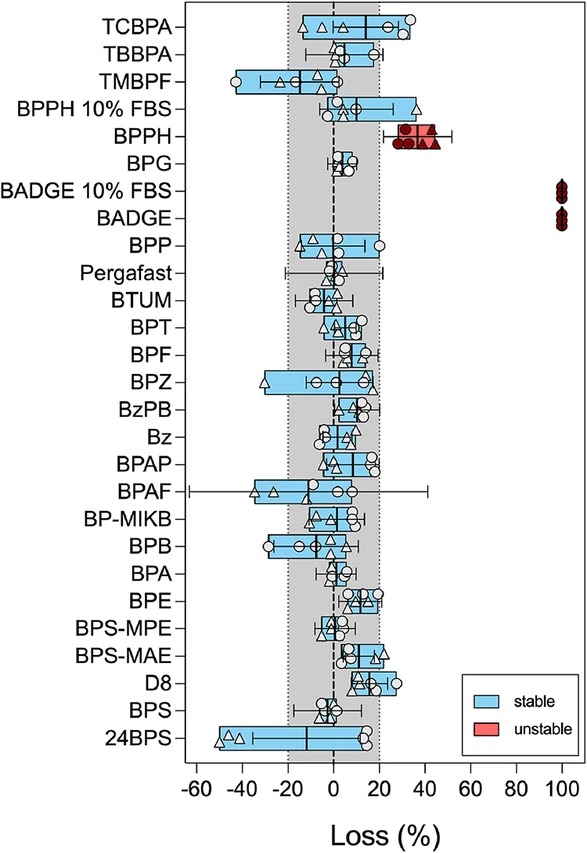 Chem. Res. Toxicol. (2026): Figure 2. Stability of BPA and 24 alternatives at 37°C in assay medium (OptiMEM supplemented with 2% cs-FBS) expressed as %loss after 48 h, different symbols indicate independent experimental replicates. Stability of BADGE and BPPH was also tested in assay medium consisting of 90% DMEM with 10% untreated FBS.
Bovine Serum Albumin Binding and Membrane-water Partitioning
The SPME method was successfully optimized for BPA and 15 of the alternatives. Binding to the pin coating as well as equilibration times were found to increase with increasing hydrophobicity (Figure S4). Chemical recoveries (sum of amount in PBS and pin coating) for the optimization experiments in PBS were high (76-111%). Several chemicals showed nonlinear sorption to the pin coating, which had to be considered in the Cfree calculation (Figure S3). Despite the good performance of the SPME method, the testable concentration range was limited for some BPA alternatives due to high LOQs (e.g., 1 μg/mL for BPP and 0.5 μg/mL for BPZ).
Chem. Res. Toxicol. (2026): Figure 3. Comparison of measured (EXP) and modelled (MBM) (A) bovine serum albumin-water distribution ratios (DBSA/w) and (B) membrane or liposome-water distribution ratios (Dm/w or Dlip/w), (C) dependence of measured (EXP) and modelled (MBM) free fractions (ffree) in assay medium (OptiMEM base medium +2% cs-FBS) of the test chemicals on the membrane-water distribution ratio (Dm/w), (D) comparison of average measured (EXP) and modelled (MBM) ffree, (E) comparison of measured freely dissolved concentrations (Cfree) with dosed nominal concentration (Cnom), (F) comparison of measured (EXP) and modelled (MBM) Cfree. Solid lines in A, B, D, E and F indicate the 1:1 line, the dotted lines indicate the 1:10 and 10:1 lines. AAFE (absolute average fold error).
Binding to BSA was measured for BPA and 15 of the alternatives (Figure S5, abbreviations in Table 1). For BPF, BPAF, BP-MIBK, BPA, BPS-MAE and D8 binding isotherms were linear, while for BPT, BPZ, BzBP, Bz, BPAP, BPB, BPE and BPS-MPE binding to BSA was concentration-dependent (Table S6). Table 2 reports the mean DBSA/w. BPS and 24BPS showed weak affinities for BSA. For BPS DBSA/w could only be determined at one concentration level and no isotherm was fitted. For 24BPS no binding could be measured at any of the tested concentrations indicating fbound < 20% at the tested BSA concentration of 1.56 g/L. Figure 3A shows a comparison of the measured DBSA/w with the values predicted from log Kow by Srebny et al. (9) Because regression models based on log Kow do not consider concentration dependence, the average DBSA/w was calculated and used for the comparison in Fig. 3A even for the chemicals with nonlinear binding isotherms, resulting in generally larger error bars (see also Table 2). On average, the measured DBSA/w agreed with the modelled values within a factor of 4.7 (AAFE). For most chemicals the measured and predicted DBSA/w agreed within a factor of 7. For benzylparabene (BzBP), BPS-MAE and D8 the measured DBSA/w were a factor of 17, 24, and 35 higher compared to the value predicted from log Kow. For BPA the measured log DBSA/w of 3.57 agrees well with literature data (29) (DBSA/w = 3.65). This literature value was also used for the comparison in Figure 3A.
Conclusion
The same concept as applied in the present study can also be used for other classes of chemicals. Abiotic stability should always be measured first. For unstable chemicals hazard assessment will need to include the formed transformation products as well and a concentration metric that considers temporal changes (e.g., area under the curve). The same applies to stable chemicals if cell lines with high metabolic capacity are used for in vitro testing (e.g., HepG2 or HepaRG). For stable and not quickly metabolized chemicals ECfree should be used for hazard ranking, if the chemicals show significant binding to medium proteins and lipids or high chemical diversity like the BPA alternatives investigated in the present study. Simple prediction models can provide a fast alternative to experimental determination of ffree, but they rely on the quality of the used chemical input parameters and are less accurate for organic acids that show nonlinear protein binding.
Finally, for IVIVE, metabolism of the BPA alternatives needs to be considered as well. Metabolization does not only differ between BPA and its alternatives, but also between different cell lines and between in vitro and in vivo. For mechanistic understanding of metabolism and its influence on toxicity it might be advisible to use a defined external metabolic system as used by Srebny et al. (9) with non-metabolically competent cell lines before testing directly in metabolically competent cells. Metabolization generally decreases estrogenicity and cytotoxicity of BPA and its alternatives, (9) but data for other end points are largely missing.