

SPE Troubleshooting: Why Won't My Sample Flow Through the SPE Cartridge?
GCMSLCMSArticle | Academy

SPE Troubleshooting: Why Won't My Sample Flow Through the SPE Cartridge?

Learn the most common causes of SPE cartridge flow problems and how to troubleshoot them. Identify issues related to samples, solvents, manifold pressure, and precipitation.
SPE Troubleshooting: Why Won't My Sample Flow Through the SPE Cartridge?
SPE Troubleshooting: Understanding and Resolving Low Recovery in Solid Phase Extraction
GCMSLCMSArticle | Academy

SPE Troubleshooting: Understanding and Resolving Low Recovery in Solid Phase Extraction

Low SPE recovery does not have to mean method failure. Learn how fraction collection and analysis can identify analyte losses and guide effective troubleshooting steps.
SPE Troubleshooting: Understanding and Resolving Low Recovery in Solid Phase Extraction
Why Is It Necessary to Dry the SPE Sorbent Before Elution?
GCMSLCMSArticle | Academy

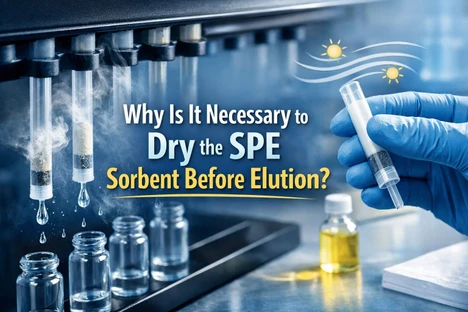
Why Is It Necessary to Dry the SPE Sorbent Before Elution?

Proper drying of the SPE sorbent is a critical step to achieve high sensitivity, good reproducibility, and maximum analyte recovery, especially for complex sample matrices.
Why Is It Necessary to Dry the SPE Sorbent Before Elution?
SPE Troubleshooting - Extra Peak
LCMSGCMSArticle | Academy

SPE Troubleshooting - Extra Peak

An SPE technical tip focused on identifying the sources of interferences and extra peaks observed after sample extraction.
SPE Troubleshooting - Extra Peak
Why are my recoveries greater than 100%?
LCMSGCMSArticle | Academy

Why are my recoveries greater than 100%?

Although 100% recovery is expected in SPE, values above 100% are sometimes observed. This article explains the most common causes and provides practical guidance on how to identify and resolve them.
Why are my recoveries greater than 100%?
Troubleshooting SPE
GCMSLCMSArticle | Academy

Troubleshooting SPE

A technical guide to troubleshooting low analyte recovery in SPE. Explains relative vs. absolute recovery and provides practical solutions for conditioning, loading, and sorbent selection.
Troubleshooting SPE
Sample Preparation Tip - What is the Matrix Effect?
LCMSArticle | Academy

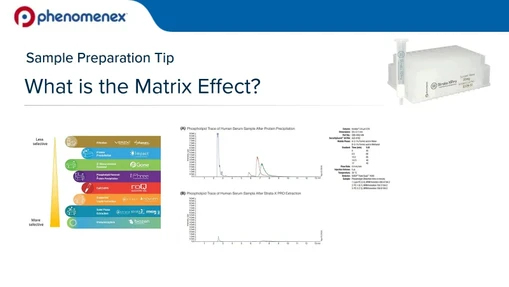
Sample Preparation Tip - What is the Matrix Effect?

Matrix effects can suppress or enhance analyte signals and compromise accuracy. Learn how sample prep techniques—especially SPE with Strata-X PRO—reduce phospholipid interference and improve LC-MS results.

Sample Preparation Tip - What is the Matrix Effect?
I am getting low recovery in my SPE method, how do I fix the problem?
LCMSGCMSArticle | Academy

I am getting low recovery in my SPE method, how do I fix the problem?

Practical troubleshooting guide for low recovery in SPE methods. Learn how to identify problems with solvents, flow rate, pH, or sorbent choice step by step.
I am getting low recovery in my SPE method, how do I fix the problem?
Over-Drying of Silica-Based SPE Cartridges Can Lead to Poor Sample Recovery
GCMSLCMSArticle | Academy

Over-Drying of Silica-Based SPE Cartridges Can Lead to Poor Sample Recovery

Over-drying silica-based SPE cartridges during conditioning can reduce analyte retention and recovery. Learn best practices to avoid losses and ensure reproducible results.
Over-Drying of Silica-Based SPE Cartridges Can Lead to Poor Sample Recovery
Sample Pre-treatment Procedures for Bioanalytical Samples
GCMSLCMSArticle | Academy

Sample Pre-treatment Procedures for Bioanalytical Samples

Bioanalytical samples often need pretreatment before SPE. Each matrix presents challenges like protein removal, red blood cell lysis, glucuronide hydrolysis, or tissue homogenization.
Sample Pre-treatment Procedures for Bioanalytical Samples