

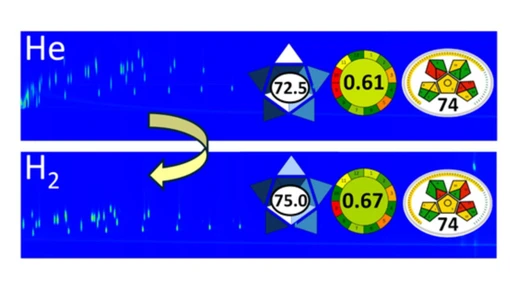
Hydrogen Carrier Gas Method Translation in Comprehensive Two-Dimensional Gas Chromatography for Sustainable Nontargeted Analysis
A helium-to-hydrogen translation strategy for GC×GC-MS preserves chromatographic performance, halves modulation time, and reduces run time by up to 60%.
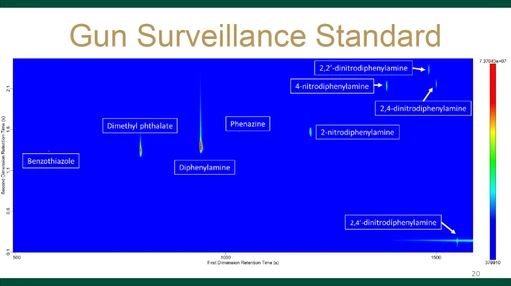
Developing a Combined Approach to Green Gunshot Residue Analysis in the Forensic Laboratory (Barbara Grace Saunders, MDCW 2026)
Learn how SEM-EDS and GC×GC-TOFMS were combined to analyze green gunshot residue, providing forensic laboratories with new tools for modern firearm discharge investigations.
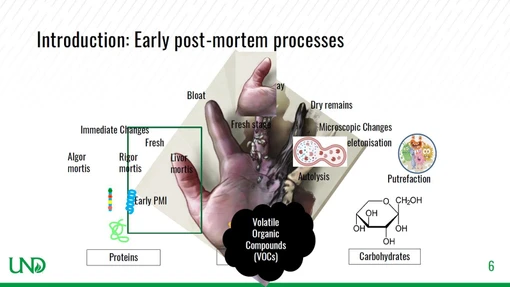
Identifying the transition from antemortem to post-mortem odor in cadavers cadavers in an outdoor environment (Darshil Patel, MDCW 2026)
How does human odor transition after death? Darshil Patel explores early postmortem VOC evolution using GC×GC-TOFMS and reveals how these chemical changes may impact cadaver and rescue dog detection.
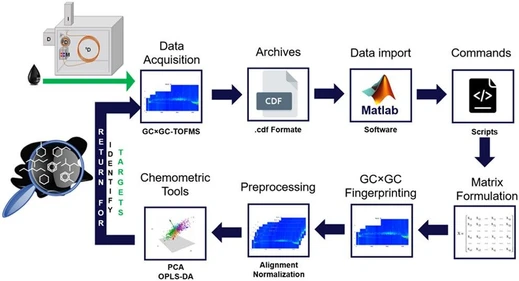
Pixel-Based Chemometric Analysis of Pre-Salt Crude Oils: Advancing GC×GC-TOFMS for Reservoir Characterization
Pixel-based GC×GC-TOFMS preprocessing enables rapid chemometric comparison of Brazilian pre-salt oils, revealing subtle light-hydrocarbon patterns and distinguishing Barra Velha from Itapema.
From Lab Building to Fingerprint Aging: Dr. Petr Vozka on Advanced Chromatography
Peter’s lab combines GC×GC innovation, real forensic workflows, and strong industry partnerships to train students and advance research from fingerprint aging to complex chemical mixture analysis.