Mo, 3.8.2026 | Original article from: Anal. Chem. (2026)
A helium-to-hydrogen translation strategy for GC×GC-MS preserves chromatographic performance, halves modulation time, and reduces run time by up to 60%.Hydrogen Carrier Gas Method Translation in Comprehensive Two-Dimensional Gas Chromatography for Sustainable Nontargeted Analysis
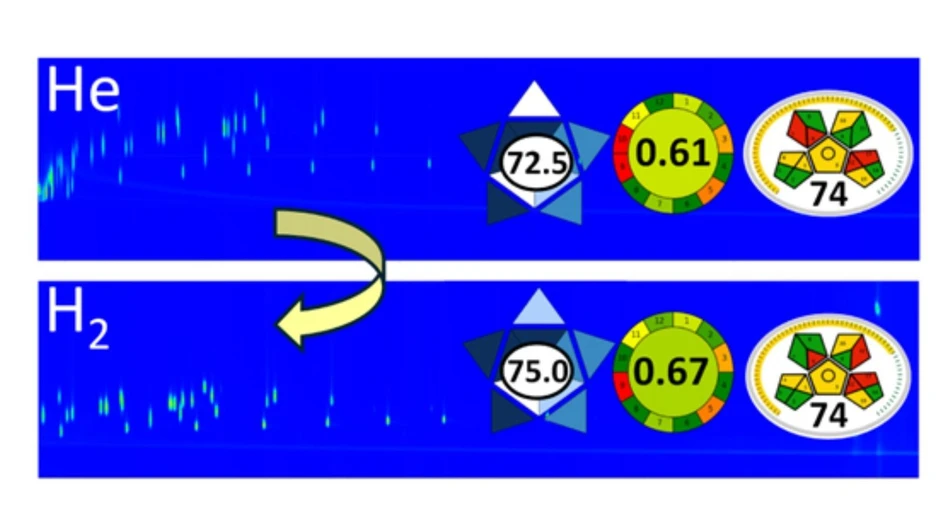
Anal. Chem. (2026): Graphical abstract
This study evaluates the translation of helium-based methods to hydrogen carrier gas in cryogenically modulated comprehensive two-dimensional gas chromatography–mass spectrometry (GC×GC-MS). Three translated methods were assessed using standard mixtures and validated with authentic fingermark residues for forensic nontargeted analysis.
A method combining flow and temperature adjustments maintained comparable peak capacity, signal-to-noise ratio, peak shape, and resolution. Hydrogen also allowed the modulation period to be reduced by 50% and shortened total analysis time by up to 60%, improving sample throughput, energy efficiency, and the overall sustainability of GC×GC-MS workflows.
The original article
Hydrogen Carrier Gas Method Translation in Comprehensive Two-Dimensional Gas Chromatography for Sustainable Nontargeted Analysis
Kira M. Fisher; Emma L. Macturk; Katelynn A. Perrault Uptmor*
Anal. Chem. (2026)
https://doi.org/10.1021/acs.analchem.6c03350
licensed under CC-BY 4.0
Selected sections from the article follow. Formats and hyperlinks were adapted from the original.
Carrier gas serves as the mobile phase that transports analytes through the column for separation in one-dimensional gas chromatography (1D GC) and comprehensive two-dimensional gas chromatography (GC×GC). Helium is traditionally used due to its inertness, but it is a finite resource obtained from natural gas with associated environmental impacts, including CO2 emissions and potential water contamination. (1, 2) Additional costs arise from extraction, transport, and handling of pressurized cylinders. As helium reserves decline and demand increases, prices have risen, limiting accessibility, particularly for routine or remote laboratory operations, and creating disparities across applications. (1, 3) Although experienced users can translate methods from helium to hydrogen using advanced knowledge and tools, there is a growing need for simplified workflows to support end users in this transition.
Hydrogen carrier gas offers distinct advantages for GC compared to helium. As described by the van Deemter equation, hydrogen enables comparable efficiency to helium at a faster optimal linear velocity due to its lower viscosity and higher diffusivity. (4, 5) This allows shorter analysis times without the loss of efficiency typically accompanied by increased helium flow rates, as observed by a flatter van Deemter curve for hydrogen than helium. For GC systems that use mass spectrometry (MS) detection, hydrogen is considered to be the most practical alternative to helium. Although nitrogen can be used in some specialized GC-MS applications, it is typically accompanied by a substantial decrease in S/N for conventional electron ionization. (6) Hydrogen is increasingly recognized as a critical alternative to helium for GC and GC×GC, mitigating challenges associated with helium’s limited availability and escalating cost. (7)
The flammability risk associated with hydrogen can be minimized through generation in a laboratory rather than obtaining it in compressed cylinders. Cylinders of hydrogen are typically produced through the process of steam-methane reforming. Hydrogen generators typically use electrolysis, where water is split into oxygen gas and hydrogen gas using an electric current. (8, 9) This generation process is more sustainable compared to nonrenewable, fossil fuel-derived alternatives for hydrogen gas production. (8) Gas transportation costs are eliminated with in-house generation since the gas is produced and subsequently consumed in real time. The flammability risk is lower with in-house generation due to the reduced storage in pressurized cylinders avoiding the accumulation of flammable gas. (9) Additionally, hydrogen poses a higher risk of reactivity with analytes in the sample. While analyte conversion is not well documented in the literature with hydrogen carrier gas, chemical reactivity considerations dictate that there could be a possible risk of reduction of oxygen-containing groups or hydrogenation of double bonds in aromatic or vinyl groups. Especially for nontargeted analyses performed using GC×GC, monitoring analyte identification during the translation process can help characterize challenges for the annotation of components.
While tools exist for translating 1D GC methods to hydrogen carrier gas, no established approaches are available for GC×GC. (10−12) One study compared key GC parameters for helium and hydrogen but did not provide translation guidance. (13) Existing 1D translation approaches do not account for the additional programmable parameters of GC×GC separations. The modulator and fast secondary separation introduce zones with parameters not addressed in 1D GC studies converting helium to hydrogen carrier gas, leaving a gap in understanding how to optimize hydrogen carrier gas for GC×GC-MS separations.
The purpose of this work was to develop and evaluate an approach for converting cryogenically modulated GC×GC-MS systems from helium to hydrogen carrier gas. Chemical standards and a 1D translation tool were used to investigate parameters governing second dimension separations and chromatographic performance. The approach was subsequently tested on authentic fingermark samples as a forensic nontargeted profiling application.
Materials and Methods
Method Translation
Compound reactivity, resolution values for peak pairs, and other component metrics (e.g., peak area, S/N, tailing factor) were compared. The Pro EZGC Method Translator (Restek Corporation, Bellefonte, PA, USA) was implemented to provide three options: translate, efficiency, and speed. Standards were analyzed using helium and all three hydrogen method options. The helium method and its three respective hydrogen methods are shown below for the indoor air standard (Table 1) and in the Supporting Information for Grob and linear alkane standards (Tables S1–S2). Resulting parameters from the tool were entered as whole values into ChromaTOF software 5.58. The first-dimension peak capacity, second-dimension peak capacity, and net peak capacity of the method were calculated using the Simply GC×GC software (LECO Corporation).
Analysis was performed on a Pegasus BT 4D GC×GC with time-of-flight MS (TOFMS) and dual-stage quad-jet cryogenic modulation (LECO Corporation, Saint Joseph, MI) using liquid injection. The syringe was rinsed with solvent and sample twice, and 1 μL of sample was injected, followed by five rinses. The inlet split ratio was 20:1, and the inlet temperature was 250 °C. Helium was of ultra high purity at 99.999% (Airgas, Radnor, PA, USA). Hydrogen was supplied at the specified flow rate and was generated by an NM Plus 600 Hydrogen Generator with a purity of 99.9996% (VICI DBS, Houston, TX) connected to the GC with stainless steel tubing, which is highly recommended for employing hydrogen carrier gas to reduce flammability risk.
Samples were analyzed by using ChromaTOF version 5.58 (LECO Corporation). Spectra were searched in the NIST MS Library Version 3.0, 2023. Samples were processed with a minimum S/N of 400 and a stick count of 3. The minimum spectral similarity was 700, and the relative abundance threshold was 10. Putative identifications were compared between methods to check the reactivity of components.
Results and Discussion
Fingermark Residue Application
Seven analytes (fatty acids and esters) were used to form an artificial fingermark residue and assess peak shape and reproducibility. These compounds were selected due to their known variability in the peak shape. Although acids often exhibit tailing without derivatization, derivatization was not used to reflect nontargeted workflows.
The analytes (Figure 5A–C) showed mixed trends for tailing factor, exhibiting both improved and worsened tailing across methods (Figure 5). Increased peak tailing was found in the analysis of adulterated drugs in traditional Chinese medicines using hydrogen carrier gas compared to helium. (9) Conversely, hydrogen produced the best peak shape among the three tested carrier gases in another study on permanent gas detection in human blood. (21) The results of this study demonstrated comparable tailing factors relative to helium depending on analyte chemistry.
 Anal. Chem. (2026): Figure 5. Analytical ion current (AIC) contour plots of fingermark standards run using hydrogen carrier gas: (A) H2 translate, (B) H2 efficiency, (C) H2 speed. D) Peak areas normalized to seven analytes (n = 9). 1) myristic acid, 2) octisalate, 3) palmitoleic acid, 4) palmitic acid, 5) oleic acid, 6) stearic acid, and 7) methyl nonadecanoate.
A key difference between the three hydrogen methods was the flow rate of the carrier gas. The helium flow rate of 1.00 mL/min was translated to 1.25 mL/min of gas flow for hydrogen. The speed method resulted in a flow of 2.50 mL/min, while the efficiency method resulted in a flow rate of 1.75 mL/min. The translate, efficiency, and speed method options had the same improved respective chromatographic run times as the standards reported above (Table 2). Studies using GC-MS that investigated drug samples found that switching to hydrogen carrier gas from helium decreased run time by more than half, thereby benefiting throughput. (2, 9) Decreased first-dimension retention times (faster elution) were expected with higher flow rates and provided similar results as above.
Significant differences were observed across methods for squalene, cholesterol, octisalate, myristic acid, palmitic acid, and methyl nonadecanoate using a one-way ANOVA test (p < 0.05) (Figure 5D). The translate method generally indicated a stronger response for many analytes and improved reproducibility for some analytes (Figure 5D). These trends align with previous 1D GC-MS studies reporting comparable reproducibility between hydrogen and helium for pesticide analysis. (20) The translate method was selected for the analysis of authentic fingermark samples.
Fingermark residue from five volunteers was analyzed using all three hydrogen methods to confirm method selection. The translate method showed the least peak tailing (Figure 6A–C) and improved suitability for quantitative analysis. Several analytes exhibited significant first-dimension tailing with the efficiency method (Figure 6B). The proposed modulation period avoided wraparound based on second-dimension retention times (Figure S6). Wraparound peaks that do not reflect true first or second dimension retention times should be avoided in GC×GC analysis to avoid retention index challenges and second-dimension broadening. (22) The modulation period was reduced by 50%, similar to the standards tested above (Table 3, Figure S6). The same metrics used for standards were also applied to authentic fingermark samples, yielding consistent results.
 Anal. Chem. (2026): Figure 6. Analytical ion current (AIC) contour plots of fingermark residue analytes using A) hydrogen translate, B) hydrogen efficiency, and C) hydrogen speed methods.
Conclusion
Helium has long been the standard carrier gas for GC-MS due to its inertness but has become increasingly expensive and challenging to acquire. Hydrogen is an attractive alternative carrier gas because of its lower viscosity and higher diffusivity relative to helium, allowing comparable chromatographic efficiency to be maintained over a wider range of linear velocities. Consequently, hydrogen can support faster separations with reduced loss of efficiency than helium at elevated flow rates. This characteristic has made hydrogen an increasingly viable carrier gas for GC and GC×GC applications. This study used analytical standards to develop a translation workflow from helium to three hydrogen methods using GC×GC-TOFMS with a cryogenic modulator and existing 1D GC translation tools. The translate option displayed the best peak shape and reproducibility over the speed or efficiency options. The run time was reduced by 60% using hydrogen compared to helium, and the modulation period could be reduced by 50%. This translation was performed with fingermark standards and authentic fingermark samples to verify the workflow. This study is the first to propose a retention time reduction ratio for translating a GC×GC-TOFMS helium method to hydrogen in cryogenically modulated systems.
Faster analyses using hydrogen carrier gas align with the green chemistry principle of energy efficiency. Shorter run times reduce electricity use per sample and increase overall throughput. The hydrogen method was comparable to its helium counterpart while reducing per-run energy consumption and nearly doubling hourly sample throughput. This provides clear advantages for routine, high-throughput laboratories. Hydrogen also offers potential sustainability benefits through on-site generation via electrolysis, in contrast to the nonrenewable sourcing of helium. The overall sustainability impact reflects a balance of factors including energy use, gas sourcing, safety considerations, and operational efficiencies. Hydrogen presents a compelling option when evaluated through this broader lens. The findings from this study were found to be replicated in real fingermark samples, making this applicable to other authentic samples analyzed using GC×GC-TOFMS.