Th, 8.10.2026 | Original article from: RAFA
Explore the newly released RAFA 2026 scientific programme, featuring the latest advances in food analysis, safety, authenticity, contaminants, HRMS, omics, and AI. Vložený markdownRAFA 2026 Scientific Programme
- Photo: RAFA: Scientific programme is available
- Video: Recent Advances in Food Analysis - RAFA: RAFA 2022 AFTERMOVIE
The wait is over! Explore the programme of the 12th International Symposium on Recent Advances in Food Analysis (RAFA 2026) and start planning your conference experience in Prague!
Discover an exciting programme featuring:
- Invited lectures and scientific sessions covering the latest developments in food analysis, safety, authenticity and emerging contaminants
- Cutting-edge analytical approaches, including HRMS, omics, chemometrics and artificial intelligence
- Interactive workshops, satellite events and vendor seminars
- Poster sessions, an exhibition and opportunities to connect with experts from academia, industry and regulatory authorities
- Join the international food analysis community to exchange knowledge, discover new ideas and build valuable connections!
📅 November 3 - 6, 2026
📍Prague, Czechia
Registration
- Late registration (From 1 October, 2026): € 955
- Student rate (From 1 July, 2026): € 605
Explore the full programme
Tuesday, November 3, 2026
WORKSHOP: Opportunities to collaborate in a European research and innovation area
9:30–9:35 Opening & Welcome
9:35–10:20 Opportunities for food scientists to participate in the Horizon Europe programme
- Nada Konickova, Technology Centre Prague, Horizon Europe NCP – Cluster 6
- Jana Cejkova, Technology Centre Prague, Horizon Europe NCP – Cluster 6
9:35–10:20 Opportunities for mobility of researchers and measures to support widening countries participation in Horizon Europe
- Petra Fedorova, Technology Centre Prague, Horizon Europe NCP – Widening participation
10:20–10:30 NCP4EIT Training, Networking and Best Practices Initiative
- Anna Voseckova, Technology Centre Prague, EIT NCP
10:30–10:50 Collaboration opportunities and support to innovation offered by the EIT Food (programmes dedicated to students, start-ups, researchers and innovators)
- Monika Tomaniova, University of Chemistry and Technology Prague, Prague, Czech Republic & EIT Food Country Representative Czech Republic
10:50 - 11:20 Coffee break
11:20–11:40 From research results to industry pilots: validation, matchmaking and technology transfer with support from innovation centres
- Julie Levkova, Central Bohemian Innovation Center, Prague, Czech Republic
11:40–12:10 Examples of EIT supported projects and activities
- MarbleMat; Galochrom
12:10–12:50 Examples of projects and activities in the European Research Area
- Data4Food2030; BIOTOXDoc; EFF-CoP
12:50–13:00 Questions & Answers & Networking / Closing of the workshop
WORKSHOP: Vibrational spectroscopy and chemometrics
9:00–10:30 W1 Basics of Vibrational Spectroscopy: NIR Principles & Instrumentation; MIR & Raman Principles & Instrumentation
- Vincent Baeten, Walloon Agricultural Research Centre, Gembloux, Belgium
10:30 - 11:00 Coffee break
11:00–12:00 W2 Basics of Chemometrics
- François Stevens, Walloon Agricultural Research Centre, Gembloux, Belgium
12:00–12:25 W3 Rapid Detection of Black Pepper Adulteration Using Benchtop and Handheld Infrared Spectrometers Combined with Chemometrics
- Paul Rentz, AERIAL, Illkirch-Graffenstaden, France
12:25–12:50 W4 Real-Time In-Field Wheat Quality Analysis and Mycotoxin Screening Using On-Combine Near-Infrared Spectroscopy
- Patrick Rennhofer, BOKU University, Department of Agricultural Sciences, Institute of Bioanalytics and Agro-Metabolomics, Tulln, Austria
12:50–13:00 Closing Remarks
- Vincent Baeten, Walloon Agricultural Research Centre, Gembloux, Belgium
14:00–14:30 Opening Ceremony & Welcome
SESSION 1 – PLENARY: Recent issues and novel approaches in food analysis I
14:30–15:00 It Takes a Small Step to Fake Food but a Giant Leap to Authenticate
- Nicolai Zederkopff Ballin, Danish Veterinary and Food Administration, Ringsted, Denmark
15:00–15:30 Data-Driven Strategies to Reduce Complexity in Non-Target HRMS Analysis of Food Samples
- Anneli Kruve, Stockholm University, Stockholm, Sweden
15:30 - 16:00 Coffee break / Exhibition
SESSION 2: Recent issues and novel approaches in food analysis II
16:00–16:20 Unravelling the Mysteries of Modified Mycotoxins
- Franz Berthiller, BOKU University, Tulln, Austria
16:20–16:40 From Bitter to Better: Fixing Off-Flavors in Plant Proteins
- Corinna Dawid, Technical University of Munich, Munich, Germany
16:40–17:00 Sample-to-Solution Approaches for Natural Toxin Analysis at the Point of Need
- Gert Salentijn, Wageningen Food Safety Research (WFSR), part of Wageningen University & Research, Wageningen, The Netherlands
17:00–17:20 Challenges of Microplastics Analysis in the Context of Food Safety
- Dorte Herzke, Norwegian Institute of Public Health, Oslo, Norway
17:20–17:40 Authentication of Insect-Based Products: Proteomics-MS to Highlight Farmed Animal Proteins Residues
- Marie-Caroline Lecrenier, Walloon Agricultural Research Centre, Gembloux, Belgium
17:40–18:00 Structure-Informed Profiling of Prebiotic Food Oligosaccharides by UHPLC-FLR-Cyclic IMS-HRMS: From Ingredient Fingerprints to Probiotic Consumption Patterns
- Thomas Tilmant, CER Groupe, Belgium & Wallonia Institute of Food Science and Technology, Charleroi, Belgium
18:00–18:10 Enantioselective GC×GC-TOFMS in Food Analysis: A Novel Analytical Approach for Food Analysis (Young Scientists’ Presentation)
- Micaela Galletta, Messina Institute of Technology c/o Department of Chemical, Biological, Pharmaceutical and Environmental Sciences, University of Messina, Messina, Italy
18:30 - 19:30 Symposium Welcome Cocktail
SESSION 3: Migrants from food contact materials
16:00–16:20 Analytical and Toxicological Methods for Safety of Food Contact Materials
- Erich Leitner, Graz University of Technology, Institute of Analytical Chemistry and Food Chemistry, Graz, Austria
16:20–16:30 A Prioritization Strategy for Chemicals Associated with Reusable Food Packaging (Young Scientists’ Presentation)
- Louna Saintcas, ANSES, Fougeres, France
16:30–16:40 Screening of IAS and NIAS in Food Packaging: Monitoring Contaminant Profiles Connecting Regulatory Guidelines and Real-World Samples (Young Scientists’ Presentation)
- Alessia Turina, UNITO, Department of Chemistry, University of Turin & INRIM, National Institute of Metrological Research, Turin, Italy
16:40–17:00 Migration Testing of Primary Aromatic Amines from Polyamide Kitchenware: The Impact of pH on Migration Versus Degradation Kinetics
- Elisabeth Koch, German Federal Institute for Risk Assessment, Berlin, Germany
17:00–17:20 Analytical Chemistry, an Essential Tool for Evaluating Strategies in Mechanical Polyolefin Recycling
- Christian Klampfl, Institute of Analytical and General Chemistry, Johannes Kepler University Linz, Linz, Austria
17:20–17:30 Fit for Food Contact? Analytical Characterization of Post-Consumer Recycled Polyolefins (Young Scientists’ Presentation)
- Elise Hecht, Graz University of Technology, Institute of Analytical Chemistry and Food Chemistry, Graz, Austria
17:30–17:50 Application of Online Coupled LC-GC-FID to Determine Specific Migration of Potentially Harmful Cyclic Siloxanes from Food Contact Silicone Elastomers
- Martin Eckardt, Labor Lommatzsch & Säger GmbH, Cologne, Germany
17:50–18:00 Beyond Detection: Observing Chemical Migration from Single Microplastics in Food with Nanospray Desorption Electrospray Ionization (Nano-DESI) Mass Spectrometry Imaging (Young Scientists’ Presentation)
- Louis Thomas, ONIRIS, LABERCA, Nantes, France & McGill University, Montréal, Canada
18:30 - 19:30 Symposium Welcome Cocktail
SESSION 4 – WORKSHOP: Smart data handling and AI in food analysis
16:00–16:30 Making Sense of Metabolomics Data: Workflows, Pitfalls, and Emerging Approaches
- Vit Kosek, University of Chemistry and Technology Prague, Prague, Czech Republic
16:30–16:50 Role of AI in the Identification of Emerging Food Systems Risks
- Akos Jozwiak, Syreon Research Institute & Institute of Food Chain Science, University of Veterinary Medicine, Budapest, Hungary
16:50–17:10 A Foundation Model for Data Independent Acquisition High-Resolution Mass Spectrometry
- Niek de Jonge, Wageningen Food Safety Research (WFSR), part of Wageningen University & Research, Wageningen, The Netherlands
17:10–17:30 Decoding Oxidation Signatures in Lipid Foods Through Explainable Artificial Intelligence and Sterol Oxidomics
- Vladimiro Cardenia, University of Turin, Grugliasco, Italy
17:30–17:50 Transfer Learning for Cross-Experiment Deep Learning in Untargeted Mass Spectrometry
- Andrea Junior Carnoli, Wageningen Food Safety Research (WFSR), part of Wageningen University & Research, Wageningen, The Netherlands
17:50–18:00 Explainable Artificial Intelligence Meets Aroma Profiling: From Cocoa Origin Authentication to Aroma Wheel Development (Young Scientists’ Presentation)
- Giorgio Felizzato, University of Turin, Grugliasco, Italy
18:30 - 19:30 Symposium Welcome Cocktail
Wednesday, November 4, 2026
SESSION 5 – WORKSHOP: Experiences, achievements and challenges by EU Reference Laboratories I
9:00–9:20 Current Challenges of the EURL/NRL Network for Halogenated POPs in Feed and Food
- Alexander Schaechtele, European Union Reference Laboratory for Halogenated Persistent Organic Pollutants in feed and food, Freiburg, Germany
9:20–9:40 Analytical Challenges and Harmonisation of Methods for Processing Contaminants: Experience from the EU Reference Laboratory
- Arvid Fromberg, European Union Reference Laboratory for Processing Contaminants hosted by the National Food Institute, Technical University of Denmark, Kgs. Lyngby, Denmark
9:40–10:00 Recent Analytical Advances by the EURL for Metals and Nitrogenous Compounds in Feed and Food (EURL-MN)
- Jens J. Sloth, European Union Reference Laboratory for Metals and Nitrogenous compounds in feed and food, National Food Institute, Technical University of Denmark, Lyngby, Denmark
10:00–10:20 EURL MP Network Activities Supporting Harmonised Control of Mycotoxins and Plant Toxins in Food and Feed and Related Challenges
- Josipa Grzetic Martens, European Union Reference Laboratory for Mycotoxins and Plant Toxins, Wageningen Food Safety Research (WFSR), part of Wageningen University & Research, Wageningen, The Netherlands
10:20–10:40 Beyond Analytical Methods: Building a Harmonised Framework for Marine Biotoxin Control
- Verónica García Morales, European Union Reference Laboratory for Monitoring of marine biotoxins, Spanish Agency for Food Safety and Nutrition (AESAN), Vigo, Spain
10:30 - 11:00 Coffee break / Exhibition
SESSION 6: Food Authenticity & Fraud I
9:00–9:20 Unmasking Hidden Adulteration in Honey: Strategies for Detecting and Characterizing Honeys Produced from Sugar-Fed Colonies
- Oscar Núñez, Department of Chemical Engineering and Analytical Chemistry & Research Institute in Food Nutrition and Food Safety, University of Barcelona, Barcelona, Spain
9:20–9:40 Honeybee Subspecies DNA as a Marker for the Geographic Authentication of Honey
- Margit Cichna-Markl, University of Vienna, Vienna, Austria
9:40–9:50 Combining Non-Targeted Screening LC-HRMS and Effect-Directed Analysis to Characterize the Toxicological Hazards of Bee Pollen Supplements (Young Scientists’ Presentation)
- Susannah Heeren, Wageningen University and Research - Laboratory of Organic Chemistry & Wageningen University and Research - Division of Toxicology & Wageningen Food Safety Research, Wageningen, The Netherlands
9:50–10:00 DART-HRMS in Food Authentication: Enabling Faster, Greener and Fit-for-Purpose Analytical Workflows (Young Scientists’ Presentation)
- Sofia Drakopoulou, National and Kapodistrian University of Athens, Athens, Greece
10:00–10:20 Detection of the Addition of Dried Blood Protein (Hydrolysates) Fom Pig in Sausage and Cold Meat by Targeted LC-MS/MS Analysis
- Stefan Wittke, University of Applied Sciences Bremerhaven, Bremerhaven, Germany
10:20–10:30 The WineChecker Project: A Collaborative NMR Based Wine Authentication Exercise (Young Scientists’ Presentation)
- Felix Wustrack, German Federal Institute for Risk Assessment, Berlin, Germany
10:30 - 11:00 Coffee break / Exhibition
SESSION 7: Food allergens
9:00–9:20 Food Allergen Risk Assessment: Past, Present, Future
- Benjamin C. Remington, Remington Consulting Group B.V., Utrecht, the Netherlands
9:20–9:30 Integrated Analytical, Biological and Computational Assessment of Allergenicity Risks in Alternative Proteins (Young Scientists’ Presentation)
- Maxime Gavage, Analytical Laboratory, CER Groupe, Marloie, Belgium
9:30–9:40 A Targeted Mass Spectrometry Method for the Detection and Quantification of Gluten in Fermented Matrices (Young Scientists’ Presentation)
- Sara Schlange, Food Allergy Research and Resource Program, Department of Food Science and Technology, University of Nebraska-Lincoln, Lincoln, United States of America
9:40–10:00 Research on Detection Technologies of Food Allergens
- Yi Yang, Beijing Center for Disease Prevention and Control, Beijing, China
10:00–10:20 Molecular Lens on Chia (Salvia hispanica): Protein Quality and Allergenicity in Novel Food Evaluation
- Sara Cutroneo, University of Parma, Parma, Italy
10:20–10:30 Rapid Protein Quantification in Complex Food Matrices by ATR-FTIR Spectroscopy: A Structure-Independent Approach Demonstrated in Plant-Based Alternatives and Bovine Milks (Young Scientists’ Presentation)
- Nima Shadmehri, Macquarie University, Sydney, Australia
SESSION 8 – WORKSHOP: Experiences, achievements and challenges by EU Reference Laboratories II
11:00–11:20 Connecting Policy and Proficiency Through Inspiring Early Lessons and Navigating Challenges from the EURL for Food Improvement Agents
- Séverine Goscinny, European Union Reference Laboratory for Food improvement agents, Sciensano, Bruxelles, Belgium
11:20–11:40 TBC
11:40–12:00 Advancing Pesticide Residue Analysis in Cereals and Feeding Stuffs: Challenges and Experiences from the EU Reference Laboratory
- Arvid Fromberg, European Union Reference Laboratory for pesticide Residues in Cereals and Feeding Stuff hosted by the National Food Institute, Technical University of Denmark, Kgs. Lyngby, Denmark
12:00–12:20 Current Challenges of EURL for Pesticide Residues in Food of Animal Origin and High Fat Commodities
- Anja Muzyka, European Union Reference Laboratory for Pesticides residues in food of animal origin and high fat commodities, Chemical and Veterinary Investigation Office (CVUA), Freiburg, Germany
12:20–12:40 Stress Test for Analytical Methods – The Importance of Performance Verification Using Incurred Matrices
- Katrin Kittler, German Federal Office of Consumer Protection and Food Safety - European Reference Laboratory for Residues of Veterinary Drugs, Berlin, Germany
SESSION 9: Food Authenticity & Fraud II
11:00–11:20 Targeted and Non-Targeted Analysis of Cinnamon Safety and Authenticity
- Marc Behr, Joint Research Centre, Geel, Belgium
11:20–11:40 ‘Cracking the Chicken-and-Egg Situation: Can Water Models Replace IRMS Databases?’
- Katharina Heinrich, Fera Science Ltd, York, United Kingdom
11:40–11:50 Carbohydrate-Based Strategy to Detect Adulteration of Fruit Juices and Fruit Juice Concentrates with Sugar Syrups (Young Scientists’ Presentation)
- Angelina Schneider, Martin-Luther-University Halle-Wittenberg, Halle, Germany
11:50–12:00 Novel Tools for Novel Foods: Next Generation Sequencing to Characterize Insect-Based Food (Young Scientists’ Presentation)
- Gabriele Spatola, University of Pisa, Pisa, Italy
12:00–12:20 Rapid On-Field LAMP Screening and TaqMan Real-Time PCR Confirmation of Bombyx mori in Insect-Based Food and Feed Products
- Joana S. Amaral, CIMO, LA SusTEC, Instituto Politécnico de Bragança, Bragança, Portugal
12:20–12:40 Authentication of Haymilk and Haymilk Yoghurt by ¹H NMR: Targeted CPFA Detection and Untargeted Metabolomics
- Ksenia Morozova, Free University of Bozen/Bolzano, Bolzano, Italy
SESSION 10: Bioactive compounds: Natural toxins and psychoactive substances I
11:00–11:20 Rapid Risk Assessment on Acute Reference Dose (ARfD) of Cereulide in Infants and Information on Acute Consumption of Infant Formulae
- Hans Steinkellner, European Food Safety Authority (EFSA), Parma, Italy
11:20–11:40 From Food-Borne Intoxications to the Recent Infant Formula Incident: Development of an LC-MS/MS Method for the Analysis of the Bacterial Toxin Cereulide
- Christoph Czerwenka, Group for Contaminant and Special Analysis, Austrian Agency for Health and Food Safety, Vienna, Austria
11:40–12:00 High from Food? Natural, Semi-Synthetic and Synthetic Cannabinoids in Edibles, Hemp Flowers, Vapes
- Stefan Weigel, German Federal Institute for Risk Assessment, Berlin, Germany
12:00–12:20 CBD as a Novel Food
- Elisa Beneventi, European Food Safety Authority (EFSA), Parma, Italy
12:20–12:40 Screening of Whey, Whey Products and Infant Formula for Toxic Plant Alkaloids Using LC-MS/MS
- Florian Kaltner, Competence Center for Food Safety, Chair of Food Safety and Analytics, Ludwig Maximilian University of Munich, Oberschleissheim, Germany
13:30–16:00 Poster Session, Exhibition, Vendor seminars
VENDOR SEMINARS
13:30–14:15 Exploring Evolution in Gas Chromatography to Address Regulatory Needs
13:30–14:15 Transforming Innovation into Operational Excellence: Advancing Technologies for Routine Success
13:30–14:15 Innovative Solutions for Faster, Smarter Laboratory Workflows for Food Analysis
- CEM
14:45–15:30 Think Big. Make it Small.
- Shimadzu
14:45–15:30 From Known Risks to Hidden Threats: Comprehensive and Advanced Workflows for Contaminant Analysis with SCIEX Triple Quad, QTRAP, and High-Resolution Mass Spectrometry (HRMS)
- SCIEX
14:45–15:30 Protecting the Food Chain: Novel LC/MS/MS Applications for the Detection of PFAS and Cereulide Biotoxin
- Agilent Technologies
SESSION 11: Bioactive compounds: Natural toxins and psychoactive substances II
16:00–16:20 Analytical Challenges Faced by Food Industry in the Field of Toxic Alkaloids
- Michele Suman, Barilla G. R. F.lli SpA, Analytical Food Science & Department of Food and Drug, University of Parma, Parma, Italy
16:20–16:30 Digging Deeper into Ergot Alkaloids: A Comparative View of Alkaloid Contamination in Grain and Sclerotia (Young Scientists’ Presentation)
- Alessandro Volkov, University of Chemistry and Technology in Prague, Prague, Czech Republic
16:30–16:40 Discovery of “SLAPAs”: Untargeted HRMS in Combination with IRIS Reveals Pyrrolizidine Alkaloids in Valerianella locusta (Young Scientists’ Presentation)
- Leonie Straub, Wageningen Food Safety Research, Wageningen University & Research & Laboratory of Organic Chemistry, Wageningen University & Research, Wageningen, The Netherlands
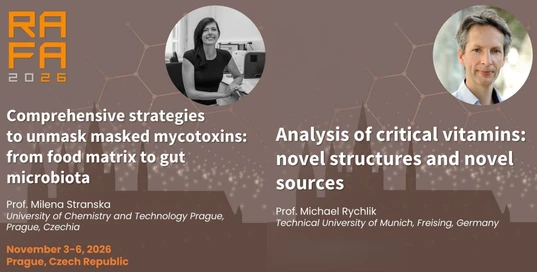
16:40–17:00 Comprehensive Strategies to Unmask Masked Mycotoxins: From Food Matrix to Gut Microbiota
- Milena Stranska, University of Chemistry and Technology in Prague, Prague, Czech Republic
17:00–17:20 Detection of Fungal Infection of Walnut by Untargeted Protein Profiling Using MicroLC-IM-QTOF
- Akram Guenaoui, Friedrich-Alexander University of Erlangen–Nuremberg, Erlangen, Germany
17:20–17:40 Breaking the 1D Barrier: Fully Automated 2D-LC-MS/MS for High-Throughput, Cost-Efficient Analysis of Aflatoxins and Ochratoxin A in Food
- Mareike Reichel, Eurofins WEJ Contaminants GmbH, Hamburg, Germany
17:40–17:50 Early Screening Approach for Detection of Mycotoxin-Producing Fusarium graminearum by Its Volatile Organic Compound Profiles (Young Scientists’ Presentation)
- Klaudia Moskot, Wageningen Food Safety Research, Wageningen University & Research & Laboratory of Organic Chemistry, Wageningen University & Research, Wageningen, The Netherlands
17:50–18:00 Assessing the Phytocannabinoid, Polyphenol, and Mycotoxin Profiles of Hemp Flowers and Hashish Concentrates as Emerging Novel Foods (Young Scientists’ Presentation)
- Yllka Visoka, FFoQSI GmbH - Austrian Competence Centre for Feed and Food Quality, Safety & Innovation, Tulln, Austria
SESSION 12: Process induced contaminants
16:00–16:20 An Overview of the Latest Scientific Knowledge on Process Contaminants in Food for Appropriate Risk Management Measures
- Thierry Delatour, Société des Produits Nestlé S.A., Nestlé Research, Lausanne, Switzerland
16:20–16:40 Ensuring Food Safety Compliance: Development and Application of Advanced Methods for Smoke-Related Contaminants Under the New EU Regulatory Framework
- Franziska Janusch, Eurofins WEJ Contaminants GmbH, Hamburg, Germany
16:40–17:00 Small Molecules, Big Challenges: UHLC–MS/MS Determination of Smoke Flavours in Ham
- Lidija Kenjeric, European Union Reference Laboratory for Processing Contaminants hosted by the National Food Institute, Technical University of Denmark, Kgs. Lyngby, Denmark
17:00–17:20 Free Asparagine Screening in Cereals: From Lab-Based Strategies Towards On-Site Application
- Aristeidis Tsagkaris, University of Chemistry and Technology in Prague, Prague, Czech Republic
17:20–17:40 Maillard Reaction Products in Plant-Based Dairy Products
- Jana Raupbach, Technical University Braunschweig, Braunschweig, Germany
17:40–18:00 Expanding N-Nitrosamine Analysis Beyond Processed Meat: Development of a Sensitive LC–MS/MS Method for Multi-Matrix Food Applications
- Agnieszka Anna Niklas, DTU National Food Institute, Kgs. Lyngby, Denmark
SESSION 13 – INTERACTIVE SEMINAR: Step by step strategies for a fast development of smart analytical methods
16:00–18:00 Step by Step Strategies for a Fast Development of Smart Analytical Methods
- Moderator: Michal Stupak, University of Chemistry and Technology Prague, Prague, Czech Republic
- Moderator: Laura Righetti, Wageningen Food Safety Research (WFSR), part of Wageningen University & Research, Wageningen, The Netherlands
- Moderator: Cinzia Cafarella, University of Messina, Messina, Italy
Thursday, November 5, 2026
VENDOR SEMINAR
7:45–8:30 Unlocking New Dimensions in Mass Spectrometry
- Plasmion
SESSION 14: Food contaminants I
9:00–9:20 Emerging Food Safety Hazards and Associated Risks: Integrating Advanced Analytical Chemistry, Predictive Modelling, and Digital Collaboration
- Rudolf Krska, BOKU University, Institute of Bioanalytics and Agro-Metabolomics, Department of Agricultural Sciences / IFA-Tulln, Tulln, Austria & Institute for Global Food Security, School of Biological Sciences, Queens University Belfast, Belfast, United Kingdom
9:20–9:40 From Regulatory Oversight to Analytical Evidence: Co-Formulants in Food
- Elena Hakme, National Food Institute, Technical University of Denmark, Kgs. Lyngby, Denmark
9:40–10:00 Seeing the Full Picture: Advanced Mineral Oil Analysis by LC-GC×GC-TOF-MS-FID
- Silvia Aguiló Losa, Institut Fresenius SGS GmbH, Berlin, Germany
10:00–10:20 Hidden Bisphenol A in Infant Formula: Encapsulation as a Critical Challenge for Comprehensive Analysis
- Thomas Behnke, Mérieux NutriSciences, Berlin, Germany
10:20–10:30 Retrospective Screening of Food Contaminants in Total Diet Study (TDS) Samples Over More Than a Decade: A Comparative Study Between LRMS and HRMS (Young Scientists’ Presentation)
- Alessandro Rozzoni, French Agency for Food, Environmental and Occupational Health and Safety, Maison-Alfort, France
SESSION 15: Progress in general food analysis I
9:00–9:20 Analysis of Critical Vitamins: Novel Structures and Novel Sources
- Michael Rychlik, Technical University of Munich, Freising, Germany
9:20–9:40 Development, Validation and Application of an HPLC-EC-FLD Method for Determination of Vitamins K1 and K2 (MK 4–10) in a Broad Range of Matrices
- Eystein Oveland, Institute of Marine Research, Bergen, Norway
9:40–10:00 From Pollen to Chemistry: Trentino Alpine Honeys
- Eugenio Aprea, University of Trento, San Michele all Adige, Italy
10:00–10:20 Development of an UPLC-ESI/MS Method for the Simultaneous Determination of Methionine, Tryptophan, Phenylalanine, Cysteine and Tyrosine Oxidation Products in Food
- Francesca Accardo, Department of Food and Drug, University of Parma, Parma, Italy
10:20–10:30 Valorization of Ficus carica L. Leaves Through Integrated Spectroscopic, Chromatographic, Elemental and Metabolomic Profiling (Young Scientists’ Presentation)
- Tamara Cilia Attard, Università degli Studi Del Piemonte Orientale, Novara, Italy
SESSION 16: Reading between the Peaks: Chances and challenges of HRMS-based screening in official food control
9:00–9:15 Introduction and Setting the Scene
- Kerstin Krätschmer, Wageningen Food Safety Research (WFSR), part of Wageningen University & Research, Wageningen, The Netherlands
9:15–9:30 Success Story – What Does "Effective Screening" Mean? A Tiered Perspective on HRMS-Based Pesticide Residue Monitoring in Fruits and Vegetables
- Amadeo R. Férnandez Alba, European Union Reference Laboratory for Pesticide Residues in Fruit and Vegetables, University of Almeria, Almeria, Spain
9:30–9:45 Success Story – Harmonising Parameters for HRMS-Screening
- Joachim Polzer, German Federal Office of Consumer Protection and Food Safety - European Reference Laboratory for Residues of Veterinary Drugs, Berlin, Germany
9:45–10:00 TBC
10:00–10:30 Panel Discussion
SESSION 17: Food contaminants II
11:00–11:20 Fit-for-Purpose Alternatives to the Inductively Coupled Plasma for Nutrient and Toxic Element Analysis of Foods
- Jake Carter, U.S. Food and Drug Administration Human Foods Program, College Park, MD, United States of America
11:20–11:40 Characterizing Bioaccessible Trace Element Species in Plant-Based Foods by SEC ICP MS and SEC QTOF MS
- Katrin Loeschner, National Food Institute, Technical University of Denmark, Kgs. Lyngby, Denmark
11:40–11:50 Assessment of the Impact of Cooking on the Fate of Potentially Toxic Elements and Nutrients in Rice and Lentils (Young Scientists’ Presentation)
- Thinhinane Hamitouche, French Agency for Food, Environmental and Occupational Health & Safety (ANSES), Maisons-Alfort, France
11:50–12:10 Fast, Reliable, and Transferable: Interlaboratory Validation of HPLC-ICP-MS for Methylmercury Determination in Foods
- Doaa Abouelenein, National Food Institute, Technical University of Denmark, Kgs. Lyngby, Denmark
12:10–12:30 Towards Closing the Gaps Between Food Analysis and Toxicological Evaluation of MOSH & MOAH
- Giorgia Purcaro, University of Liege, Gembloux Agro-Bio Tech, Gembloux, Belgium
SESSION 18: Progress in general food analysis II
11:00–11:20 Advancing Broad-Scope Food and Environmental Analysis Through Expansion and Interlaboratory Evaluation of the Food Safety Mass Spectral Library
- Serena Rizzo, Wageningen Food Safety Research, Wageningen University & Research, Wageningen, The Netherlands
11:20–11:40 Ion Mobility, Flexible Ion Chemistry and Improved Performances: New Avenues for Direct Injection Mass Spectrometry in Food Applications
- Franco Biasioli, Fondazione Edmund Mach, San Michele all'Adige, Italy
11:40–12:00 easyIMS - A No-Code Solution for GC-IMS Data Interpretation
- Nabiollah Mobaraki, Institute of Instrumental Analytics and Bioanalytics, Mannheim, Germany
12:00–12:20 Towards a Holistic Assessment of the Carbon Footprint of LC-MS/MS-Based Mycotoxin Analysis
- Stephan Freitag, BOKU University, Department of Agricultural Sciences, Institute of Bioanalytics and Agro-Metabolomics, Tulln, Austria
12:20–12:40 Implementation of a Microscale LC Method Combined with the Quantitative Structure-Retention Relationship Theory for the Reliable Identification of Phenolic Compounds
- Francesca Rigano, University of Messina, Messina, Italy
SESSION 19 – LIVING LAB: Authenticity on trial: What it actually takes to catch food fraud
11:00–12:30 Authenticity on Trial: What It Actually Takes to Catch Food Fraud
- Moderator: Anastasia Vlachou, Rezos Brands Anonymi Emporiki Eteria Idon Diatrofis, Athens, Greece
13:30–16:00 Poster Session, Exhibition, Vendor seminars
VENDOR SEMINARS
13:30–14:15 Revealing More from Olive Oil: Advanced GC×GC-TOFMS Workflows for Contaminants, MOSH/MOAH, Quality, and Authenticity
13:30–14:15 Next Gen Orbitrap MS Solutions for Isotope Ratio and POPs Analysis
13:30–14:15 Enhancing Laboratory Efficiency with Biotage® Workflow Solutions for PFAS Analysis in Foods of Animal Origin
- Biotage
14:45–15:30 AFFINIMIP®SPE: Molecularly Imprinted Polymers Kits for the Analysis of Regulated or Prohibited Substances in Foodstuffs
- Affinisep
14:45–15:30 Environmental and Food Organic Xenobiotics – EFOX Integrated Workflow Solutions, Built for What’s Next
- Thermo Fisher Scientific
14:45–15:30 From Weighed Sample to Final Report: An Automated QuPPe Workflow Combining Robotic Sample Preparation, LC-MS/MS and Python-Based Evaluation
- Tecan
SESSION 20: Flavour and off-flavour significant compounds
16:00–16:20 Different Approaches to Identifying Taints and Off-Notes
- Jane K. Parker, University of Reading, Reading, United Kingdom
16:20–16:40 How Advances in Chromatography and Mass Spectrometry Enable Improved Flavour Analysis: The Flavourgrams Concept
- Hans-Gerd Janssen, Unilever Foods R&D & Wageningen University & Research, Wageningen, The Netherlands
16:40–17:00 Analysis of Aroma Compounds as a Tool to Support Fruit Production Under a Changing Climate
- Barbara Siegmund, Graz University of Technology, Institute of Analytical Chemistry and Food Chemistry, Graz, Austria
17:00–17:10 Comprehensive Analysis of Flavour Compounds in Biscuit Model Systems Enriched by Rapeseed Protein (Young Scientists’ Presentation)
- Tomas Kourimsky, University of Chemistry and Technology in Prague, Prague, Czech Republic
17:10–17:20 Protein-Flavor Interactions: Quantitative Analysis of Covalent and Non-Covalent Binding Between Aldehyde Flavor Compounds and Plant Proteins (Young Scientists’ Presentation)
- Mincong Liu, Wageningen University & Research, Wageningen, The Netherlands
17:20–17:30 GC-QTOF-Based Metabolomics Revealed Distinct Aroma-Active Compounds Between Wagyu and Non-Wagyu Beef (Young Scientists’ Presentation)
- Thanyaporn Tengsuttiwat, National Center for Genetic Engineering and Biotechnology (BIOTEC), National Science and Technology Development Agency (NSTDA), Pathum Thani, Thailand
17:30–17:50 HS-GC-IMS Profiling of Mineral Water in Plastic Bottles as a Rapid Method for Assessing Safety and Sensory Characteristics: A Case Study
- Marco Arlorio, Department of Pharmaceutical Sciences - University of Piemonte Orientale, Novara, Italy
17:50–18:00 Monitoring of Allyl Esters and Related Aroma Compounds in Fermented Milk Products Using GC-MS (Young Scientists’ Presentation)
- Anna Maria Gabler, German Federal Institute for Risk Assessment, Berin, Germany
SESSION 21: Human biomonitoring and exposomics
16:00–16:20 Sharpening Nutrition Science with Analytical Chemistry
- Josep Rubert, Wageningen University & Research, Wageningen, The Netherlands
16:20–16:40 A SUPRAS-Based Workflow for Dietary Exposome Assessment in Mediterranean Fish
- Noelia Caballero-Casero, University of Córdoba, Córdoba, Spain
16:40–17:00 Understanding Gender-Based Differences in Exposure to Persistent Pollutants in Arctic Food Systems Through Dietary Patterns and Food Contamination
- Gaud Dervilly, ONIRIS-LABERCA, Nantes, France
17:00–17:20 Food-Focused Exposomics in Human Biofluids by LC-HRMS
- Tessa Reinert, Department of Food Chemistry and Toxicology, University of Vienna, Vienna, Austria
17:20–17:40 Chemical Contaminants in Human Milk: An Analytical Approach to Exposure and Toxicological Risk
- Jaime Salcedo Dominguez, Instituto de Agroquímica y Tecnología Alimentaria (IATA)-CSIC, Paterna, Spain
17:40–18:00 Exposomics-Informed Biomonitoring of Food Contaminants in Breast Milk Samples from Western Australia
- Max Lennart Feuerstein, Department of Food Chemistry and Toxicology, University of Vienna, Vienna, Austria & Exposome Austria, Research Infrastructure and National EIRENE Node, Austria
SESSION 22: AOAC INTERNATIONAL and ILSI Europe: Harmonizing methods and managing risk: A food industry perspective
16:00–16:10 Introduction
- Katerina Mastovska, AOAC International, United States of America
- Isabelle Guelinckx, ILSI Europe, Belgium
16:10–16:35 Be Mindful with Your Method and Proud of Your Data! They Drive Food Safety
- Thierry Delatour, Société des Produits Nestlé S.A., Nestlé Research, Lausanne, Switzerland
16:35–16:55 Risk Assessment of Microcrystalline Wax (E905); A Case Study on the Importance of Toxicologically Relevant Characterisation of MOSH and MOAH
- Juan-Carlos Carrillo, Shell, Hague, The Netherlands
16:55–17:15 Is Your Analytical Data Meaningful for Food Allergen Risk Assessment? Implementing AOAC INTERNATIONAL Method Validation, Verification, and End User Guidance in Risk-Based Frameworks
- Melanie Downs, Food Allergy Research & Resource Program, University of Nebraska-Lincoln, Lincoln, United States of America
17:15–17:35 Allergen QRA: What the Laboratory Must Deliver
- Simon Flanagan, Mondelez International, Reading, United Kingdom
17:35–18:00 Panel Discussion
Friday, November 6, 2026
SESSION 23: Per- and polyfluoroalkyl substances (PFAS)
9:00–9:20 Never-Ending Analytical Challenges in PFAS Analysis of Food
- Darina Dvorakova, University of Chemistry and Technology in Prague, Prague, Czech Republic
9:20–9:40 From Sample to Injection: DoE-Based Optimization of Automated PFAS Sample Preparation and Online SPE Enrichment
- Friederike Habedank, State Office for Agriculture, Food Safety and Fisheries, Rostock, Germany
9:40–10:00 Bridging Analytical Chemistry and Metrology: Validation of IDMS Methods and Development and Characterization of Candidate Reference Materials for PFAS in Food Matrices
- Chiara Portesi, Barilla SpA & University of Parma, Parma, Italy
10:00–10:20 Analytical Methods for PFAS in Foods and Food Packaging: Research and Applications in the U.S. FDA’s Human Foods Program
- Lowri deJager, US Food and Drug Administration, College Park, United States of America
10:20–10:30 Suspect Screening of Emerging PFAS in Wild Boar Liver: An Interlaboratory Study (Young Scientists’ Presentation)
- Bas van Dijk, Wageningen Food Safety Research (WFSR), part of Wageningen University & Research, Wageningen, The Netherlands
10:30–10:40 From Soil to Tomato: DoE-Optimized Extraction and Multi-Platform Mass Spectrometry Strategy for the Quantification of Ultra-Short-Chain, Short-Chain, and Legacy PFAS (Young Scientists’ Presentation)
- Michela Torrelli, University of Turin & National Institute of Metrological Research, Turin, Italy
10:40–10:50 Ultra-Short-Chain PFAS in Czech and Belgian Beers: Method Development and Occurrence (Young Scientists’ Presentation)
- Ondrej Parizek, University of Chemistry and Technology Prague, Prague, Czech Republic
10:50–11:10 Plant-Forward Dietary Transitions Redistribute Rather Than Reduce Dietary Chemical Risks in the French Population
- Octavian Mihalache, Oniris, INRAE, LABERCA, Nantes, France
SESSION 24: Omics strategies in food analysis
9:00–9:20 The Gas-Phase Goldmine: Volatilomics from Cutting Edge Platforms to Real World Use
- Philipp Weller, Technical University of Applied Sciences Mannheim, Mannheim, Germany
9:20–9:40 Towards Quantitative Volatilomics: Multidimensional Analytical Strategies for Robust and Transferable Food Volatile Measurements
- Chiara Cordero, University of Turin, Turin, Italy
9:40–9:50 Non-Targeted Volatilomics in Food Authenticity: Bridging Resource-Efficient HS-GC-IMS and High-Resolution GC-MS (Young Scientists’ Presentation)
- Lukas Bodenbender, Technical University of Applied Sciences Mannheim, Mannheim, Germany & Technical University of Berlin, Berlin, Germany
9:50–10:00 Multi-Year GC×GC Volatilomics and Machine Learning for Robust and Generalizable Shelf-Life Prediction (Young Scientists’ Presentation)
- Sara Tanilli, University of Turin, Turin, Italy
10:00–10:20 LC or GC? Let´s Do Both: Multiplatform HRMS Metabolomics with Data Fusion for Comprehensive Evaluation of Treatment Effects in Cannabis
- Michal Stupak, University of Chemistry and Technology Prague, Prague, Czech Republic
10:20–10:30 Integrating Non-Targeted Metabolomics and Chemoinformatics to Map the Chemical Diversity and Functionality of Coffea arabica Leaf Extracts (Young Scientists’ Presentation)
- Davide Rovelli, University of Parma, Parma, Italy
10:30–10:40 QuantyFey: An Open-Source Tool for Targeted LC-MS Quantification with Integrated Drift Correction (Young Scientists’ Presentation)
- Markus Aigensberger, Department of Agricultural Sciences, Institute for Bioanalytics and Agro-Metabolomics, BOKU University Vienna, Austria
10:40–10:50 Continuous Online Headspace GC-IMS and Convolutional Neural Networks for Automated Volatile Profiling in Mammalian Cell Cultures (Young Scientists’ Presentation)
- Richard Frey, Technical University of Applied Sciences Mannheim, Mannheim, Germany
10:50–11:00 Advancing AI-Driven Food Volatilomics Through GC×GC–HRMS: Bridging Instrumental and Physiological Sensitivity (Young Scientists’ Presentation)
- Andrea Caratti, University of Turin, Turin, Italy
SESSION 25: Bioanalytical methods for food quality & safety control
9:00–9:20 Immunoreagents for the Simultaneous Rapid Analysis of Deoxynivalenol and Its Metabolites
- Josep V. Mercader, IATA-CSIC, Paterna-Valencia, Spain
9:20–9:30 Development of a Rapid and Cost-Effective Multiplex qPCR Screening Method for Simultaneous Detection of Foodborne Pathogens in Food Matrices (Young Scientists’ Presentation)
- Martina Annunziata, University of Campania L. Vanvitelli & University of Naples Federico II, Napoli, Italy
9:30–9:50 Analytical Strategies for the Detection of Organisms Edited Using New Genomic Techniques: Outcomes from the DETECTIVE Project
- Frédéric Debode, Walloon Agricultural Research Centre (CRA-W), Gembloux, Belgium
9:50–10:00 Nanoplate-Based dPCR Detection and Quantification of Genetically Modified Organisms in Food and Feed Samples (Young Scientists’ Presentation)
- Ivo Ferreira Machado, Competence Centre for Molecular Biology, SGS Global, SA, Lisbon, Portugal
10:00–10:10 Development and Validation of KFOMetabarcoding: A Long-Read Amplicon Sequencing Method for Species-Level Authentication of Insects in Processed Products (Young Scientists’ Presentation)
- Yoon-Soo Gwak, Kyung Hee University, Yongin, South Korea
10:10–10:20 Plant Species Identification in Complex Food Matrices Using Illumina Platforms (Young Scientists’ Presentation)
- Andrea N. Aigner, Austrian Agency for Health and Food Safety GmbH (AGES), Vienna, Austria
10:20–10:40 Advanced Analytics Meets Effect-Based Analysis: Practical Case Studies in Food Safety
- Andrea Hochegger, Institute of Analytical Chemistry and Food Chemistry, Graz, Austria
10:40–11:00 Oligoesters Migrating from Food Varnishes and Coatings – Organic Synthesis, In Vitro Testing and Exposure Assessment
- Ronan Cariou, Oniris, INRAE, LABERCA, Nantes, France
SESSION 26: Food analysis beyond imagination
11:30–12:00 Recent Developments and Outlook of EU Policy in Food on Contaminants with a Focus on Related Analytical Challenges
- Frans Verstraete, European Commission, DG Health and Food Safety, Brussels, Belgium
12:00–12:20 Simplifying the Interpretation of Complex Botanical Mixtures Through Bioactivity-Based Molecular Networking (Young Scientists’ Presentation)
- Hilva Gjoni, University of Parma, Parma, Italy
12:20–12:40 Imaging Food: The Power and the Limits of Seeing Molecules in Food
- Laura Righetti, Wageningen Food Safety Research (WFSR), part of Wageningen University & Research, Wageningen, The Netherlands
12:40–13:00 Summary of RAFA 2026 Highlights
- Michele Suman, Barilla Analytical Food Science, Parma, Italy
13:00–13:20 RAFA 2026 Poster Award / Sponsored Poster Awards
13:20–13:30 Closing Address – Announcement of the 13th RAFA 2028, Prague, Czech Republic
- Jana Pulkrabova, RAFA 2026 Chair
- Stefan van Leeuwen, RAFA 2026 Chai