Mo, 16.11.2026 | Original article from: ACS Omega (2026) 11 (32): 47804–47816
HS-GC-MS profiling of stored corn reveals VOC markers tracing the transition from biological deterioration to self-heating and smoldering combustion.Chemical Indicators of Self-Heating and Spontaneous Combustion in Stored Grains Investigated by HS-GC-MS
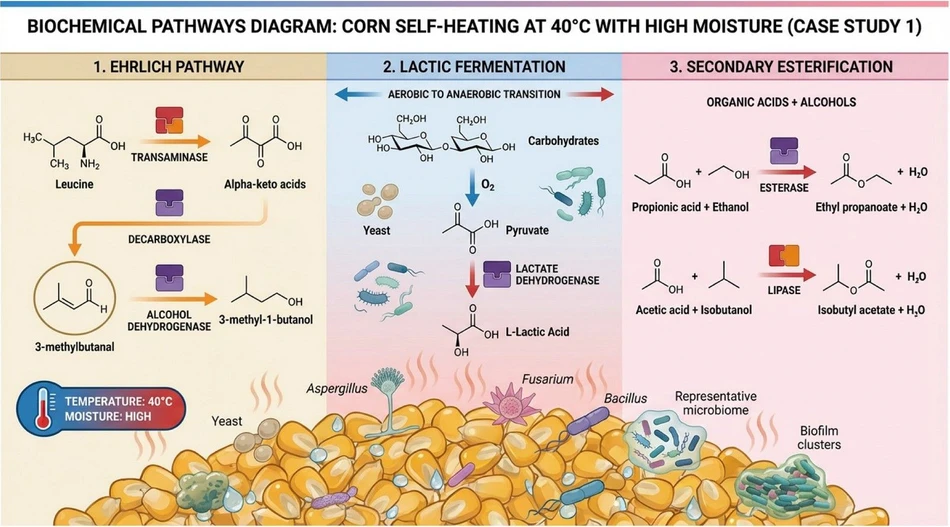
ACS Omega (2026) 11 (32): 47804–47816: Figure 7. Proposed biochemical mechanisms for the initial stage of self-heating in Case Study 1 (high moisture and 40 °C). The diagram details the metabolism of the microbiota inherent to the grains, illustrating the degradation of amino acids via the Ehrlich pathway, the transition to lactic fermentation under oxygen depletion, and the subsequent formation of the detected volatile esters.
This study investigates volatile organic compounds as chemical indicators of self-heating and spontaneous combustion in stored corn. HS-GC-MS was used to characterize VOC profiles from real fire incidents and controlled simulation experiments, revealing a progressive chemical transition from biological deterioration to thermochemical degradation.
Mapping these VOC markers enabled reconstruction of the thermal evolution toward smoldering combustion. The results demonstrate the potential of HS-GC-MS as a forensic tool for identifying self-heating processes and supporting determination of fire causes in agricultural storage facilities.
The original article
Chemical Indicators of Self-Heating and Spontaneous Combustion in Stored Grains Investigated by HS-GC-MS
Paula Baptista Leme*; Gustavo Cabral Ferraz; Teresa Cristina Brazil Paiva; Maurício Lamano Ferreira; Eliane Corrêa Pedrozo* ; Flávio Teixeira da Silva*
ACS Omega (2026) 11 (32): 47804–47816
https://doi.org/10.1021/acsomega.6c03108
licensed under CC-BY 4.0
Selected sections from the article follow. Formats and hyperlinks were adapted from the original.
In this context, understanding the causes of fires and explosions in storage silos plays a crucial role in both the mitigation of operational risks and postincident investigation. In scenarios involving insurance coverage, technical investigations also provide essential support to insurers and claims adjusters, assisting in the classification of the event and the determination of coverage according to policy terms.
Among the mechanisms associated with fires and explosions in grain storage systems, the self-heating of the stored material stands out as one of the main triggers, frequently related to fermentative processes and the formation of potentially explosive atmospheres. High moisture contents, inadequate aeration, and microbial activity favor the generation of flammable gases, especially carbon monoxide, characteristic of smoldering combustion, a slow and flameless form of combustion. (1, 2, 6−14)
The risk of spontaneous combustion in agricultural storage silos is widely recognized in both scientific literature and regulatory standards. In Brazil, for example, the Fire Department of the State of São Paulo requires, through Technical Instruction No. 27/2018, (33) the installation of thermometry systems in storage silos for the continuous monitoring of hot spots, with the objective of preventing autoignition events.
In fire investigations, physical and chemical evidence is fundamental for the development and validation of hypotheses related to spontaneous combustion. (1, 2, 6−8) Typical indicators include the presence of carbonized clusters, elevated levels of carbon monoxide in the internal atmosphere of the silo, and anomalous records in thermal monitoring systems indicating localized heating. (1, 2, 4−14, 30−32, 34)
In recent years, the profiling of volatile organic compounds (VOCs) has emerged as a powerful strategy for monitoring grain quality and deterioration. While sensor arrays and electronic noses (E-noses) offer rapid screening, Gas Chromatography–Mass Spectrometry (GC-MS) remains the gold standard for the qualitative and structural elucidation of complex volatiles. (35, 36) Despite its high sensitivity, the analysis of spontaneous combustion processes by GC-MS presents limitations, particularly when applied to complex biomass matrices using spectral libraries instead of authentic analytical standards as references. (35) Recognizing these limitations, this study employed HS-GC-MS as a comparative forensic tool by correlating the profiles of volatile organic compounds (VOCs) detected as physical evidence in real large-scale silo fires. This work established a novel forensic approach to chemically reconstruct the self-heating timeline, mapping the transition from biological deterioration to smoldering combustion.
Experimental Section
Gas Chromatography with Headspace Sampling Coupled to Mass Spectrometry (HS-GC-MS)
Volatile organic compounds (VOCs) were analyzed by gas chromatography with headspace sampling coupled to mass spectrometry (HS-GC-MS). The headspace technique allows the analysis of volatile components released from the sample matrix after heating in a hermetically sealed vial, minimizing sample handling and preserving the original chemical profile.
The GC-MS analyses were performed using a Shimadzu QP-2010 gas chromatograph coupled to a TQ-8040 mass spectrometer. The mass spectrometer operated in full-scan mode, in the m/z 40–700 range. Helium was used as the carrier gas, with a split ratio of 1:5. All analyses were conducted under controlled instrumental conditions, appropriate for the analysis of volatile organic compounds by headspace.
Compound identification was performed by comparing the obtained mass spectra with reference data from the NIST 17 spectral library, applying a minimum spectral similarity threshold of 80%. Considering the inherent limitations of identification based exclusively on spectral library-matching, especially in complex biomass matrices, the compounds were classified as tentative identifications. (35, 36) This analytical approach provides a reliable assignment of chemical classes and is widely employed in exploration and comparative studies, particularly in forensic investigations based on volatile organic compound (VOC) profiling. However, unequivocal structural confirmation, including the exact distinction between isomers, requires the analysis of authentic analytical standards and/or the calculation of additional orthogonal parameters, such as retention indices (RI). (35) Detailed instrumental parameters are presented in the Supporting Information.
Results and Discussion
Chemical Interpretation and Implications for Self-Heating
The comparative analysis of the VOC profiles obtained by HS-GC-MS reveals distinct chemical signatures that allow the chronological mapping of the biological, physical, chemical, and thermochemical phases of the self-heating process. The predominance of markers of biological origin in the Case Study 1 samples reflects the analytical conditions employed, characterized by high water activity and a moderate temperature of 40 °C, which simulated the initial stages of moisture accumulation in a silo. In this environment, metabolic pathways associated with amino acid degradation and alcoholic fermentation were favored, justifying the presence of compounds such as 3-methyl-1-butanol. As oxygen was progressively depleted within the real silo, this initial biological phase evolved into an intense anaerobic deterioration stage prior to ignition. (29) This transition is chemically evidenced by the exclusive accumulation of lactic acid and the subsequent formation of secondary volatile esters, such as ethyl propanoate and pentyl acetate. (17)
In turn, the accelerated aging simulation (60 °C) of Case Study 2 adequately models the transition the transition from predominantly metabolic processes to heating-induced chemical reactions. (28) As the thermal stress progresses and microbial activity is inhibited, the lipids naturally present in the corn undergo accelerated oxidative degradation. The temporal evolution demonstrates that lipid esters are gradually cleaved into short-chain aldehydes, especially hexanal and nonanal, which act as primary markers of this thermal escalation. (18)
As self-heating reaches critical temperatures, more advanced thermochemical degradation of the biomass matrix occurs. (13, 28) Marked differences in the VOCs composition between the laboratory simulations and the real partially burned samples provide a chemical timeline of the incident. In these advanced stages, the detection of nitrogenous heterocyclic compounds (such as pyridines and tetramethylpyrazine) confirms their predominantly thermal origin, driven by extreme Maillard reactions and Strecker degradation at high temperatures. (39, 44, 46)
Concurrently, the formation of substituted phenols, such as 2-methylphenol and 4-ethyl-2-methoxyphenol (homoguaiacol), derives from the partial pyrolysis of phenolic compounds present in the plant cell wall. (41)
In contrast, the absence of volatile compounds in the fully carbonized clusters observed in Case Study 1 evidence the intense thermal volatilization of the organic matrix subjected to the high temperatures of the active combustion zone. (12, 13)
A further detailed analysis of the thermochemical pathways synthesized in Tables 3 and 4 elucidates the apparent absence of light alcohols (e.g., ethanol and propanol) during the early stages of fermentation, an aspect that warrants careful forensic consideration. While short-chain alcohols are typical primary metabolites of yeast, their nondetection in the advanced sampling stages is scientifically justified by their volatility and the system’s thermodynamics. In the open-system simulations and during the delayed field collection of the heated silo samples, these highly volatile compounds rapidly dissipate into the surrounding atmosphere. Furthermore, under aerobic or semiaerobic conditions, transient light alcohols are rapidly consumed by acetobacteria and oxidized into acetic acid, a robust secondary marker that was prominently detected in our analyses. (17)
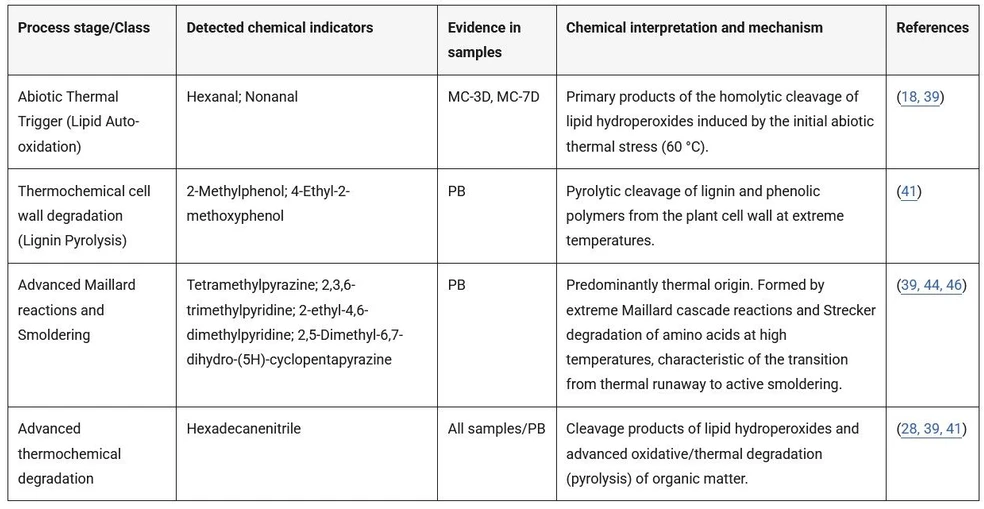 ACS Omega (2026) 11 (32): 47804–47816: Table 3.Correlation of the Compounds Detected by HS-GC-MS with the Spontaneous Combustion Stages in Case Study 1a,b,c
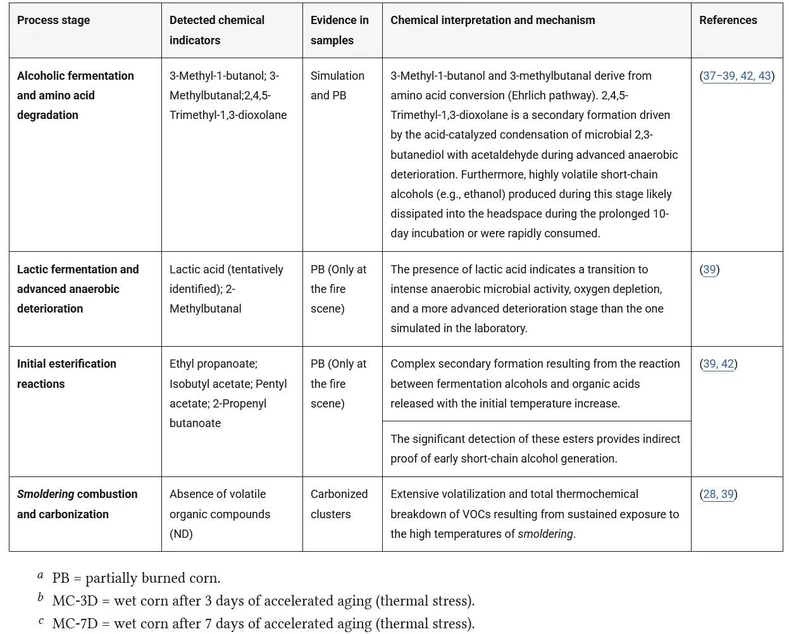 ACS Omega (2026) 11 (32): 47804–47816: Table 4.Correlation of the Compounds Detected by HS-GC-MS with the Spontaneous Combustion Stages in Case Study 2
Finally, the HS-GC-MS acquisition parameters are fundamentally optimized to detect heavier, more persistent biomarkers (such as 1-pentanol and 1-hexanol) that remain entrapped within the biomass matrix. Therefore, the absence of light alcohols does not contradict the biological trigger hypothesis; rather, it highlights the continuous biochemical conversion and volatilization processes that characterize the transition to the thermal runaway phase.
Despite the proposed timeline, the interpretation of these VOCs requires caution. Establishing specific and universal compounds as definitive markers of spontaneous combustion remains a challenge. (28) Thermochemical and biological processes in complex matrices, such as corn, involve overlapping mechanisms. (28, 35) For example, environmental variations, localized oxygen availability, and the microbiome inherent to the environment in which the sample is found may cause significant changes in the volatile compounds. (29, 40) Therefore, rather than treating individual VOCs as definitive and isolated evidence, the chemical signatures discussed in this study should be interpreted as part of a broader forensic tool supporting the self-heating hypothesis. (1, 6, 8) Future quantitative studies using authentic analytical standards and multidimensional chromatography are recommended to further reduce these analytical uncertainties. (35, 36)
Together, this chemical mapping, from moisture accumulation and microbial fermentation to lipid oxidation and biomass pyrolysis, allows the reconstruction of the chemical timeline of the event. The proposed biochemical reaction mechanism is synthesized in Table 3 and illustrated in Figure 7 for Case Study 1, as well as in Table 4 and Figure 8 for Case Study 2. These chemical markers provide a scientific basis for interpreting the origin of the fire through the intrinsic self-heating of the biomass. However, recognizing the inherent uncertainties of complex fire scenes, the definitive exclusion of external ignition sources strictly depends on the broader investigative context and corroborating documentary evidence. Therefore, these findings demonstrate the applicability of HS-GC-MS not as a standalone proof, but as a powerful complementary analytical tool. When integrated with other physical and forensic aspects, it can significantly assist fire investigators in ruling out external ignition hypotheses in agricultural storage incidents. (1, 6)
ACS Omega (2026) 11 (32): 47804–47816: Figure 7. Proposed biochemical mechanisms for the initial stage of self-heating in Case Study 1 (high moisture and 40 °C). The diagram details the metabolism of the microbiota inherent to the grains, illustrating the degradation of amino acids via the Ehrlich pathway, the transition to lactic fermentation under oxygen depletion, and the subsequent formation of the detected volatile esters.
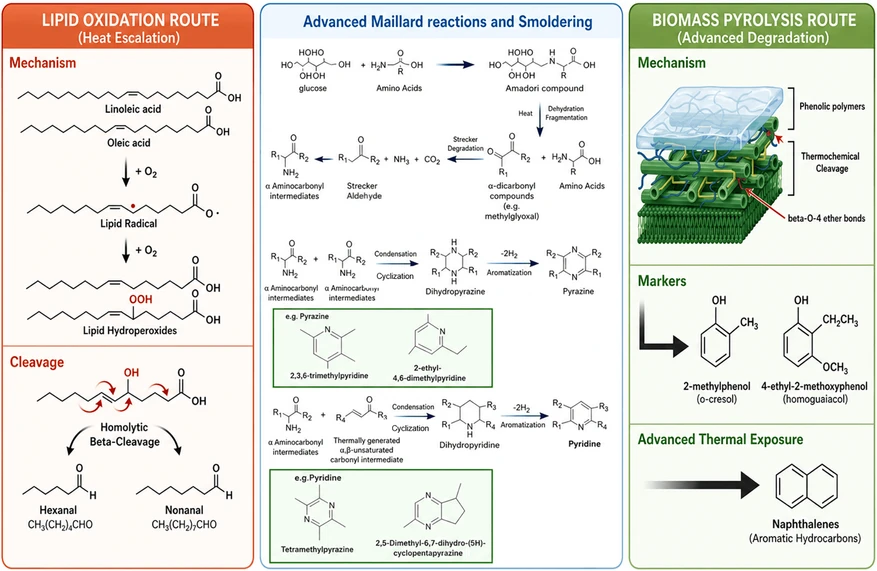 ACS Omega (2026) 11 (32): 47804–47816: Figure 8. Proposed strictly thermochemical reaction mechanisms for the escalation of self-heating in Case Study 2. The pathways illustrate the transition from an abiotic thermal trigger (lipid auto-oxidation) induced by the drying temperatures to the final thermochemical cleavage of cell wall phenolic polymers and advanced Maillard reactions, immediately prior to smoldering combustion.
Conclusions
Distinct profiles of volatile organic compounds (VOCs) were identified, allowing the proposal of a chronological mapping of the self-heating and smoldering combustion processes in stored corn. The detection of alcohols, organic acids, and nitrogenous heterocyclic compounds provided supportive chemical evidence of intense microbial activity, indicating the transition to anaerobic deterioration conditions that precede ignition. In subsequent stages, the conversion of esters associated with the formation of aldehydes, phenols, nitrogenous heterocycles, and aromatic hydrocarbons reflects the thermal escalation resulting from lipid oxidation reactions and the progressive thermochemical degradation (pyrolysis) of the biomass matrix. The comparative analysis by HS-GC-MS demonstrated its potential as a valuable tool for forensic investigation by allowing a reconstruction of the chemical evolution of the event based on the chemical markers generated in the different degradation stages.
Furthermore, the comparative evaluation between the two case studies provided valuable insights into the distinct mechanisms driving the self-heating progression. While the 40 °C scenario (Case Study 1) highlighted the biological trigger through the emission of primary alcohols and organic acids derived from microbial metabolism, the 60 °C scenario (Case Study 2) demonstrated how temperatures lethal to the microbiota shift the process toward strictly abiotic thermochemical reactions, primarily dominated by lipid auto-oxidation and subsequent structural degradation.
The comparative analysis by HS-GC-MS proved to be a valuable tool for forensic investigation by allowing the reconstruction of the chemical evolution of the event based on the chemical markers generated in the different degradation stages. This approach contributes to the understanding of self-heating mechanisms in stored biomass and, when integrated with the systematic investigation method proposed by NFPA 921, strengthens the scientific reliability in determining the causes of fires in agricultural storage systems. (1)
As future perspectives, in order to overcome the inherent limitations of library-based identification in complex agricultural matrices, subsequent studies should focus on the quantitative validation of these key biomarkers using authentic analytical standards, calculation of retention indices (RI), or the application of advanced multidimensional chromatography and detailed analysis of the mass spectra of each identified peak.
Furthermore, to fully elucidate the biological triggers of the self-heating process, the fermentation simulations should be complemented by the molecular identification of the deteriorating microbiota. Conducting isolated in vitro fermentation assays using specific yeast strains (such as Saccharomyces cerevisiae) is recommended to quantitatively monitor the exact emission pathways of these primary volatile precursors in corn grains.