We, 11.11.2026 | Original article from: KNAUER
KNAUER AZURA SMB systems bring simulated moving bed chromatography into practical use, combining modular hardware, flexible column configurations, and PurityChrom MCC software for continuous purification.How KNAUER transforms SMB chromatography from a theoretical concept into hardware
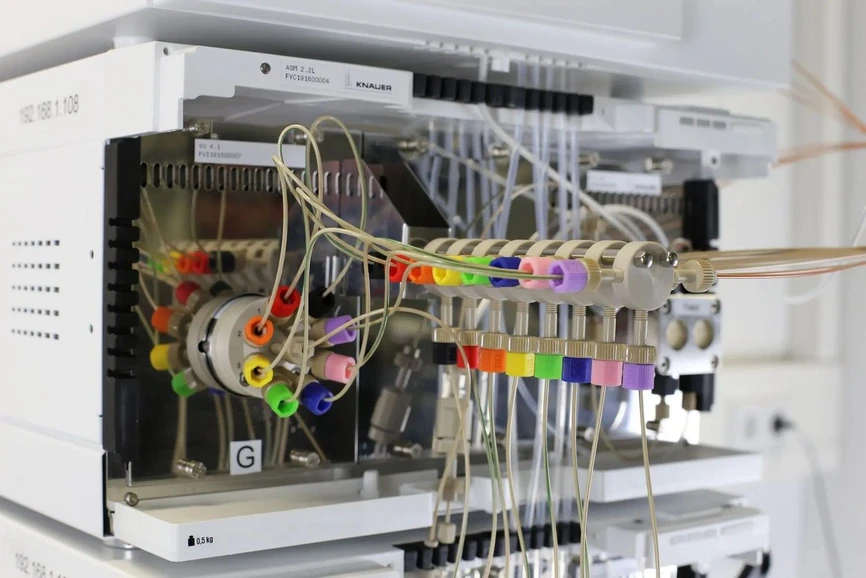
KNAUER: Simulated Moving Bed Chromatography
Simulated moving bed (SMB) chromatography offers an efficient approach to continuous separation, but translating the underlying principle into a reliable laboratory or pilot-scale process requires more than a suitable column. KNAUER's AZURA® SMB systems bring together modular chromatography hardware, flexible column configurations, and dedicated PurityChrom MCC software to make continuous purification accessible from method development through pilot production.
For laboratories exploring SMB during preparative method development, the key question is often how the theoretical movement of the stationary phase can be reproduced in a functioning instrument. KNAUER addresses this challenge with ready-to-use systems built around components already used in its AZURA preparative chromatography portfolio. The company has supplied laboratory- and pilot-scale SMB equipment for almost three decades.
From the SMB principle to an operating system
The AZURA SMB architecture uses a standardized arrangement of four pumps and seven multiposition valves. Three pumps—assigned to the extract, raffinate, and eluent streams—operate within the SMB cycle, while a fourth pump introduces the feed from outside the cycle.
The multiposition valves route the mobile phase between the pumps and separation columns. Four eight-port valves are installed at the pump outlets, and three valves are positioned at the pump inlets. The feed pump is the exception: its inlet is not connected to a multiposition valve.
In the conventional eight-column arrangement, the columns form four separation zones, with two columns in each zone. This layout provides the foundation for several AZURA SMB configurations.
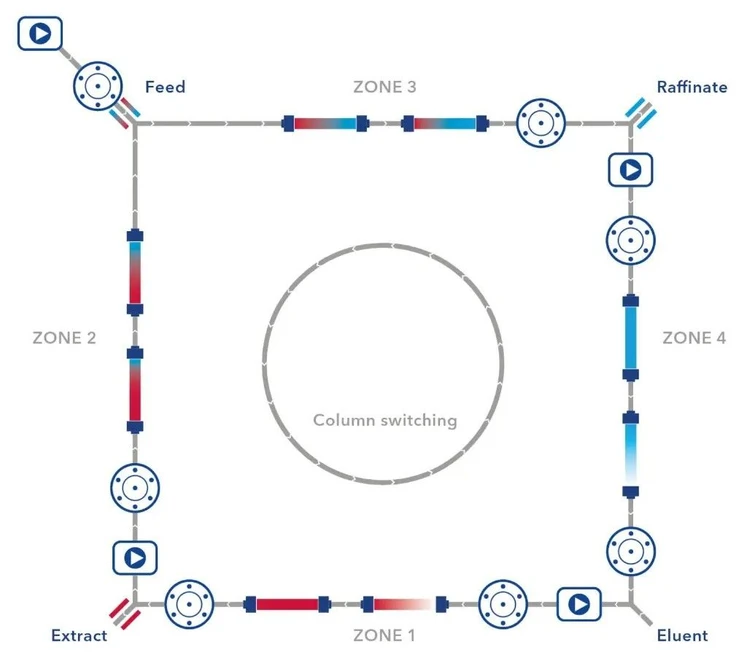 KNAUER: Figure 1: SMB concept with eight columns, two in each of the four zones of the SMB cycle. The four pumps and seven multposition valves and their placement in the SMB cycle are highlighted
AZURA SMB systems for laboratory and pilot applications
KNAUER offers several versions of the same underlying SMB concept, allowing users to select the system that best matches their process scale and purification requirements.
- AZURA Lab SMB System: Available with stainless-steel or biocompatible fluidic components, this configuration is intended for small-scale SMB method development and gram-scale purification of small molecules or biomolecules.
- AZURA Pilot SMB System: Designed for continuous separation of binary mixtures at gram-to-kilogram scale, with a focus on productivity and extended operation.
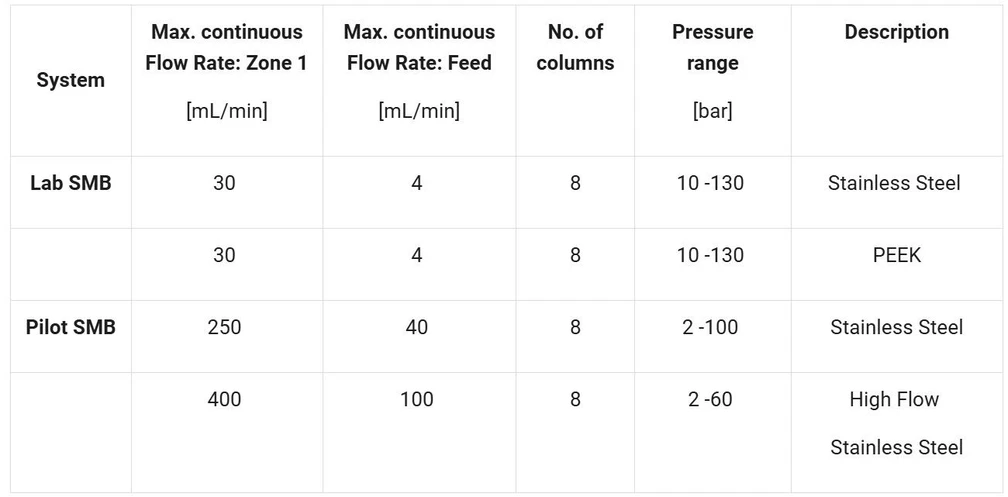
- AZURA Pilot SMB High-Flow System: A higher-capacity pilot configuration supporting continuous flow rates of up to 400 mL/min in Zone 1 and feed flow rates of up to 100 mL/min.
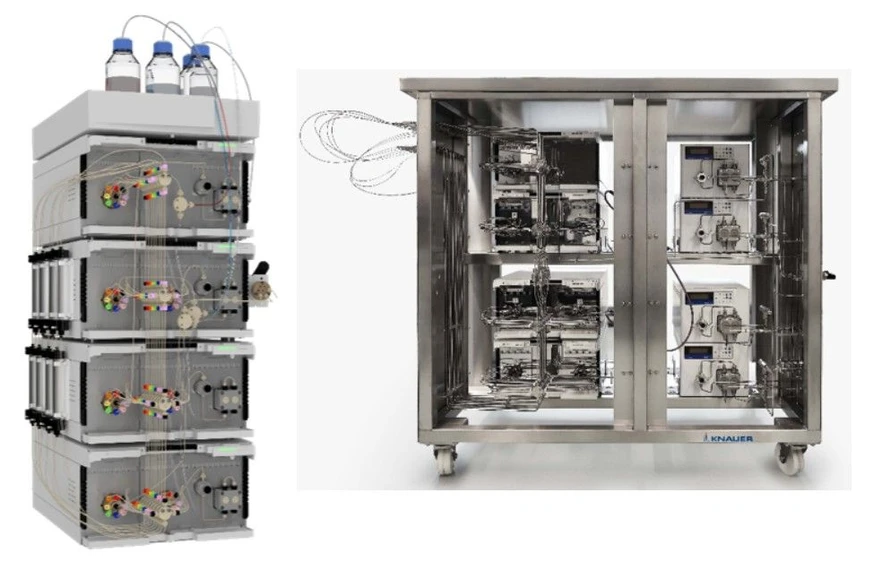 KNAUER: Figure 2: KNAUER SMB systems – AZURA Lab scale system (left) & AZURA Pilot scale system (right)
The available operating pressure and flow capacity depend on the selected version. Standard eight-column systems can operate at pressures up to 130 bar, while the maximum pressure is lower in the higher-flow pilot configurations. Column temperature can also be selected according to the application.
 KNAUER: Table 1
Flexible distribution of columns between SMB zones
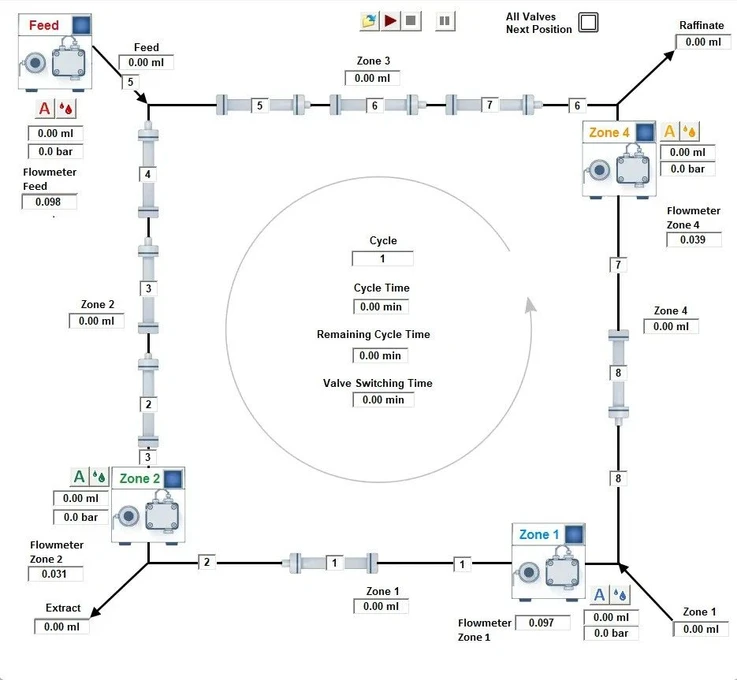
A major advantage of the AZURA design is the ability to adapt the number of columns assigned to each zone. The conventional arrangement is 2:2:2:2, meaning that all four zones contain two columns. This configuration is commonly used for classical SMB separations.
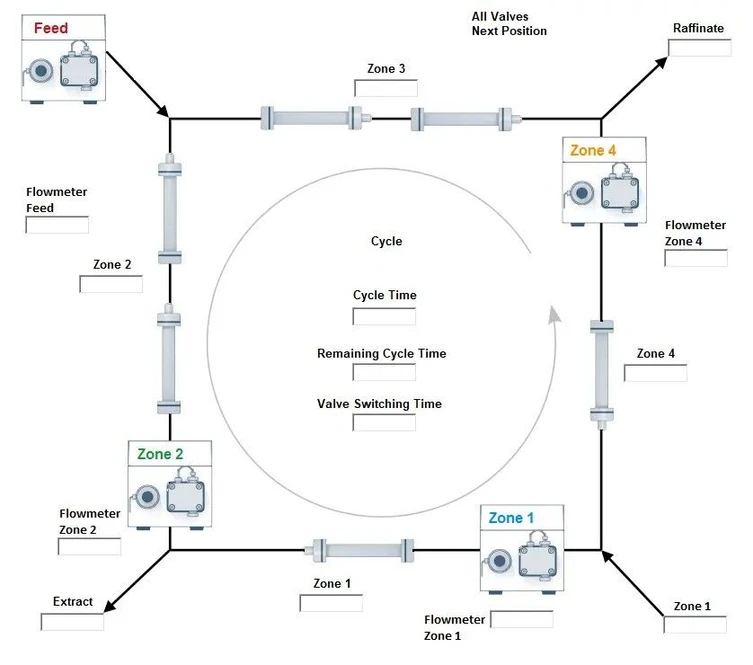
When a separation requires greater capacity in the central zones, the column distribution can be changed to 1:3:3:1. In this arrangement, Zones 2 and 3 each contain three columns, while Zones 1 and 4 contain one column. The adjustment can be made through the control software without changing the basic eight-column hardware layout.
KNAUER also supports configurations with fewer columns:
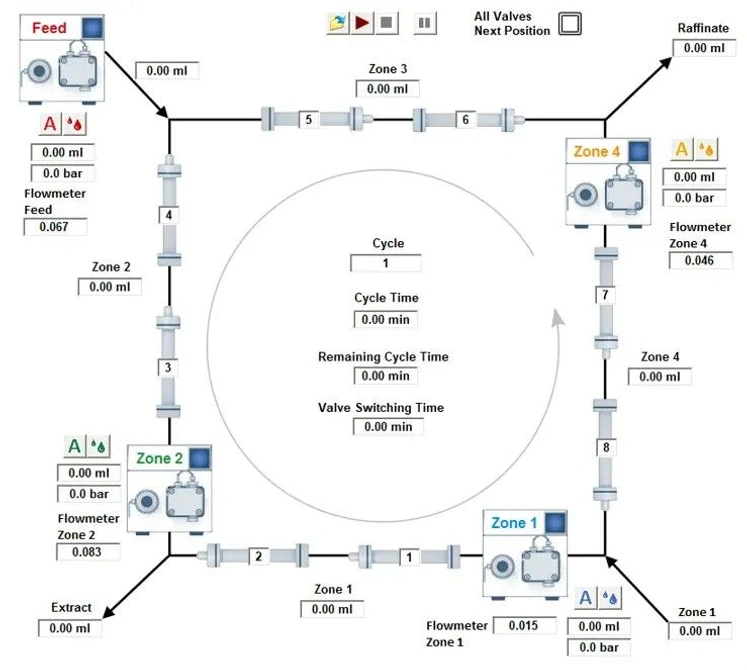
1:2:2:1: Six columns distributed across the four zones.
1:1:1:1: Four columns, with one column assigned to each zone.
Reducing the total number of columns lowers the quantity of stationary phase needed and can therefore help reduce operating expenses. Unlike switching between eight-column arrangements, however, six- and four-column setups require both software changes and manual modifications to the capillary connections.
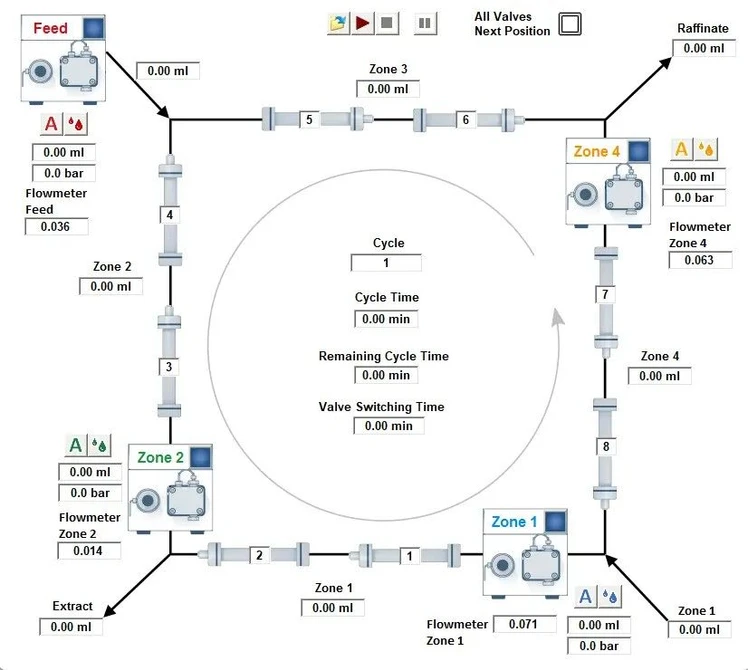 KNAUER: Figure 3: Different column set-up of the KNAUER SMB systems; A) 2:2:2:2 columns (screenshot from PurityChrom MCC plus software)
 KNAUER: Figure 3: Different column set-up of the KNAUER SMB systems; B) 1:3:3:1 columns (screenshot from PurityChrom MCC plus software)
 KNAUER: Figure 3: Different column set-up of the KNAUER SMB systems; C) 1:2:2:1 (screenshot from PurityChrom MCC plus software)
PurityChrom MCC: Software for continuous chromatography
An SMB system depends on accurate coordination of its pumps, valves, columns, and process conditions. For this reason, KNAUER developed PurityChrom MCC, a version of its purification software tailored to continuous chromatography.
The software displays a graphical representation of the fluidic system, giving users a clear view of the process and access to the relevant device controls. This visual approach simplifies the operation of a system in which several flow paths and switching events must work together.
 KNAUER: Figure 4: SMB system visualization with functionalized operation buttons in PurityMCC plus software
The software provides several tools for method development and routine operation:
- Adjustments during a run: Instruments shown in the fluidic diagram can be controlled individually, allowing operators to modify and optimize process conditions while the separation is underway.
- Assistance with method setup: An SMB parameter wizard helps users create methods and refine operating parameters, including adjustments during an ongoing process.
- Monitoring and data handling: The software records, stores, and processes warnings, error messages, UV and RI detector signals, flowmeter readings, and other analog inputs.
- Support for regulated work: PurityChrom MCC complies with the requirements of 21 CFR Part 11.
- Continuous flow verification: Pilot systems include four flowmeters, one for each pump, so that deviations from the intended flow rates can be identified and addressed in real time. These flowmeters can also be obtained separately for laboratory-scale systems.
An operating-point calculator is another feature available to support the development and optimization of SMB methods.
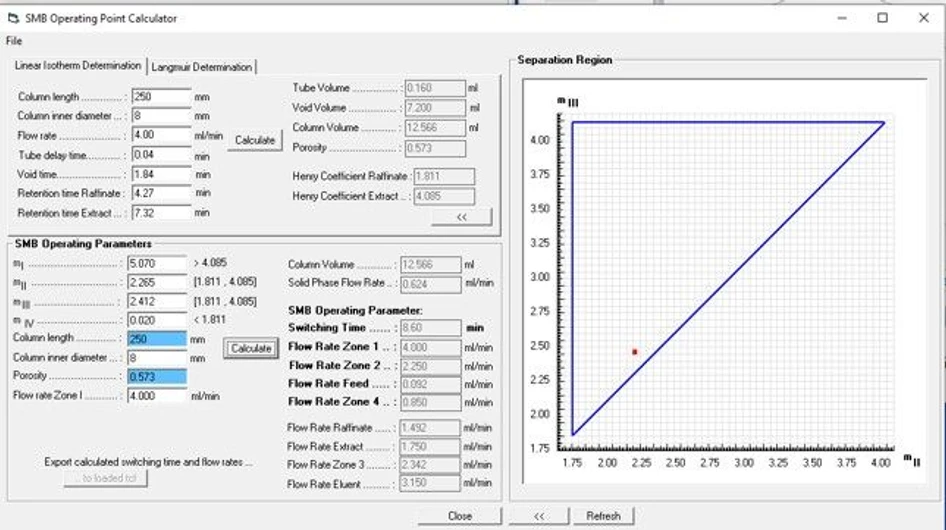 KNAUER: Figure 5: SMB Operating point calculator (screenshot PurityMCC plus software)
Connecting method development with continuous production
The combination of modular hardware and purpose-built software makes the AZURA SMB platform adaptable to different separation tasks. A method can be developed on a laboratory system and subsequently transferred toward pilot-scale operation using the same overall system concept.
The ability to change column distributions is particularly useful when balancing separation performance, stationary-phase consumption, and process productivity. At the same time, software visualization and continuous monitoring provide operators with greater control over an otherwise complex chromatographic process.
These capabilities support the use of SMB in applications such as pharmaceutical production, food processing, and fine-chemical purification. Examples of separation tasks include sugar fractionation and the isolation of cannabinoids.
Conclusion: A modular approach to SMB separation
KNAUER's AZURA SMB range translates the principles of simulated moving bed chromatography into configurable equipment for continuous purification. Its practical strengths lie in the integration of four-pump, seven-valve hardware, adaptable zone arrangements, and the PurityChrom MCC control environment.
Users can work with established eight-column configurations, redistribute columns to meet more demanding separation needs, or reduce the column count when the process allows it. Combined with software-assisted method development, process monitoring, and options for laboratory and pilot operation, this makes AZURA SMB a flexible solution for moving continuous chromatography from experimental development toward practical production.
This version of the article was adapted from the original text using AI-assisted rewriting and editorial review.