We, 28.10.2026 | Original article from: KNAUER
Learn how Simulated Moving Bed chromatography enables continuous separation with higher productivity, lower solvent use, and improved recovery.Simulated Moving Bed Chromatography: Efficient Continuous Separation
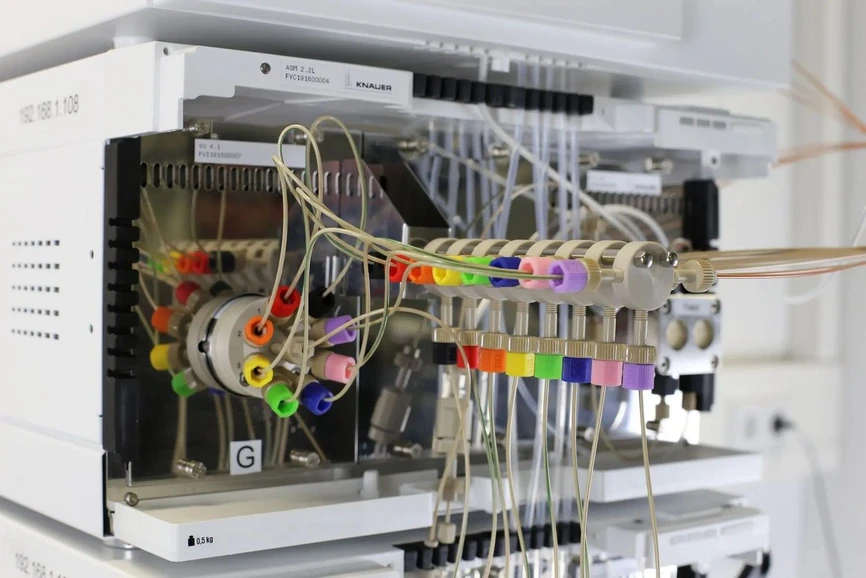
KNAUER: Simulated Moving Bed Chromatography: Efficient Continuous Separation
Are you currently using single-column batch chromatography to isolate and purify target compounds, but struggling with high solvent demand, low product concentration, or limited throughput? Simulated Moving Bed chromatography offers an alternative approach that can address many of these limitations through continuous multi-column separation.
What is Simulated Moving Bed Chromatography (SMB)?
Simulated Moving Bed (SMB) chromatography is a continuous multi-column separation technique designed to make more efficient use of the stationary phase while minimizing solvent consumption. It is particularly well suited to the purification of binary and pseudo-binary mixtures, including enantiomers, sugars, petrochemical products, and fine chemicals.
Conventional Batch Chromatography
In traditional batch chromatography, the sample is introduced onto a single chromatographic column and transported through the stationary phase by the mobile phase. Individual compounds interact with the stationary phase to different extents and therefore travel through the column at different rates:
- Weakly retained compounds migrate more rapidly.
- Strongly retained compounds move through the column more slowly.
The separated substances consequently leave the column at different retention times and can be collected as individual fractions (Fig. 1). Before a new sample is normally introduced, the previous sample must be completely eluted and the column prepared for the next separation.
Although single-column batch chromatography is versatile and comparatively easy to operate, several disadvantages become increasingly important at production scale. The stationary phase is not continuously involved in useful separation, which can limit productivity. Other drawbacks include substantial solvent consumption, diluted product fractions, repeated column regeneration, and potential loss of valuable product.
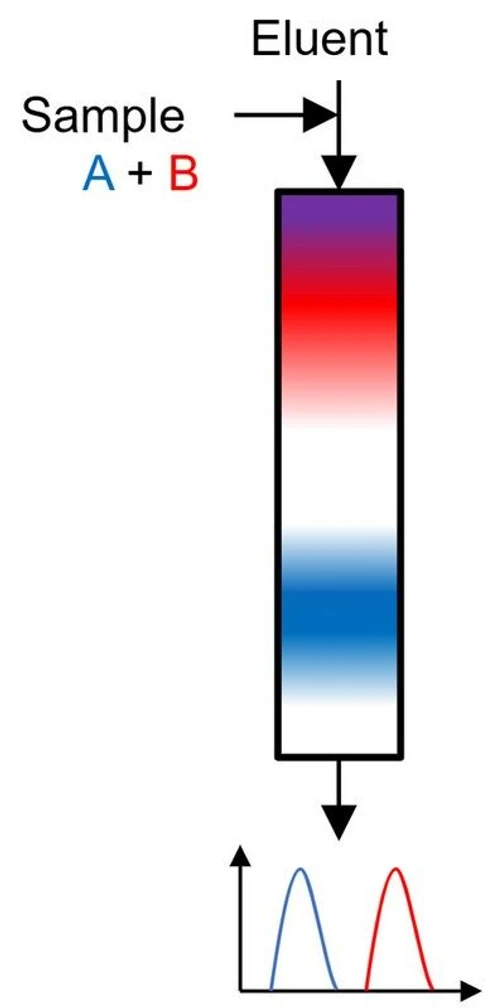 KNAUER: Figure 1: Single column separation; A – fast eluting component, B – retaining component
From True Moving Bed to SMB
The principle behind SMB originates from the theoretical True Moving Bed (TMB) process. In an ideal TMB system, the liquid mobile phase and the solid stationary phase continuously travel in opposite directions. This counter-current arrangement takes advantage of differences in the affinity of individual compounds toward the two phases.
Consider a binary mixture containing components A and B. Component A interacts more strongly with the stationary phase, whereas component B is less strongly retained and preferentially follows the liquid mobile phase. Under appropriate operating conditions, the two substances effectively migrate in opposite directions and can be collected continuously through separate outlets (Fig. 2).
While this concept is highly efficient from a theoretical perspective, continuously moving a packed solid chromatographic adsorbent is technically difficult to realize.
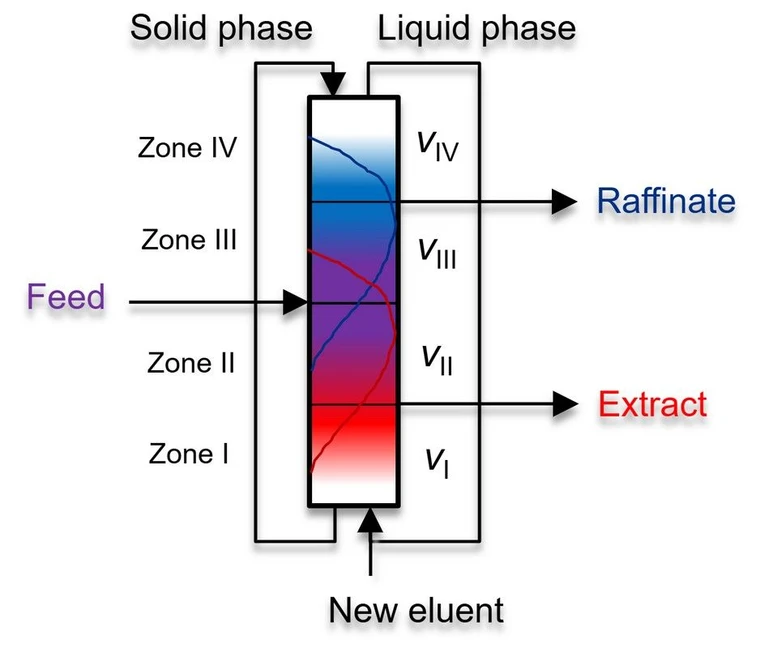 KNAUER: Figure 2: True Moving Bed concept
Four process ports divide the system into four functional zones (Zone I–IV):
- Eluent (desorbent) inlet
- Extract outlet
- Feed inlet
- Raffinate outlet
Feed and eluent are introduced continuously, while two product streams are simultaneously withdrawn:
- Extract – the strongly retained, later-eluting component
- Raffinate – the less strongly retained, earlier-eluting component
The Four Functional Zones
Each of the four zones has a defined purpose and operates at its own internal flow rate (VI–VIV):
- Zone I regenerates the stationary phase.
- Zone II prevents the weakly retained component from entering the extract stream.
- Zone III prevents the strongly retained component from contaminating the raffinate.
- Zone IV enables recovery and internal reuse of the remaining solvent.
How is the TMB Principle Implemented in SMB?
SMB eliminates the need to physically move the stationary phase. Instead, the adsorbent remains fixed inside the chromatographic columns, while the positions of the liquid inlet and outlet ports are periodically shifted.
From the perspective of these moving connection points, the stationary phase appears to travel in the opposite direction to the liquid phase. SMB therefore reproduces the counter-current behavior of a TMB system without physically transporting the packed adsorbent (Fig. 3).
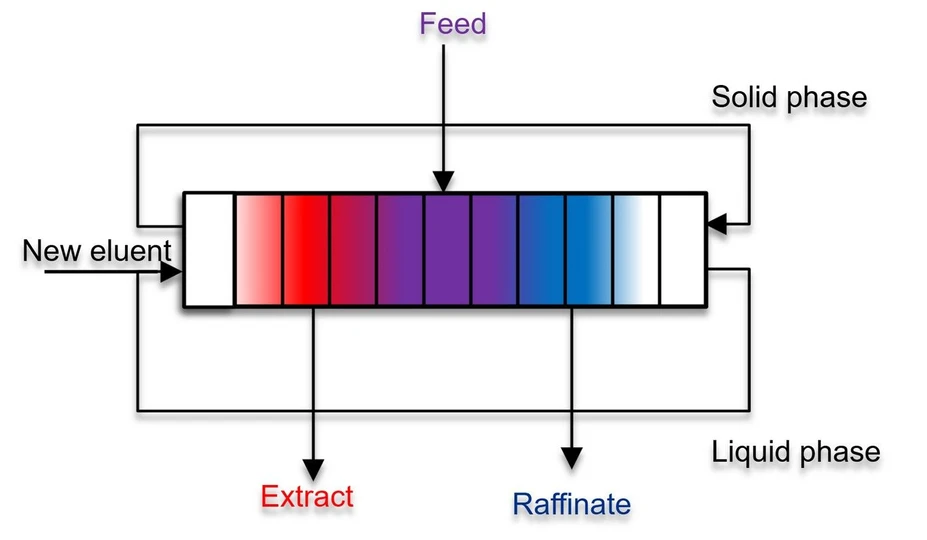 KNAUER: Figure 3: Transfer TMB concept to SMB concept
A typical SMB setup consists of several chromatographic columns arranged in a closed loop. A standard configuration often uses eight columns, although the number can be adapted according to the application.
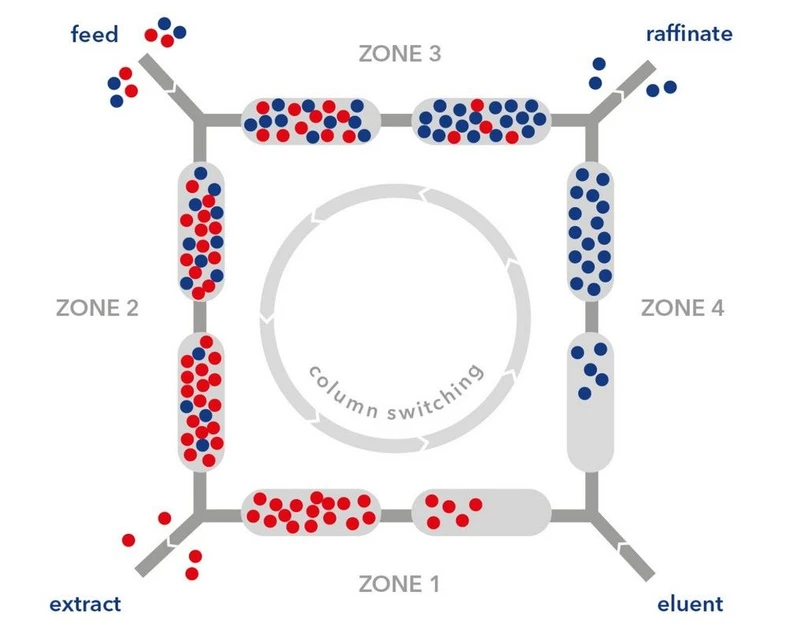 KNAUER: Figure 4: SMB concept
After a predefined switching time, all inlet and outlet positions move forward by one column in the direction of the mobile-phase flow. The columns themselves stay in place, but their functional roles within the process change.
By repeatedly shifting the ports, the system creates the effect of a stationary phase moving counter-currently to the mobile phase. With eight columns, eight switching steps are required to complete one full SMB cycle.
Following an initial transition period, the process reaches a cyclic steady state. Concentrations continue to fluctuate during individual switching intervals, but the overall concentration profile repeats after every complete cycle.
Increasing the number of columns and reducing the size of individual switching steps allows the SMB system to reproduce ideal TMB behavior more closely. Systems containing fewer columns exhibit more pronounced discrete switching effects and can require more sophisticated dynamic modeling during process development.
What are the Main Advantages of SMB?
1. Continuous Operation and Higher Productivity
The key benefit of SMB chromatography is continuous operation. Feed and eluent enter the system continuously, while purified extract and raffinate streams are removed at the same time.
As a result, SMB systems can operate for prolonged periods—from several days to even several weeks—with very limited interruption.
Because several chromatographic columns perform different separation functions simultaneously, the stationary phase is utilized much more effectively than in conventional batch chromatography. This can translate into higher productivity, improved process efficiency, and a continuous supply of purified product.
2. Reduced Solvent Consumption
Conventional batch chromatography can require substantial volumes of mobile phase to achieve separation and product recovery. The collected fractions are often highly diluted, creating an additional need for downstream concentration.
SMB maintains concentration profiles within the circulating system and uses the mobile phase more efficiently. Partial internal recycling of solvent is an inherent part of the process.
Lower solvent consumption can lead to:
- Reduced raw-material costs
- Lower volumes of liquid waste
- Reduced energy requirements for solvent evaporation
- More concentrated product streams and less downstream concentration
3. High Recovery and Reproducible Product Quality
Once the process reaches cyclic steady state, SMB can continuously generate product streams with stable and reproducible composition.
Additional advantages can include high product recovery, lower product dilution, more efficient use of the stationary phase, and straightforward integration into continuous manufacturing strategies.
What are the Differences Between Batch LC and SMB?
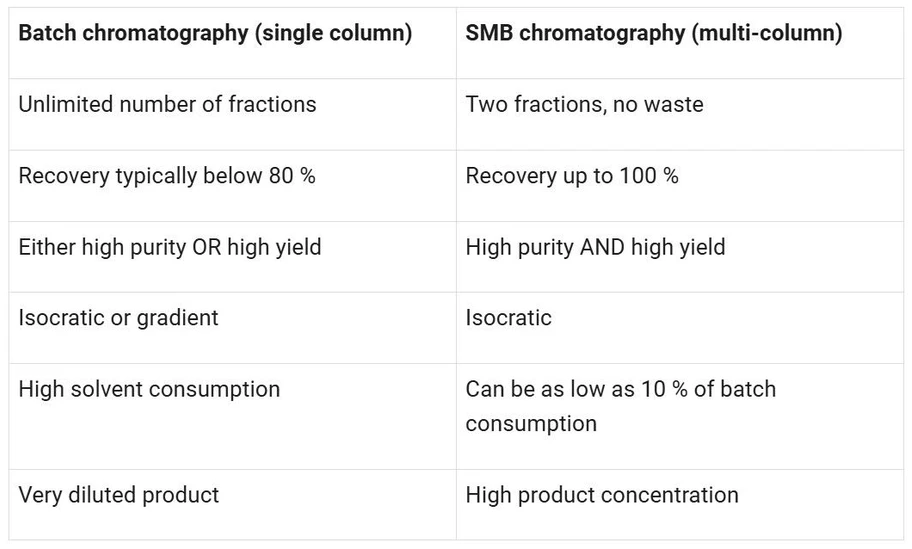 KNAUER: Differences between batch LC and SMB
Where is SMB Used?
SMB technology is established across several industries and can be applied to purification processes ranging from gram-scale production to several tons per day (Fig. 5).
Typical and emerging applications include:
- Sugar purification
- Petrochemical separations
- Chiral separations
- Fine chemical production
- Pharmaceutical intermediates
- Selected biomolecule separations
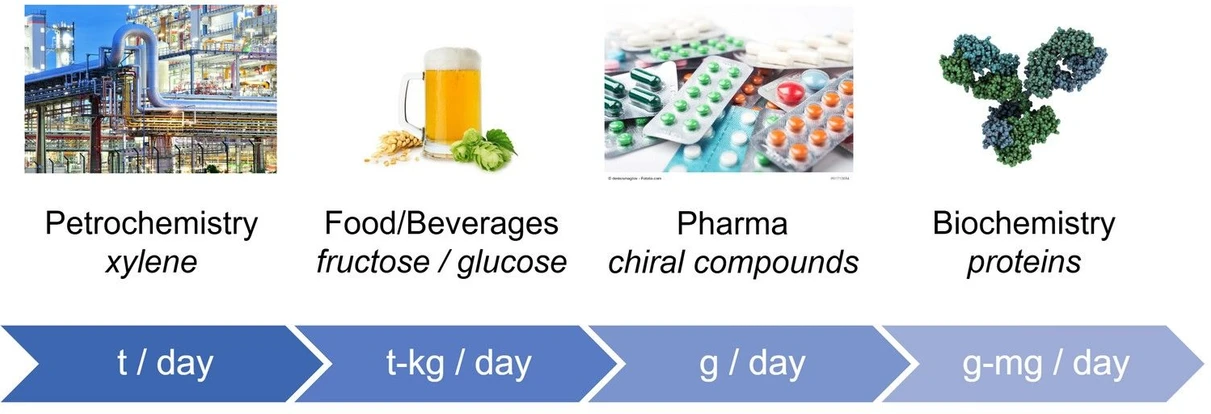 KNAUER: Figure 5: SMB application areas; author's illustration
Limitations of SMB
Although SMB can provide substantial advantages, it is not necessarily the ideal solution for every chromatographic separation.
The instrumentation and process configuration are more complex than conventional single-column chromatography. Several pumps, valves, columns, and liquid pathways must be controlled precisely. Successful method development therefore requires a solid understanding of adsorption equilibria, mass-transfer effects, and fluid dynamics.
Classical four-zone SMB is primarily intended for binary and pseudo-binary separations. More complicated mixtures may require modified SMB configurations, additional purification steps, or multiple coupled SMB systems.
SMB is generally most economically attractive when relatively large quantities of a consistent feed material are processed continuously over extended periods.
Batch chromatography can remain the better option for small-scale production, frequent changes between products, complex multicomponent mixtures, or applications that depend on flexible gradient separations.
Conclusion
Simulated Moving Bed chromatography converts the theoretical counter-current principle of True Moving Bed separation into a practical continuous chromatographic process. Instead of physically transporting the stationary phase, SMB periodically changes the positions of the feed, eluent, extract, and raffinate connections. This reproduces the effect of counter-current movement between stationary and mobile phases.
Compared with conventional batch chromatography, SMB can provide higher productivity, more efficient stationary-phase utilization, substantially lower solvent consumption, and more concentrated product streams. Continuous operation makes the technology particularly attractive for demanding large-scale binary separations, including the purification of pharmaceutical enantiomers.
Although successful SMB implementation requires accurate process data, careful method development, and precise control of operating conditions, the technology demonstrates how an idealized chromatographic principle can be transformed into a robust and efficient industrial separation strategy.
This version of the article was adapted from the original text using AI-assisted rewriting and editorial review.