We, 4.11.2026 | Original article from: LabRulezGCMS Library
This week we bring you application notes by LECO, Shimadzu and Waters Corporation!News from LabRulezGCMS Library - Week 45, 2026
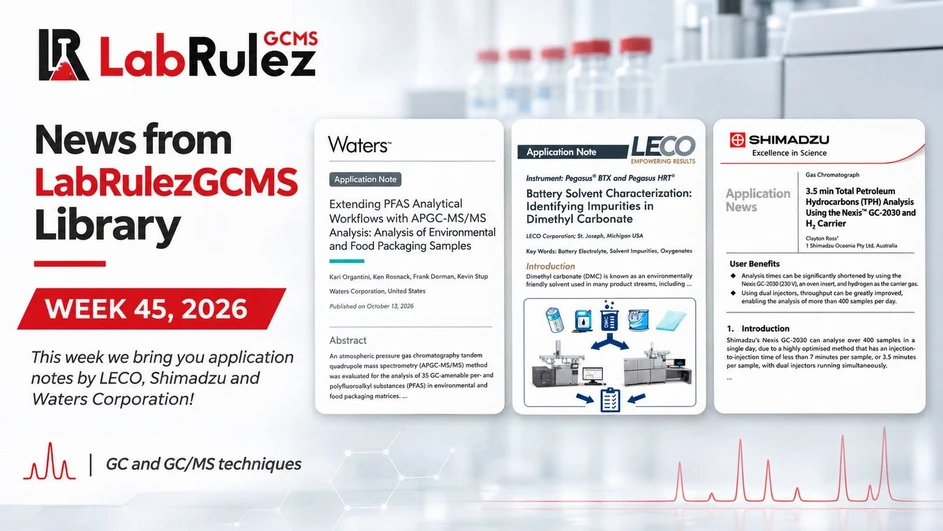
LabRulez / AI: News from LabRulezGCMS Library - Week 45, 2026
Our Library never stops expanding. What are the most recent contributions to LabRulezGCMS Library in the week of 2nd November 2026? Check out new documents from the field of the gas phase, especially GC and GC/MS techniques!
👉 SEARCH THE LARGEST REPOSITORY OF DOCUMENTS ABOUT GCMS AND RELATED TECHNIQUES
👉 Need info about different analytical techniques? Peek into LabRulezLCMS or LabRulezICPMS libraries.
1. LECO: Battery Solvent Characterization: Identifying Impurities in Dimethyl Carbonate
- Application note
- Full PDF for download
Dimethyl carbonate (DMC) is known as an environmentally friendly solvent used in many product streams, including development of rigid plastics, oxygenated additives for diesel, and EPA-approved VOC-exempt coatings and paints. Determination of impurities in DMC is crucial to prove suitability for use and prevent side-reactions in high-performance material production, especially when used as battery electrolyte solvent. The presence of unexpected organic species in DMC can reduce the overall efficiency of the batteries by degrading solid electrolyte interfaces on battery anodes, creating complexes that consume lithium ions, or producing unexpected gas buildup that leads to safety hazards during battery use. A clearer understanding of unintentional byproducts in DMC assists with refining the solvent production process, improving energy efficiency for generating high-purity solvent and for downstream solutions dependent on quality components.
The extraordinary sensitivity of the Pegasus BTX allows for detection of below-ppb-level contaminants. Coupled with + complementary data from the high-resolution Pegasus HRT , confident identification of byproduct species including nitriles, alcohols, and other hydrocarbons can be confirmed.
Experimental
A producer-provided sample of dimethyl carbonate solvent was analyzed on the Pegasus BTX and Pegasus HRT to assess purity and identify potential unknown contaminants. After a short gas chromatography (GC) separation (Agilent 8890 GC), electron ionization + (EI) mass spectral information was produced on the Pegasus BTX, while the Pegasus HRT produced high-resolution, accurate mass spectra in multiple modes, including EI and methane-assisted positive chemical ionization (PCI) using a single ionization source. EI spectra for peaks of interest were library-matched against NIST and Wiley spectral libraries for preliminary identification. High resolution accurate mass was leveraged to further confirm library hit assignments; in cases where molecular ion was low abundance or not present in EI spectra, PCI spectra from corresponding peaks were used to confirm molecular ion and other methane-adducts when available.
Conclusions
Unparalleled sensitivity of the Pegasus BTX paired with high-resolution mass spectral data from the Pegasus HRT confirmed identification of several previously undetected compounds of interest in a sample of dimethyl carbonate, providing useful insight into the solvent manufacturing process.
2. Shimadzu: 3.5 min Total Petroleum Hydrocarbons (TPH) Analysis Using the Nexis GC-2030 and H2 Carrier
- Application note
- Full PDF for download
User Benefits
- Analysis times can be significantly shortened by using the Nexis GC-2030 (230 V), an oven insert, and hydrogen as the carrier gas.
- Using dual injectors, throughput can be greatly improved, enabling the analysis of more than 400 samples per day
Shimadzu’s Nexis GC-2030 can analyse over 400 samples in a single day, due to a highly optimised method that has an injection-to-injection time of lessthan 7 minutes per sample, or 3.5 minutes per sample, with dual injectors running simultaneously.
This method can resolve C10 to C40 alkanes, allowing it to be applied to almost all TPH/TRH applications. C6 to C40 can be resolved with a modified method (Figure 1). During the production and use of petroleum hydrocarbon products, the environment, including waters and soils can be contaminated. Petroleum hydrocarbons do not, in general, biodegrade readily. Furthermore, some pose risks to health, consequently, the control of contamination is important.
The analysis of petroleum products in waters and soils is commonly referred to as TPH (Total Petroleum Hydrocarbon) or TRH (Total Recoverable Hydrocarbon), which covers a range of standardised method variants. Some classes of petroleum products pose greater risks than others. Hence, reporting the total concentration of TPH does not provide a reliable basis for evaluating the potential risks to the environment and human health.
For this reason, the chromatographic separation is divided into bands and resolves the analytes based on carbon atom (C) numbers.
Optimisation of method speed
Traditionally, TPH columns are selected with a thinner film thickness to reduce elution times of the high-boiling components. This often impacts the resolution of the low boilers from the solvent. Consequently, the GC oven starting temperature is typically low (30-35 ˚C), resulting in extremely long cool-down timesthat greatly limit sample throughput.
The Rxi-1ms column from Restek, with non-conventional dimensions (Table 2), was selected to improve sample throughput. This allows for separation of the volatile components from the solvent at a higher starting temperature and reduces retention of the high-boiling hydrocarbons up to C40 (Figure 2).
Conclusion
Shimadzu’s GC-2030 with split/splitless inlet and FID offers an ideal solution for TPH and TRH analysis across the widest boiling point range. The GC-2030NX’s high-performance oven and the use of hydrogen carrier gas facilitate a very short run time. The combination of this, with a dual line configuration, results in injection-to-injection run times of below 3.5 minutes per sample.
Over a 24-hour period, a single GC-2030 instrument is able to analyse over 200 samples. With dual FID-2030s fitted, a single GC-2030 can analyse over 400 samples in a 24-hour period The Labsolutions GC software’s highly flexible integration parameters allow various baselines and bandings to be performed automatically. This offers easy conversion from existing Chromatography data systems (CDS).
3. Waters Corporation: Extending PFAS Analytical Workflows with APGC-MS/MS Analysis: Analysis of Environmental and Food Packaging Samples
- Application note
- Full PDF for download
Benefits
- An APGC-MS/MS method for the analysis of 35 GC-amenable PFAS allowing for characterization of PFAS samples beyond the suite of commonly targeted LC-MS/MS compounds, enabling a more complete assessment of PFAS burden
- Sensitive and robust analysis to detect GC-amenable PFAS in complex sample matrices, supporting reliable data generation across diverse sample types
- Provides complementary information to LC-MS/MS workflows by identifying PFAS precursor compounds and transformation pathways, helping laboratories better understand contamination sources, environmental fate, and treatment outcomes
- Enables confident monitoring of food contact materials at concentrations well below emerging European regulatory limits, supporting compliance testing and regulatory preparedness
- Expands laboratory capabilities beyond routine targeted PFAS analysis, allowing customers to deliver comprehensive investigations, differentiate their analytical services, and generate deeper insight into PFAS occurrence in environmental samples
While liquid chromatography coupled with mass spectrometry (LC-MS) remains the dominant approach for routine PFAS analysis, it is not well suited for all PFAS classes. A subset of PFAS compounds, particularly volatile and semi-volatile species, exhibit chromatographic and analytical characteristics that favor gas chromatography (GC)-based methods. These include fluorotelomer alcohols (FTOHs), fluorotelomer acrylates (FTAcrs), fluorotelomer methacrylates (FTMACs), fluorotelomer acetates (FTOAcs), and several related precursor compounds. Other PFAS classes, such as sulfonamides and sulfonamidoethanols, can be successfully analyzed using either LC or GC platforms.
Many GC-amenable PFAS are recognized as precursor compounds because they can undergo environmental and biological transformation to form PFCAs and perfluoroalkyl sulfonates (PFSAs), the terminal degradation products that have been the focus of most PFAS monitoring and toxicological studies. In addition to their role in PFAS manufacturing processes, these compounds have historically been incorporated into commercial products, including food contact materials and textile treatments, where they provide oil, stain, and water-resistant properties. The environmental behavior of these precursor compounds differs from that of many ionic PFAS due to their increased volatility, which enables atmospheric transport and deposition over long distances. As a result, they can contribute to PFAS contamination through pathways that are not fully captured by conventional LC-based analytical approaches. Although toxicological information for many of these compounds remains limited, their potential health impacts and their ability to generate persistent PFCA and PFSA transformation products have increased interest in their measurement and environmental occurrence.
FTOH, FTAcr, FTMAC, PFSA, N-xFOSA, and N-xFOSE compounds are known to have been used as raw materials in the synthesis of surface protectants, such as those used to grease proof paper and paperboard food packaging materials.1 In recent years, global efforts have been made to phase out and ban their use in food contact materials. In 2020, the US Food and Drug Administration (FDA) announced the voluntary removal of 6:2 FTOH for use in food contact materials with complete removal of all packaging containing this compound in 2025.2,3 Furthermore, in 2025, 35 Food Contact Notifications (FCNs) for PFAS compounds that declare the use of a substance safe in food contact materials were revoked by the FDA.4 Concurrently, from August 12, 2026, Regulation (EU) 2025/40 restricted PFAS in food contact packaging enforcing strict limits for individual targeted PFAS, the sum of targeted PFAS, and total PFAS content.5 In accordance with this regulation, a limit of 25 ppb was set for individual targeted PFAS in any food packaging material.
As discussed in a previous application note, atmospheric pressure gas chromatography coupled with tandem quadrupole mass spectrometry (APGC-MS/MS) provides a sensitive approach for the determination of volatile and semi-volatile PFAS.6 The development of the method and the overall method performance are discussed there. The work presented here extends that methodology to the analysis of authentic environmental and food packaging samples, demonstrating the value of GC-MS/MS techniques for more comprehensive PFAS characterization and improved understanding of PFAS sources and transformation pathways.
Experimental
- GC system: Agilent 8890 Gas Chromatography System
- Autosampler: 7693A Automatic Liquid Sampler
- MS system: Xevo™ TQ Absolute Mass Spectrometer
- Software: waters_connect™ for Quantitation Software
Conclusion
The APGC-MS/MS method developed for the analysis of 35 GC-amenable PFAS demonstrated robust performance across diverse environmental and food packaging matrices, providing sensitive and selective detection of volatile and semi-volatile PFAS that are not routinely captured by LC-MS/MS alone. Application of the method identified FTOHs as the predominant GC-amenable PFAS in wastewater and soil samples. This method proved to be complementary to previous LC-MS/MS analysis by identifying precursor compounds that appear to have transformed into terminal PFCAs during the treatment process. The method also successfully characterized PFAS contamination associated with ski wax application and showed good accuracy for most target analytes in environmental matrices. Analysis of paper and paperboard food packaging materials did not detect any of the targeted PFAS, suggesting compliance with current regulatory restrictions for the compounds included in this study. Post-spike experiments confirmed the method's suitability for monitoring PFAS at concentrations well below emerging European regulatory limits. By expanding PFAS characterization beyond routinely monitored analytes, the combined APGC-MS/MS and LC-MS/MS workflow provides laboratories with greater confidence when investigating PFAS sources, environmental fate, and regulatory compliance. Overall, the method performance was strong, demonstrating that APGC-MS/MS is a valuable complementary tool to LCMS/MS for PFAS characterization, environmental monitoring, source identification, and regulatory compliance testing.